A full shelf can still be a bad purchase if the next customer wants a different genre. In Paper Lantern Books, a weekly supplier market shows both available stock and unit price. Scarce titles cost more, abundant titles cost less, and the customer order at the counter tells you which inventory can turn back into cash.
This fictional bookshop starts with eight coins, one Mystery title, three Garden titles, and a two-copy Mystery order. The supplier offers one Mystery copy at four coins and four Garden copies at one coin each. Buy one Mystery, pair it with the copy already on the shelf, and complete the order for ten coins. The arithmetic exposes the tradeoff between a low quote and the stock that actually meets demand.
Make supplier stock change the buying decision
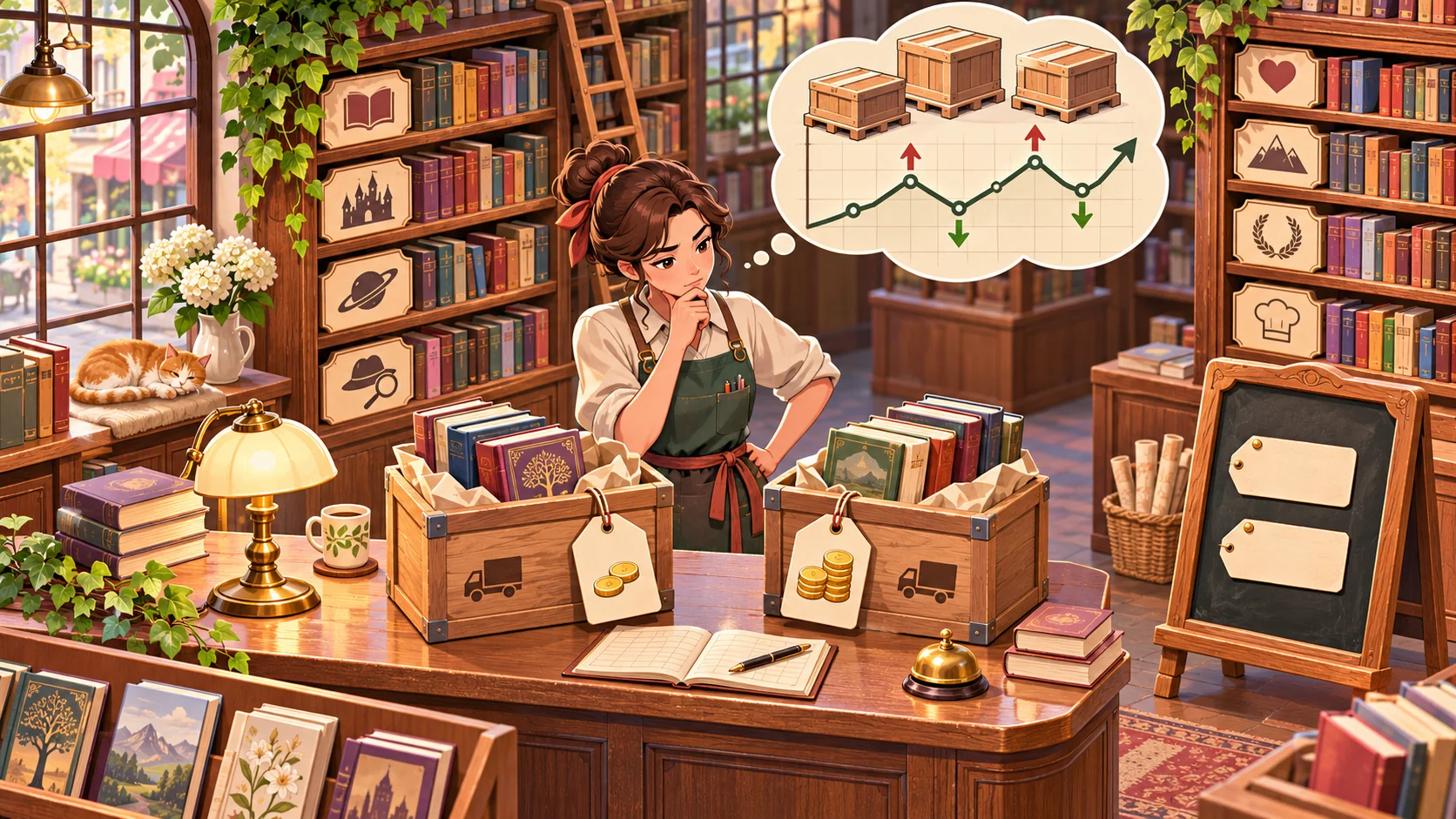
At the weekly market, show each genre’s supplier quantity and unit quote before the player buys. Use a small price table: one available copy costs four coins, two or three cost two coins each, and four or more cost one coin each. The shop begins with eight coins, one Mystery book and three Garden books. Supplier availability begins at one Mystery and four Garden. The counter order asks for two Mystery copies and pays five coins per copy. Buying one Mystery for four coins raises shelf stock to two; selling both returns ten coins and clears the order, leaving cash at fourteen. Garden is cheaper at one coin because the supplier has four, but Garden stock cannot satisfy a Mystery order. After the week closes, show a new supplier shipment: four Mystery copies and two Garden. Refresh quotes from the new quantity before opening the next order. Do not change a quote halfway through a committed purchase. This keeps the market legible: availability sets the quote at refresh, the player chooses a quantity, stock moves to the shop, and customer demand moves matching stock back out. The first example uses fixed values rather than a hidden economy formula, so a designer can see exactly why a unit costs what it does. Add demand trends and spoilage only after inventory, cash and market quotes reconcile.
| Market state | Rule and result |
|---|---|
| Supplier quantity 1 | Quote is 4 coins per copy at the weekly refresh. |
| Supplier quantity 2–3 | Quote is 2 coins per copy at the weekly refresh. |
| Supplier quantity 4 or more | Quote is 1 coin per copy at the weekly refresh. |
| Mystery order | Customer requests 2 Mystery copies and pays 5 coins per copy; genres do not substitute. |
| Purchase and sale | Subtract purchase cost once, add purchased copies to shop stock, then subtract sold copies and credit revenue. |
| Market refresh | After the week closes, replace supplier quantities and quotes together before the next order. |
Trace a market refresh and one wrong purchase
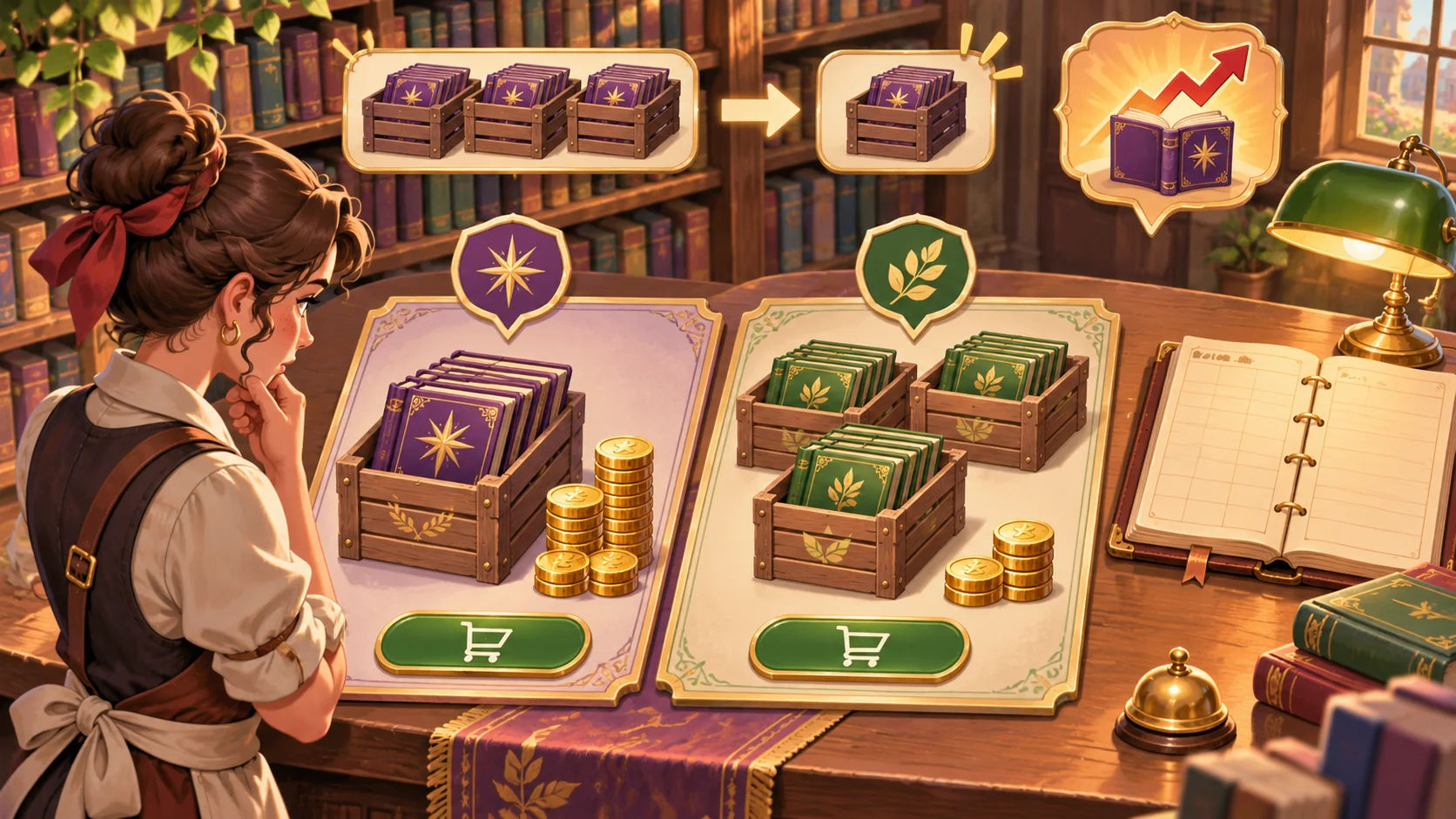
Start with cash 8, shelf stock Mystery 1 and Garden 3. Supplier quantities are Mystery 1 at quote 4, and Garden 4 at quote 1. A customer order requests two Mystery books and pays five each. Buy one Mystery for four: cash becomes 4 and Mystery shelf stock becomes 2. Sell both copies: stock falls to zero, revenue is 10, and cash becomes 14. The order is complete. At the next weekly refresh, Mystery supplier quantity becomes 4, so its quote falls to 1; Garden quantity becomes 2 and its quote rises to 2. The next customer wants one Mystery. Buy one for 1, sell it for 5, and cash ends at 18. Counterexample: buy one cheap Garden copy during the first order. Cash becomes 7, but Mystery stock remains 1, so the customer cannot be served and no sale revenue is credited. The market quote is only useful when the purchased genre matches the order.
| Check | Expected result |
|---|---|
| Open week 1 market | Mystery quantity 1 at 4 coins; Garden quantity 4 at 1 coin. |
| Buy one Mystery | Cash 8→4; shelf Mystery 1→2. |
| Complete two-copy order | Sell 2 at 5 each; cash 4→14 and Mystery stock returns to 0. |
| Refresh the market | Mystery quantity 4 quotes at 1; Garden quantity 2 quotes at 2. |
| Buy for week 2 order | One Mystery costs 1; a five-coin sale leaves cash at 18. |
| Buy Garden instead in week 1 | The Mystery order stays short and produces no sale. |
Ask AI for a small bookshop economy
Ask SEELE for one shop week and one market refresh, not a full tycoon economy. State the quantity-to-price bands, current cash and stock, exact customer demand, and the order in which purchase, sale and refresh update the ledger. Compare the correct buy with the cheap-but-wrong-genre counterexample.
Create a local bookshop management prototype called Paper Lantern Books. Start with cash 8, shelf stock Mystery 1 and Garden 3, and a customer order for two Mystery copies at five coins each. At weekly market refresh, supplier quantity 1 quotes at 4 coins per copy, quantity 2–3 at 2 coins, and quantity 4 or more at 1 coin. Week 1 suppliers offer Mystery quantity 1 and Garden quantity 4. Buy one Mystery for 4, reducing cash to 4 and raising Mystery shelf stock to 2. Sell two Mystery books for revenue 10; cash becomes 14 and stock becomes 0. After the week closes, refresh suppliers to Mystery quantity 4 and Garden quantity 2, recalculate quotes as 1 and 2, then serve an order for one Mystery: buy at 1 and sell at 5, ending cash at 18. Counterexample: spend one coin on Garden during week 1; the Mystery order remains short and earns no sale. Show quote, supplier quantity, shelf stock, cash, order and ledger after each action. Lock a quote for each purchase batch and never update it mid-transaction. Add reset. Keep purchase and order actions keyboard-operable without timed input.Show where each coin and book moves
The first draft changed the Mystery quote after each copy was bought, so the same market purchase charged two different prices. Snapshot the quote at weekly refresh and apply it to the entire purchase batch. Move the cash, supplier quantity and shop stock only after the player confirms the quantity, then show the ledger entries separately.
Replay the Mystery purchase and the cheaper Garden counterexample. Confirm that only matching genre stock satisfies an order, each sale removes one copy, and revenue is credited once. Refresh all supplier quantities and quotes together between weeks. Godot Resource and save-game references can guide a data-driven prototype, but this local package does not implement persistence.

Add genres only after orders match the market
Keep the two genres and two market weeks fixed until a player can predict which quote meets the waiting order. The ledger should explain the full cash change from eight to fourteen, then eighteen, without hiding purchase cost or sale revenue. After that, add one genre or a seasonal demand card and check whether supplier quantity still gives a useful buying decision.
Read Godot Resource documentation.
Read Godot save-game documentation.
Frequently asked questions
Why do supplier quantities change book prices?
A small authored quote table makes scarcity visible: one available copy costs more than a shipment of four or more. It gives the player a reason to compare the market with current customer demand before spending cash. This turns timing into a choice.
Can a different genre fulfill an order?
No. In this example, a Mystery order requires Mystery shelf stock. Cheap Garden copies may be useful for a later customer, but they cannot substitute in the current sale. Show genre and quantity on both the order and the ledger.
Start a local game prototype with SEELE.
When should the market price refresh?
Refresh supplier quantity and unit quote together between weeks. Keep the displayed quote stable for the full purchase batch so the player can calculate cost before confirming. A later delivery can change next week’s quote without rewriting a completed transaction.
Does the example prove this market is balanced?
No. Paper Lantern Books uses a tiny authored quote table and fixed customer orders to show a bookkeeping loop. It does not claim player research, an implemented shop economy or balanced prices. Add more demand and costs only after this ledger reconciles.