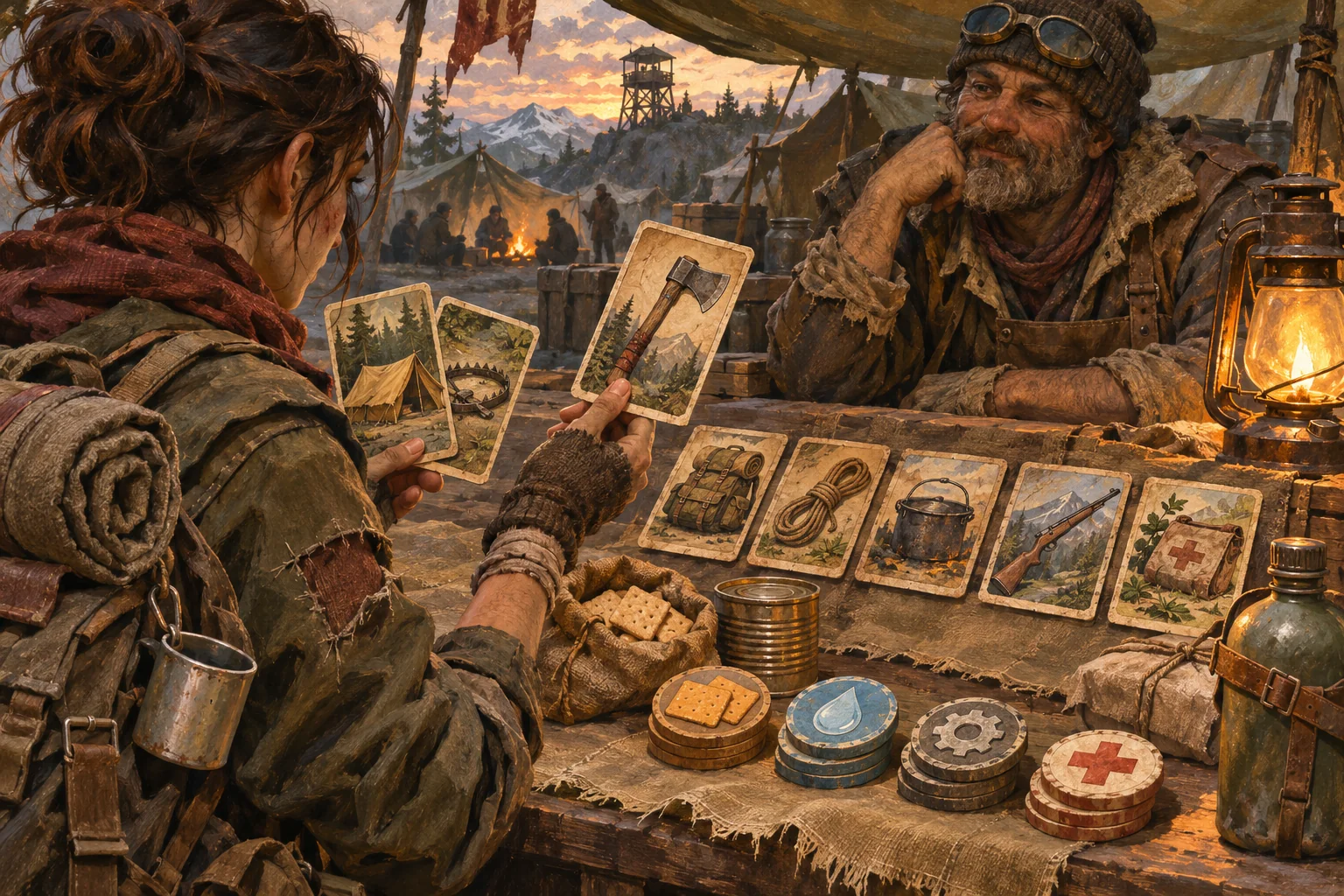
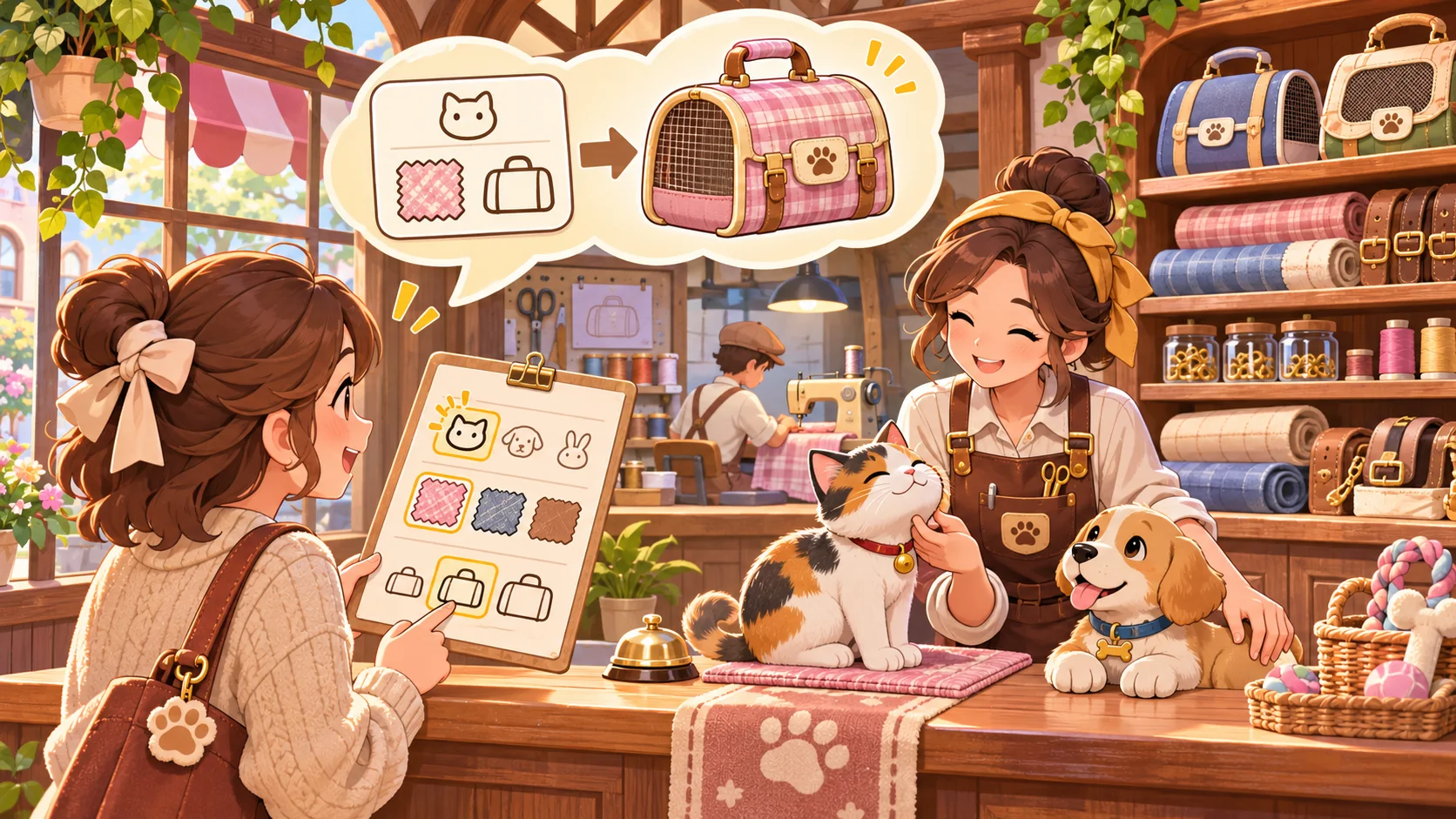
A shop can run without a separate menu for every department. In Paper Lane, customer requests, supplier lots, staff actions and coin values are all represented by cards. Playing a card changes one visible part of the shop state; orders move from request to paid only through an exact stock match and a staff service card.
Start with three coins and one Cedar Lantern in stock. A customer card asks for two Cedar Lanterns. The stock card offers one more for two coins, leaving one; the staff card then serves the exact order for five coins, ending at six. The trace also tries a Rose Lantern order against Cedar stock. The service card refuses it, the order stays open and the ledger does not record a sale.
Make customers, stock and staff into shop cards
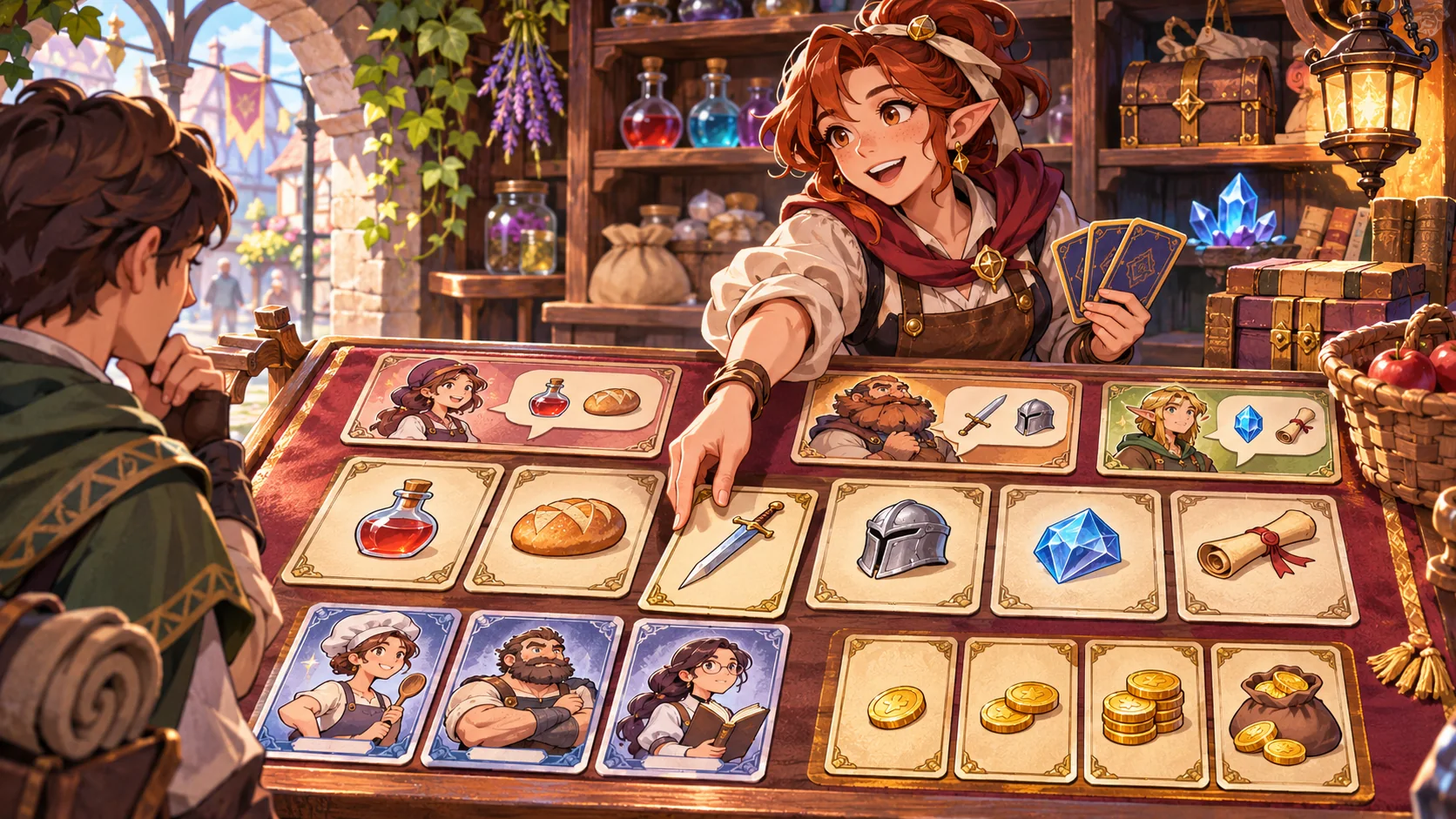
Use card faces and zones to show every business decision. Customer cards open an order, stock cards state a product and supplier quote, staff cards serve eligible requests, and Coin cards record available money. No separate shop, inventory or staff menu is needed.
| Card / zone | Rule and result |
|---|---|
| Customer card | Playing it opens the printed order and moves it from request deck to open orders. |
| Stock card | Playing it adds the printed quantity of one named product at its supplier quote, if the Coin stack can pay. |
| Coin cards | One Coin card represents one coin. Attach cards to a purchase or payout; update the ledger once per transaction. |
| Staff card | Playing it serves an open order only when product and quantity match stock; move the order to complete and record its payout. |
| Card zones | Draw deck, hand, open orders, stock row, discard and ledger remain visible. Used action cards go to discard. |
| Exact match | A different variant or insufficient quantity blocks service; do not consume stock or create payment. |
| No extra menus | All purchases, order changes and staff services begin by playing the corresponding visible card. |
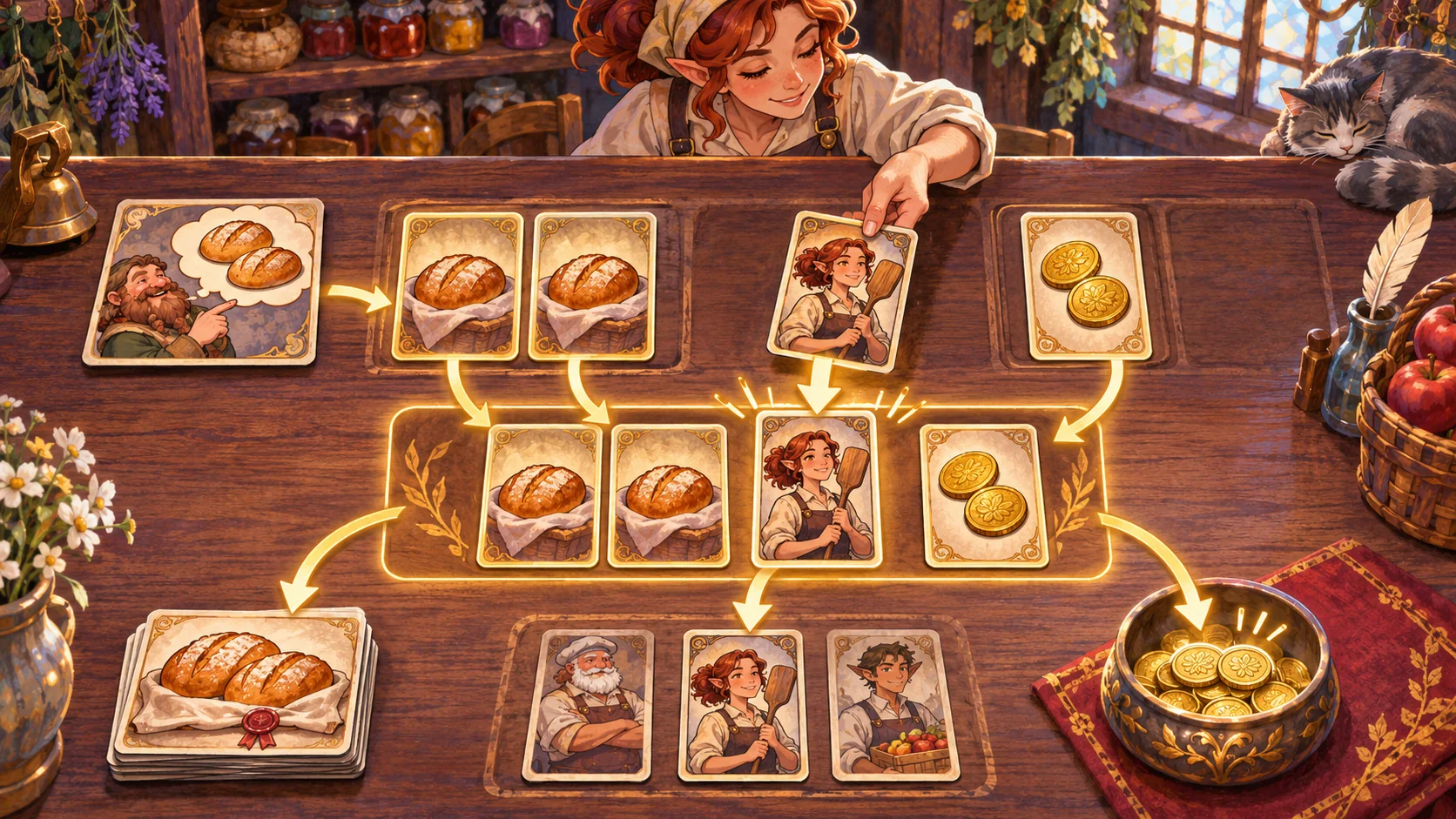
Trace a full sale and an exact-match failure
Initial state is cash 3, Cedar Lantern stock 1 and no open orders. Play Customer: Cedar Lantern ×2 to open a request. Play Stock: Cedar Lantern ×1 at a quote of 2; attach two Coin cards to pay, leaving cash 1 and stock 2. Play Staff: match the product and quantity, remove two lanterns, move the order to complete and post its five-coin payout once. Cash becomes 6 and stock returns to 0. The transaction ledger shows purchase −2 and sale +5. Next, play Customer: Rose Lantern ×2. The stock row contains no Rose variant, so a Staff card cannot complete it; the request remains open, no Cedar stock moves and cash stays 6. Counterexample: offering one Cedar Lantern for the original two-item order also fails on quantity. Do not let a staff card silently substitute a nearby product or partially fulfill the sale. This card trace makes every state transition visible and guards the ledger from duplicate payment.
| State / card played | Expected result |
|---|---|
| Initial shop | Cash 3; Cedar Lantern stock 1; no open orders. |
| Customer: Cedar Lantern ×2 | Create one open request for the exact product and quantity. |
| Stock: Cedar Lantern ×1, quote 2 | Spend 2 coins; stock 1→2 and cash 3→1. |
| Staff: fulfill the Cedar order | Match exact item and quantity; stock 2→0 and move request to complete. |
| Post order payment +5 | Record once; cash 1→6 and ledger shows −2, then +5. |
| Customer: Rose Lantern ×2 | Open a different product request; Cedar stock cannot satisfy it. |
| Staff attempts Rose order | Reject without consuming stock or changing cash; keep request open. |
Ask AI for a card-only shop loop
Ask SEELE to build a shop where cards are the entire business interface. Keep orders, products, staff, coins and transaction history in visible card zones, and make each play create an auditable state change.
Create a compact card-based business game called Paper Lane with no separate shop, inventory or staff menus. Represent customer requests, supplier products, staff actions and money as cards. Start with cash 3, Cedar Lantern stock 1 and an empty open-order row. A Customer card requests two Cedar Lanterns. A Stock card can buy one named unit at its printed quote of 2 by spending Coin cards from the wallet. A Staff card serves an order only when product variant and quantity exactly match stock, consumes the units, moves the request to completed and records a five-coin payout exactly once. Show a deterministic trace: open the two-Cedar order; play the stock card, spend two Coin cards, leaving cash 1 and stock 2; play Staff, consume two, complete the request and post +5, ending cash 6 and stock 0. The ledger shows purchase −2 and payout +5. Then open a Rose Lantern ×2 request and attempt service with only Cedar stock; reject it with the request open, stock unchanged and no payout. Also show a one-Cedar quantity mismatch. Use visible draw, hand, open-order, stock, discard and ledger zones. Every business change begins with a card play; do not add menu-only actions or hidden payments.Show card states and the coin ledger
Keep each card’s type, product variant, quantity and quote readable at table size. If the stock and order cards use different product names, the staff card should reject service and explain the mismatch while preserving both the request and inventory.
Treat the Coin zone and ledger as separate views of the same transaction. Spending two Coin cards reduces cash by two once; the completed order creates a five-coin payout once. Moving or replaying the Staff card must not duplicate the sale.
A first build needs only one supplier card, one customer request, one staff service and the Coin cards. After the matching and mismatch traces agree, add another product family or employee role as additional cards that follow the same explicit transitions.
Add new departments after the loop works
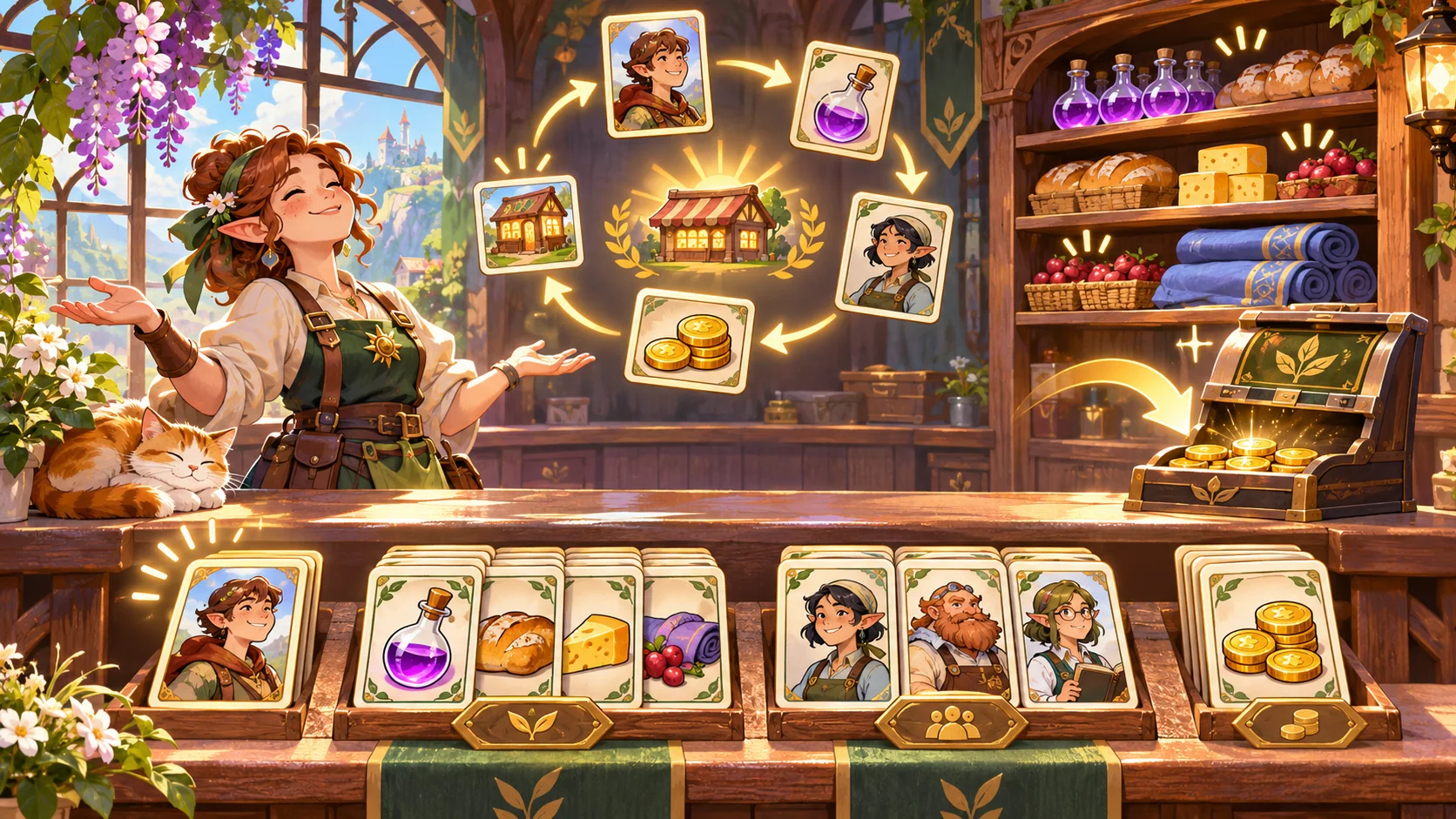
The shop’s core loop is a sequence of visible card plays: demand, supply, service and payment. Once card zones and the ledger agree, add new product families and supplier choices without allowing an unplayed menu action to bypass the order rules.
Read Godot Resource documentation.
Read Godot saving-game documentation.
Frequently asked questions
Can every business action really be a card?
Yes, in this prototype concept. Customer, stock, staff and Coin cards each begin a specific action, while the open-order row, stock zone and ledger show the resulting state. A later interface can still use menus, but its underlying transitions should follow the same card rules.
What happens if the product variant is wrong?
The Staff card cannot complete the order. Keep the request open, preserve the available stock and record no payout. Cedar Lanterns do not substitute for Rose Lanterns just because their price or quantity seems close; the product identifier must match the customer card.
Start a local game prototype with SEELE.
How does the ledger avoid paying twice?
Move the request to completed as part of the same service resolution that consumes stock and posts the payout. If the same Staff card is replayed, the completed order is no longer eligible. Keep the transaction ID on the order or ledger entry so duplicate actions are easy to catch.
Is the card shop tested or balanced?
No. Paper Lane and its coin values are a fictional design example, not tested market behavior or a balanced economy. Replay the stock, service and mismatch cases by hand, then adjust quotes and payouts while keeping exact matching and single-payment rules explicit.