A contract can do more than award coins at the end of a room. In the Copper Route, every customer order sets the next job’s cargo target, travel hazard, deadline and reward. The cards in your deck answer those terms: a Carrier delivers goods, an Escort lowers danger, and a Letter of Credit can change what the next customer offers.
This fictional deckbuilder starts with a two-contract campaign. Each contract gives the player two card plays to satisfy its delivery and hazard conditions. Complete both conditions before the deadline and add the customer’s reward card to the discard pile; miss either condition and the campaign loses its route bonus. The trace keeps the first two orders fixed so card choices, reward timing and a missed deadline can be checked without random draws.
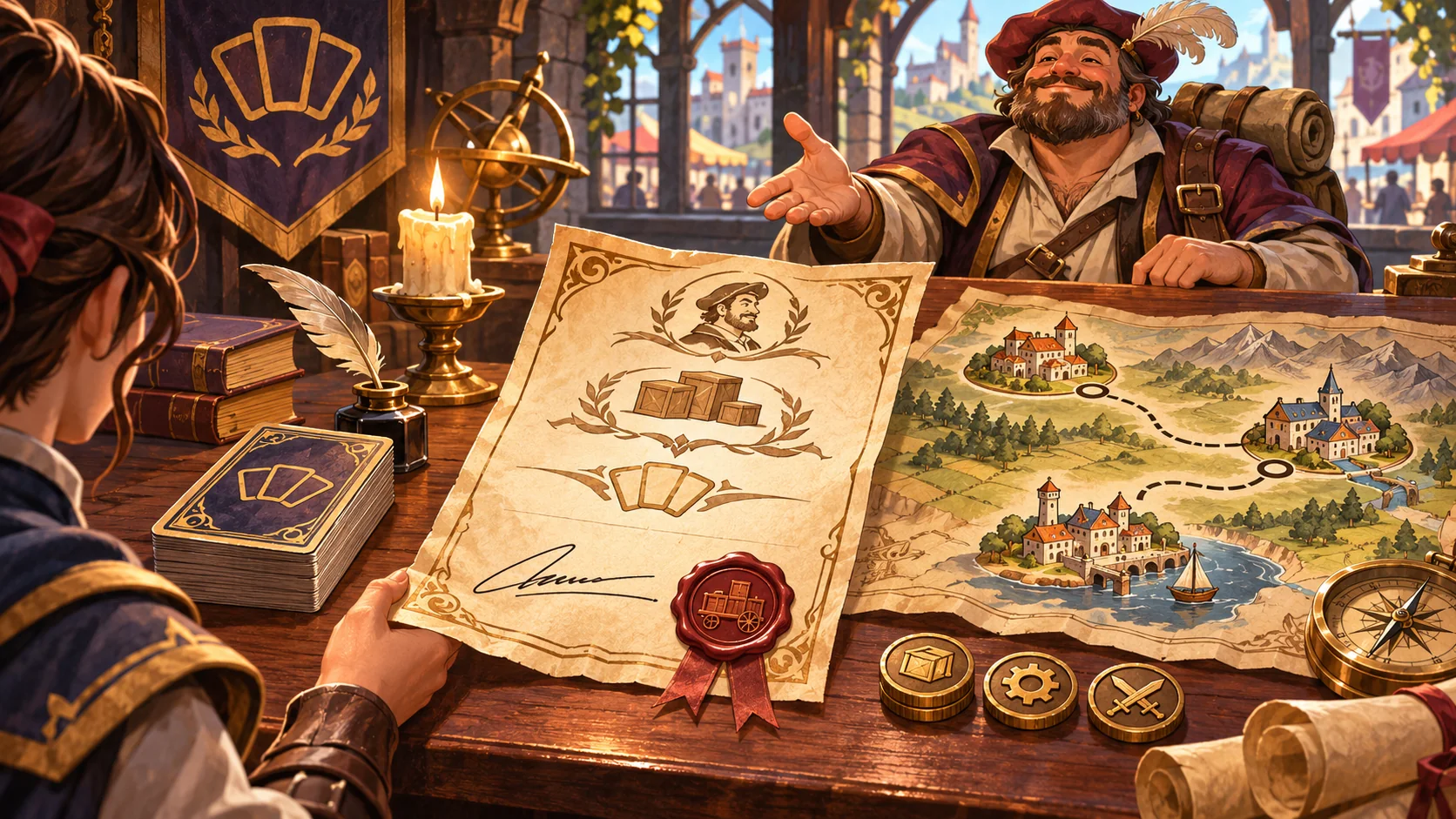
Turn each customer order into a campaign rule
Keep the first campaign to two fixed customer contracts and a six-card deck. Each contract specifies a cargo demand, one route hazard, a deadline of two card plays and a reward card. At the start of a job, reveal three cards and play one per turn. Carrier moves two matching goods from the shared cargo row to the customer. Escort reduces the active route hazard by one. Haggle adds one coin but does not satisfy either contract clause. After each play, update the remaining deadline. A contract completes only when cargo demand is zero and hazard is zero before the deadline expires. On completion, place that customer’s reward card in the discard pile and reveal the next contract. The reward card joins the draw pile after reshuffle and modifies a later job; it does not retroactively change an already resolved contract. If the deadline reaches zero with either clause open, mark the contract missed and remove its route bonus from the campaign. The opening order asks for two grain crates on a storm route. Start with two cargo, hazard one, three coins and two turns. Play Carrier to deliver the crates, then Escort to lower the storm to zero. The contract completes and adds Trusted Route to the discard. A second contract asks for two lantern crates with a bandit hazard; the new card can reduce the cost of the Escort, showing how a customer reward changes the next order. If the player spends a turn on Haggle instead, only one card play remains and both clauses cannot be cleared in time. This makes customers the campaign spine, rather than a list of unrelated bonus payouts.
| Contract element | Resolution rule |
|---|---|
| Demand | The contract lists one cargo type and a quantity; Carrier delivers exactly two matching goods. |
| Route hazard | Escort reduces the hazard by 1. It must reach 0 before the deadline expires. |
| Deadline | Begin with two card plays and play one card per turn; check completion after each play. |
| Reward card | A cleared order adds its named card to discard for a later draw and changes future choices. |
| Haggle | Gain 1 coin, but do not reduce cargo demand or route hazard. |
| Missed order | If either clause remains when the deadline reaches 0, mark the customer contract missed and remove the route bonus. |
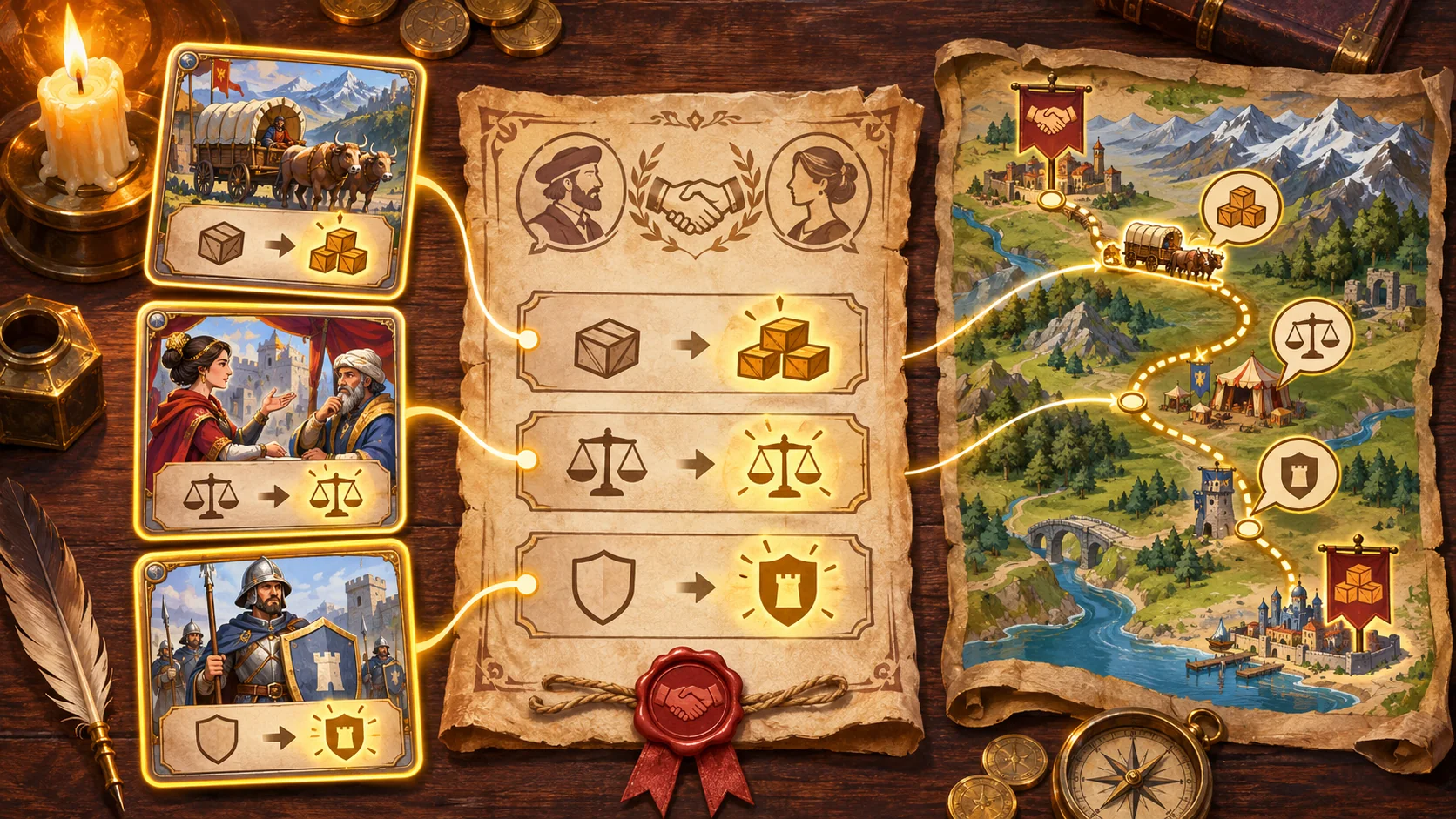
Trace two contracts and a missed deadline
Begin the Harbor Pantry contract with two grain in cargo, demand two grain, hazard one, deadline two card plays and three coins. The opening hand is Carrier, Escort and Haggle. Turn one: Carrier transfers both grain crates, reducing demand from two to zero; hazard remains one and deadline becomes one. Turn two: Escort reduces hazard from one to zero. Both clauses are clear before the deadline expires, so the order completes. Add Trusted Route to discard and open the Hill Market contract, which requests two lanterns and starts with bandit hazard one. The reward card reduces the cost of the next Escort, preserving a coin for a future purchase. Counterexample: play Haggle first. It adds one coin but leaves both delivery and hazard unresolved; after Carrier on the last turn, the hazard remains and the deadline expires. The customer order is missed and the campaign route bonus is lost. Every transition comes from the active contract, not a random event.
| Check | Expected result |
|---|---|
| Start Harbor Pantry | Demand 2 grain, hazard 1, deadline 2 plays; cargo has 2 grain. |
| Play Carrier | Deliver 2 grain; demand becomes 0 and one play remains. |
| Play Escort | Hazard becomes 0; the contract clears before its deadline. |
| Complete the order | Trusted Route enters discard and the Hill Market contract opens. |
| Play Haggle instead of Escort | Gain one coin, but the route hazard remains and the deadline is missed. |
| Reshuffle between jobs | The earned reward card can appear in a later hand; it cannot rewrite the completed order. |
Ask AI for a small contract-driven deckbuilder
Ask SEELE to build a local two-contract prototype with a fixed opening hand and visible clause counters. Put delivery, hazard, deadline and reward resolution in one order, then compare the success path and missed-order counterexample with the trace before adding procedural customers.
Create a local roguelike deckbuilder called Copper Route, driven by customer contracts. Start with three coins, two grain cargo, a six-card deck, and a fixed Harbor Pantry contract: deliver two grain, reduce route hazard from one to zero, and do so within two card plays. Reveal Carrier, Escort and Haggle. The player may play one card per turn. Carrier transfers two matching goods from cargo to the order. Escort reduces hazard by one. Haggle adds one coin and satisfies no contract clause. After each card, reduce the deadline by one and complete the contract only if cargo demand and hazard are both zero before the deadline expires. Clear orders add the named customer reward card to discard and reveal the next fixed contract; the reward joins future draws after reshuffle. The next Hill Market order asks for two lanterns and starts with hazard one. Trusted Route lowers the cost of its Escort. In the success trace, Carrier then Escort clears Harbor Pantry and adds Trusted Route. In the counterexample, Haggle then Carrier leaves hazard one when the deadline expires, so the customer is missed and the campaign route bonus is removed. Show each clause, deck/discard change, deadline and campaign node. Add reset to restore the exact opening hand, cargo and contract. Keep card actions keyboard-operable without timed input.Show why a reward changes the next job
The first draft awarded a reward when the delivery clause was met even though the road hazard remained. Make completion a single predicate: cargo demand is zero and hazard is zero before the deadline. Only then move the reward card to discard and advance the campaign node. Show each clause as open or cleared so a player can see why a contract is still active.
Replay Carrier then Escort, and Haggle then Carrier. Confirm that deadlines fall once per card play, a successful order rewards exactly once, and a missed order does not leak its reward into a later draw. If this becomes a web prototype, make draw, play and confirm keyboard actions; the W3C keyboard guide is reference material, not a conformance claim.
Add customers after the contract loop is clear
Keep the two customer orders fixed while checking whether their requirements actually shape deck choices. A player should be able to explain why Carrier and Escort clear the first order and how Trusted Route changes a later decision. Once the trace is stable, add one customer contract with a different cargo or hazard, then rerun both deadlines. The related card narrative guide can help you make completed orders affect later scenes without blurring the contract rules.
Read the inventory-management roguelike guide.
Start a local game prototype with SEELE.
Frequently asked questions
What makes contracts drive the campaign?
Each customer order defines the cargo target, route hazard, deadline and reward card for a leg. Clearing both clauses opens the next named customer. The player is therefore responding to the campaign’s active terms, while the deck reward carries one decision into a later job.
Can a reward card change a contract already completed?
No. On completion, place the reward in discard. It enters a later hand only after the deck is reshuffled. Keep the resolved contract snapshot unchanged so a new card cannot alter an earlier delivery or deadline result. Keep that boundary explicit.
Read Godot Resource documentation.
How should a missed contract affect the run?
Use an explicit outcome such as losing the route bonus or opening a harder customer. Do not silently grant completion when cargo arrives but the hazard remains. Show which clause failed when the deadline reaches zero so the campaign consequence is predictable.
Should customer orders be random at first?
Start with two fixed contracts and a known opening hand. That makes it possible to verify reward timing and a missed-order counterexample. Add a small contract pool only after each card can satisfy a visible clause and the campaign map advances in a repeatable way.