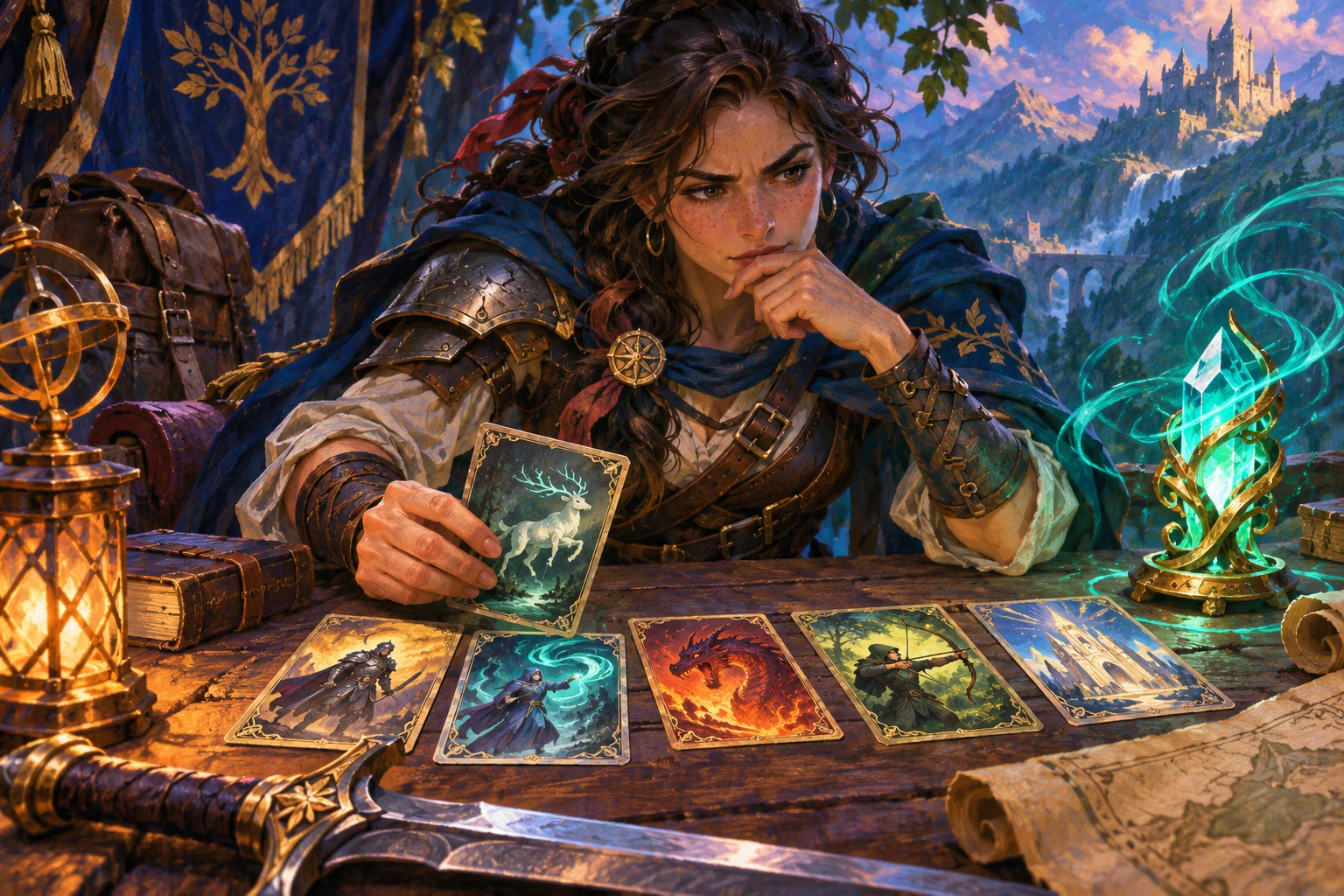
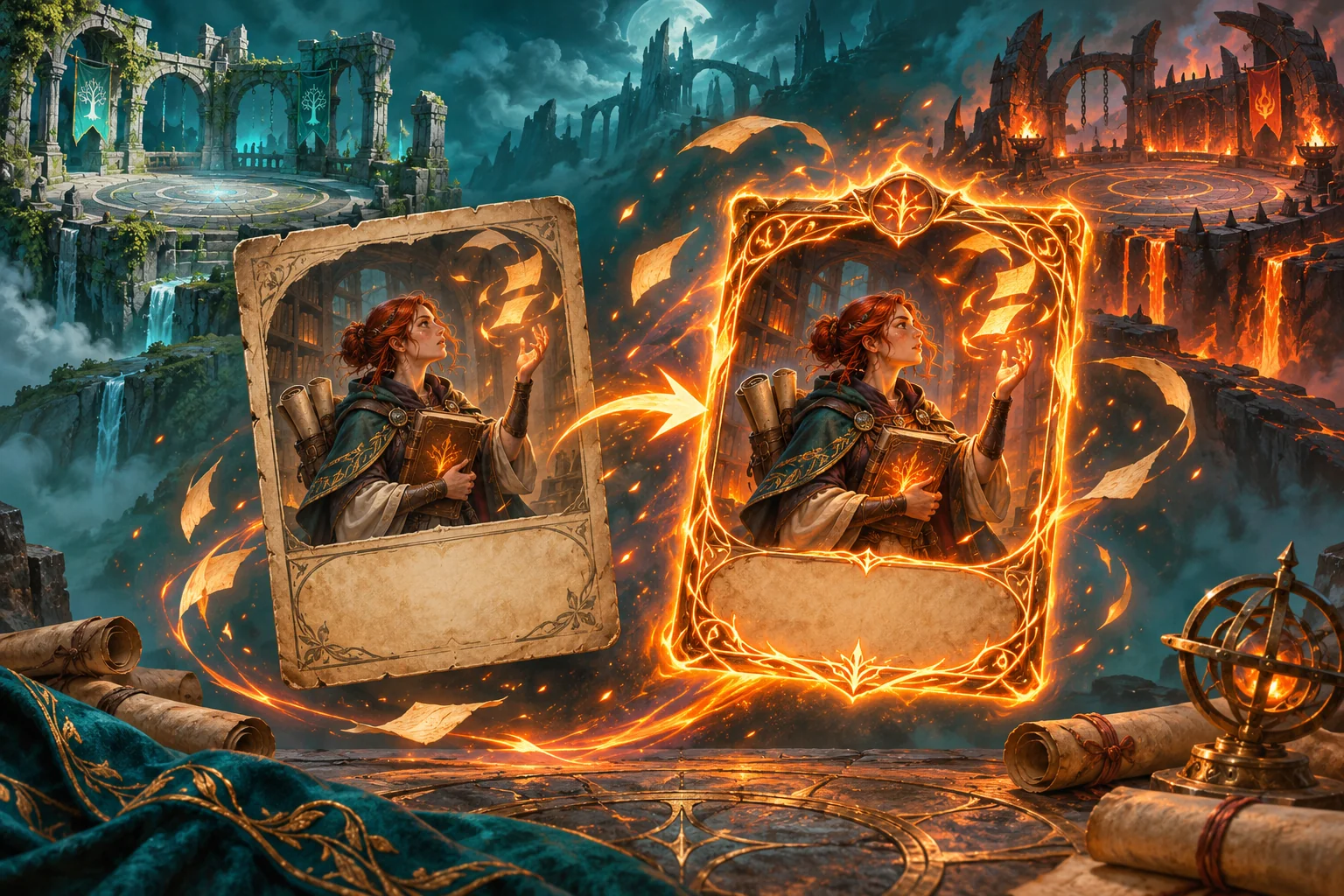
In a deck-building game, equipment can do more than add a stat. In Relic Loom, each hero’s weapon chooses the six cards that hero contributes to the party’s shared twelve-card battle deck. Lio’s glass bow supplies precise shots and marks; Mira’s hooked shield supplies defense, pulls, and counters. When Lio changes bows at camp, his old six-card package leaves the deck and the new one takes its place.
The replacement rule makes the loadout legible. Swapping gear does not quietly enlarge the deck or leave old cards hiding in a discard pile. Each hero has one weapon slot, a known package for every weapon, and a clear time when changes are allowed: camp, between fights. At battle start, assemble twelve unique card instances, shuffle once with a visible seed, and draw five. During combat, equipment stays locked so players can plan around the cards actually available.
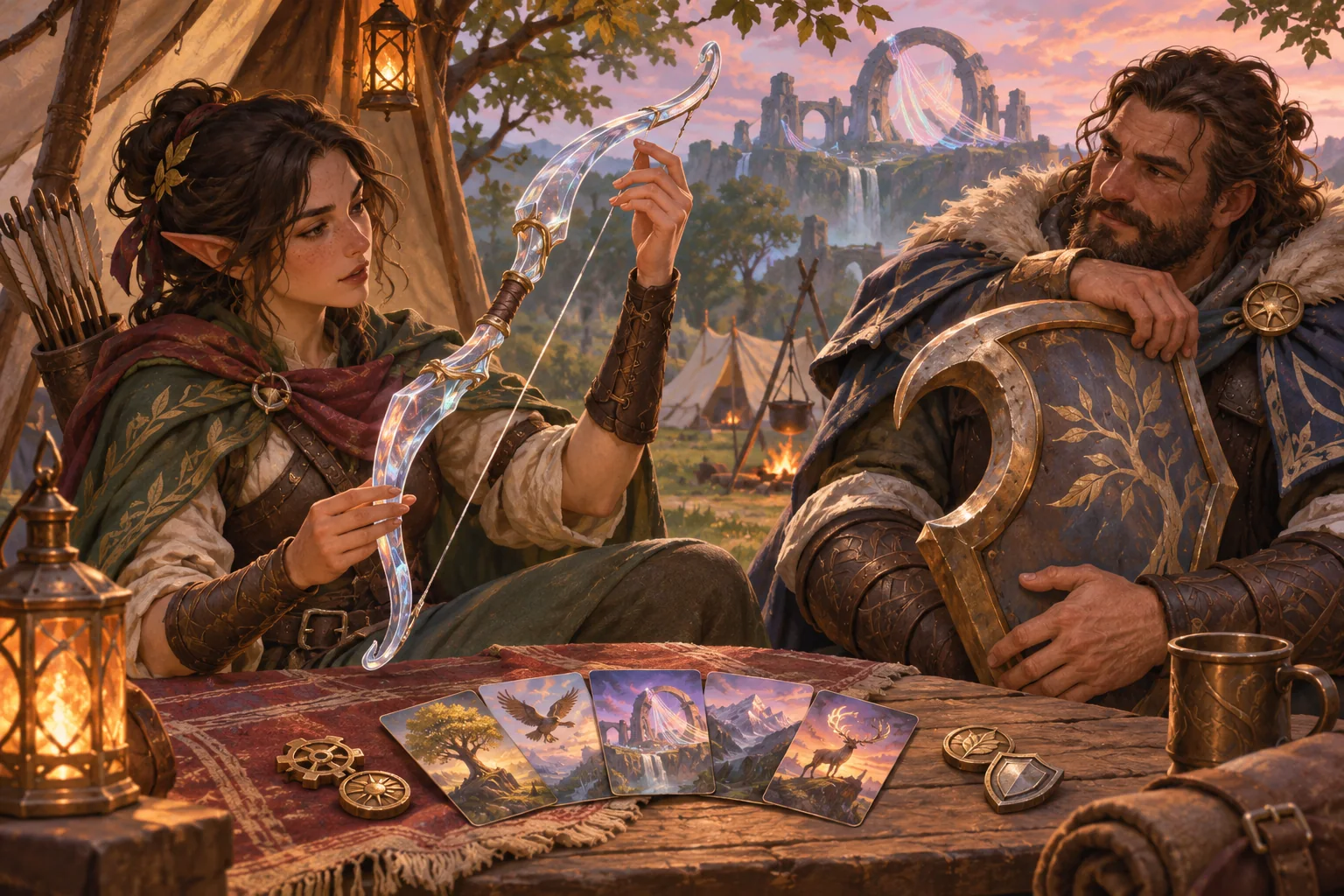
Tie a card package to each character’s weapon
Use two heroes: Lio and Mira. Each has one weapon slot and contributes exactly six card instances to a shared twelve-card deck. Lio can equip Glassbow (Pinpoint ×2, Fan Shot ×2, Mark ×2) or Flintbow (Piercing Line ×2, Quick Draw ×2, Ash Mark ×2). Mira can equip Hookshield (Brace ×2, Hook ×2, Counter ×2) or Sunshield (Aegis ×2, Bash ×2, Rally ×2). Gear can change only at camp between encounters. When a weapon changes, remove all six card instances from that hero’s hand, draw pile, discard pile, and exhaust pile; then create the newly equipped six. The other hero’s package remains untouched. At battle start, combine the current two packages, assign a visible shuffle seed, shuffle once, and draw five. Each hero has two energy each round. At round start draw two up to a hand limit of seven. A card states its energy cost, owner, target, and effect; only its owner may play it. Spent cards go to discard unless the card says exhaust. No equipment changes occur in combat. Victory ends the encounter and returns exhausted cards to the between-fight state; reset restores the selected weapons, twelve-card composition, health, energy, and seeded draw order. The first slice uses no random card rewards or permanent deck upgrades, so gear remains the only package selector.
| System | Expected behavior |
|---|---|
| Character package | Each hero contributes six distinct card instances; two equipped heroes make a twelve-card shared draw deck. |
| Glassbow / Flintbow | Pinpoint, Fan Shot, Mark / Piercing Line, Quick Draw, Ash Mark; two copies of each. |
| Hookshield / Sunshield | Brace, Hook, Counter / Aegis, Bash, Rally; two copies of each. |
| Swap timing | Change one weapon at camp between encounters; lock both weapon slots during battle. |
| Replacement | Remove that hero’s old cards from hand, draw, discard, and exhaust before adding the new six. |
| Draw and energy | Shuffle once with a visible seed, draw five; each round draw two to a hand cap of seven; each hero gets two energy. |
| Reset | Restore weapon choices, exact twelve-card inventory, health, energy, and the seeded draw order. |
Define the deck rebuild and battle lock
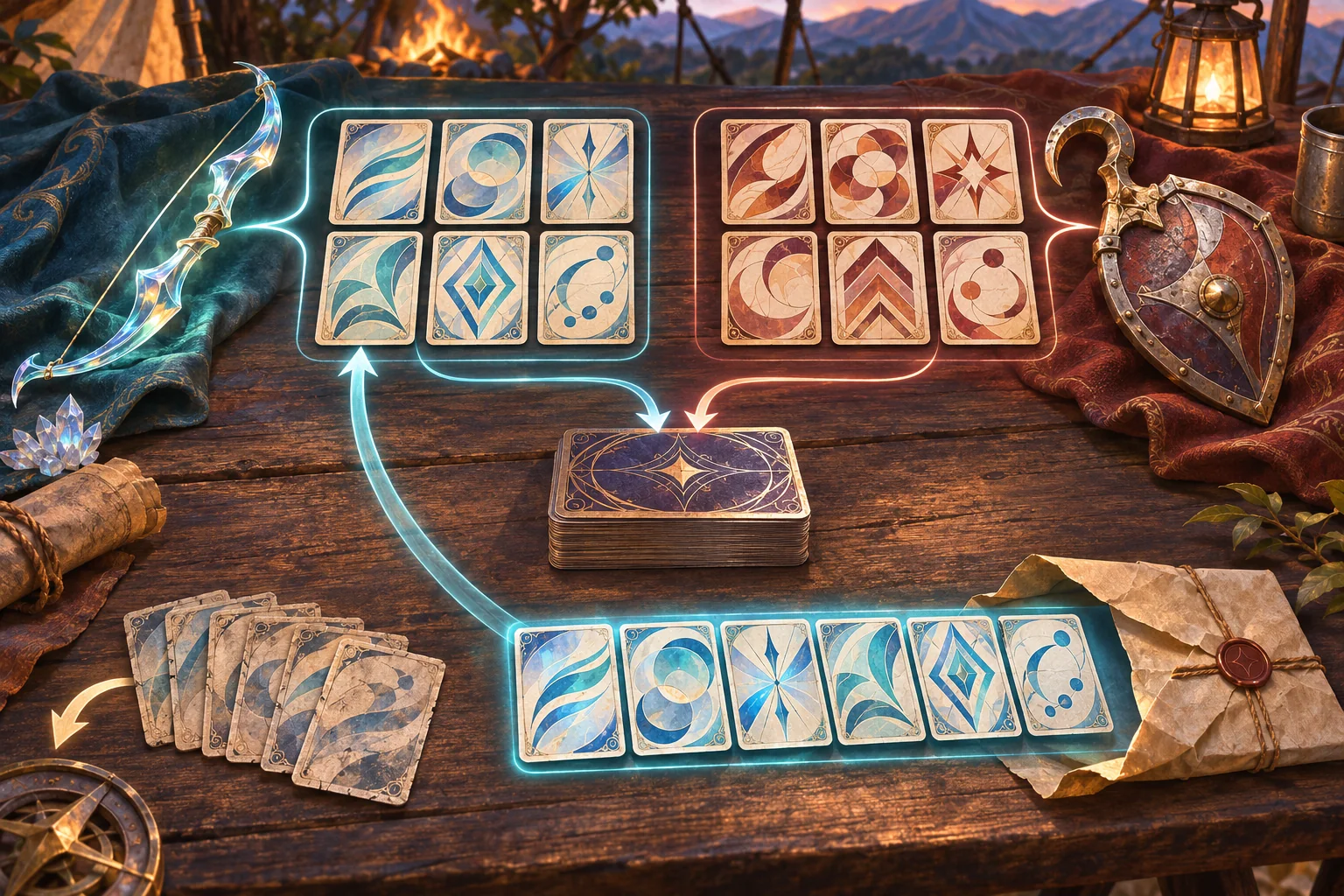
At camp, Lio equips Glassbow and Mira equips Hookshield. The new deck has Pinpoint A/B, Fan Shot A/B, Mark A/B, Brace A/B, Hook A/B, and Counter A/B: twelve instances, with no cards from the unselected weapon sets. Battle begins with visible seed 418; the deck is shuffled once and five cards are drawn. Suppose Lio’s Pinpoint A and Mira’s Brace A are in hand. After the encounter, return to camp and give Lio Flintbow. First remove Pinpoint A/B, Fan Shot A/B, and Mark A/B wherever they currently sit—in hand, draw, discard, or exhaust. Then add Piercing Line A/B, Quick Draw A/B, and Ash Mark A/B. Mira’s six Hookshield cards remain in their current between-fight state. The rebuilt deck again contains exactly twelve instances. The next encounter gets a new displayed seed and a fresh shuffle. If Lio swaps back before battle, Flintbow cards are removed as a complete set and Glassbow’s set returns once; no copy accumulates. This is a hand-authored inventory trace, not a playable test.
| Check | Expected result |
|---|---|
| Equip Glassbow and Hookshield | Build six Lio instances plus six Mira instances. |
| Start battle with seed 418 | Shuffle the twelve instances once; draw five; equipment becomes locked. |
| Draw, discard, or exhaust a Lio card | Track its instance ID in exactly one pile; ownership remains Lio. |
| Return to camp and swap Lio to Flintbow | Remove all six Glassbow instances from every pile; add six Flintbow instances. |
| Keep Mira’s weapon unchanged | All six Hookshield instances retain their state and owner. |
| Swap Lio back before the next fight | Remove Flintbow and add Glassbow once; deck count remains twelve. |
| Reset the encounter | Restore selected gear, health, energy, all card instances, and initial seeded draw order. |
Trace one equipment swap across every pile
Ask SEELE to prototype equipment as a deck-package selector, not a card bonus layered over the old deck. Keep cards owned by a hero and reconcile all draw, discard, hand, and exhaust piles whenever equipment changes at camp.
Create a local collectible card game prototype called Relic Loom with two heroes, Lio and Mira. Each has one weapon slot and contributes exactly six card instances to one shared twelve-card deck. Lio's Glassbow package is Pinpoint x2, Fan Shot x2, Mark x2. His Flintbow package is Piercing Line x2, Quick Draw x2, Ash Mark x2. Mira's Hookshield package is Brace x2, Hook x2, Counter x2. Her Sunshield package is Aegis x2, Bash x2, Rally x2. Allow equipment changes only at camp between encounters; lock gear during battle. On a weapon swap, remove every card instance owned by that hero from hand, draw pile, discard pile, and exhaust pile, then add exactly the newly equipped six. Do not alter the other hero's cards. Give every copy a unique instance ID and owner. Before battle, combine the current packages, show a user-visible shuffle seed, shuffle once, and draw five. At round start draw two to a hand limit of seven. Each hero receives two energy per round. A card displays cost, owner, target, and effect; only its owner can play it. Spent cards go to discard unless marked exhaust. For the written trace, equip Glassbow and Hookshield, draw five with seed 418, then return to camp and swap Lio to Flintbow. Show all six Glassbow instances removed from their current piles and six Flintbow instances added; verify the total stays twelve and Mira's package is unchanged. A second swap back must not duplicate cards. Reset restores gear, health, energy, inventory, and initial seeded deck order. Show current equipment, package contents, card owners, pile counts, energy, and swap availability. Do not add permanent card rewards, random equipment, in-combat gear changes, or hidden shuffle behavior to this first slice.Ask AI to keep loadout and card ownership aligned
The first draft added the newly equipped cards without removing the old set. Repeated swaps then increased the deck and made draw odds depend on camp history. Replace all six cards owned by the changed hero across hand, draw, discard, and exhaust before adding the new set. This fix follows the written inventory trace, not a test of a running game.
Replay a swap when one old card is in hand, another in discard, and another exhausted. Each must be removed once; the other hero’s package must not change. Confirm a second swap back restores exactly twelve cards and that combat gear stays locked. Give cards stable instance IDs so duplicate names remain separate physical copies.
Revise the first swap rule before adding gear
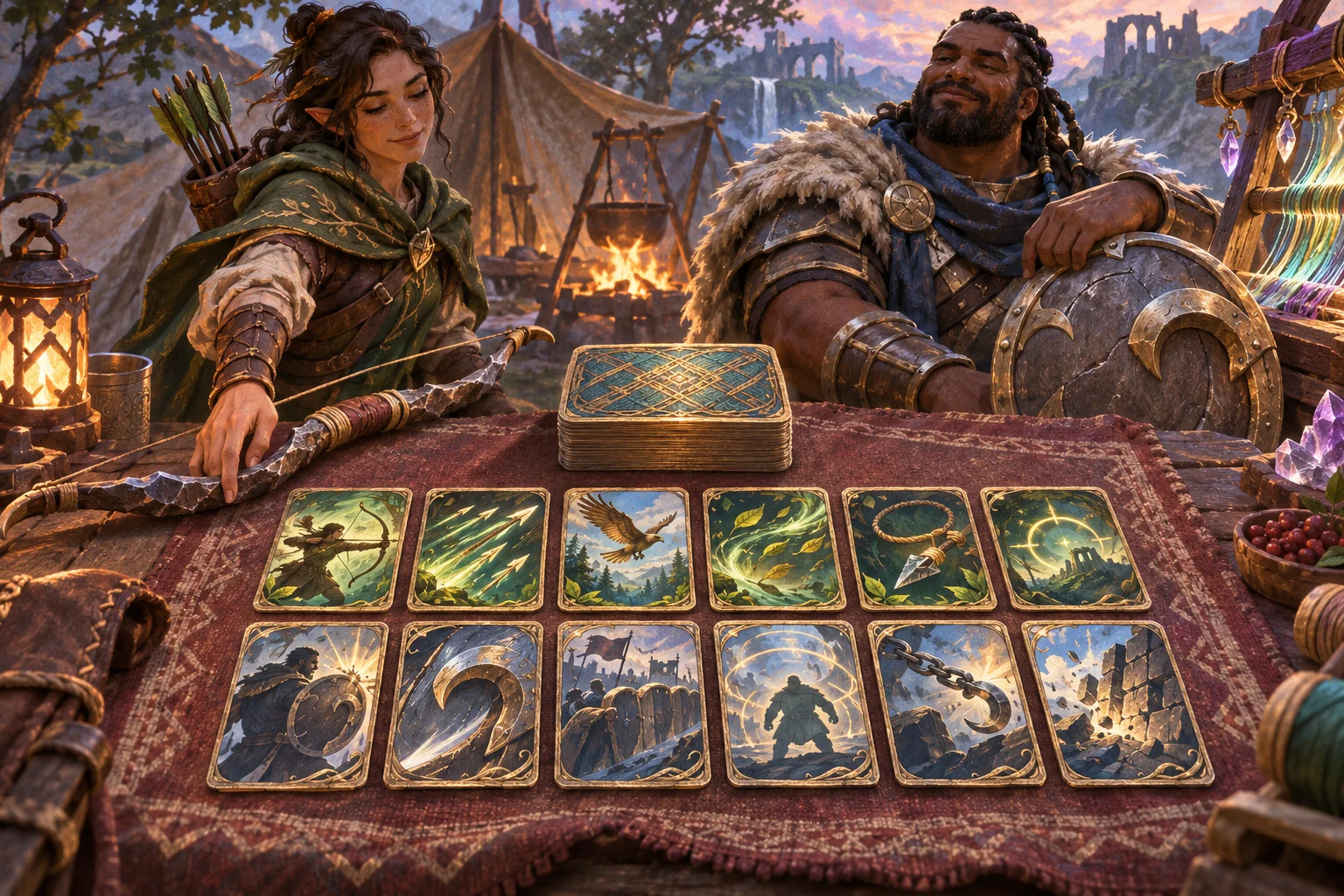
Keep the first build to two heroes, two weapons per hero, one six-card package per weapon, and camp-only swaps. Track each card instance in exactly one pile and show which hero owns it. After the twelve-card rebuild is reliable, add equipment with a different tactical role or a reward choice. Do not introduce permanent card upgrades until replacement and reset are easy to audit.
Read the narrative card-game design guide.
Create a first card-game prototype with SEELE.
Frequently asked questions
How should equipment change a character’s deck?
Let each item select a known card package for its owner. On a camp swap, remove the old package from every pile and add the new package once. A fixed number of cards makes the equipment effect easy to compare and stops repeated swaps from inflating the deck.
Why not just add the new gear cards?
Adding without removing makes the deck grow every time a player swaps back and forth. Draw odds then depend on swap history rather than the selected loadout. Replacing a full package keeps deck size stable and makes card ownership inspectable.
Read W3C keyboard interaction guidance.
Can players change equipment during battle?
Keep gear locked during the first combat slice. A between-encounter swap rebuilds the deck at a clear boundary and prevents a player from changing the available cards in response to a draw. If mid-battle swaps become a feature, define their timing and pile cleanup separately.
How do I prevent duplicate cards after a swap?
Give every copy a stable instance ID and track whether it is in hand, draw, discard, or exhaust. Remove each old ID once, then add the new six IDs. A reset and a swap-back check should both finish with exactly twelve instances.