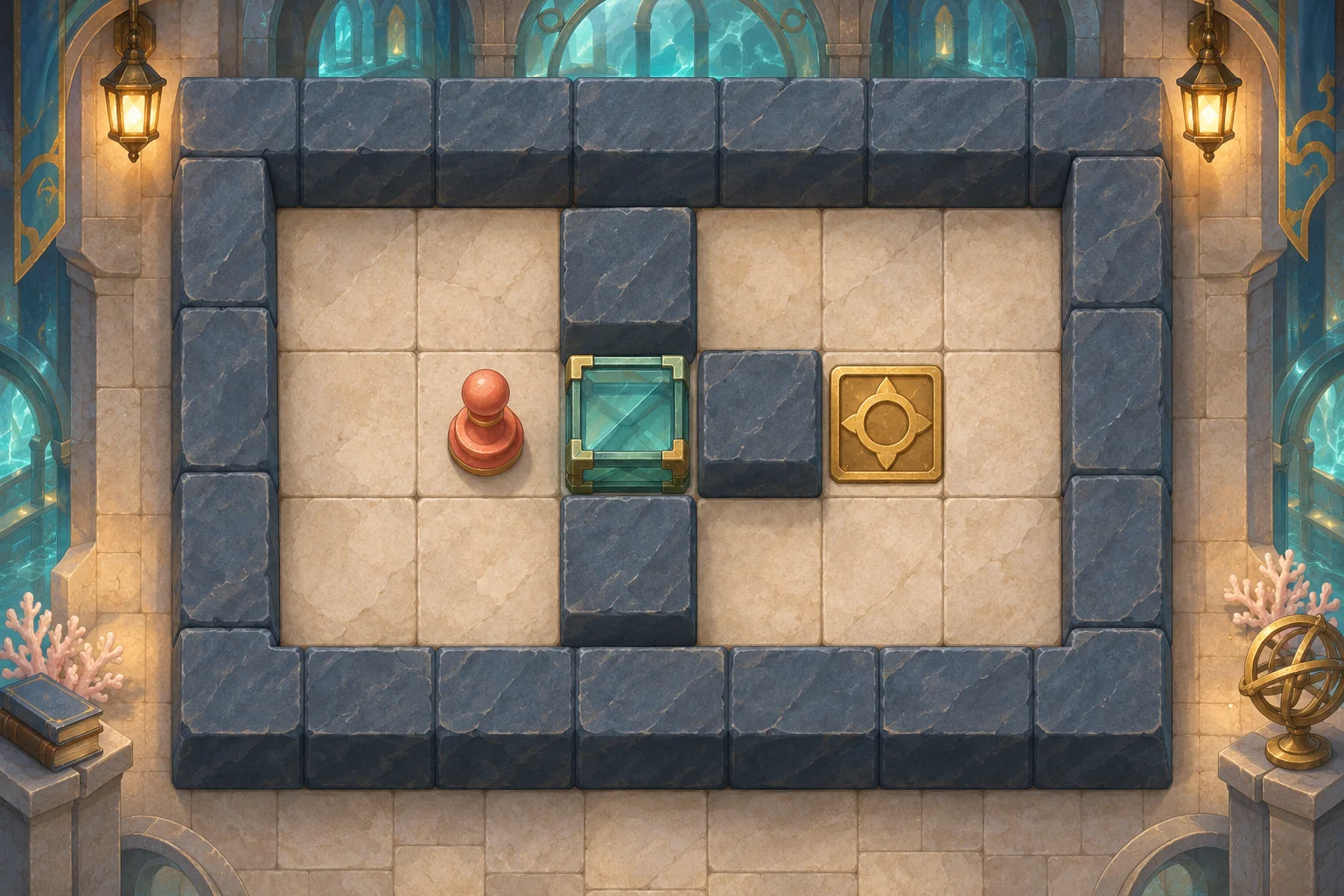
Make the choice legible before you add content
A push-your-luck game needs more than a button that says “keep going.” At every push, the player should see what is already safe, what is still at risk, how much the next success adds, and what a bust removes. Set those four facts and the stopping rule first. Then compare the value of a sure bank with the value of continuing.
This guide uses Emberline Vault, an original fictional one-run design. Its route, fair-die assumption, scores, traces, and rule revision are calculated on paper from the rules below. No prompt was run, and no playable build or playtest is being reported.
The example’s key choice occurs at tier 3 with three points at risk: banking guarantees a partial score of 3; pushing gives a 50% chance to reach the six-point goal and a 50% chance to lose the haul. The two choices have the same expected immediate score under this simple model, but different chances of clearing the goal.
Set one route, one haul, and one stop rule
Keep the first run small enough to trace. A courier starts at a cool-blue return lift and can push through four fixed basalt tiers toward ember crystals. There is no branching map, card-built route, enemy, or second run. The intended decision is whether to secure the haul now or risk it for the next tier’s reward.
| State | Meaning | What the player can verify |
|---|---|---|
| Tier | Current step, from 1 to 4. | The risk and reward for the next push. |
| Unbanked haul | Points earned in this run but not secured. | A bust sets this haul to zero. |
| Banked score | Points secured at the entrance lift. | A bust leaves already banked score unchanged. |
| Goal | Bank at least 6 points in this one run. | A lower bank is a safe partial score, not a clear. |
At the start, banked score and haul are both 0, and the courier is at tier 1. A Push rolls one assumed-fair six-sided die. At tier t, results 1 through t bust; any higher result succeeds and adds t points to the haul. After a safe result at tiers 1–3, the player may Bank or continue at the next tier. Bank moves the full haul into banked score and ends the run. A successful tier-4 push banks automatically; there is no tier 5. Restart begins a fresh run with both scores at 0 and the courier back at the lift.
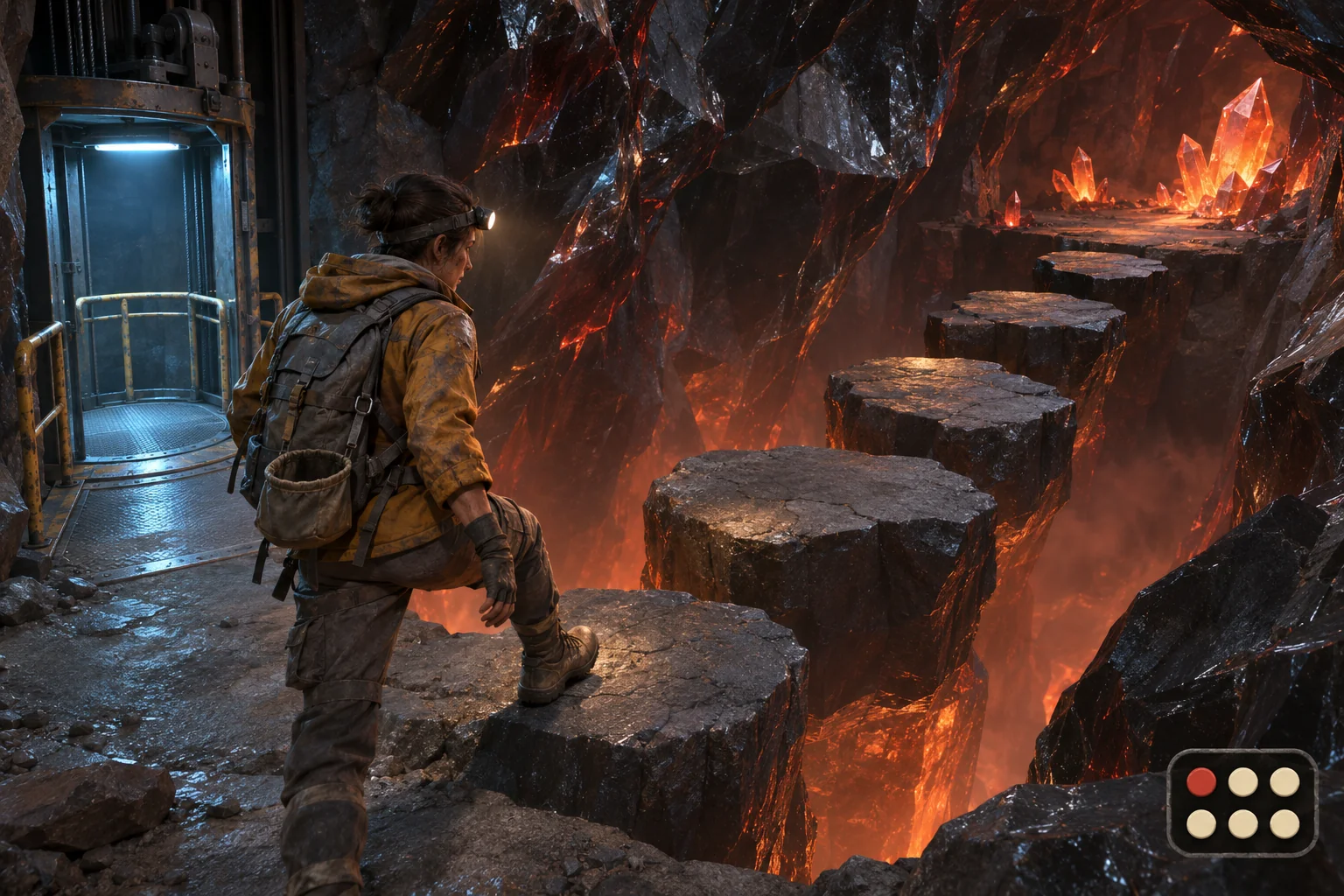
That contract separates three outcomes that are easy to blur in a vague prompt: a safe push adds haul, Bank secures haul and ends the run, and a bust removes only the unbanked amount. State each one before adding collectibles, upgrades, or alternate paths.
Make each deeper push riskier and more valuable
Use the same rule at every tier: the bust threshold and the successful reward both equal the tier number. On a fair d6, the bust chance is t/6 and the safe chance is (6−t)/6. This example deliberately makes deeper pushes less likely to succeed while increasing their reward.
| Tier | Bust results | Bust chance | Safe results | Haul added if safe | After a safe push |
|---|---|---|---|---|---|
| 1 | 1 | 1/6 | 2–6 | +1 | Bank or enter tier 2. |
| 2 | 1–2 | 2/6 | 3–6 | +2 | Bank or enter tier 3. |
| 3 | 1–3 | 3/6 | 4–6 | +3 | Bank or enter tier 4. |
| 4 | 1–4 | 4/6 | 5–6 | +4 | Bank automatically and end. |
The values are teaching calculations under the stated fair-die assumption, not measured odds from a game. They also do not say that the later tiers are automatically “better.” At tier 4, only two die faces succeed, and a bust can wipe a large unbanked haul. The point is to make the tradeoff visible before deciding whether the curve feels right for your intended audience.
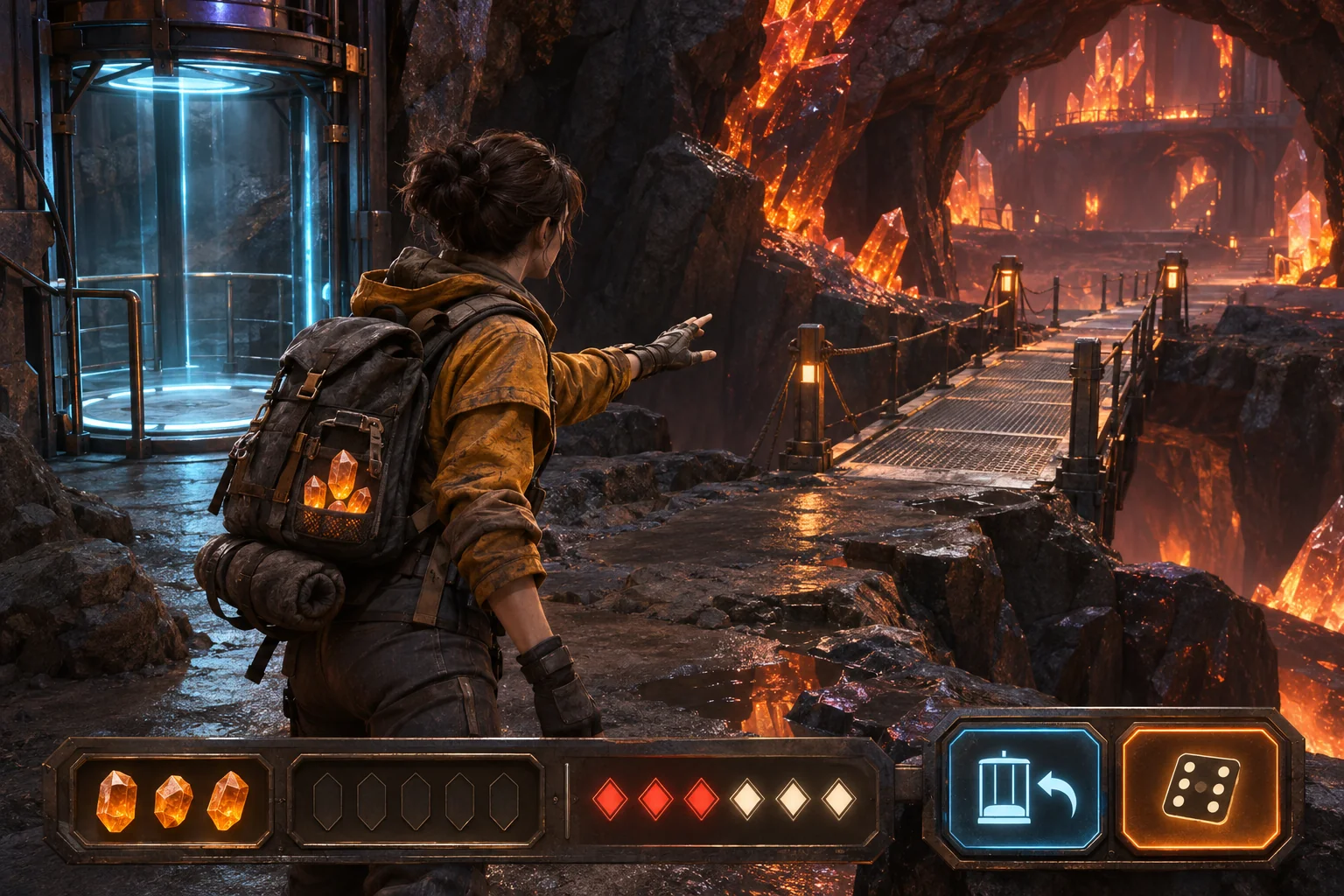
Show danger and reward together. If the interface displays only “50% bust,” players cannot see what they stand to gain; if it shows only “+3,” they cannot judge the loss. In the design, three of six marks are dangerous and a safe result adds three crystals. The return lift stays visible behind the courier, so banking is a meaningful action rather than an abstract menu choice.
Prompt the first run with explicit state changes
Give a game-creation prompt the route, state variables, action rules, feedback, restart condition, and a way to check a result. This keeps the central risk decision testable when you eventually inspect a build. The template below is a starting specification, not an executed prompt.
Create a small original push-your-luck exploration game called Emberline Vault. Use a fixed four-tier volcanic-glass passage leading back to one safe entrance lift. Track current tier, unbanked haul, and banked score. Start at tier 1 with haul 0 and banked score 0. The goal is to bank at least 6 points in this one run.

At tier t from 1 to 4, Push rolls one fair six-sided die. Results 1 through t bust: set unbanked haul to 0, preserve banked score, and end the run. A result above t succeeds and adds exactly t points to unbanked haul. After a safe result at tiers 1 through 3, offer Bank or Push at the next tier. Bank transfers all unbanked haul to banked score and ends the run. A successful tier-4 push adds 4, banks automatically, and ends; there is no tier 5. Restart resets tier to 1, both scores to 0, and position to the entrance lift.

Make the player-visible state show tier, loose haul, secured score, the next tier's bust faces, safe faces, and reward. Distinguish loose crystals from banked crystals. Before adding extra content, return a rule table, a clear trace using rolls 5, 6, 4 then Bank, a bust trace using 5, 6, 2, and checks for tier-4 auto-bank, tier-4 bust, low-score Bank, and Restart. Keep all rules consistent with this request; do not claim a result until the actual behavior has been inspected.
A useful first review compares the requested rules with the returned state transitions: Did the bust clear only the loose haul? Does Bank end the run? Does a safe tier-3 roll add 3? Does tier 4 stop automatically? Record mismatches one at a time. A prompt can state a goal, but the goal text alone does not prove the mechanics have been implemented correctly.
Hand-check a bank choice and two routes
After safe rolls 5 and 6, the courier reaches tier 3 with haul 3 and banked score 0. Banking now secures 3 for certain. If the courier pushes, rolls 1–3 bust and end at 0; rolls 4–6 add 3, bringing the haul to 6, which can then be banked to clear the goal. If the player plans to Bank immediately after a safe tier-3 result, the expected immediate score is (3/6 × 6) + (3/6 × 0) = 3. That equals the sure bank of 3 in this simplified model, while changing the chance of reaching the goal to 50%.
| Trace | After each roll | Stop decision and final state |
|---|---|---|
| Clear: 5, 6, 4 | Tier 1 roll 5: haul 1. Tier 2 roll 6: haul 3. Tier 3 roll 4: haul 6. | Choose Bank before tier 4. Banked score 6, haul 0; goal cleared. |
| Bust: 5, 6, 2 | Tier 1 roll 5: haul 1. Tier 2 roll 6: haul 3. Tier 3 roll 2: bust. | Run ends with banked score 0 and haul 0. The earlier Bank choice would have kept 3. |
The clear route stops after the tier-3 success. It does not collect the tier-4 reward. If the courier safely pushed all four tiers, the maximum haul would be 1+2+3+4=10 and tier 4 would bank it automatically; if tier 4 busts after three earlier successes, the unbanked 6 is lost.

These traces make the choice concrete without pretending to measure player behavior. A different audience may prefer a gentler first tier or a safer route. Change the rule deliberately, then compare the same inputs and outcomes on paper before asking for a new version.
Revise one threshold on paper before tuning further
For a simple design comparison, define v0 as “a roll of 1 busts at every tier” while the safe reward remains +tier. In v1, change only the bust condition to “1 through the current tier bust.” Keep the route, rewards, Bank action, and goal fixed.
Replay rolls 5, 2. Both versions pass tier 1 on 5 and enter tier 2 with haul 1. In v0, only a 1 busts at tier 2, so 2 succeeds and adds 2; Bank would secure 3. In v1, 1 or 2 busts at tier 2, so the same 2 ends the run with haul 0. This reveals the exact consequence of increasing the threshold. It does not establish that v1 is more balanced or more fun, and it is not a real test.
When you do get a build to inspect, use the same short roll sequence if the rules permit controlled inputs. Write down the rule, action, visible response, and state after each step. If the game cannot expose or control a die roll, say that the comparison was not verified rather than treating a paper trace as observed behavior.
Check the stop, bust, and reset boundaries
Turn the rule contract into cases with one expected result. These are acceptance targets for a future build, not completed test results.
| Start and action | Expected result | State to preserve or inspect |
|---|---|---|
| Tier 1, Push, roll 1 | Bust; end the run with haul 0. | Banked score remains unchanged. |
| Tier 1, Push, roll 6 | Safe; add exactly 1 haul and offer Bank or tier 2. | Do not skip to tier 3. |
| Tier 3 after rolls 5 and 6, choose Bank | Transfer 3 haul to banked score and end the run. | Do not roll tier 3 or continue after Bank. |
| Tier 3 after rolls 5 and 6, Push and roll 4 | Add 3 to haul, reaching 6; offer Bank or tier 4. | Do not auto-bank before tier 4. |
| Tier 3 after rolls 5 and 6, Push and roll 2 | Bust; end with haul 0 and banked score 0. | Do not preserve the loose 3. |
| Tier 4, Push and roll 5 | Add 4, automatically bank the full haul, and end. | Do not offer a fifth tier or a second Bank. |
| Tier 4, Push and roll 4 | Bust; end with unbanked haul 0. | Keep already banked score unchanged. |
| Bank a haul below 6 | End safely with a partial score. | Do not mark the six-point goal cleared. |
| Restart after any run outcome | Return to tier 1 at the entrance lift. | Both scores are 0; do not carry crystals forward. |
Start each future check from a fresh run and record the observed state, not just “passed.” If one case fails, change the specific rule it exercises. Avoid adjusting the die threshold, reward, goal, and bust penalty in one revision; otherwise the cause of a changed outcome is hard to see.
Carry the rule contract into a game workflow
A compact first request can name the player, route, first choice, state variables, outcome, and what should be reviewed. SEELE’s current Free AI Game Maker page describes plain-English game input, a playable 2D or 3D first version, browser testing, and refinement with follow-up prompts. It advertises free Koins and says to review displayed cost before each generation; its cost FAQ says to check the selected model, Koin balance, and displayed cost in Workspace. These are general workflow facts. The page does not verify Emberline Vault, its risk curve, or its rules.
If you explore a similar design in a game-creation workflow, inspect the returned result against the acceptance cases above: the correct faces bust at each tier, the reward matches the tier, Bank protects the current haul, and the final tier ends as specified. Describe only behavior you actually saw as verified. The fictional example and its concept images are planning aids, not proof of an implementation.
When you are ready to develop your own idea, start with the Free AI game maker. Review the displayed generation cost, describe the first risk decision, and compare any returned result with the rules you supplied.
Start with one risk decision
Write the starting haul, banked amount, next bust condition, reward, and end rule in plain language. Trace one safe route and one bust by hand. Once the player can see what is at risk and what a safe push earns, you have a useful first slice to explore and refine.
Push-your-luck game questions
What makes a push-your-luck game satisfying?
The next push should present a visible loss and a meaningful gain. Let the player compare the current haul with what a safe result would add, and make the bust consequence clear before the decision. In Emberline Vault, each tier raises both the bust threshold and the reward. That is one design choice, not a universal formula; the goal is an informed stop-or-continue decision.
How do I choose bust odds and rewards?
Start from the number of outcomes players can see, then state which outcomes bust and what a safe result earns. With a fair six-sided die, making results 1 through tier t bust gives a t/6 bust chance. Pair that with a reward you can explain, and hand-check the resulting haul. These calculations describe the proposed rules only; they do not predict whether a real audience will find the game fair.
When should a player bank a haul?
Offer Bank after a safe result when the player can name what it secures and what it gives up. In the tier-3 example, banking protects 3; pushing risks that 3 for a possible six-point clear. A different goal or bust penalty changes the decision, so show the current amount, next risk, and next reward together.
Is Emberline Vault a tested or generated game?
No. Emberline Vault is a fictional teaching design. Its probabilities, v0/v1 comparison, and routes are calculated by hand from the stated rules. No prompt execution, generated build, playable sample, or real playtest is being claimed. The images illustrate authored concepts and do not show verified software behavior.
Can SEELE make this exact push-your-luck game?
The official page describes plain-English game input, a playable 2D or 3D first version, browser testing, and follow-up-prompt refinement; it also says to review displayed cost before each generation. It does not verify Emberline Vault’s risk curve or promise exact rule fidelity. Check every bust threshold, reward, Bank transfer, and terminal state in any returned result before calling the mechanic implemented.