Railway management game design
A focused design loop for balancing passenger capacity, freight deadlines, and one shared track block—plus a paper-checked schedule change you can turn into a future build test.
Start with one corridor, two services, and a dispatch board that makes every reservation visible before a train leaves. That small loop gives the player a real planning choice: fit both trains into the shared track window, or revise one departure and check whether the delivery still arrives on time.
Scope note: Tideglass Junction is a fictional design exercise. Its stations, times, capacities, and block rule are invented for this example, not real railway data or operating advice. No game-generation prompt was run and no playable build or measured iteration is available here; the schedule below is checked on paper only.
Start with one service goal
A railway management game becomes easier to reason about when the first screen asks the player to move a small number of services through a constrained network. For Tideglass Junction, the whole first slice is a pair of connected stations: Junction and Harbor. One shared track block links them. A passenger local must carry four riders from Junction to Harbor; a freight train must take six crates from Harbor back to Junction before a stated deadline.
The player’s job is to assign a train with enough capacity, choose departure windows, and resolve a block conflict before dispatch. The first slice does not need a sprawling map, a city economy, or dozens of train models. It needs a readable route, two different service goals, and feedback that shows why a timetable is valid or blocked.
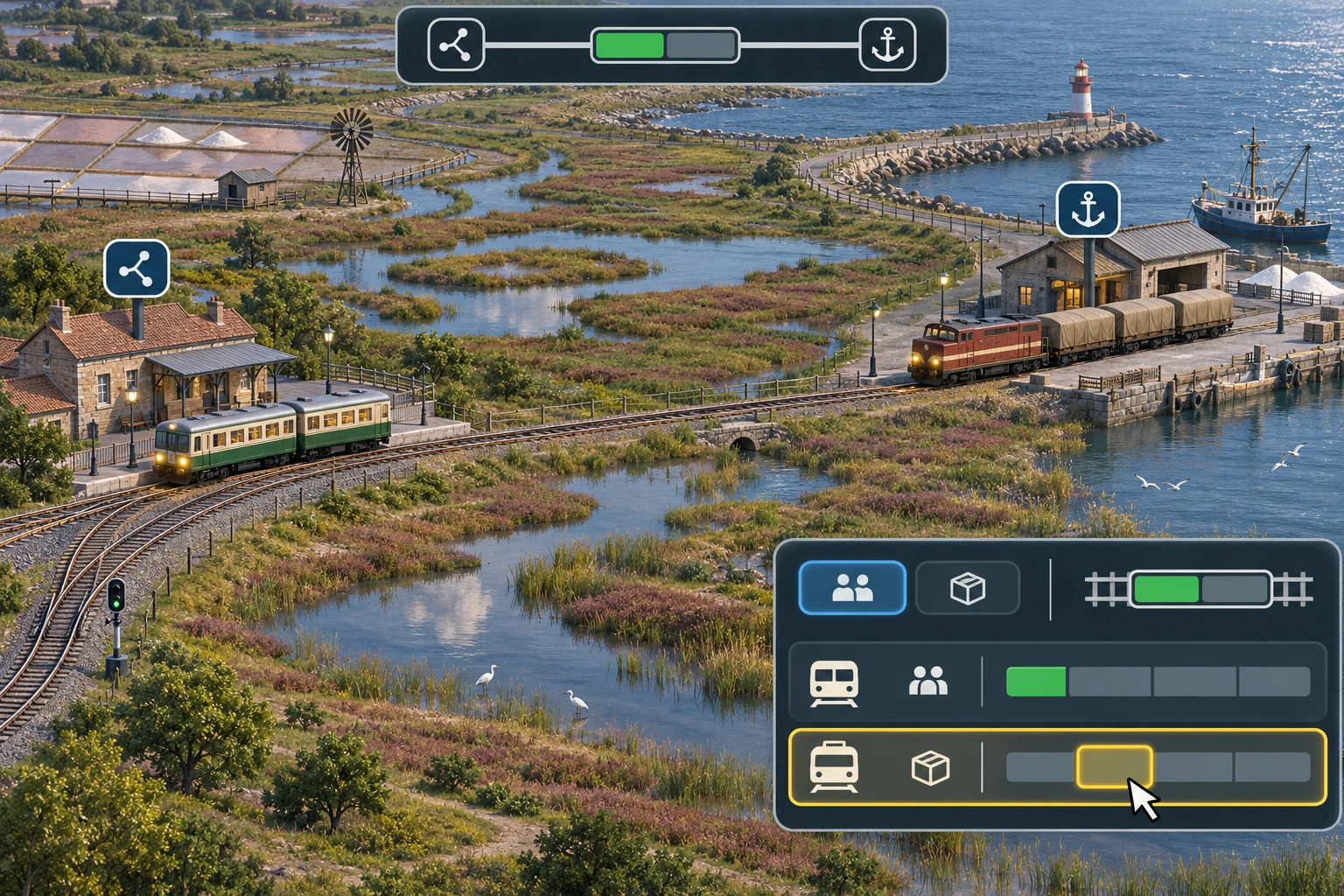
That gives the prototype a clear question for the player: can both services use the corridor without occupying the same block at once, while still meeting their delivery goals?
Draw stations and service demand
Write down what must move before designing a timetable screen. Capacity and scheduling are separate checks. A four-seat local can satisfy the passenger load, but it still needs a free block window. A six-slot freight wagon can carry the crates, but it can still miss its deadline if the departure is too late.
Two service obligations in the fictional first slice
| Service | Route | Capacity needed | Schedule goal |
|---|---|---|---|
| Passenger local | Junction → Harbor | 4 riders in 4 seats | Reserve the shared block from 08:02 to 08:04 |
| Freight | Harbor → Junction | 6 crates in 6 slots | Reach Junction by the invented 08:10 deadline |
Keep route direction, train capacity, block occupancy, and due time visible in the same decision flow. A player should be able to answer four questions without guessing: where does the service start, what does it carry, how much space does it need, and by when must it arrive?
Prompt the first timetable slice
A useful first request describes the loop, not just the theme. Name the stations, the two service goals, the shared block, the dispatch rule, the feedback for a conflict, and the reset behavior. Ask for a compact playable view that lets you inspect the schedule before moving either train.
Copyable first-build prompt
Create a small railway management game called Tideglass Junction as a fictional design prototype, not a real railway simulator. Use a clear three-quarter overhead view of two stations, Junction and Harbor, connected by one shared track block. The player manages one four-seat passenger local carrying four riders from Junction to Harbor and one six-slot freight train carrying six crates from Harbor to Junction. Each trip reserves the shared block for two fictional game minutes. Show both services, train capacity, each departure and arrival time, cargo or passenger demand, and the 08:10 freight deadline on a readable dispatch board. Only one train may hold the shared block at a time. Before dispatch, visibly flag overlapping reservations and disable release until the player edits a departure. Let the player change the freight departure, then show the updated block window and whether the delivery meets its deadline. Include a reset that restores the original timetable. Keep this as a single-corridor planning loop; do not add extra stations, real signaling rules, crashes, route construction, or unsupported railway claims. After building, let me inspect the state transitions and tell me what to test next.The request makes the intended output inspectable: a route view, service data, a block reservation, a blocked release state, an editable departure, and a reset. It does not guarantee that a game maker will implement those rules correctly. After any generated version, inspect the schedule logic rather than assuming the visual board proves the mechanic works.
Resolve a single-track window
For the paper example, each train holds the shared block for two minutes. The passenger local reserves it from 08:02 to 08:04. The freight baseline reserves the same block from 08:03 to 08:05. The two intervals overlap from 08:03 through 08:04, so the fictional dispatch board should mark the schedule as conflicting and prevent release until the player changes one departure.
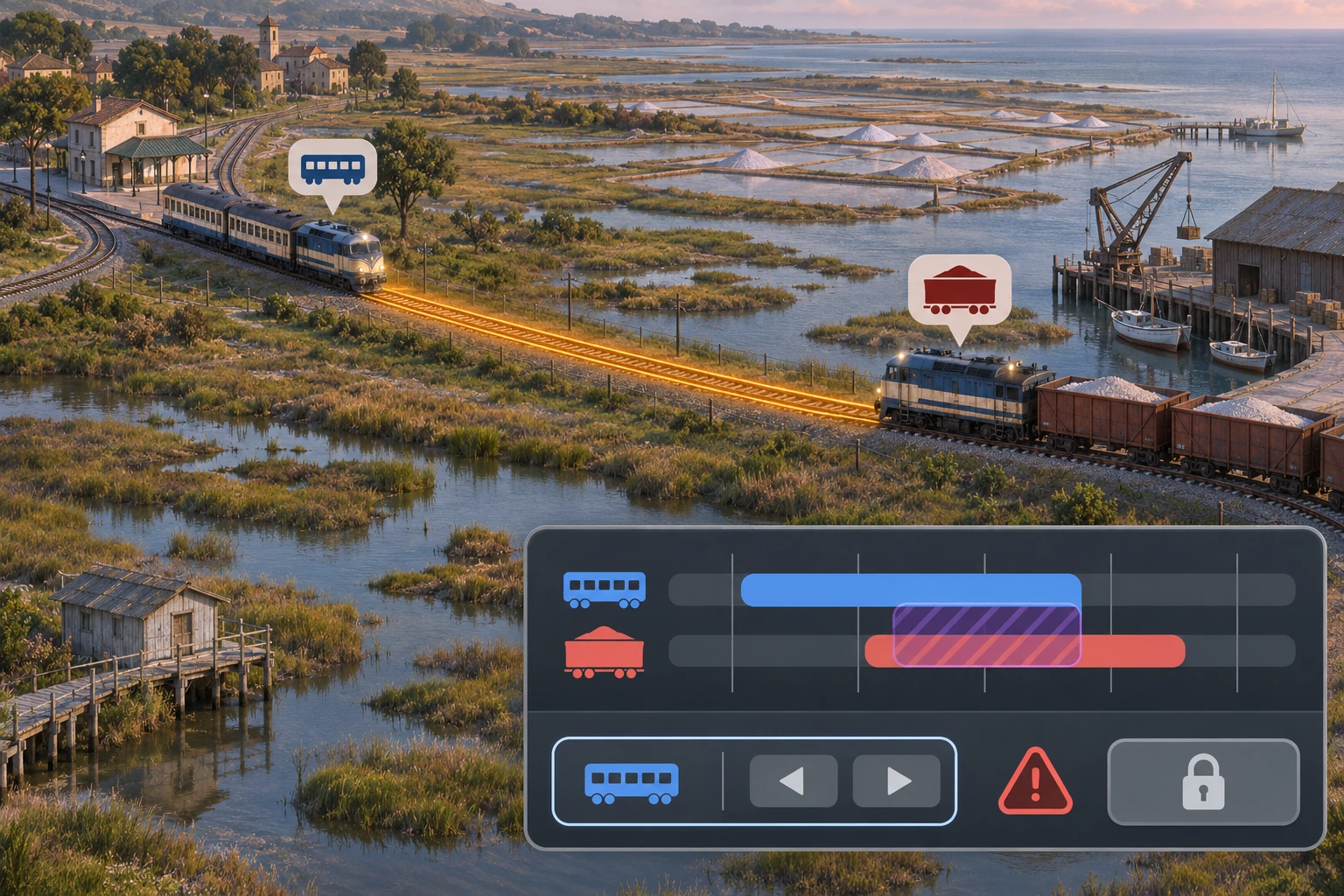
Make the conflict legible before dispatch. A useful board can highlight the shared section on the map and align each service’s reservation bar on one time lane. The player should see that capacity is available on both trains, but the corridor is not available to both at once. This is a scheduling constraint in the invented game model, not a claim about real railway signaling.
Avoid turning an invalid schedule into a simulated crash. The player is making a planning decision before release; the intended feedback is a blocked action and a clear edit path. That keeps the prototype about network capacity and timetable choice.
Paper-check one departure change
Change only the freight departure: move it from 08:03 to 08:05. Leave the route, two-minute travel reservation, six-crate load, passenger time, and 08:10 delivery goal unchanged. The freight then occupies the shared block from 08:05 to 08:07. The passenger reservation ends at 08:04, leaving one clear minute before freight enters the block.
Baseline conflict and one-variable paper revision
| Schedule | Passenger block | Freight block | Check |
|---|---|---|---|
| Baseline | 08:02–08:04 | 08:03–08:05 | Overlap from 08:03 to 08:04; dispatch is blocked |
| Freight moved to 08:05 | 08:02–08:04 | 08:05–08:07 | One clear minute after the passenger run; freight arrives 3 minutes before 08:10 |
This is a hand-calculated design scenario, not a measured iteration. It demonstrates what the player should be able to inspect: one departure changed, one conflict removed, and the same freight deadline still met under the fictional two-minute rule.
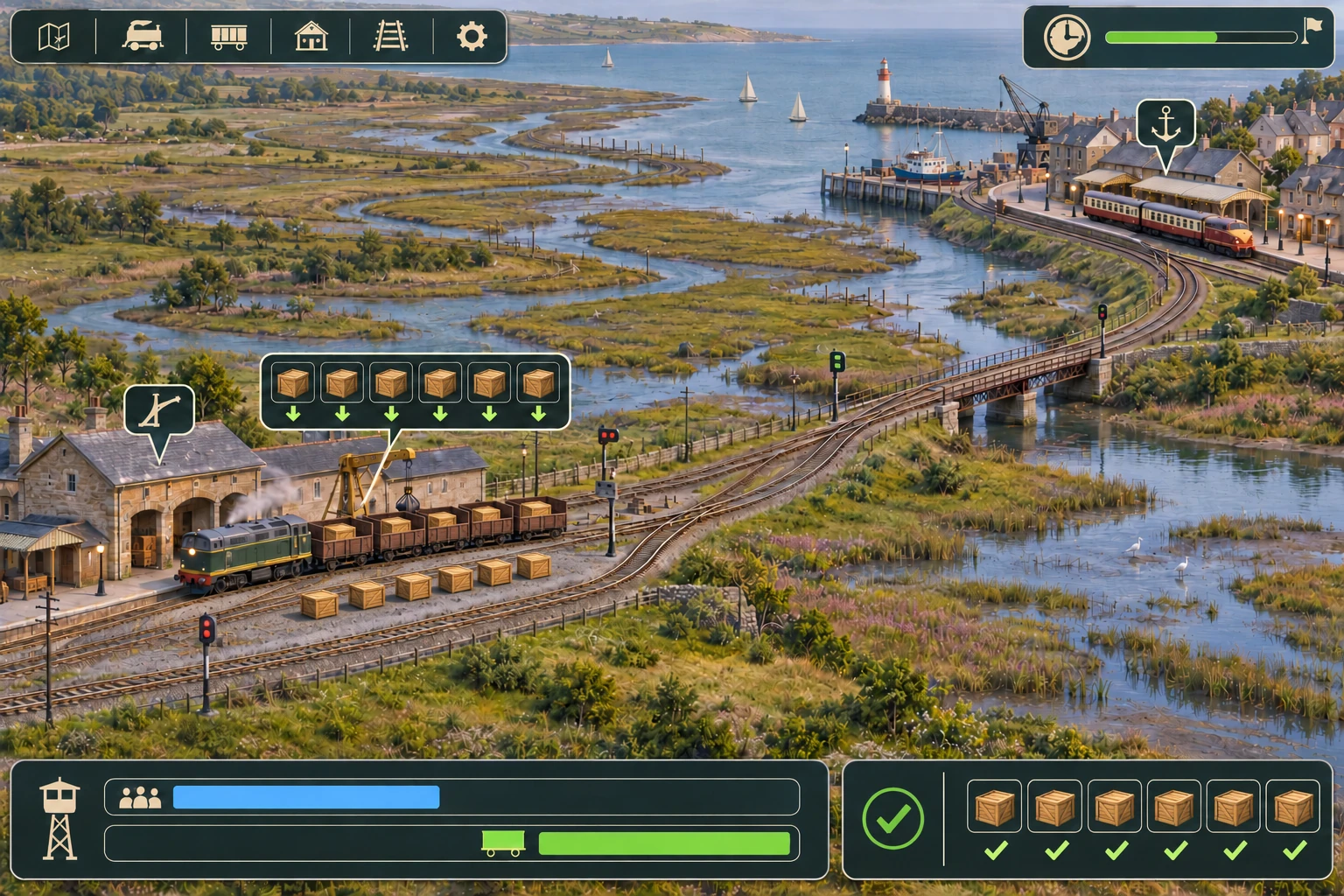
When the game exists, test the same state rather than relying on the picture. Confirm that the baseline reservation is rejected before dispatch, that moving freight to 08:05 produces a non-overlapping 08:05–08:07 window, and that the six crates arrive by 08:10. Also verify that reset restores the original 08:03 conflict.
Review the build and choose the next step
Once the first version is available, inspect each part of the loop separately:
- Does the map show exactly two stations and one shared block?
- Can you tell passenger demand and freight capacity apart?
- Does the board show both reservation windows before dispatch?
- Does any overlap block release and explain which service needs a new slot?
- After one departure change, do capacity, arrival time, and deadline feedback update together?
- Does reset return the original state without keeping the edited schedule?
SEELE’s public Free AI Game Maker page describes a general workflow: express an idea in plain English, review a playable 2D or 3D version in the browser, refine it with follow-up prompts, and check the displayed cost before generating. That supports a way to start and inspect a prototype; it does not promise railway scheduling, conflict detection, or correct timetable arithmetic.
For a first prompt, keep the request small and then look for visible evidence of the rule you care about. If a schedule board shows times but does not prevent an overlapping release, ask for that transition explicitly and test the same state again. A label alone is not proof that the underlying rule works.
Start a railway-management game brief with Free AI game maker
Frequently asked questions
What is a useful first track-capacity rule?
For this fictional prototype, one shared block can be reserved by only one train at a time. That rule makes a timetable conflict easy to see and test before dispatch. It is a game-design assumption, not real signaling guidance; an actual railway needs qualified operating and safety rules.
How should the game show an overlapping reservation?
Show both services on the same time lane, highlight the shared block on the map, mark the overlap clearly, and disable dispatch until a departure changes. The player should be able to identify which two windows conflict and see the revised interval before releasing either train.
Does the 08:05 freight departure prove a real schedule is safe?
No. Junction, Harbor, the block duration, and the deadline are invented. Moving freight to 08:05 only resolves the overlap in this paper example. It is not real timetable data, a railway operating procedure, or evidence that a generated game was tested.
What should a first railway-game prompt include?
Name the stations, route, train capacities, passenger or cargo demand, shared-block reservation rule, deadline, conflict feedback, editable departure, and reset state. Ask for a board that makes those values visible, then inspect whether the game enforces the rules you requested.
What should I test after a first version is built?
Check that the overlapping baseline is blocked, the revised 08:05 freight window can be released, both service capacities are sufficient, the deadline remains visible, and reset restores the original state. These are future checks for the build; they have not been run for the fictional example in this article.
Write a small brief around one route, one capacity decision, and one visible timetable rule. Then inspect the actual state changes before adding more stations or services.