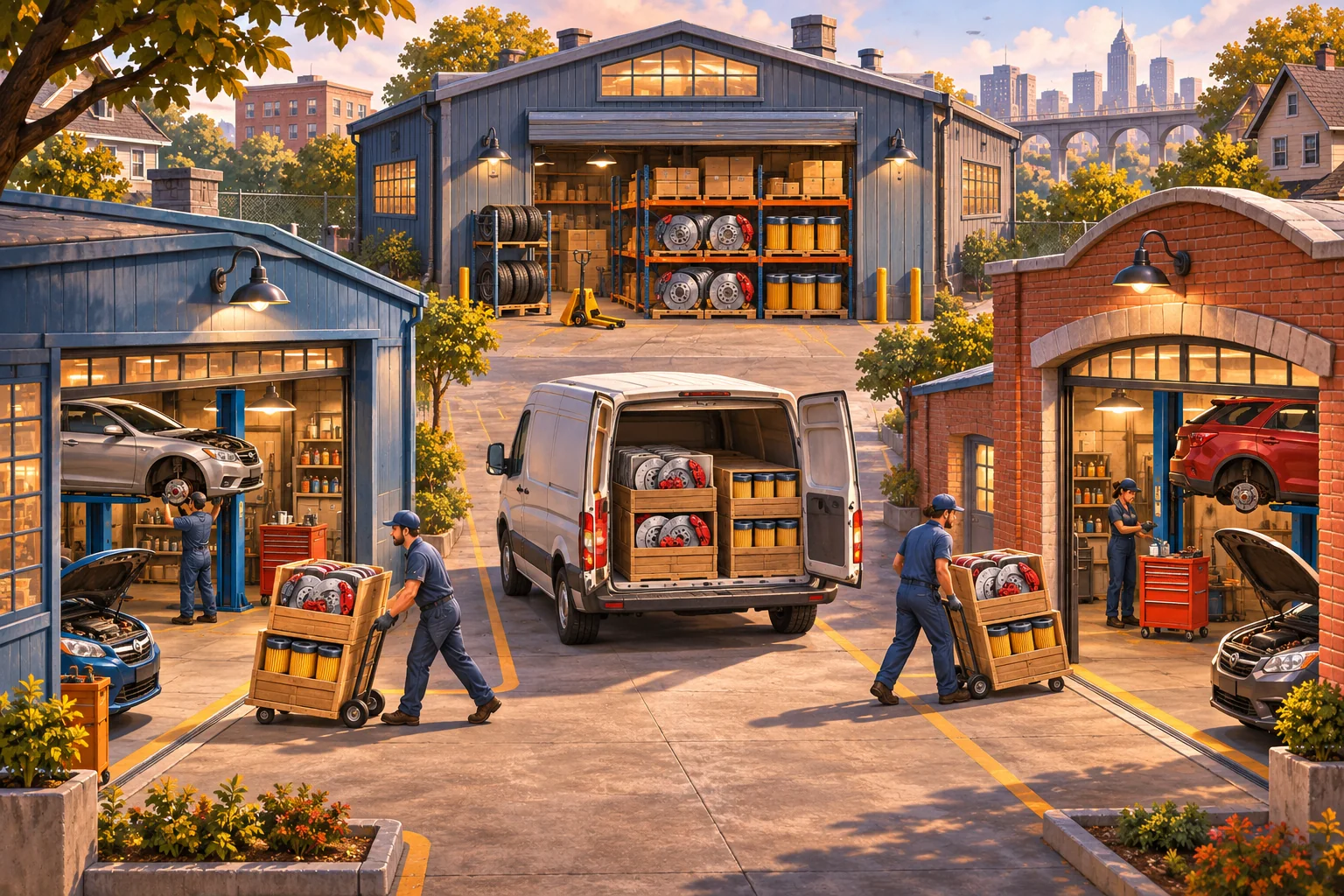
A repair-shop management game can connect independent businesses through one shared supply network. In fictional Northline, three garages order filter kits from the same depot. The player allocates stock and plans a delivery van route; each shop can complete its repair only after enough parts arrive. A decision for one branch affects what the others can receive.
Keep the first logistics puzzle countable. Use a straight road, a fixed amount of depot stock, one van and one repair order per shop. The route replay below compares which two shops receive parts on time. It is a paper simulation of the rules, not a measured business or gameplay result.
Give separate shops one depot and a visible shared stock
Treat each shop as an independent business with its own repair queue and deadline. All three request the same filter kit from one depot. The depot holds eight kits at the start of the morning, while each repair order needs four. Show the stock once in a shared ledger, then show each delivery reducing it so the tradeoff is easy to follow.
Do not silently refill a branch from another. Until a van delivers its four kits, that shop's order remains waiting. This makes the network itself the main mechanic: players decide which businesses get served by the common supply, rather than managing three unrelated inventories.

Make delivery distance a second limit on the network
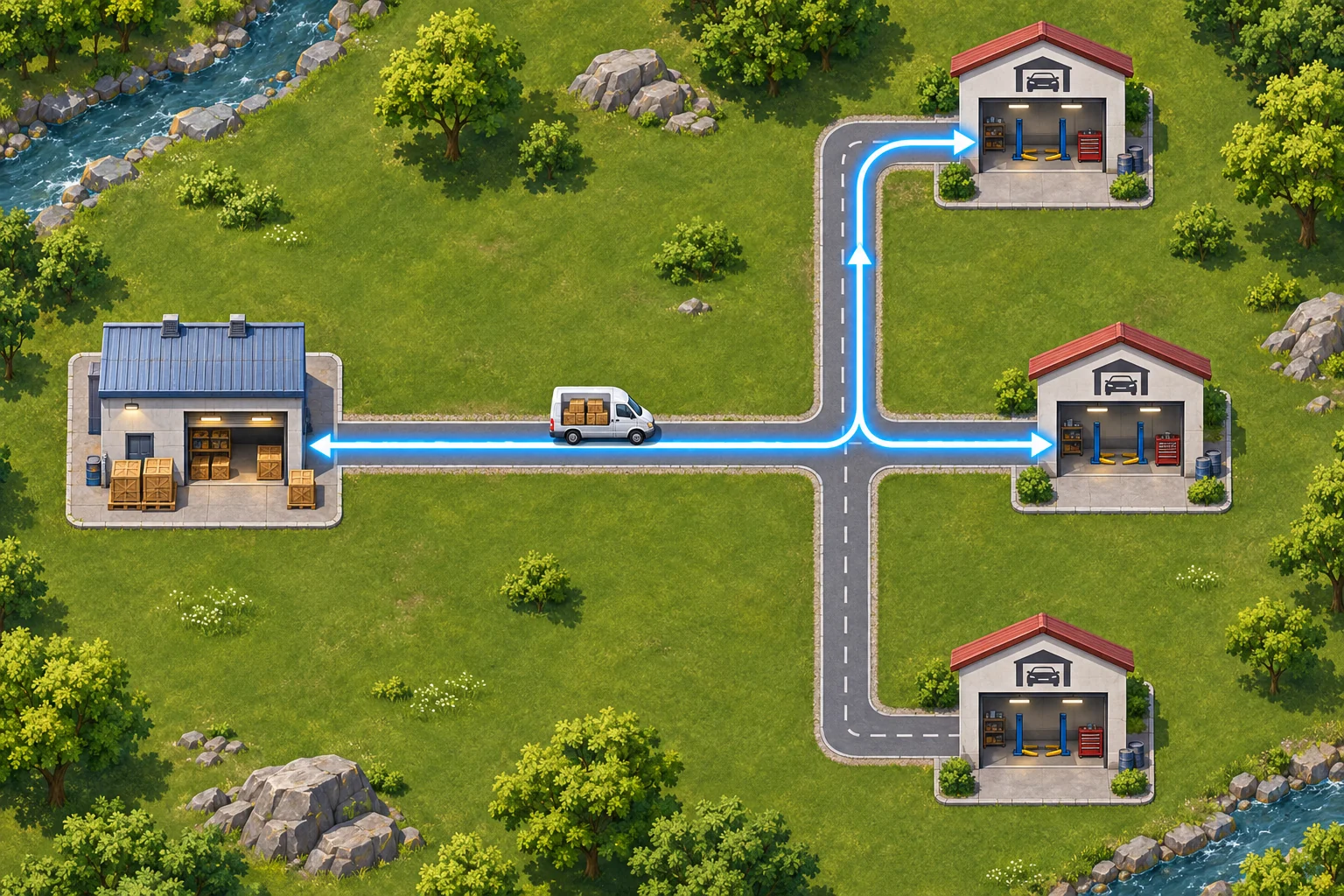
Place the depot at (0,0) and shops A, B and C at (2,0), (4,0) and (6,0). The van starts and ends at the depot, and its daily route budget is eight grid edges. One edge takes one beat. Shop A's order is due by beat 3, B's by beat 5 and C's by beat 7. A delivery is complete when the van reaches a shop with its four-kit allotment.
Display the route, remaining kit count, distance budget and due time together. Keep the road unobstructed in the first prototype. Players can then understand whether a shop missed service because stock was allocated elsewhere or because the van could not cover the route.
Compare delivery plans against stock, distance and deadlines
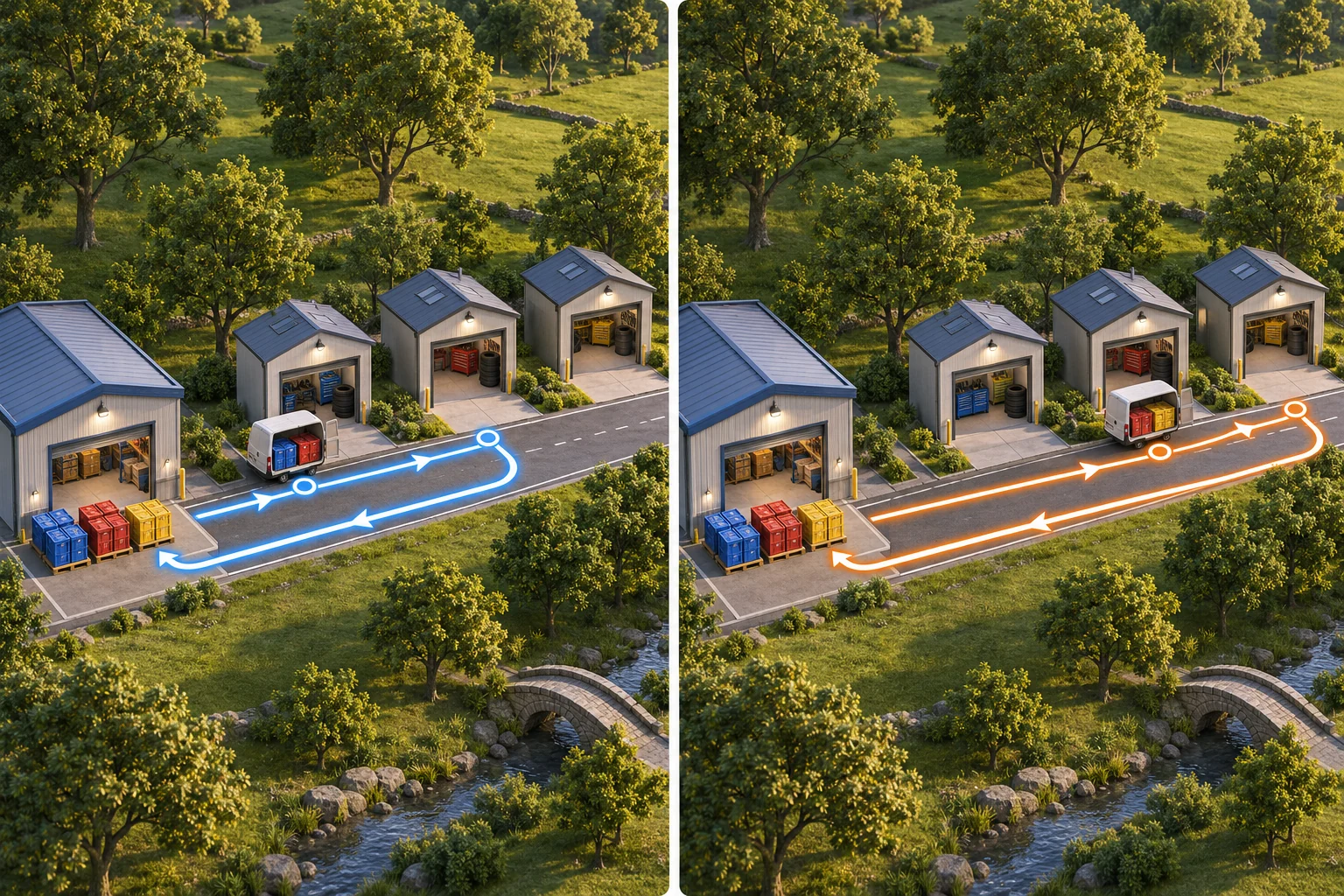
Route from the depot to A, then B, then return: 2 + 2 + 4 = 8 edges. A receives four kits at beat 2, before its beat-3 deadline; B receives four at beat 4, before beat 5. The van uses all eight kits and serves two orders. Alternatively, B then C uses 4 + 2 + 2 = 8 edges. They receive parts at beats 4 and 6, meeting deadlines 5 and 7.
A route that reaches both A and C without stopping at B is 2 + 4 + 6 = 12 edges, beyond the van's budget. Stock also cannot cover all three orders: 3 × 4 = 12 kits, but the depot has 8. These paper calculations show two separate limits. They do not report measured delivery performance.
Prototype allocation before adding variable suppliers
Build the depot ledger, three shop queues, van token, route budget, deadlines and a resettable morning. Let players allocate the shared kits and trace the route. Make the cause of an unserved order explicit: stock was used by another shop, the van budget ran out, or a deadline passed.
Once the tradeoff is clear, add one variable at a time, such as a delayed supplier, a blocked road or a shop that needs a different part mix. Preserve the shared ledger and route preview so each expansion deepens the logistics decision instead of hiding it.
Create Northline, a repair-shop simulator where three independent garages share one parts depot and delivery van. Depot (0,0) starts with 8 filter kits; shops A (2,0), B (4,0), C (6,0) each have one order requiring 4 kits. Van route budget is 8 grid edges per morning, returning to depot; one edge is one beat. Deadlines are A beat 3, B beat 5, C beat 7. Show allocation, delivery route, remaining stock, route distance and due times. Replay depot→A→B→depot (2+2+4=8): deliveries at beats 2 and 4 meet deadlines. Replay depot→B→C→depot (4+2+2=8): deliveries at beats 4 and 6 meet deadlines. A→C without B costs 12 edges, and all three orders need 12 kits. Make this a resettable paper-rule prototype; do not claim measured outcomes.
SEELE's official page describes a general workflow: generate a playable first version from a prompt, test it in a browser and refine it with follow-up prompts. Use it to inspect whether players can understand stock allocation and the delivery route; Northline and its logistics rules are fictional design guidance.
Prototype the shared supply network in SEELE
Frequently asked questions
How can several repair shops share one supply network in a game?
Give the shops separate work queues but connect them to one depot ledger and delivery route. Stock sent to one location is no longer available to another. Show delivery timing and remaining stock so players can see how one allocation changes the other businesses.
What should a shared-depot simulator show?
Display depot inventory, each shop's demand, van capacity or route budget, delivery destinations and order deadlines. Keep units consistent and make it clear when a local repair can begin. Start with fixed stock and routes before adding supplier delays or traffic.
How do I test whether logistics rules are understandable?
Replay a fixed set of orders with a stated stock total and route budget. Calculate deliveries and arrival beats for each plan, then identify which orders miss and why. A paper calculation checks consistency, not measured business performance. Also compare a route that uses its full budget with one that returns early, so unused stock and travel costs are visible.