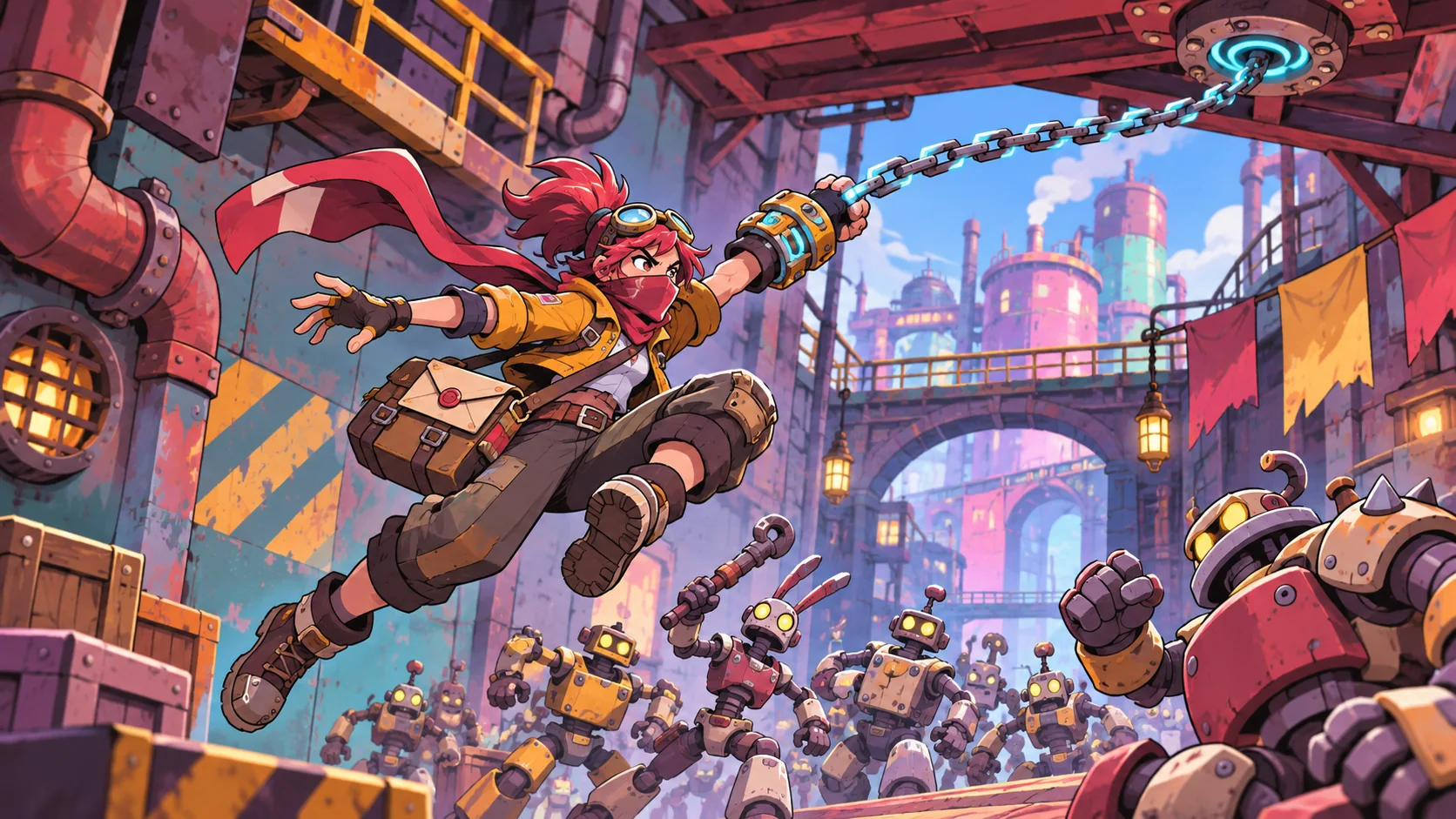
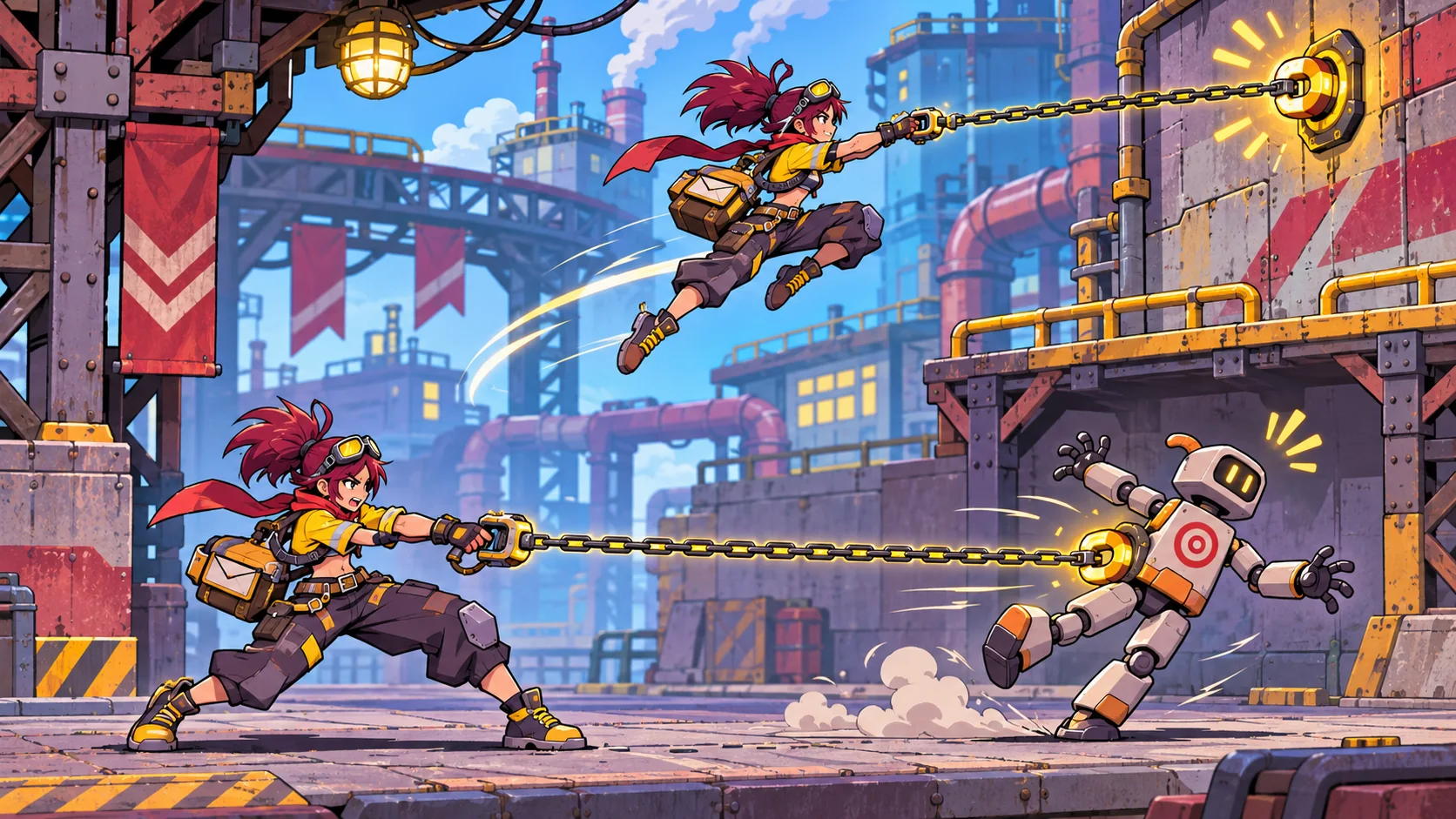
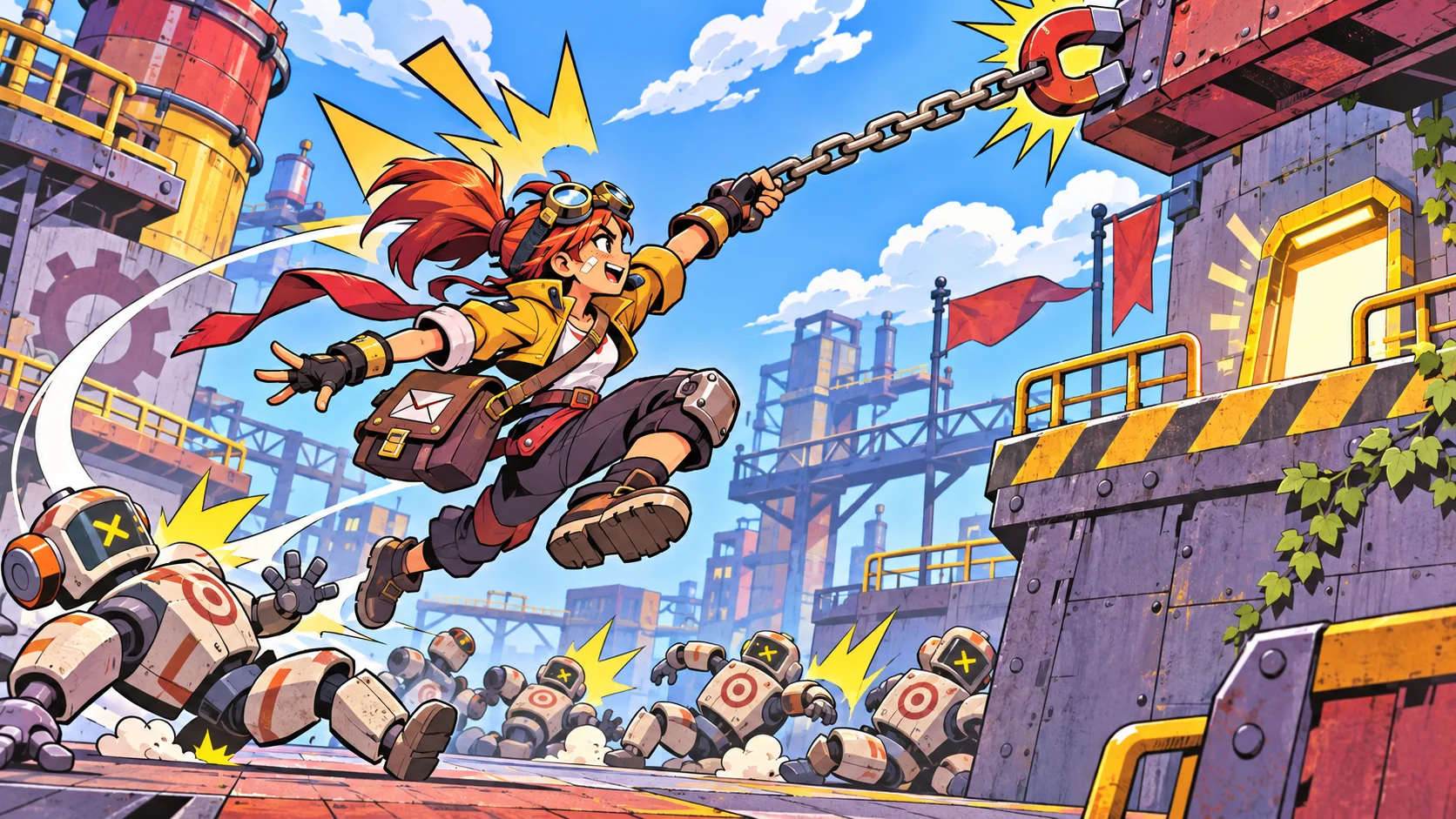
Rivet Runner’s magnetic chain is both a weapon and a way through the stage. The courier can pull a nearby light bot into a brief stagger, or attach the same chain to a wall anchor and zip over a floor gap. Both actions spend the same two-charge battery, so a charge used to control a crowd is unavailable for traversal until the hero reaches a recharge pad.
Each encounter has two bots and a raised exit gate. Basic strikes disable enemies, while the chain creates a short opening or carries the hero across a hazard. The player can fight with careful timing, save charge for movement, or take a slower ground route. The shared resource makes the level layout and crowd decisions part of one brawler loop.
Make the chain both a weapon and a route
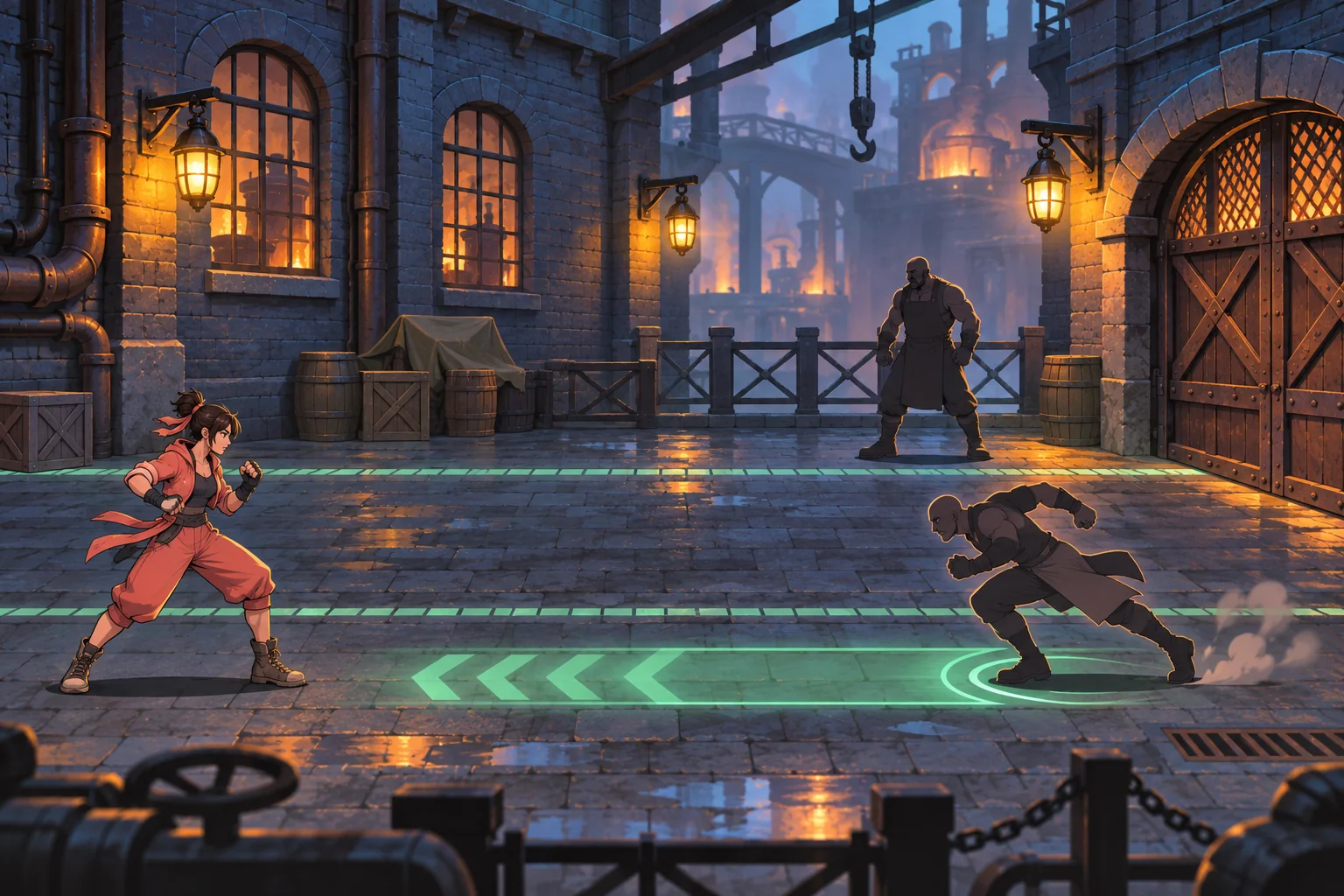
Build Rivet Runner as a side-scrolling brawler with two depth lanes, a horizontal camera and three short stages. The courier has 4 health and a magnetic chain battery with maximum 2 charges. At the start of each stage, the battery is full. Basic Strike has range 1.5 units and deals 1 damage. Each light bot has 2 health; when its health reaches 0, it is disabled and removed from the encounter. Chain Pull costs 1 charge, targets one light bot in the hero’s lane within 6 units, pulls it to 2 units away and stuns it for 2 seconds; it deals no damage. Anchor Zip costs 1 charge and attaches to a marked anchor within 8 units, moving the hero across the marked gap to the anchor’s landing tile. A chain action cannot target a bot and an anchor in the same activation. A battery pad restores 1 charge after the hero stands in its zone for 2 seconds, up to the maximum. Each stage has two light bots, one anchor gap and one battery pad before the gap. A stage exit opens after both bots are disabled; if the hero does not want to use Anchor Zip, a lower ground route crosses the gap in 5 seconds but passes the second bot’s approach lane. Take one damage from a bot hit; at 0 health the stage restarts and restores the stage-start battery. Clear stage three to win. Show health, charge, target range, stun timer, enemy health, lane and open route. Chain Pull never instantly disables a bot, and Anchor Zip never damages an enemy. The charge is shared; there are no separate weapon and grapple meters.
| System | Prototype rule |
|---|---|
| Player | 4 health; 2 depth lanes; horizontal movement through 3 stages. |
| Chain battery | Maximum 2 charges; starts full each stage; both Chain Pull and Anchor Zip cost 1. |
| Basic Strike | Range 1.5 units; deals 1 damage; bots have 2 health. |
| Chain Pull | Same lane, target within 6 units; costs 1 charge; pulls bot to 2 units away and stuns 2 seconds; no damage. |
| Anchor Zip | Anchor within 8 units; costs 1 charge; moves hero to the marked landing tile across a gap; no damage. |
| Battery pad | Stand in the pad zone for 2 seconds to restore 1 charge, up to 2. |
| Stage encounter | 2 light bots, 1 anchor gap, 1 battery pad before gap; exit opens when both bots are disabled. |
| Alternate route | Lower route crosses in 5 seconds and passes the second bot's approach lane. |
| Failure and win | Bot hit removes 1 health; at 0 restart stage with full stage-start battery. Clear stage 3 to win. |
| Targeting | One chain activation selects either one bot or one anchor, never both. |
Define combat, charge and anchor rules
Stage 1 begins with 2 charges, 4 health and two bots. Bot A is in the same lane at distance 5. The courier spends one charge on Chain Pull; A is pulled to distance 2 and stunned for 2 seconds, but retains both health points. Two Basic Strikes disable A. The courier now has 1 charge and approaches the anchor gap. Anchor Zip spends the final charge and carries the hero to the far landing tile. Bot B approaches from the lower route; the courier uses two Basic Strikes to disable it. The exit opens because both bots are disabled. The battery pad is before the anchor gap, so in a later run the courier could pause there for 2 seconds to restore one charge before choosing between a pull and a zip. The ground route remains available but passes the second bot’s lane. This trace shows that Chain Pull controls a threat without replacing combat, and the same charge is needed for traversal. It is authored rule arithmetic, not a playable or user test.
| Event | Expected state |
|---|---|
| Stage start | Health 4, battery 2/2; bots A and B each have 2 health. |
| Chain Pull on A | Spend 1 charge; A moves to 2 units and is stunned 2 seconds; health remains 2. |
| Two Basic Strikes on A | A reaches 0 health and is disabled; battery remains 1/2. |
| Anchor Zip across gap | Spend final charge; hero moves to marked far landing tile. |
| Two Basic Strikes on B | B is disabled; both bots are cleared and exit opens. |
| Battery pad option | Stand still for 2 seconds to restore 1 charge; cannot exceed 2. |
| Ground route option | Cross in 5 seconds without charge, but pass through B's approach lane. |
Trace one encounter across a gap
Tell the generator that Chain Pull and Anchor Zip share one charge pool. Define what each action changes, what it does not change, and how the player can recover a charge before the next layout decision.
Create a side-scrolling brawler called Rivet Runner with two depth lanes and three stages. The courier has 4 health and a magnetic chain battery capped at 2 charges, full at each stage start. Basic Strike has 1.5-unit range and deals 1 damage. Each light bot has 2 health. Chain Pull costs 1 charge, targets one bot in the same lane within 6 units, pulls it to 2 units away and stuns it for 2 seconds without dealing damage. Anchor Zip costs 1 charge and moves the hero to a marked landing tile from an anchor within 8 units; it crosses a gap and deals no damage. Both actions use the same battery, and one activation cannot target both a bot and anchor. Each stage contains two bots, one anchor gap and a battery pad before the gap. Stand in the pad for 2 seconds to restore one charge up to 2. The exit opens after both bots are disabled. The lower ground route crosses the gap in 5 seconds but passes the second bot's approach lane. A bot hit removes 1 health; at zero health restart the stage and restore 2/2 battery. Clear stage three to win. Show health, battery, target range, stun timer, bot health, lane and exit state. Do not create a separate grapple meter or let Chain Pull instantly defeat a bot. This is a design specification, not a playable test claim.Prompt AI for the brawler prototype
An early draft gave the chain a separate grapple meter and combat meter. That removed the intended choice, so the final rule uses one two-charge battery for both actions. Spending a charge on a bot leaves less for the anchor gap unless the hero reaches a pad.
The pull action also risked becoming a one-button defeat. The revised rule only moves and stuns a light bot; two Basic Strikes are still needed to disable it. Anchor Zip only changes position and never damages enemies, keeping combat and traversal effects readable.
Revise a resource timing rule
Prototype one stage with a bot, a wall anchor, a battery pad and the slower ground route. Check charge use, stun duration, basic damage and stage-gate conditions before adding later rooms. The numbers here are authored design inputs and not observed game balance or playtest results.
Read the related brawler crowd-flow guide.
Try the SEELE AI game maker workflow.
Frequently asked questions
How can the chain be both a weapon and movement tool?
Chain Pull spends one charge to pull and stun a nearby bot; Anchor Zip spends one charge to move across a gap. They share the same battery, so choosing one changes which option remains available. This gives the level designer a shared resource choice instead of two unrelated special moves.
Does Chain Pull defeat an enemy by itself?
No. It pulls a light bot into range and stuns it for two seconds but causes no damage. The hero still needs two Basic Strikes to disable a bot with two health. The short stun creates a safe window for follow-up without replacing the rest of the combat system.
Check Godot's official CharacterBody2D reference.
Can I cross a gap without using Anchor Zip?
Yes. The lower ground route remains open and takes five seconds, but it passes the second bot's approach lane. The player can reserve charge for combat or accept the longer, riskier route. The choice depends on health, crowd position and whether a charge is still available for the anchor.
Has Rivet Runner been tested as a playable game?
No. The stage layout, chain range, battery, enemy health and action trace are authored design inputs. This package does not claim a playable build, browser check, user test or measured balance result; those require implementation and review. The shared battery, enemy timing and alternate route still need implementation and real playtesting before balance can be judged.