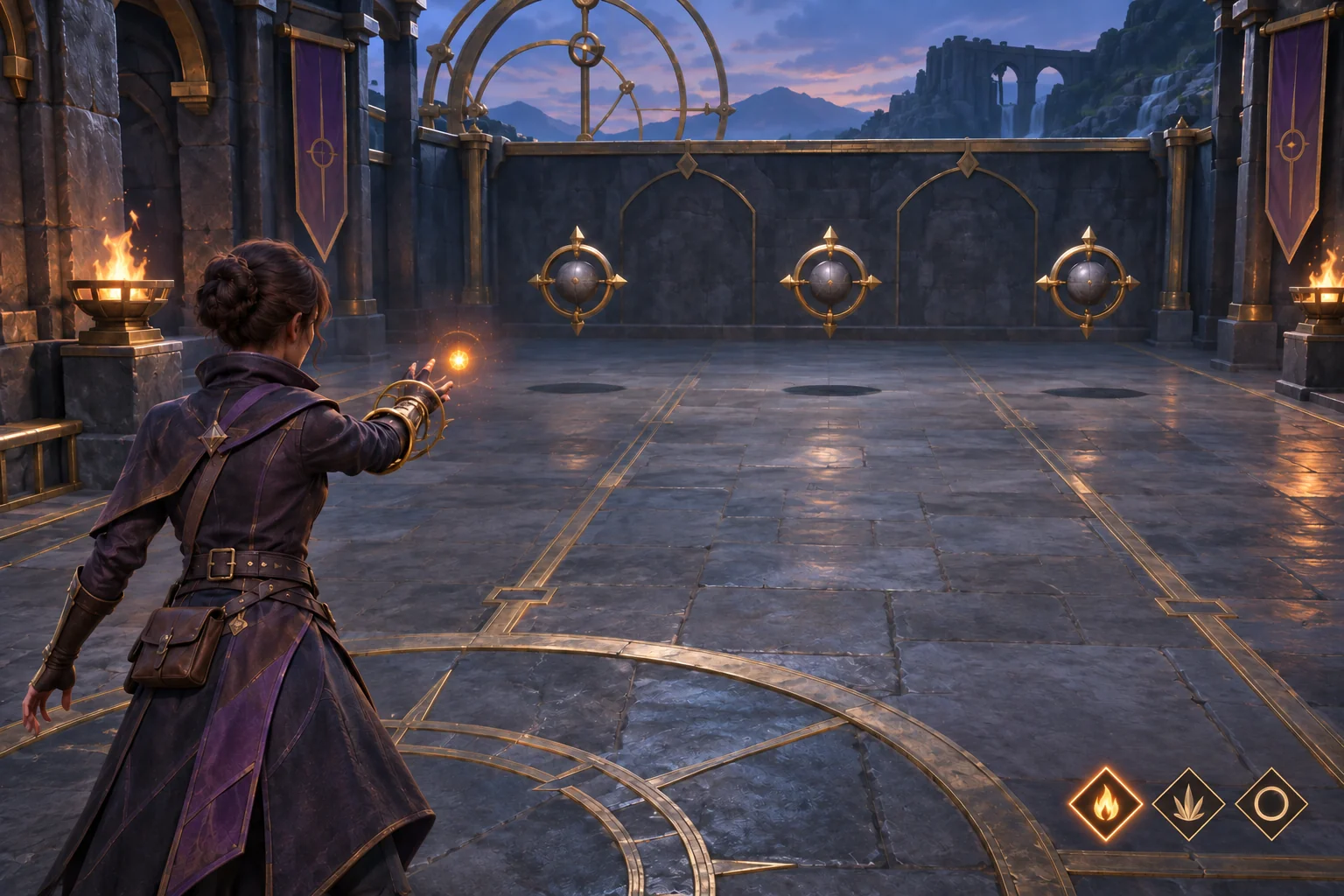
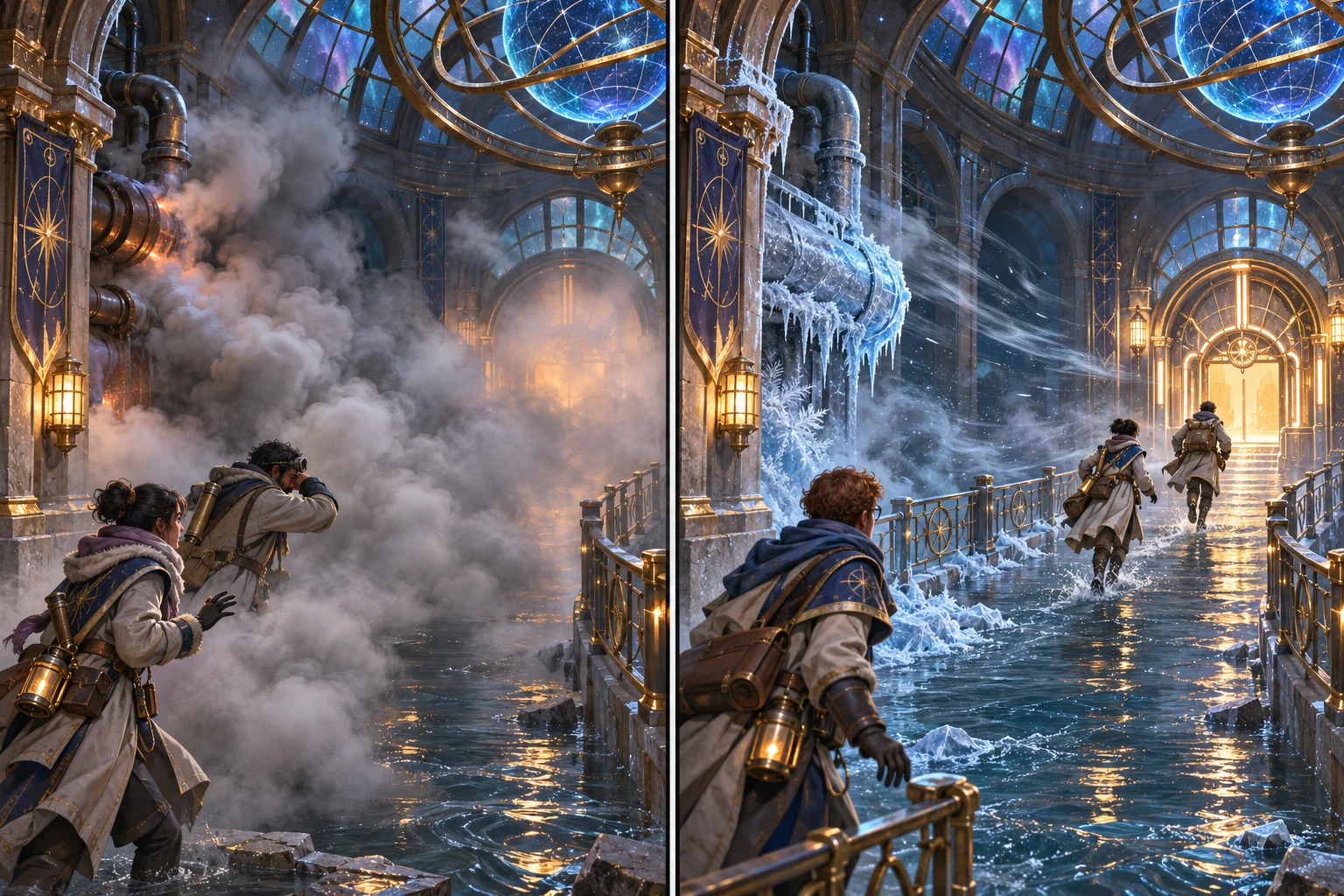
A spellcasting shooter does not need to measure success by enemies defeated. In the fictional game Lantern Wake, the player aims spells into a flooded observatory to open a safe path for stranded researchers. Frost seals a steam vent for two turns; Gust pushes smoke aside. Cast Gust through frost residue and it creates a calm lane that survivors can cross.
Give the player a limited mana budget and a rescue counter instead of a kill tally. The challenge is to aim spells at hazards and combine their effects before the exit window closes. Replay the same corridor with and without the Frost–Gust sequence, then compare how many people reach extraction and how much mana remains.
Make rescue progress the score the player can read
Build a short 3×5 corridor with three stranded researchers, a steam vent, a smoke bank and an extraction gate. The player wins by guiding two researchers through the gate within four turns. A person outside the gate at the deadline is not counted. Do not add a kill counter; show rescued, waiting and endangered states instead.
Give the caster 4 mana for the corridor. Each spell shot costs 1, and only three spells are available at first: Frost seals a vent for two turns, Gust shifts a smoke bank one tile, and Beacon calls nearby survivors to move one safe tile toward extraction. Aim at a hazard or marked surface, not an enemy health bar.

Let spell order create a safe path through hazards
Frost and Gust should interact when the second spell crosses the tile frozen by the first. The Gust turns frost residue into a calm lane that protects anyone crossing that tile during the next movement step. The combo costs 2 mana total, lasts one rescue step and does not clear the whole corridor permanently. Show the order, target tiles and duration before casting.
Beacon calls nearby researchers to move one safe tile toward extraction. In the test setup, two researchers wait one tile from the gate while the third is farther back. If smoke still covers their next tile or the vent is active, they wait instead of entering the hazard. This gives the player a readable sequence: seal the vent, redirect smoke through the frozen tile, then call the nearby pair across the protected lane.

Compare the same rescue corridor with and without the combo
Reset the corridor with three researchers, four turns and 4 mana. Two researchers start one safe tile from the gate; the third begins farther back. Without Frost and Gust, the active vent and smoke block their next step. Casting Beacon alone moves no one through the hazard, so the rescue count remains zero at the deadline. Record that as the baseline rather than treating a spell animation as progress.
Replay with the same layout. Cast Frost at the vent, then Gust through its frozen tile to make a calm lane, and use Beacon to call the researchers. The protection lasts for the next movement step; two people reach the gate by turn four while the third remains behind. The caster spends 3 of 4 mana. This is a paper-simulated example, not a built-game measurement. Track rescued count, turns, mana spent and hazard exposure. If the combo is always mandatory, add another safe route or make one hazard timing variable.
Prototype spell targeting and rescue state before adding combat
Build spell aiming, tile effects, hazard timing, survivor movement and gate checks before adding hostile creatures. Add a resettable four-turn corridor with the same vent cycle on every run. Once players understand how spells make a safe route, expand the spellbook or add optional combat that does not replace the rescue objective.
Create a compact spellcasting shooter called Lantern Wake. Show a 3×5 flooded observatory corridor with three stranded researchers, one steam vent, a smoke bank and an extraction gate. The player has 4 mana and four turns; win by guiding two people through the gate, with no kill counter. The caster aims spell projectiles at hazards or marked surfaces. Frost seals the vent for two turns. Gust shifts smoke one tile; if it crosses frost residue, it creates a calm lane that protects anyone crossing that tile during the next movement step. Beacon calls nearby survivors to move one safe tile toward extraction. Survivors wait if the route is hazardous. Show spell cost, target tiles, combo order, rescued/waiting/endangered states and turns remaining. Add a resettable comparison with Beacon alone versus Frost, Gust and Beacon. Track rescues, mana, turns and hazard exposure.
SEELE's official AI Game Maker page describes creating a playable first version from a prompt, testing it in a browser and refining it with follow-up prompts. Use that general workflow to inspect spell aiming, hazard states and rescue tracking; Lantern Wake and its rules are fictional design guidance.
Build the rescue-focused spellcasting shooter in SEELE
Frequently asked questions
How can a spellcasting shooter use rescue instead of a kill counter?
Make the player aim spells at hazards, routes or rescue signals, then count people who reach extraction. Show waiting, endangered and rescued states so progress is visible without enemy defeats. Give the mission a clear deadline and a minimum number of survivors to recover.
How do spell combinations support a rescue objective?
Let one spell change the surface or hazard that another spell interacts with. Frost can seal a vent, then Gust can redirect smoke through the frozen tile to create a protected step. Show mana cost, order and duration so players can plan the safe route.
What should I measure in a first spell-rescue test?
Replay the same corridor and record rescued count, turns, mana spent and hazard exposure. Compare a single spell with a planned combination. If the combo is always required or never useful, adjust the hazard timing, route length or spell duration.