A terraforming game needs more than a dramatic planet view. Give the player a zone with conditions to change, a limited budget, and a clear check that says whether the zone meets its target. In this original paper example, a dry basin starts below its heat, moisture, and atmosphere bands. The player chooses which stations to run, watches the meters update, and decides whether to wait another phase or increase the next phase’s energy budget. The names, meter values, costs, thresholds, and outcomes below are invented game rules. No prompt has been run and no playable build or environmental simulation is being presented. The useful result is a compact design contract: state what changes, what it costs, when the game checks success, and what the player sees afterward.
Start with a zone the player can change
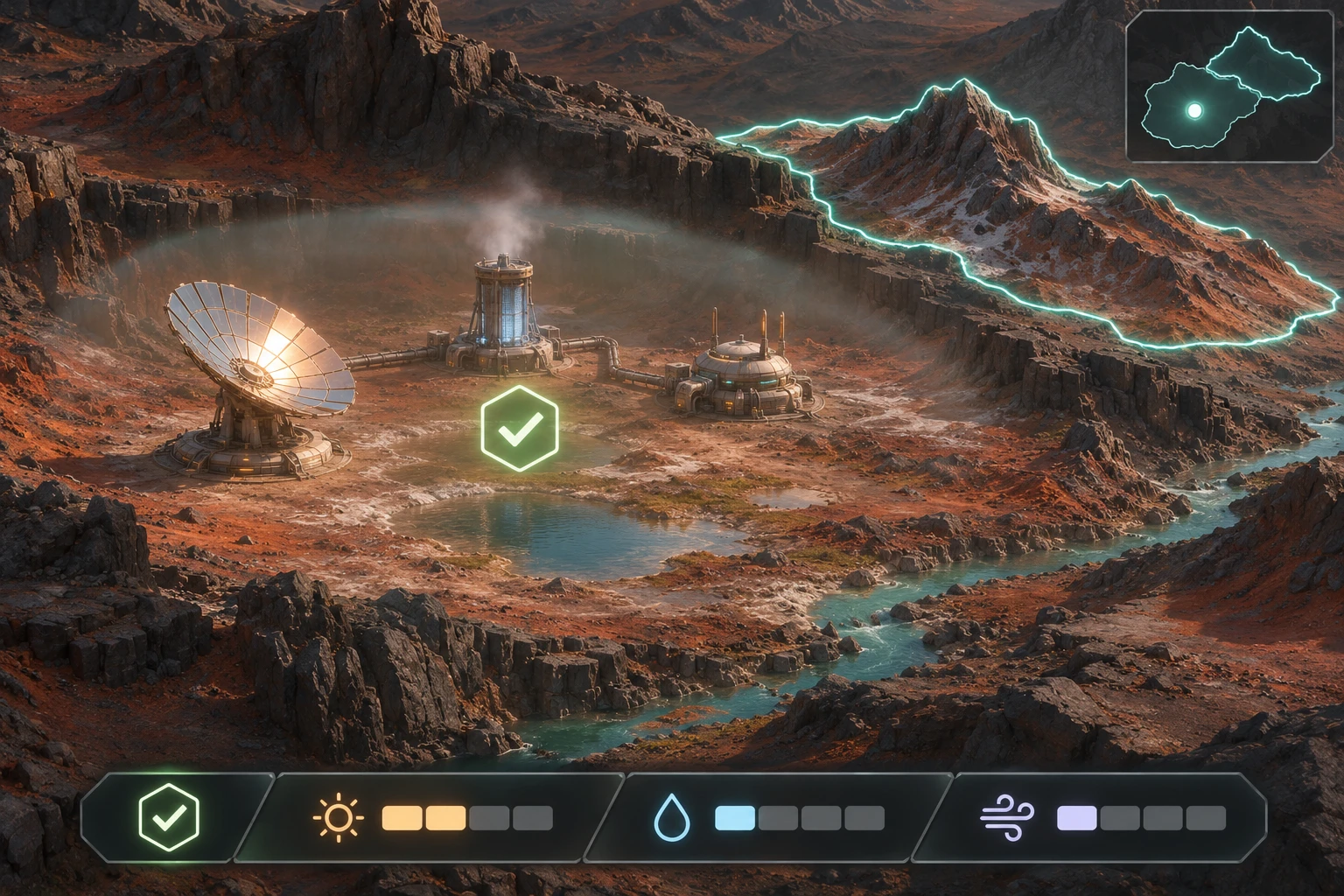
Call the fictional planet Cinder Reach and start in one target zone, Cinder Basin. Beyond it sits Cinder Ridge, which stays unavailable until the basin reaches its authored stability band. This gives the player a reason to act: each phase is a short allocation puzzle, and a successful check opens a next destination.
The core loop is survey a zone → allocate power → resolve environmental meters → check stability → reroute or expand. Each step answers a different question. What needs changing? Which station can change it? Can the phase budget cover the plan? Did the resolved values reach every threshold? What becomes possible next? A small loop like this is easier to describe and review than a broad request to “terraform a planet.”
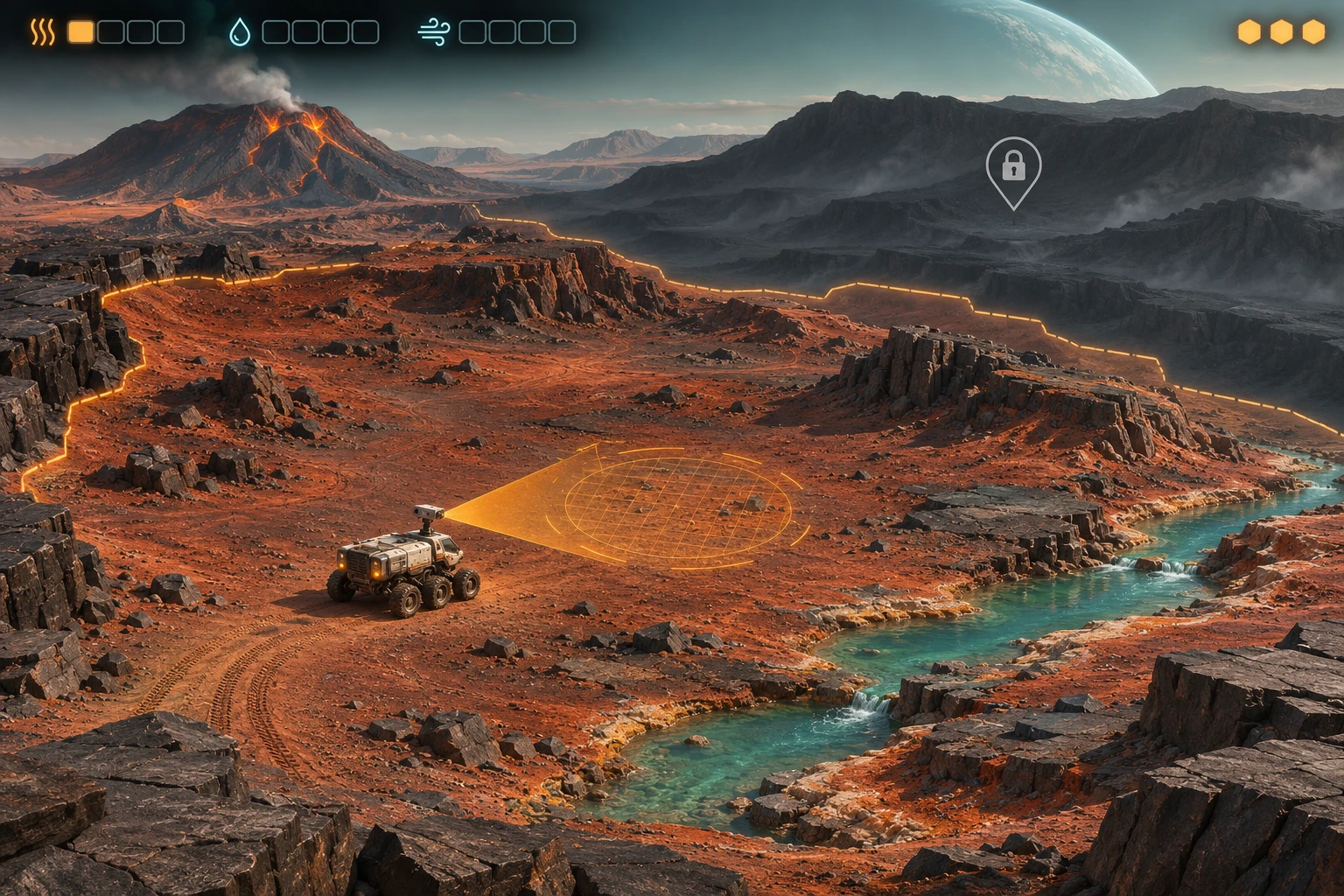
This is an invented management-game setup, not a model of real planetary conditions. The meters are abstract interface values; “stable” only means that the rules below have passed their own target check. Keeping that boundary clear lets you use concrete numbers without confusing a game mechanic with environmental science.
Set the world state before adding systems
Write the initial state and the success band first. Each condition meter uses a fictional scale from zero to four. The first basin starts with heat at one and the other conditions at zero. Its check requires heat of at least two, moisture of at least one, and atmosphere of at least one. No meter drifts on its own in this first zone.
| Game meter | Basin at start | Pass threshold | Readable feedback |
|---|---|---|---|
| Heat | 1 of 4 | At least 2 | Amber pips |
| Moisture | 0 of 4 | At least 1 | Blue pips |
| Atmosphere | 0 of 4 | At least 1 | Pale-cyan pips |
| Phase energy | 3 units | Enough to pay each chosen station | Energy icons reset at the next phase |
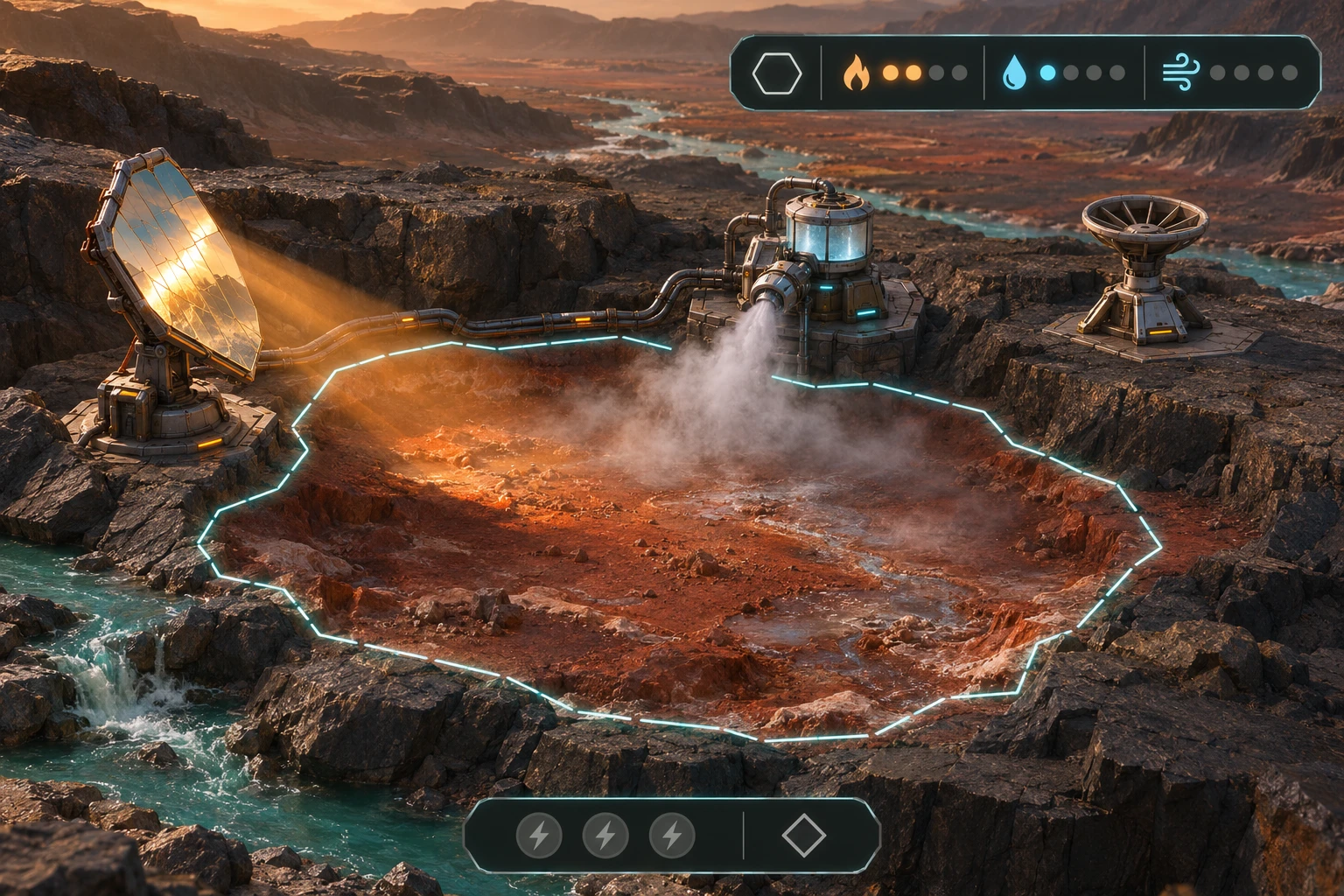
Use three stations with non-overlapping effects. Each can run once per phase, energy resets at the next phase with no carryover, and all commands resolve before the stability check.
| Station | Energy cost | Effect on the selected zone |
|---|---|---|
| Solar Mirror | 1 | Adds 1 heat |
| Mist Condenser | 2 | Adds 1 moisture |
| Air Seeder | 1 | Adds 1 atmosphere |
After the first two stations operate in the paper model, heat is 2/4, moisture is 1/4, and atmosphere remains 0/4. All three units of phase energy are spent, so the Air Seeder is still idle. The phase-end check fails because the atmosphere target is short by one. These values come from the written rules and arithmetic, not from verified gameplay or image evidence.
Ask for one playable planet loop
A useful first prompt names the zone, the player's choices, the budget, the order of resolution, and the feedback that lets someone judge the result. It should also say what to leave out. The following is a design prompt for a future build; it has not been submitted to a generator.
Create one original real-time 3D isometric planet-management room for a fictional game called Cinder Reach. Show one dry zone named Cinder Basin and a neighboring destination named Cinder Ridge that stays locked until the Basin passes its authored stability check. Treat all environment values as fictional game meters, not planetary science.

Start Cinder Basin at heat 1/4, moisture 0/4, and atmosphere 0/4. The target is heat at least 2, moisture at least 1, and atmosphere at least 1. Give the player 3 energy at the start of each phase; unused energy does not carry over. During a phase, let the player operate each selected-zone station at most once. Solar Mirror costs 1 and adds 1 heat. Mist Condenser costs 2 and adds 1 moisture. Air Seeder costs 1 and adds 1 atmosphere. Values are capped at 4. Resolve station effects before checking stability, with no passive meter drift.

Show current meter values and remaining energy with clear icon-only feedback. When the phase ends, show either which target remains unmet or a stable state; unlock Cinder Ridge only after the Basin passes all three thresholds. Include a full reset to the starting values and locked destination. Keep the first room focused on zone state, station choice, energy deduction, phase resolution, and unlock feedback. Do not add real-world habitability claims, farming, crafting, combat, multiplayer, or unrelated resource systems.

Return a short control list and the ordered state transitions. Include an acceptance checklist: at budget 3, Solar Mirror plus Mist Condenser costs exactly 3 and leaves atmosphere below target; a following phase can use Air Seeder to pass; reset restores (1,0,0), 3 energy, and locked Ridge. If a rule is ambiguous or behaves differently, report it and suggest one correction instead of silently claiming that the expected result occurred.
This prompt makes the expected behavior observable, but it cannot guarantee a particular implementation. A useful response would give the creator a playable first room to inspect, not proof that every authored rule has been implemented. The next step is to check the actual state transitions against the written contract.
Follow the three-energy baseline
At the starting budget of three, the player can choose Mirror plus Mist for a total cost of 1 + 2 = 3. Because there is no passive drift and actions resolve before the check, the resulting state is heat 2, moisture 1, atmosphere 0. The first two requirements pass; atmosphere misses its minimum by one. Cinder Basin stays unstable and Cinder Ridge stays locked.
| Phase | Actions | Energy used | Basin after resolution | Check |
|---|---|---|---|---|
| 1 | Solar Mirror + Mist Condenser | 1 + 2 = 3 of 3 | (heat 2, moisture 1, atmosphere 0) | Not stable; atmosphere is short by 1 |
| 2 | Air Seeder | 1 of the reset 3 | (heat 2, moisture 1, atmosphere 1) | Stable; Ridge unlocks |
The second phase begins with a fresh three-energy budget, but only one station needs to run. The unused two energy do not carry into another phase. Stating this rule prevents the reader from making an accidental assumption about saved power. The check happens only after all chosen actions resolve, so the zone does not unlock halfway through a phase.
Change only energy output
Now make one controlled revision: raise the phase budget from three to four. Keep the initial state, thresholds, station costs, one-use rule, effect size, phase order, and no-drift rule fixed. The player can now run all three stations in one phase: Solar Mirror (1) + Mist Condenser (2) + Air Seeder (1) = 4 energy. The basin resolves to (2,1,1), reaches all three targets, and passes the phase-end check.
That changes the paper schedule from two phases to one. It is a consequence of the authored numbers, not evidence that the revision feels better, that the generated game will follow the rules, or that players prefer faster progress. To evaluate those questions, a future playable build would need actual observations.
| Paper pass | Only changed input | Station plan | Authored result |
|---|---|---|---|
| Baseline | None; budget is 3 | Mirror + Mist in phase 1; Air Seeder in phase 2 | Target reached after two phase checks |
| Revision | Budget 3 → 4 | Mirror + Mist + Air Seeder in phase 1 | Same target reached after one phase check |
The one-variable comparison is useful because it isolates capacity. If you also changed the thresholds, action costs, effects, or unlock timing, you would not know which adjustment produced the new schedule. Here the arithmetic is easy to audit: four units are needed to run every station once, and the revised budget supplies exactly four.
Turn the paper contract into future checks
The paper trace is not a build test. When a playable version exists, use a small run sheet to record what happened rather than filling gaps with assumptions. Start with a reset at (1,0,0) and budget three. Run Mirror and Mist once, verify their individual meter changes and total energy deduction, then end the phase. The visible state should be (2,1,0), the atmosphere requirement should remain unmet, and the Ridge should still be locked.
Begin a fresh phase and run Air Seeder once. Check that energy resets to three before the action, that one unit is deducted, and that atmosphere reaches one while the other values stay unchanged. At phase end, confirm the stable state and Ridge unlock. Then reset and check that the meters, energy and destination lock all return to their declared starting state. These are future acceptance checks; no observations have been recorded for this package.
| If a future build shows… | Check the rule first | Keep the next edit focused |
|---|---|---|
| Basin passes without atmosphere | Does the phase-end check test all three thresholds? | Correct the threshold check before changing station effects. |
| Energy goes below zero | Is each station cost deducted before the next choice? | Fix the budget guard before changing the budget. |
| Ridge opens after the first two stations | Does unlock wait for the end-of-phase stability check? | Correct check timing before changing target values. |
| Reset keeps a meter or unlock state | Does reset restore all declared starting fields? | Repair the reset list before adding more zones. |
Record the build identity, starting state, action order, energy before and after each action, end-of-phase meters, stable/not-stable feedback, unlock state, and reset result. That log can tell you whether a mismatch comes from presentation, cost handling, action order, or the check itself. It cannot be reconstructed from the paper calculation.
Use an AI game maker with clear inputs
The reader's input is a short natural-language brief: one basin goal, its starting values and target bands, the three station actions, costs, phase order, visible feedback, and reset behavior. The official SEELE Free AI Game Maker page describes turning a plain-English prompt into a playable first 2D or 3D version, testing it in a browser, and refining it with follow-up prompts. It also advises reviewing the displayed cost before generation. Those are general workflow facts, not a promise that this example's stations or meters will be implemented.
For this task, the requested output is a first room the creator can inspect: zone values, station choices, energy deductions, a phase-end check, an unlock state, and a restart. Compare the actual result with the acceptance checks above. If a meter is missing or an action behaves differently, report the mismatch and revise one rule at a time. Do not treat the request itself as proof of a successful game.
The broad game-studio capability is relevant because it accepts a natural-language game idea. The current catalog describes general game creation; it does not list a terraforming-specific feature or guarantee this management loop. The official product page is the source for the general workflow only.
Continue with one planetary decision
Start a terraforming prototype with one zone, three conditions, a small resource budget and an end-of-phase check. The Cinder Reach model shows exactly how a 3-energy allocation misses atmosphere and how a 4-energy allocation reaches the same authored target one phase sooner. It is a paper design, not a real build or tested iteration. Once you have a playable version, measure the actions and state changes before revising the numbers. To draft your own first room, try the Free AI game maker and inspect its actual result against your rules.
Frequently asked questions
Is the Cinder Reach example based on real planetary science?
No. Heat, moisture, atmosphere, their scales, and the stability thresholds are fictional game meters. They are designed to make a small resource-allocation loop easy to calculate, not to describe a real planet or advise on habitability. Keep real scientific claims out of this example unless you research them separately from authoritative sources.
Why does the three-energy baseline take two phases?
Mirror and Mist cost 1 + 2 = 3, so they leave no energy for Air Seeder in phase 1. The resulting state is (2,1,0), which misses the atmosphere target. A fresh phase provides three energy again; Air Seeder costs one and moves the state to (2,1,1), which passes the authored check.
What changes in the four-energy paper revision?
Only the phase budget changes, from three to four. That lets the player run Mirror, Mist, and Air Seeder once in the same phase for a total cost of four. The resulting (2,1,1) state passes at that phase's check. This is a hand calculation, not a tested balance change or observation about player preference.
Has this terraforming prompt or game been tested?
No. The prompt is a proposed design artifact and has not been submitted to a game maker; no playable build, environmental simulation, or playtest is available. The table is a deterministic paper rehearsal under invented rules. It cannot verify implementation, comprehension, or fun. A future test must record the build and observed state changes.
Can SEELE guarantee that it will generate these terraforming mechanics?
No. SEELE's official page describes a general plain-English game-creation workflow, playable 2D or 3D output, browser review, and follow-up prompting. It does not guarantee these stations, meters, thresholds, or unlock rules. Inspect the actual generated game and test each action, energy deduction, phase check, and reset before relying on it.