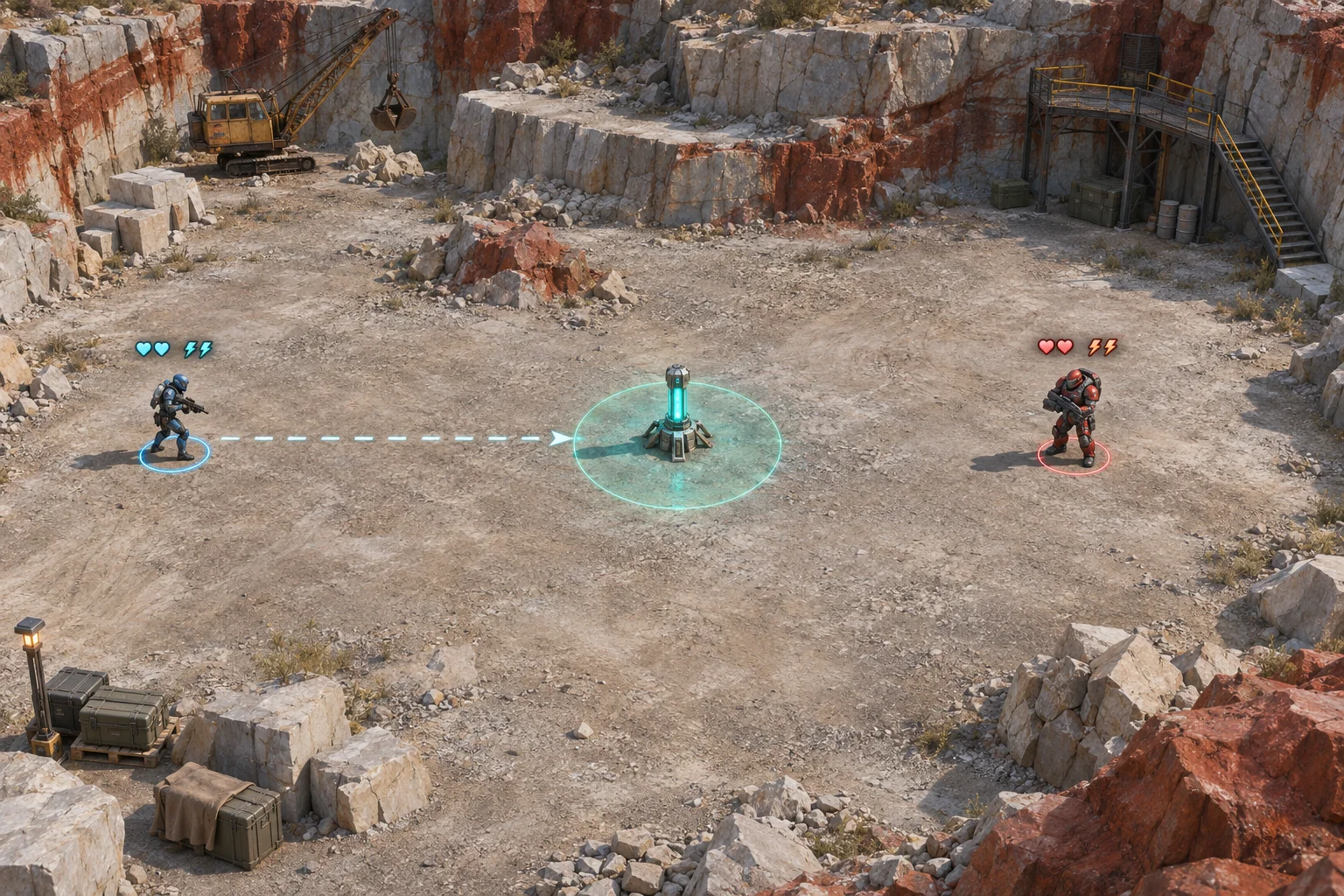
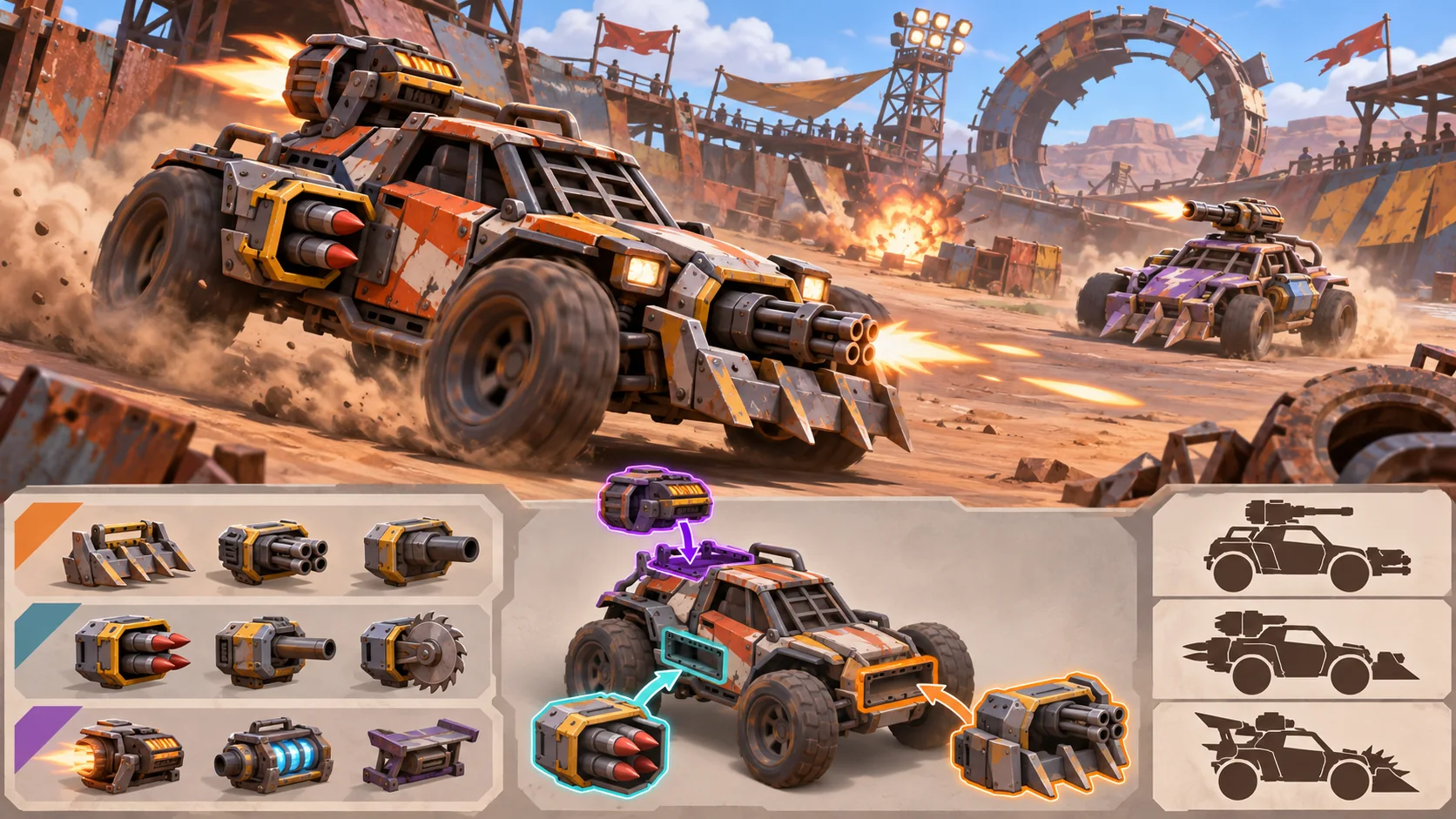
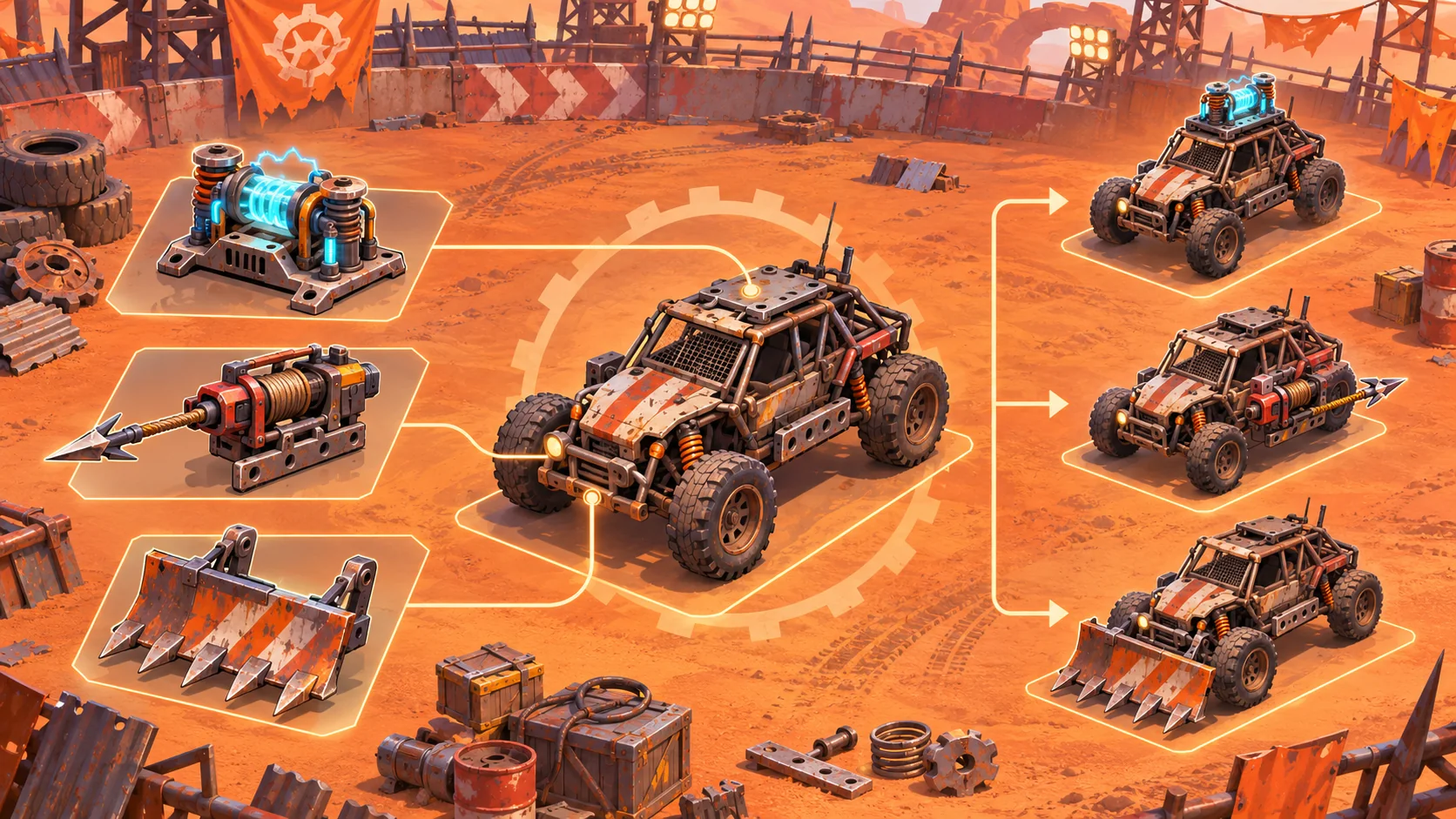
A modular vehicle is interesting when swapping parts changes how a player approaches the arena. In Scrap Circuit, one buggy has a front weapon head and a power core. Pair a harpoon head with a capacitor core to tether a rival and pull it two cells; pair a plow with a spring core to shove at close range; pair a mortar head with a stabilizer core to lob a short splash shot. Only a full recipe can be installed.
Between rounds, choose one recipe and inspect its range, cooldown, and effect. During a round, the loadout stays locked. That makes the part bench a tactical decision instead of a menu the player can open while under fire. The example arena uses a simple grid and a three-point armor track so you can reason about a weapon effect before adding vehicle physics or more components.
Make two parts produce one weapon behavior
Use a 7-by-6 arena with one player buggy, one rival buggy, scrap barriers, and an extraction pad. Each vehicle has three armor points. The player vehicle has exactly two weapon slots: one head and one core. The legal assemblies are Harpoon + Capacitor, which tethers a rival within five cells and pulls it two cells toward the player; Plow + Spring, which shoves an adjacent rival two cells; and Mortar + Stabilizer, which fires up to five cells and deals one armor damage to targets in a one-cell splash radius. A recipe with an unlisted combination is inactive and cannot fire. All three recipes have a two-turn cooldown, except Plow + Spring, which has a one-turn cooldown. A weapon can be installed only in the assembly bay between rounds; changing a component replaces the previous part in that slot. Loadout is locked during combat. Each round lasts six player turns. One turn allows one drive command and, if ready, one fire command. The player cannot fire while on cooldown. Rival armor reaching zero ends the round in a win; player armor reaching zero ends it in a loss. Otherwise the round ends after six turns and the vehicle with more armor wins; a tie is a draw. Run three rounds and win two to take the match. The extraction pad is an optional post-round objective and does not change the round result. Reset restores both vehicles to three armor, resets the turn and cooldowns, and returns the player to the assembly bay. Components do not break, duplicate, or change their effect based on cosmetic appearance. The arena has no real-world weapon references, injury depictions, or uncontrolled friendly fire. Show recipe name, range, effect, cooldown, armor, and remaining turns in the HUD.
| System | Expected behavior |
|---|---|
| Vehicle | Player and rival each start a round with 3 armor; player uses one chassis and two weapon slots. |
| Legal kits | Harpoon+Capacitor: 5-cell tether, pulls target 2 cells. Plow+Spring: adjacent shove 2 cells. Mortar+Stabilizer: 5-cell range, 1 armor in 1-cell splash. |
| Invalid pair | Any unlisted head/core combination is inactive and cannot fire. |
| Assembly | Choose one complete kit in the bay between rounds. Loadout is locked in combat. |
| Turn and cooldown | One drive and one ready fire per turn. Harpoon and Mortar cooldown 2 turns; Plow cooldown 1. |
| Round result | Destroy rival armor, or compare armor after 6 turns; ties draw. Three rounds, win 2 for match victory. |
| Reset | Restore 3 armor, clear turn/cooldown state, and return to assembly bay. |
Define three legal assemblies
At the assembly bay, choose Harpoon + Capacitor. The vehicle has three armor and the rival is four cells ahead with three armor. The displayed five-cell range makes the rival a legal target. On turn one, drive one cell toward the middle barrier, then fire; the tether connects and pulls the rival two cells toward the player. The weapon enters a two-turn cooldown, so it cannot fire on turn two or turn three. On turn two, drive around the barrier while the rival advances. On turn three, the cooldown expires after the turn resolves; do not allow a second fire command before it is ready. In the next round, install Plow + Spring in the bay. The loadout is locked once the round begins. If the player reaches an adjacent cell, a fire command pushes the rival two cells but does not remove armor. A later round can use Mortar + Stabilizer to damage a target in the one-cell splash radius. The trace describes intended state changes only; it is not a playable or user test.
| Step | Expected state |
|---|---|
| Install Harpoon + Capacitor | Kit is legal; UI shows range 5, pull 2 and cooldown 2. |
| Turn 1 drive | Move one cell; keep rival within five cells and line of sight. |
| Turn 1 fire | Tether rival and pull it two cells; no armor damage; start cooldown. |
| Turn 2 | Fire is rejected while cooling down; drive command remains available. |
| Turn 3 | Cooldown resolves; show weapon ready only after its timer reaches zero. |
| Between rounds | Return to bay and swap head/core; combat loadout cannot change mid-round. |
| Install Plow + Spring | At adjacent range, shove rival two cells without armor damage. |
| Match end | After 3 rounds, win at least 2; optional extraction pad does not change round outcome. |
Trace a tether setup and arena turn
Describe component compatibility and the resulting effect table before asking for art or vehicle physics. Start with one arena, one rival, visible cooldowns, and a reset that clears the loadout state.
Create a small top-down vehicle combat prototype called Scrap Circuit on a 7 by 6 grid. The player and rival each have one vehicle chassis and 3 armor. The player's weapon is assembled from exactly one head and one power core. Legal recipes: Harpoon + Capacitor tethers a rival within 5 cells and pulls it 2 cells with no armor damage; Plow + Spring shoves an adjacent rival 2 cells with no armor damage; Mortar + Stabilizer fires up to 5 cells and deals 1 armor damage to each target within a 1-cell splash radius. Unlisted pairs are invalid and cannot fire. Each round lasts 6 player turns. Each turn permits one drive command and one ready fire command. Harpoon and Mortar cooldown for 2 turns; Plow cooldown for 1. The loadout can only change in the assembly bay between rounds and is locked during combat. Rival armor at zero wins the round; player armor at zero loses it. Otherwise compare armor after turn 6; ties draw. Play 3 rounds and win at least 2 for match victory. Add an optional extraction pad after each round that does not affect the result. Show installed parts, recipe validity, range, effect, cooldown, both armor values and turns remaining. Reset restores armor, turn count, cooldown and assembly bay state. Do not invent extra parts, damage values, friendly fire, weapon breakage or mid-round swapping. Use clear non-graphic vehicle effects and communicate blocked shots or invalid recipes directly.Prompt AI for a bounded vehicle prototype
A first draft said any two parts could form a weapon but never defined the resulting behavior. That made loadouts impossible to review. The final recipe table lists three legal pairs and marks every other combination inactive, so the player can predict range and effect before entering a round.
The tether initially damaged armor as well as repositioning the rival. Removing that extra damage keeps the recipe distinct from the mortar and makes its value positional. The trace now checks the pull, no-damage result, and cooldown separately.

Revise one ambiguous assembly rule
Start with the assembly table and the three recipe behaviors on a grid. Confirm that an invalid pair cannot fire and that each valid pair produces only its named effect. Then replace grid movement with driving while keeping the part table, cooldowns, armor, and round rules unchanged. The written trace is not a playable or user test.
Read the related vehicle combat game guide.
Try the SEELE AI game maker workflow.
Frequently asked questions
Can every weapon head pair with every core?
No. The prototype defines three legal recipes: Harpoon with Capacitor, Plow with Spring, and Mortar with Stabilizer. Any other pairing is visibly inactive and cannot fire. This keeps the assembly rules inspectable before expanding the component library. This lets players inspect an assembly before combat instead of relying on undocumented combinations.
Does the tether damage the rival?
No. Harpoon plus Capacitor pulls a target two cells when it is within five cells, but removes no armor. Its role is to change position and create a route for a later move, while the mortar is the recipe that deals armor damage.
Check Godot's official VehicleBody3D reference.
Can I swap parts during a round?
No. The vehicle returns to the assembly bay between rounds, where the player may replace its head or core. Once combat begins, the selected loadout stays locked for all six turns so cooldowns and weapon effects remain predictable. The assembly bay is the only place to change parts, which keeps the selected recipe visible and predictable during combat.
Has this modular weapon system been tested in a playable game?
No. The parts, recipe table and turn trace are authored rules for a local prototype brief. They have not been implemented as a playable game, tested with users, or verified in a browser. The numbers describe a design starting point, not a tested balance result.