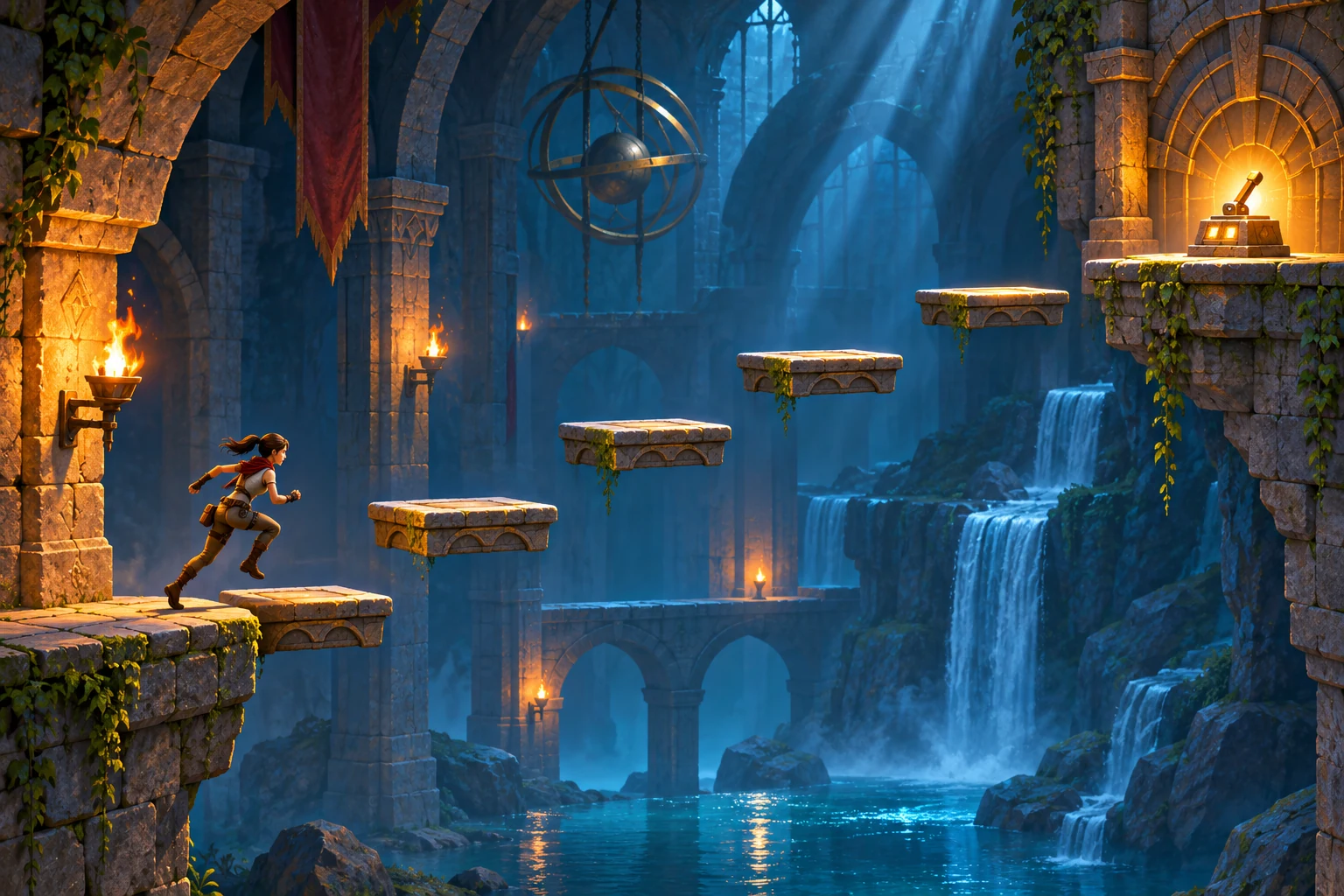
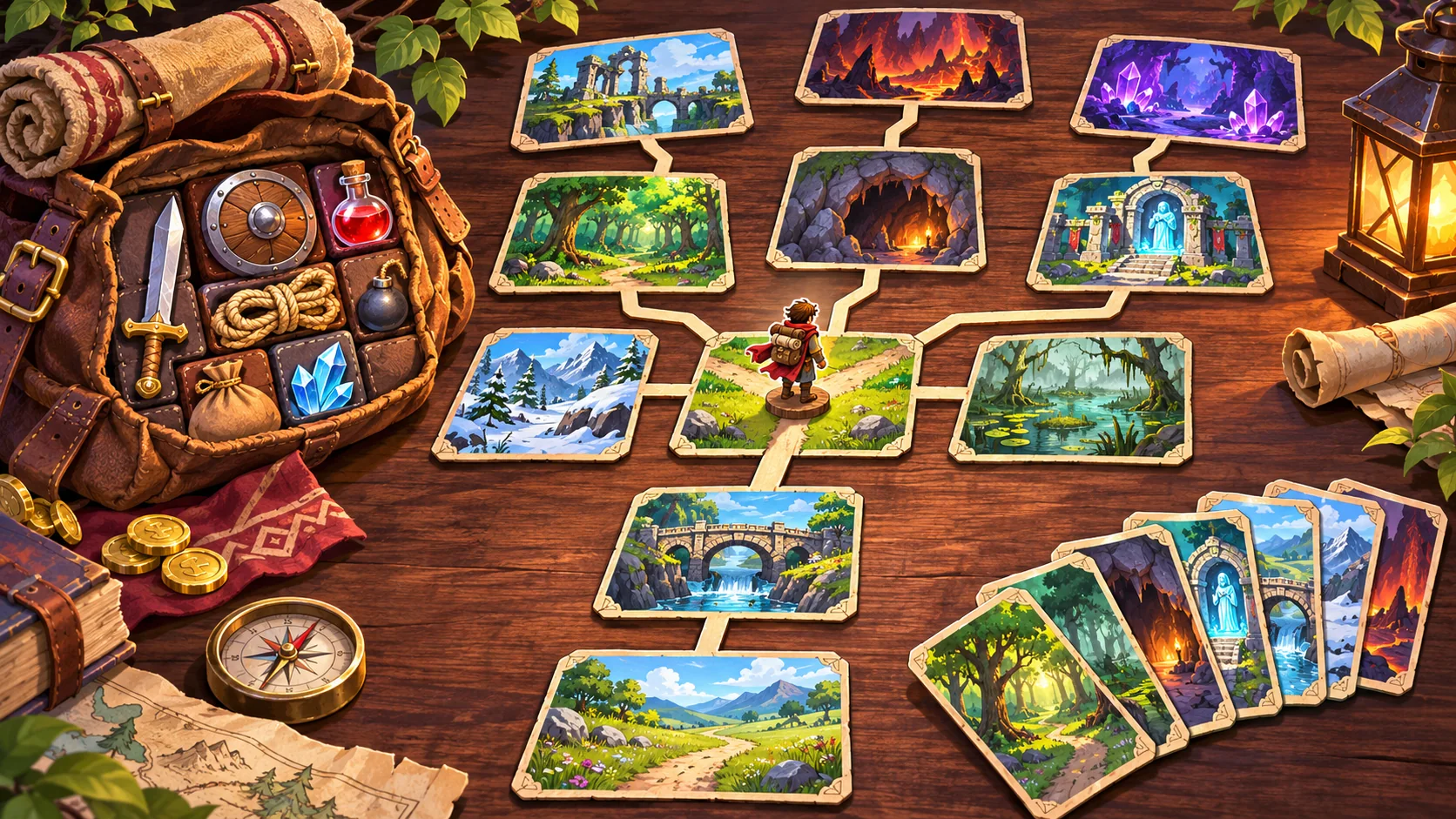
In Glassline, reaching the rooftop beacon changes the level behind the runner. A maintenance switch retracts the ascent wall between Drift and Vent, opens a return-only seam from Vent to Anchor, and drops a ladder from Anchor to the Dock. The fastest way up is no longer a valid way back.
The route is a six-ledge graph with a grip meter. Two ascent wall-runs spend one grip each; landing on the Anchor restores one. At the beacon, a four-beat storm timer starts. The old reversed path needs five edges, but the changed return route reaches the Dock in three. The player has to keep one grip point for the return seam and choose the Anchor recharge before climbing.

Make the trip back a new route puzzle
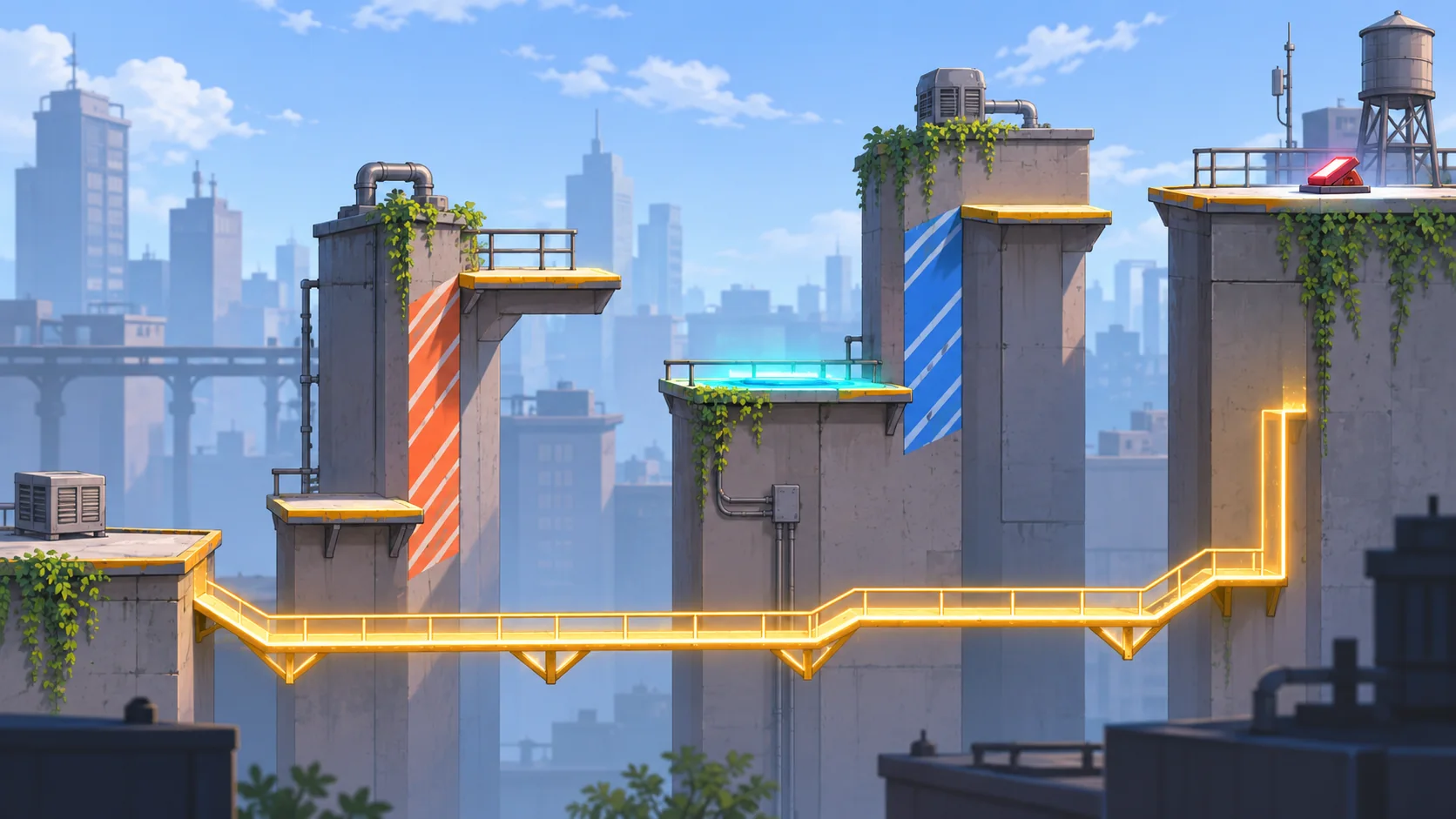
Build Glassline as a deterministic side-view wall-running platformer represented by six ledges: Dock (A), Sign (B), Drift (C), Anchor (D), Vent (E) and Beacon (F). Each traversed edge costs one beat. The ascent edges are A→B (jump), B→C (wall-run, costs 1 grip), C→D (safe landing, restores 1 grip up to a maximum of 3), D→E (wall-run, costs 1 grip), and E→F (jump). Start with 2 grip. Touching Beacon F flips the route graph and starts a four-beat storm countdown: close the reverse E→D wall, open a return-only E→C wall seam that costs 1 grip, and deploy a no-cost C→A ladder. F→E remains open. The runner must reach A before the countdown reaches zero and may not begin a wall-run with less than 1 grip. Falling or running out of time resets the level and grip. Display current ledge, route direction, wall grip, recharge state, changed edges and timer. Clear requires an ascent that recharges at D and a return via F→E→C→A. The reversed ascent route F→E→D→C→B→A takes five beats and fails the four-beat deadline.
| System | Prototype rule |
|---|---|
| Ledges | Dock A, Sign B, Drift C, Anchor D, Vent E, Beacon F. |
| Beat | Each ledge-to-ledge edge takes one beat. |
| Grip | Start at 2, maximum 3; a wall-run costs 1. |
| Anchor | Landing on D restores 1 grip, up to 3. |
| Ascent | A→B jump; B→C wall-run; C→D safe landing; D→E wall-run; E→F jump. |
| Beacon switch | At F close reverse E→D, open return-only E→C wall seam, and deploy C→A ladder; begin a 4-beat timer. |
| Return | F→E costs no grip; E→C costs 1 grip; C→A ladder costs none. |
| Failure | No wall-run without grip; fall or timer zero resets the attempt. |
| Clear | Use the Anchor recharge, reach F, then reach Dock A in three return beats. |
| Interface | Show ledge, legal edges, edge cost, grip, switch state and storm beats remaining. |
Define grip, wall surfaces and the beacon switch
Start at Dock A with grip 2. Beat 1 jumps A→B; grip stays 2. Beat 2 wall-runs B→C and spends 1, leaving 1. Beat 3 lands on the safe Anchor D and recharges to 2. Beat 4 wall-runs D→E and spends 1, leaving 1. Beat 5 jumps E→F. The beacon switch closes the reverse E→D wall, opens the E→C return seam, deploys the C→A ladder and starts the storm timer at 4. Return beat 1 moves F→E with grip 1. Return beat 2 wall-runs E→C, spends the final grip and reaches 0. Return beat 3 takes the ladder C→A. The runner escapes with one beat remaining. Without the Anchor recharge, the second ascent wall-run leaves no grip for the return seam; without the route switch, the reverse climb takes five beats and misses the four-beat deadline. This is an authored state trace, not a playable or user test.
| Beat | Expected state |
|---|---|
| Start | Dock A; grip 2; ascent graph active. |
| 1 · A→B | Jump; grip 2. |
| 2 · B→C | Wall-run; grip 1. |
| 3 · C→D | Anchor landing restores grip 1→2. |
| 4 · D→E | Wall-run; grip 1. |
| 5 · E→F | Jump to Beacon; flip route graph; storm timer 4. |
| Return 1 · F→E | Grip 1; three beats remain. |
| Return 2 · E→C | Return-only wall seam; grip 0; two beats remain. |
| Return 3 · C→A | Ladder reaches Dock; escape succeeds with one beat left. |
Trace grip across the climb and escape
Ask the generator to store ascent and return edges separately. Touching Beacon should swap the graph once, show which walls closed and which return links opened, and start the timer only after that state change. Keep grip costs attached to edges, not animation frames.
Create a deterministic side-view wall-running platformer called Glassline with six ledges: Dock A, Sign B, Drift C, Anchor D, Vent E and Beacon F. Each edge takes one beat. Start with grip 2, maximum 3; wall-runs cost 1 grip and landing on D restores 1. Ascent: A→B jump, B→C wall-run, C→D safe landing, D→E wall-run, E→F jump. At F flip the route graph once: close reverse E→D, open return-only E→C (costs 1 grip), deploy C→A ladder (free), and start a four-beat storm timer. F→E stays open. Clear only by reaching A before timer zero. Replay the climb with the Anchor recharge and return F→E→C→A. Show current ledge, grip, edge cost, switch state and timer. Also show that the reversed ascent path needs five beats and fails. Restart restores the original graph and grip.Prompt AI to build the route switch
The first escape plan simply reversed the ascent, but that route required five edges after the beacon while the storm allowed four beats. It also treated the closed Vent wall as usable in reverse. The revised switch changes the graph at the summit: it retracts that wall, opens a return-only seam and deploys a ladder from the recharge ledge. The player must reserve grip for the seam. This is a design revision in the authored specification, not a measured playtest.

Revise the route before the storm timer starts
Implement the route as explicit directed edges with grip cost and availability flags. Trigger the route swap once at Beacon, then start the timer. Replay the five ascent beats and three return beats; check that the Anchor is the only recharge, the seam consumes the final grip, and the ladder is free. Godot CharacterBody3D offers collision and wall-state helpers for a real-time controller, but the authored route trace is not an engine test. Use SEELE’s precision-platformer guide to shape the retry loop and AI Game Maker to draft a starting level.
Read SEELE’s precision-platformer timing guide.
Review Godot’s official CharacterBody3D reference.
Frequently asked questions
Why does the return route change at the beacon?
The beacon activates a maintenance switch. It closes the reverse Vent wall, opens a return-only seam and drops a ladder from the Anchor. That graph change makes the return a distinct route puzzle instead of a replay of the climb. The route display shows the legal edges before and after the flip so players can compare them.
How much grip should the runner save?
The Anchor recharge restores one point during the ascent. The runner reaches the Beacon with one grip, spends it on the return seam, then uses a free ladder. Spending grip on an optional wall-run leaves no legal escape edge. The interface should reserve that final point until the return escape begins.
Why does the reversed ascent fail?
The old route back uses five edges from Beacon to Dock, but the storm countdown allows four beats. It also attempts to use the Vent wall after the switch closes its reverse direction. The prototype should show both the missing edge and the extra beat.
Has Glassline been tested as a playable level?
No. The ledges, grip costs, route swap, four-beat timer and climb-and-return sequence are authored prototype specifications. This package does not claim an implemented level, browser test, user test or measured difficulty. Its local previews are static HTML and the result is an authored state trace.