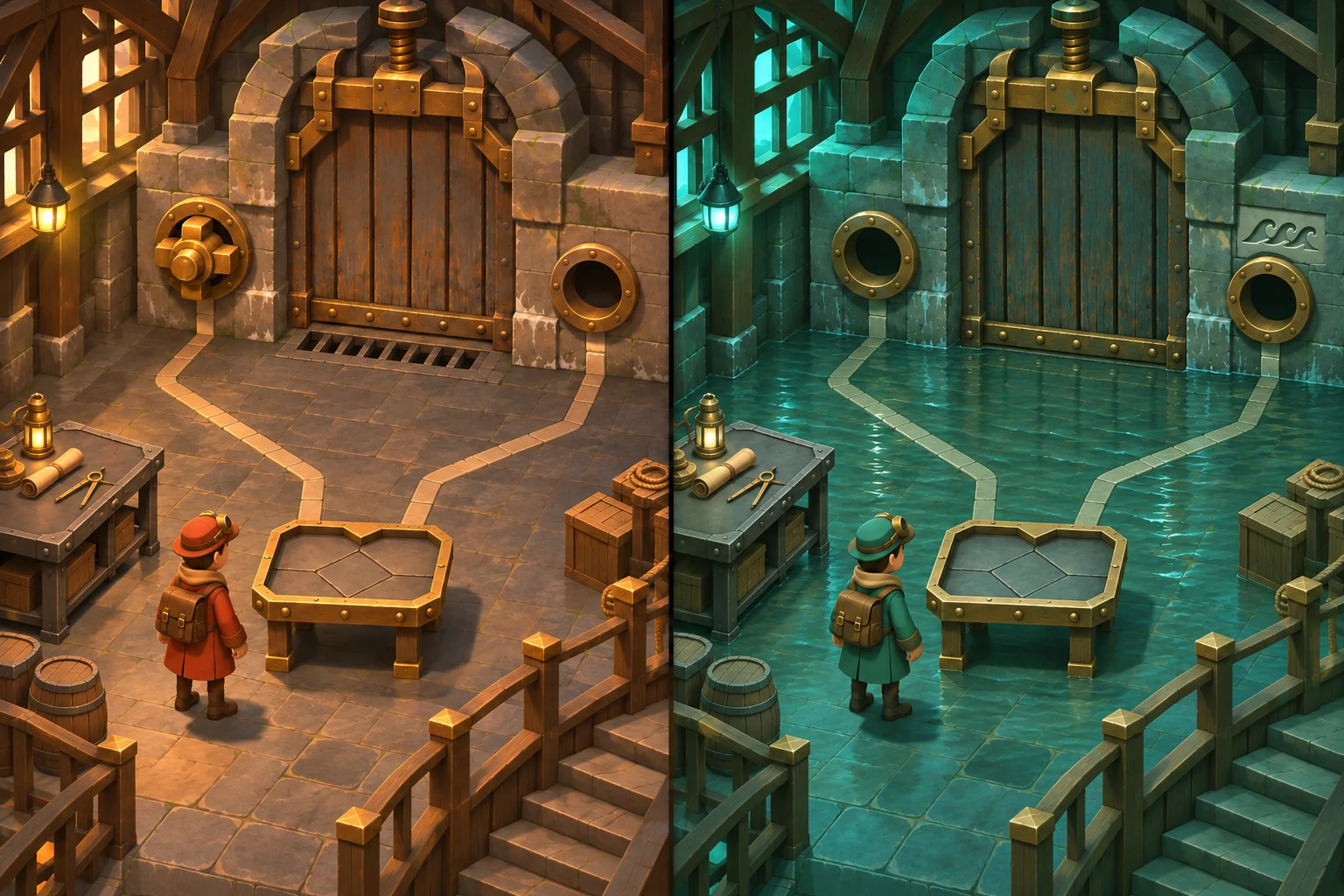
In fictional Echo Vault, reaching a switch changes the route back to the entrance. The player jumps up through platforms at (2,1) and (4,2) to reach the switch at (6,2). Each jump can span 2.5 units horizontally and 1.5 vertically. The switch removes the high platform at (4,2) and creates a lower return platform at (4,0.5). Keep the jump limits and all coordinates fixed. Report the outbound path, both platform changes, the return path, and whether the player reaches the exit. The challenge comes from reading a changed route, not from changing the controls.
Build an outbound route within fixed jump limits
Set the entrance at (0,0), platform A at (2,1), platform B at (4,2), and the switch at (6,2). The player can travel no more than 2.5 units across or 1.5 units up in one jump. Each step fits: the entrance to A is 2 across and 1 up, A to B is 2 across and 1 up, and B to the switch is 2 across at the same height. The player can reach the switch without a special upgrade.
Represent the room as two explicit phases, such as Godot Resources for the active platform set. Keep the starting point, switch, jump envelope, and coordinates constant between phases. Before activation, show platforms A and B as solid and the lower return platform as absent. This makes the puzzle state legible before the player commits to the switch.

Let the switch replace one useful platform
When the player activates the switch at (6,2), retract platform B at (4,2) and create platform C at (4,0.5). Do not move platform A or the entrance. The route has changed because the platform set changed: the high stepping stone used on the way in is gone, and a lower landing point now supports the trip back.
Record the before-and-after platform lists, then test the return jumps from the switch. From (6,2) to C is 2 units across and 1.5 down; C to A is 2 across and 0.5 up; A to the entrance is 2 across and 1 down. Every jump remains within the same envelope. The old B landing is unavailable after activation, so the return route visibly differs.

Check that the new route reaches the entrance
The full outbound route is (0,0) → (2,1) → (4,2) → (6,2). After the switch, use (6,2) → (4,0.5) → (2,1) → (0,0). The entrance is therefore reachable in both phases, but the player must use the newly created platform C to get home. Keep the exit condition tied to arriving back at the entrance after activation.
For a deterministic check, assert each adjacent pair against the horizontal and vertical limits, confirm B is absent and C is present in the return phase, then confirm a path from the switch to the entrance. Report the exact routes, changed platform coordinates, and exit result. Echo Vault and its numbers are fictional; this test measures only the stated movement envelope and phase rules.

Give the AI a fixed changing-route platform test
Create a puzzle platformer in fictional Echo Vault. The entrance is (0,0), platform A is (2,1), platform B is (4,2), and the switch is (6,2). The player jump limit is 2.5 units horizontally and 1.5 vertically. The outbound route is entrance → A → B → switch. On activation, remove B at (4,2) and add platform C at (4,0.5). Keep the entrance, A, switch, coordinates, and jump limits fixed. Test and report the return route, changed platforms, and whether the player reaches the entrance exit.
Check every outbound jump: (0,0) to (2,1), (2,1) to (4,2), and (4,2) to (6,2). After activation, confirm B is absent and C at (4,0.5) is present. Verify the return route (6,2) to (4,0.5) to (2,1) to (0,0) stays within 2.5 horizontal and 1.5 vertical units per jump.
FAQ
How can a platformer make the return trip feel different?
Change the room after the player reaches a clear trigger. Remove a platform used on the way in and add a new landing point for the return. Keep movement limits steady so players understand that the level changed, rather than assuming their controls changed.
How do I check whether a platform route is reachable?
List each landing coordinate and compare consecutive jumps with the horizontal and vertical movement limits. Then run the check again for the post-switch platform set. A route is valid only if every step fits and each landing exists in that phase.
What should a puzzle prototype report?
Show the outbound route, the platform removed and the platform added, then list the return route. Include fixed jump limits and confirm whether the exit can be reached. These details make the phase change and its result straightforward to review.