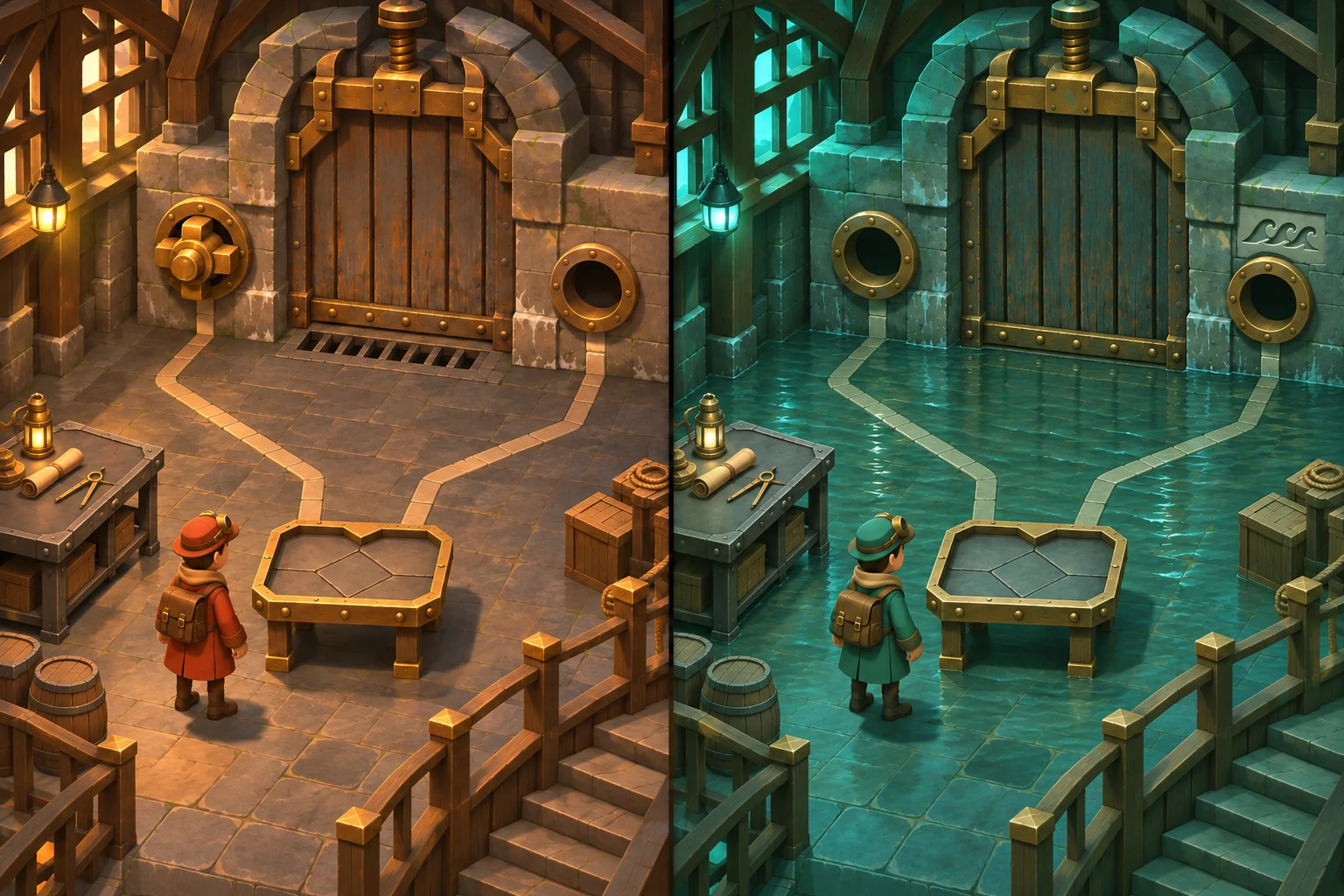
An asymmetric co-op puzzle can make coordination physical when partners share one tool. In fictional Relay Vault, the Surveyor can dash across open tiles and the Engineer can open heavy doors, but only the current holder of the Tuning Wand can activate relay consoles. The partners must decide where to meet and when to pass it.
Start with a small open map and two relays. Make tool ownership visible, require orthogonal adjacency for a handoff, and charge one action to pass it. The fixed example below checks whether both consoles can be activated through a five-action sequence. It is a paper puzzle, not a measured co-op playtest.
Give each partner a distinct ability and one shared capability
The Surveyor can dash up to two open tiles once per room. The Engineer can open a heavy door without the Wand. Both players can move one tile per action, but neither can activate a relay unless holding the Tuning Wand. The Wand has exactly one owner at a time, so it cannot be duplicated or used remotely.
This creates complementary decisions. The Surveyor can reach a useful handoff spot quickly; the Engineer can clear a route after receiving the tool. Keep both role abilities visible and make their limits explicit. If either partner can solve every obstacle alone, the shared item becomes a prop rather than a co-op mechanic.
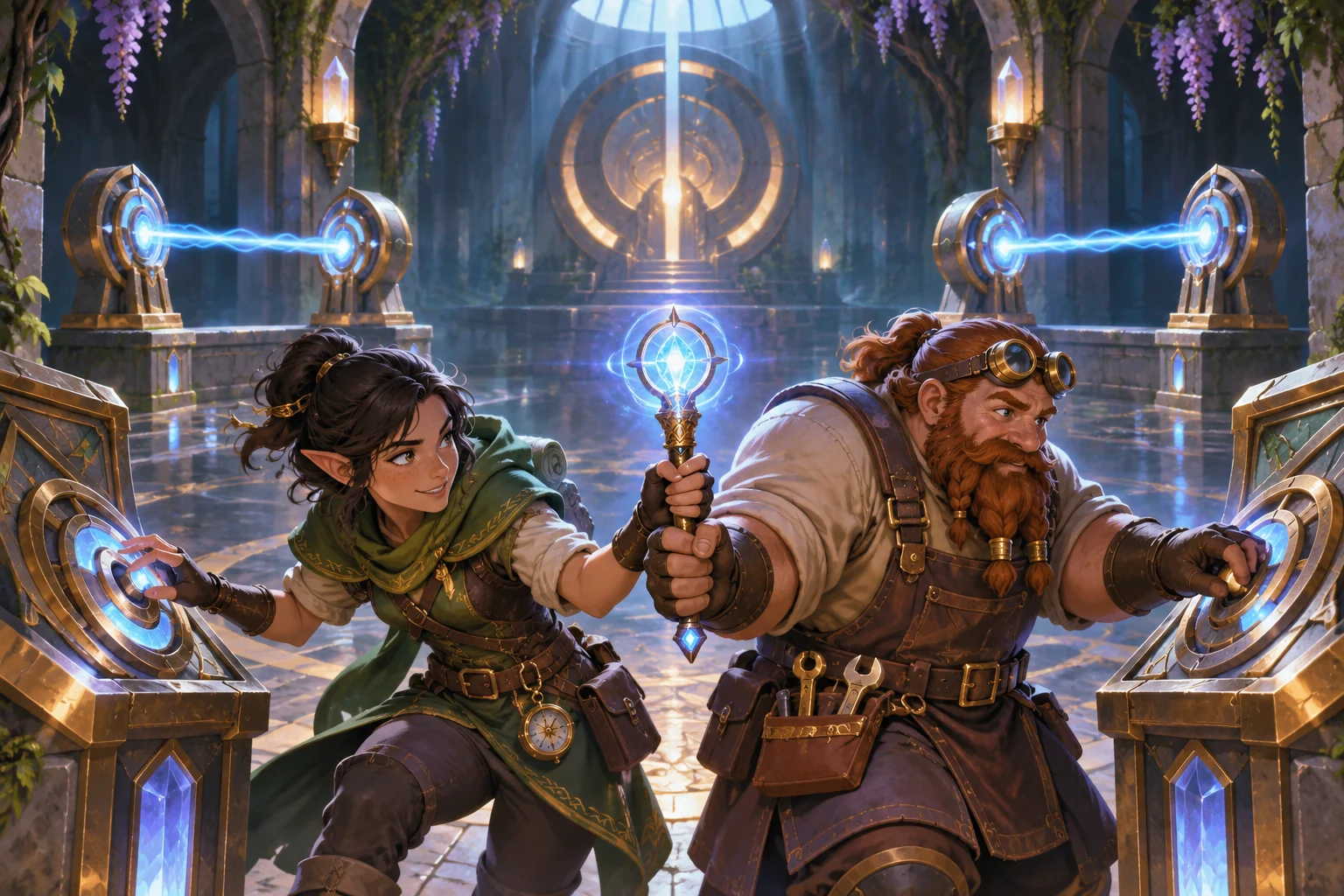
Make a handoff a clear action with a visible range
Use a 7×5 grid. A player may pass the Wand only to the other player on an orthogonally adjacent tile, and passing costs one action. The receiver becomes the sole holder. A relay activates when its holder stands next to it and spends one action; once lit, it stays lit. Show the holder, legal receiver and relay state at all times.
Do not let the handoff happen through a wall or from across the map. A short range makes positioning part of the puzzle. Give players a preview when they step into an adjacent handoff cell, and explain why a pass is unavailable when distance is greater than one.
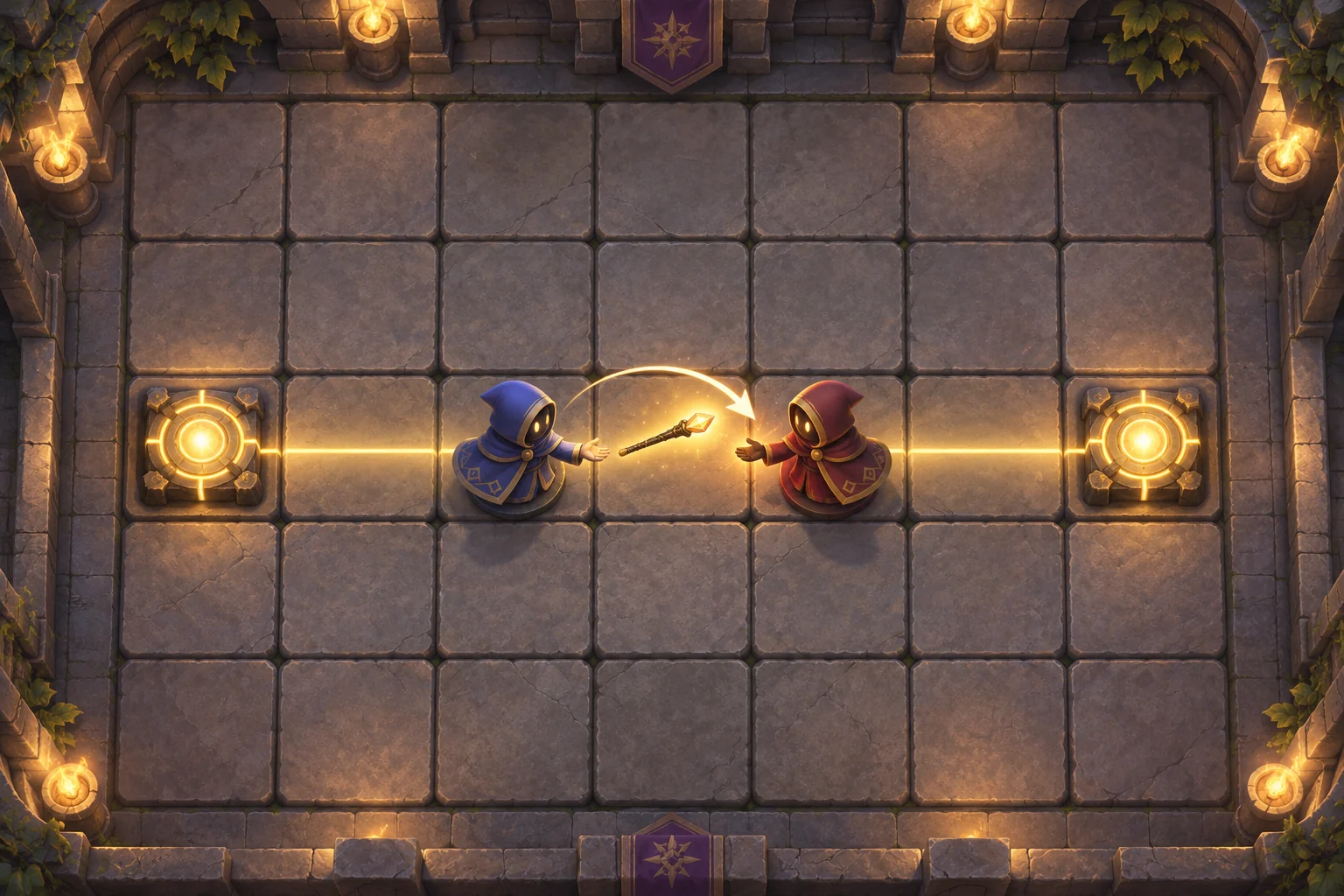
Replay the route to activate both relays
Start the Surveyor at (1,3) with the Wand and the Engineer at (4,3). The West relay at (1,2) is next to the Surveyor, so activating it costs one action. The Surveyor then uses the once-per-room dash from (1,3) to (3,3) for one action. That tile is adjacent to the Engineer, allowing a one-action pass.
The Engineer now holds the Wand. Move from (4,3) to (5,3) in one action, then activate the East relay at (6,3) with one more. The sequence costs 1 + 1 + 1 + 1 + 1 = 5 actions. Both relays stay lit. This fixed paper replay checks the movement, ownership and handoff rules; it does not establish that players will find the route intuitive.
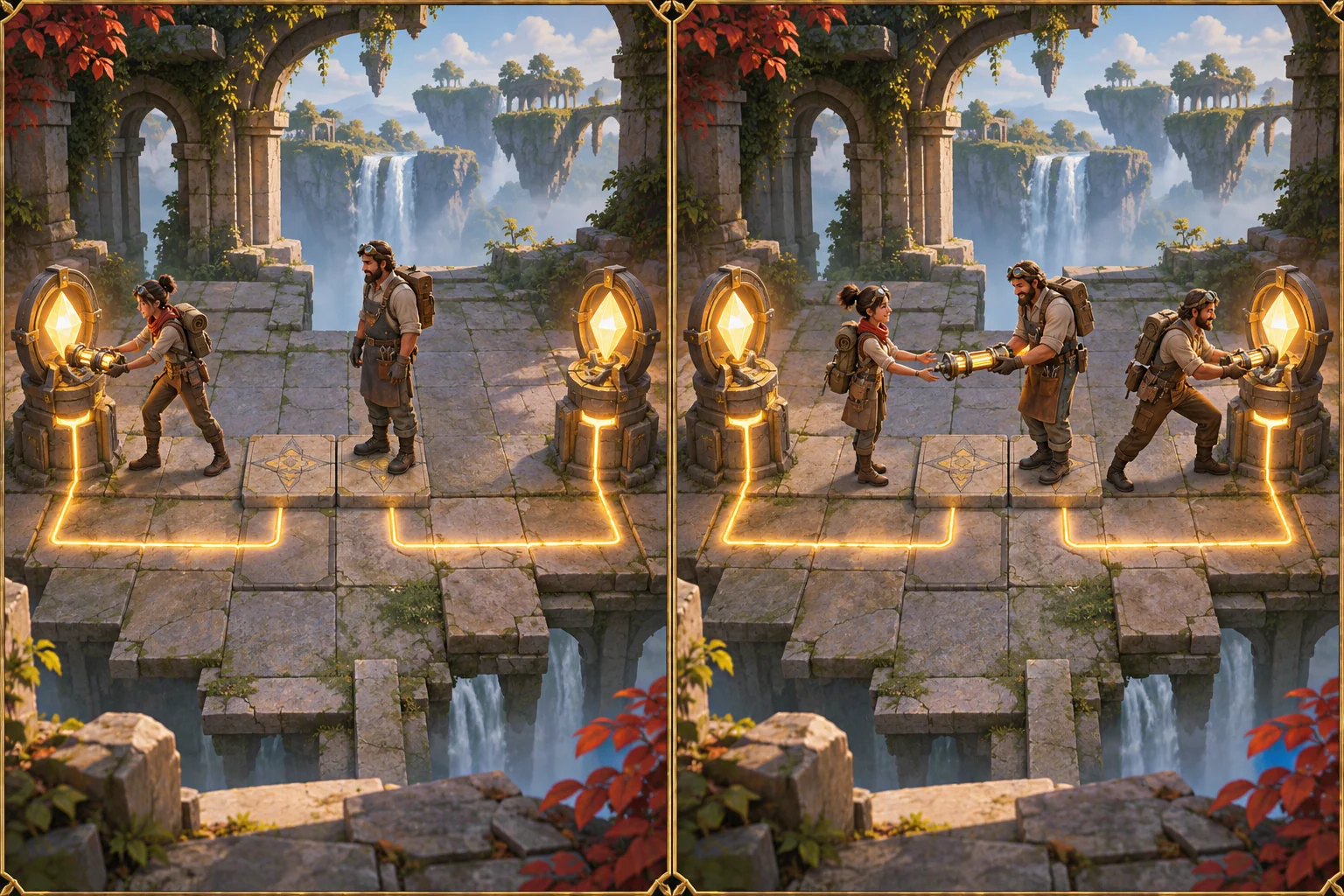
Prototype the relay puzzle before adding enemies
Build the grid, two role tokens, the Wand, two relays, action counter and reset. Let a pair attempt the puzzle and show the Wand's owner after every action. Test edge cases: passing while not adjacent, trying to activate a relay without the tool, or spending the Surveyor dash twice in one room.
Only after those rules read clearly should you add a moving hazard, a heavy door or a second relay pair. Keep the objective and ownership state on both screens so the challenge comes from coordinating distinct abilities, not guessing hidden rules.
Create Relay Vault, a two-player asymmetric co-op puzzle on a 7×5 grid. Surveyor can dash up to two open tiles once per room; Engineer can open heavy doors. Only the current holder of one shared Tuning Wand can activate relays, one action per relay. The Wand can be passed only to an orthogonally adjacent partner, costing one action and transferring sole ownership. Fixed scenario: Surveyor starts (1,3) holding the Wand; Engineer starts (4,3). West relay is (1,2), East relay (6,3). Activate West (1 action), Surveyor dashes to (3,3) (1), passes to adjacent Engineer (1), Engineer moves to (5,3) (1), activates East (1). Both relays remain lit. Show ownership, legal handoff range and action count. Add reset and do not claim playtest results.
SEELE's official page describes a general workflow: generate a playable first version from a prompt, test it in a browser and refine it with follow-up prompts. Use it to inspect whether partners understand tool ownership and handoff range; Relay Vault and its rules are fictional design guidance.
Prototype the shared-tool co-op puzzle in SEELE
Frequently asked questions
How do you make a shared tool matter in a co-op game?
Give the tool an action only its current holder can perform, then require partners to pass it to reach different objectives. Make the ownership, handoff range and action cost visible so players can coordinate around a real constraint rather than an invisible rule.
What makes an asymmetric co-op puzzle readable?
Give each role a distinct ability, explain where it works and show the shared objective state. Keep the first map small and make tool ownership and legal handoff positions easy to see. Add hazards only after the basic role interaction is understandable.
How should I test a player-to-player handoff mechanic?
Replay a fixed route and count movement, tool use and passing actions. Check invalid cases such as nonadjacent passing or activating without the tool. A paper sequence verifies rule consistency, but only player testing can show whether the handoff feels intuitive.