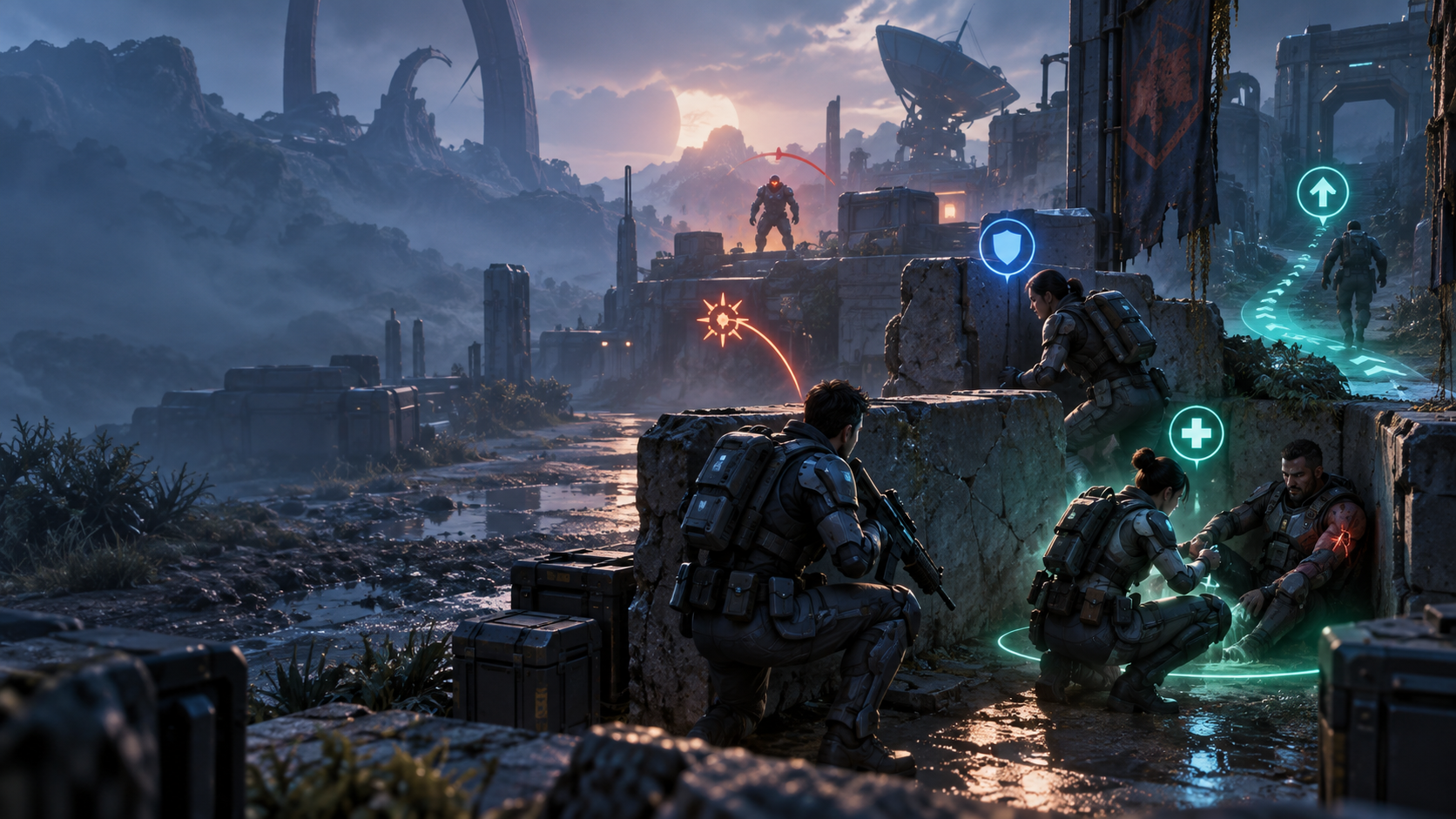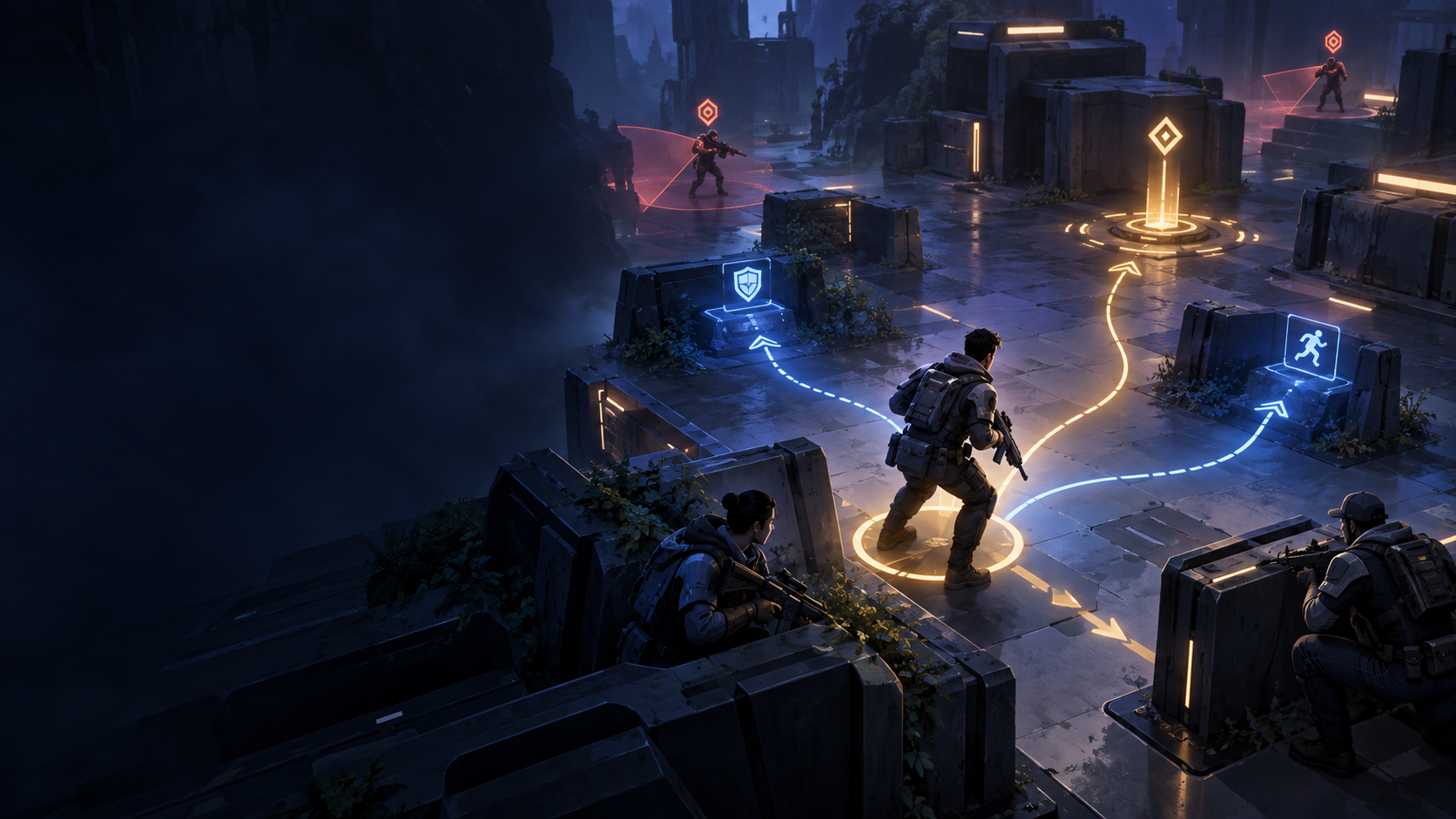
JEV は、ゲーム用のリアルタイム意思決定モデルです。これは、ゲーム世界の変化する状態とアクションを実行するシステムの間に位置し、NPC またはエージェントが一連の実行可能な選択肢から次に何をすべきかを選択するのに役立ちます。実際には、JEV は、危険、目的、資源、同盟国、機会を比較検討し、攻撃、撤退、回復、援護、味方の支援、新しいエリアの調査などの戦術行動を選択できます。その定義は、JEV が完全なゲーム脳であると言うよりも意図的に狭くされています。 JEV は、ゲーム エンジン、物理学、アニメーション、ナビゲーション、レンダリング、対話システム、または作成されたルールを置き換えるものではありません。その役割は、変化する状況下での意思決定の選択です。この境界により、これが便利になります。ゲームは可能なことを制御し続けますが、JEV は、その瞬間に最も適した可能なアクションを決定するのに役立ちます。JEVとは何ですか?JEV は、戦術的意思決定層として理解できます。ゲームでは、現在の状況のコンパクトなスナップショットと、キャラクターが実行できるアクションのリストが提供されます。 JEV はそのコンテキストを評価し、通常はパラメーターまたはターゲットを含む Choice を返します。ゲームは応答を検証し、通常のゲームプレイ システムを通じて実行します。_
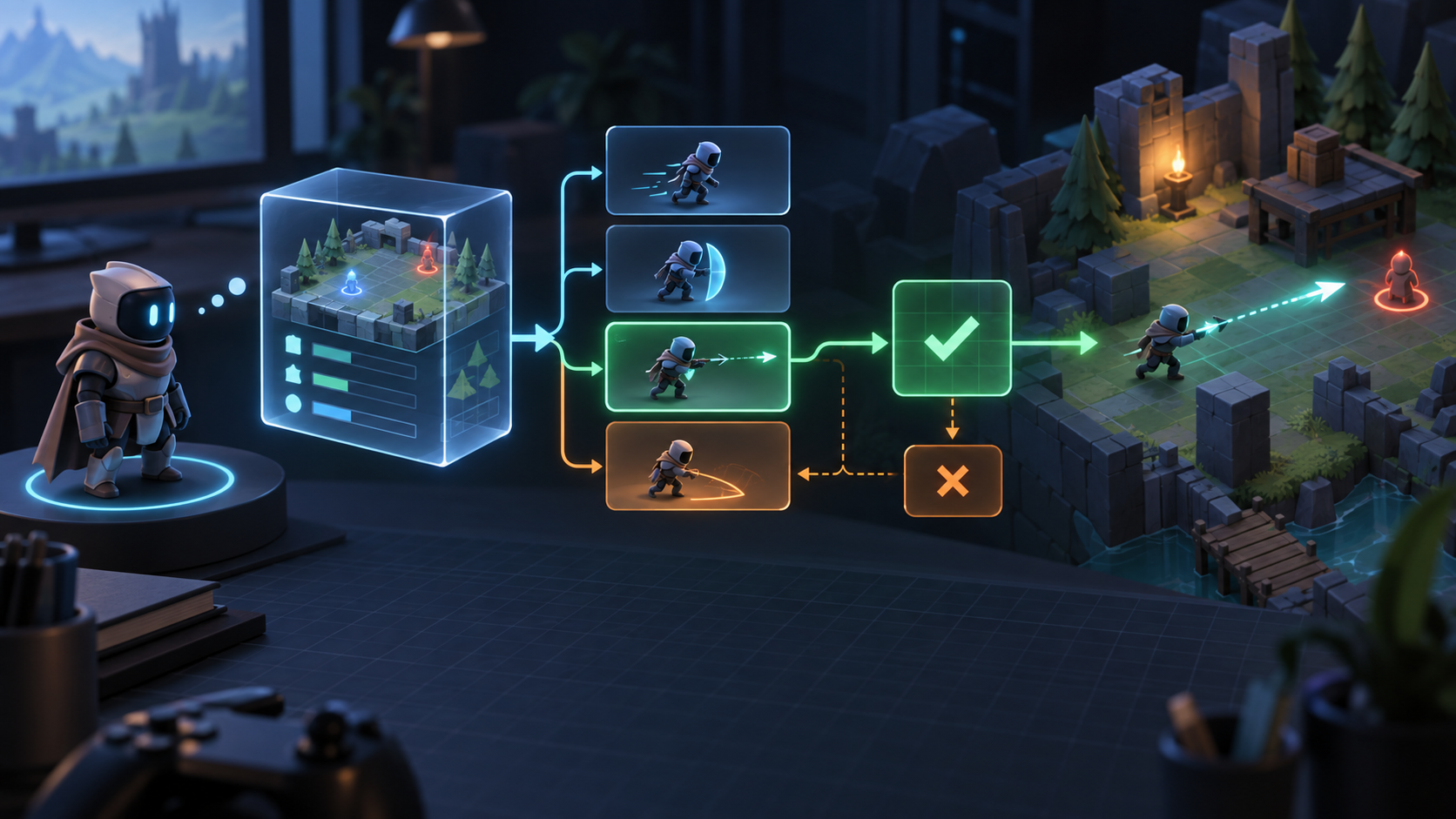
有用なメンタル モデルは、_観察、フィルター、評価、選択、実行、そして再度観察
です。観察により、健康状態、目に見える脅威、遮蔽物、距離、クールダウン、チームの役割、目標などの関連する事実が捕捉されます。フィルタリングにより、不可能なアクションが削除されます。評価では、残りのオプションをエージェントの目標および現在のリスクと比較します。 Choice はアクションを生成しますが、実行は決定論的なゲーム コード内に留まります。JEV はどのような問題を解決しますか?従来の NPC ロジックは、条件の数が少なく予測可能な場合に適切に機能します。ただし、ゲームが成長するにつれて、決定はローカルな事実と競合する目標の組み合わせになります。 NPC は、目標を保護し、負傷したチームメイトの露出を回避し、弾薬を節約し、同時に新たな脅威に対応する必要がある場合があります。ネストされた条件や手動で作成されたトランジションが長く続くと、バランスを取ることが難しくなり、修正がさらに難しくなる可能性があります。JEV は、実行の問題ではなく選択の問題に対処します。これにより、設計者は目標とアクション契約を表現する場所が得られ、同時に意思決定ポリシーがより豊かな状態に対応できるようになります。その結果、無制限の即興演奏が可能になるわけではありません。これは、ゲームが定義するインターフェイスから制御される Choice です。JEV はゲーム AI とどのように関係しますか?ゲーム AI は、ナビゲーション、認識、計画、アニメーションの選択、チームの調整、学習システムなどを含む幅広いカテゴリです。 JEV は、そのカテゴリ内のコンポーネントの 1 つです。これは、中間レベルまたは戦術的な意思決定層に最も自然に使用されます。目標とトレードオフを理解するのに十分な高さですが、具体的な次のアクションを作成するのに十分な低さです。たとえば、ゲームはナビゲーションを決定論的に保ち、ビヘイビア ツリーを使用してリロード シーケンスを実行し、JEV を使用してリロードが避難よりも優れているかどうかを判断できます。システムは補完的です。エンジンは真実と実行を所有します。 JEV は、状況に応じた選択に貢献します。JEV を、LLMs、ビヘイビアー ツリー、および FSMs と比較LLMs は柔軟な言語モデルです。彼らは、対話、物語の解釈、自然言語の計画、テキストやコードの生成を得意としています。一般的な LLM は、必ずしも適切なティックごとのコントローラーではありません。安全性が重要なアクションのコントラクトとしては、遅すぎる、制約するのが難しい、または一貫性がない可能性があります。 JEV は、出力サーフェスが狭いゲーム デシジョン レイヤーです。動作ツリーは、セレクター、シーケンス、条件、およびタスクを介した作成された制御フローを表します。これらは透過的で反復可能な実行に優れています。 JEV はビヘイビアー ツリーの上に位置し、ツリーがステップを処理しながら、実行するブランチまたは高レベルのインテントを選択できます。有限状態マシン は、パトロール、追跡、攻撃、逃走などの明示的な状態と遷移をモデル化します。これらを推論するのは簡単ですが、条件が増えると遷移グラフが混雑する可能性があります。 JEV は次のインテントを選択できますが、FSM は明確に定義された実行状態の開始と終了を担当します。実際の比較は、既存のすべての技術を置き換えるものではありません。それは、ゲームが実際に持つ不確実性を処理する最小のシステムを選択することです。典型的なJEVの使用例戦闘戦術:_ 圧力、退却、援護、回復、または連携から選択能力。分隊調整:
エージェントを支援、側面攻撃、蘇生、防御、またはサバイバル ゲーム:_ 貿易探索、クラフト、食料、住居、および時間と脅威に対する脅威の回避リソース。ステルス:_ 音を調査するか、非表示にするか、検索するか、助けを求めるか、元の場所に戻るかを決定します。 Route.反応的な遭遇:
作成されたルールが公平性を維持しながら遭遇応答を選択し、進行状況。JEV でできないことJEV には、物理学の発明、権限のバイパス、任意の世界状態の直接変更、レンダリングされたフレームごとのアバターの制御を求められるべきではありません。ヒット検出、動作の妥当性、経済ルール、またはマルチプレイヤー権限に関する唯一の情報源であってはなりません。これらの責任はゲーム コードとエンジン システムに属します。強力な統合により、この境界が明確になります。ゲームは、決定に必要な状態のみを公開し、Legal Actions のみをリストし、応答を検証し、フォールバック を定義します。この設計により、動作が観察可能になり、チームは記録されたシナリオを使用して意思決定層をテストできるようになります。ゲームはどのような場合にJEVを使用する必要がありますか?JEV は、NPC にいくつかの意味のあるオプションがあり、最適なオプションがライブ コンテキストに応じて変化し、作成されたルールだけでも維持コストが高くなる場合に適しています。これは、固定されたアニメーション シーケンス、単純な巡回ルート、または実行ごとに同一でなければならない決定にはあまり役に立ちません。 1 つの限定された決定から開始し、レイテンシと品質を測定し、契約が理解できる場合にのみ拡張します。シナリオに焦点を当てた説明については、JEV ゲーム AI: NPCs のためのリアルタイム戦術的決定を参照してください。 JEV が AI 支援ゲーム作成にどのように適合するかを理解するには、JEV がゲームの生成にどのように役立つか を参照してください。開発者は、JEV チュートリアル_. の実装ウォークスルーに従うことができます。JEV FAQJEV は完全なゲームを生成しますか?いいえ。 JEV は、実行時の決定の選択に焦点を当てています。生成モデルではアセット、コード、シーン、またはその他のコンテンツを作成できますが、JEV では、生成されたゲーム内で生成された NPC の応答性を高めることができます。JEV は LLM ですか?JEV は、一般的な会話モデルとしてではなく、特殊な意思決定機能として扱う必要があります。重要な違いは、制限されたゲーム状態の入力と実行可能なアクションの出力です。JEV はビヘイビア ツリーを置き換えますか?通常はそうではありません。ビヘイビア ツリーは、選択されたアクション JEV を実行でき、それを実行する透過的でテスト可能な方法をチームに提供します。_. Observation captures relevant facts such as health, visible threats, cover, distance, cooldowns, team roles, and objectives. Filtering removes impossible actions. Evaluation compares the remaining options against the agent's goals and current risks. Choice produces an action, while execution stays inside deterministic game code.
What problem does JEV solve?
Traditional NPC logic works well when the number of conditions is small and predictable. As a game grows, however, decisions become combinations of local facts and competing goals. An NPC may need to protect an objective, avoid exposing a wounded teammate, conserve ammunition, and respond to a new threat at the same time. A long chain of nested conditions or hand-authored transitions can become difficult to balance and even harder to revise.
JEV addresses the selection problem rather than the execution problem. It gives designers a place to express goals and action contracts while allowing the decision policy to respond to a richer state. The result is not unrestricted improvisation. It is a controlled choice from an interface the game defines.
How does JEV relate to game AI?
Game AI is a broad category that includes navigation, perception, planning, animation selection, squad coordination, learning systems, and more. JEV is one component within that category. It is most naturally used for a mid-level or tactical decision layer: high enough to understand goals and trade-offs, but low enough to make a concrete next-action choice.
For example, a game can keep navigation deterministic, use a behavior tree to perform a reload sequence, and use JEV to decide whether reloading is better than taking cover. The systems are complementary. The engine owns truth and execution; JEV contributes context-sensitive selection.
JEV compared with LLMs, behavior trees, and FSMs
LLMs are flexible language models. They are strong at dialogue, narrative interpretation, natural-language planning, and generating text or code. A general LLM is not automatically a good per-tick controller: it may be too slow, difficult to constrain, or inconsistent for a safety-critical action contract. JEV is a game decision layer with a narrower output surface.
Behavior trees represent authored control flow through selectors, sequences, conditions, and tasks. They are excellent for transparent, repeatable execution. JEV can sit above a behavior tree and choose which branch or high-level intent to run, while the tree handles the steps.
Finite-state machines model explicit states and transitions such as patrol, chase, attack, and flee. They are easy to reason about, but transition graphs can become crowded as conditions multiply. JEV can select the next intent while the FSM remains responsible for entering and leaving well-defined execution states.
The practical comparison is not about replacing every existing technique. It is about choosing the smallest system that handles the uncertainty a game actually has.
Typical JEV use cases
- Combat tactics: choose between pressure, retreat, cover, healing, or a coordinated ability.
- Squad coordination: assign an agent to support, flank, revive, guard, or reposition.
- Survival games: trade exploration, crafting, food, shelter, and threat avoidance against time and resources.
- Stealth: decide whether to investigate a sound, hide, search, call for help, or return to a route.
- Reactive encounters: select an encounter response while authored rules preserve fairness and progression.
What JEV does not do
JEV should not be asked to invent physics, bypass permissions, directly mutate arbitrary world state, or control an avatar every rendered frame. It should not be the only source of truth for hit detection, movement validity, economy rules, or multiplayer authority. Those responsibilities belong in game code and engine systems.
A strong integration makes this boundary explicit. The game exposes only the state needed for a decision, lists only legal actions, validates the response, and defines a フォールバック. That design makes behavior observable and lets teams test the decision layer with recorded scenarios.
When should a game use JEV?
JEV is a good fit when an NPC has several meaningful options, the best option changes with live context, and authored rules alone are becoming expensive to maintain. It is less useful for a fixed animation sequence, a simple patrol route, or a decision that must be identical on every run. Start with one bounded decision, measure latency and quality, and expand only when the contract remains understandable.
For a scenario-focused explanation, read JEV Game AI: Real-Time Tactical Decisions for NPCs. To understand how JEV fits into AI-assisted game creation, see How JEV Helps Generate Games. Developers can follow the implementation walkthrough in the JEV tutorial.
JEV FAQ
Does JEV generate a complete game?
No. JEV focuses on runtime decision selection. Generation models can create assets, code, scenes, or other content, while JEV can make generated NPCs more responsive inside the resulting game.
Is JEV an LLM?
JEV should be treated as a specialized decision capability, not as a general conversational model. The important distinction is the bounded game-state input and legal-action output.
Does JEV replace behavior trees?
Usually not. A behavior tree can execute the action JEV selected, giving the team a transparent and testable way to carry it out.