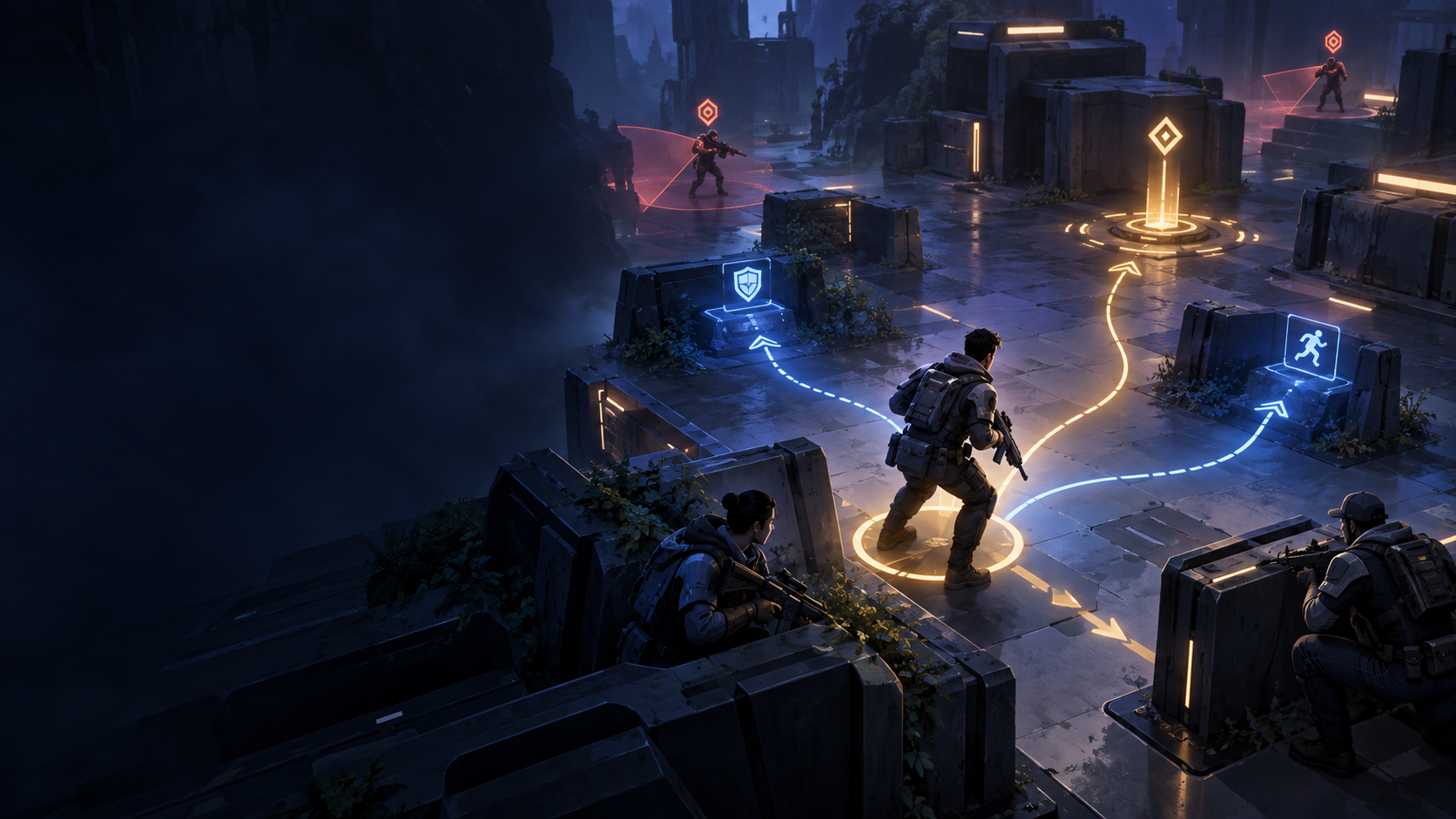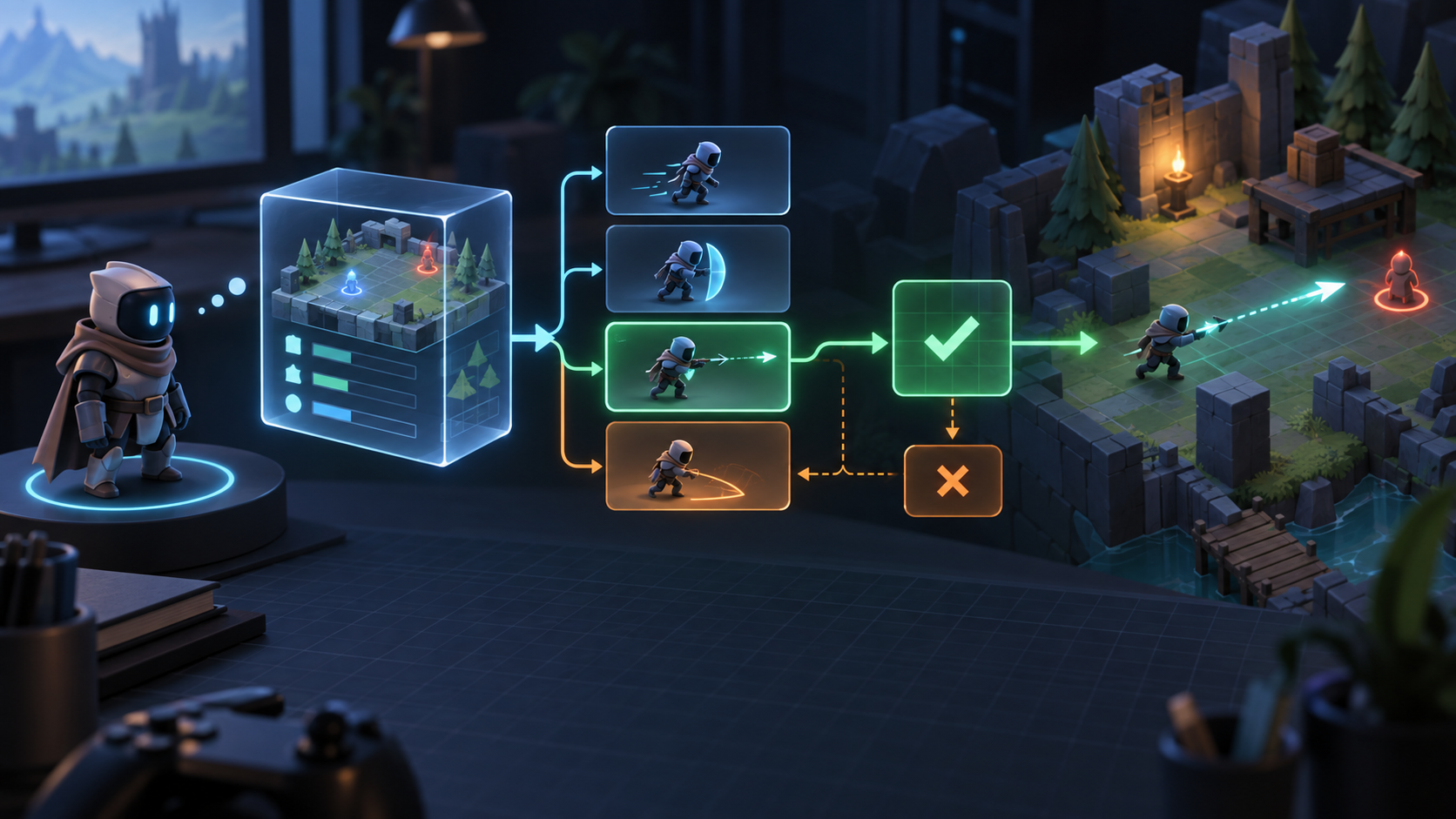
JEV は、生成されたゲームの応答性を高めるのに役立ちますが、それ自体でゲーム全体を生成するわけではありません。完全なゲームは、コンテンツ、ルール、コード、アセット、シミュレーション、およびプレイヤー向けシステムを組み合わせたものです。 JEV は、そのスタックの 1 つの重要な部分に貢献します。それは、Game State が変更されたときの NPC の戦術アクションの選択です。この区別により、一般的なカテゴリ エラーが防止されます。シーン、キャラクター モデル、またはゲームプレイ コードのブロックを生成することは、キャラクターが実行時に何をすべきかを決定することとは異なります。最初の問題はコンテンツの作成です。 2 つ目は、ライブ制約の下での限定された意思決定です。JEV はゲームを生成できますか?JEV は AI 支援ゲーム生成ワークフローに参加できますが、ワンクリック ゲーム ジェネレーターではありません。生成モデルは、コンセプトをシーン、アセット、スクリプト、または再生可能なプロトタイプに変えることができます。言語モデルは、対話、クエスト、計画に役立つ場合があります。 JEV は、プロトタイプまたは製品版ゲーム内で NPC の決定コントラクトを提供できます。有用な結果は分業です。各システムには明確な入力、出力、および権限の境界があります。これにより、制約なしで世界を発明し、すべてのシステムを記述し、すべてのキャラクターを制御することを要求される単一のモデルよりも、結果のテストが容易になります。_4 つの部分の分業モジュールプライマリ責任
_世代モデルシーン、キャラクター、アセット、レベル、スターターを生成するコード。LLMヘルプ対話、物語、テキスト、デザインの探求、そしてより長い視野を備えた計画中。
_
選択ゲームによって公開される実行可能な選択肢からのリアルタイムの戦術アクションとターゲット。ゲーム コードとエンジン独自のルール、物理学、国家権限、ネットワーキング、ナビゲーション、アニメーション、実行。これらの境界は単に組織的なものではありません。これらは、チームがゲームをデバッグする方法を決定します。 NPC が壁を通り抜ける場合は、ナビゲーションまたは衝突が原因である可能性があります。有効な選択肢から不適切なターゲットを選択した場合は、決定契約またはポリシーが調査の対象となります。生成されたコードがインターフェイスに違反している場合は、生成および検証パイプラインに注意が必要です。プロンプトから再生可能なループまで狭い概念を生成する:_ ジャンル、プレイヤー ループ、ロール、リソース、勝敗を定義する条件。決定論的スケルトンを配線します:
状態、ルール、物理、入力、および小さなセットを実装します。アクション。NPC コントラクトを定義します:_ 各ロールが監視できる内容と許可されるアクションを選択しますselect.Add JEV:_ループ。シミュレーションとテスト:_ シナリオを再生し、Choice を検査し、目標を調整します。制約。狭いループから始めることが重要です。生成されたプロトタイプには多くの魅力的なシステムが含まれている可能性がありますが、NPC の決定が有用かどうかを評価するための構造はほとんどありません。ヒーラー、ディフェンダー、および 1 つの目標を備えた小さなアリーナでは、テスト不可能な大規模な世界よりも、意思決定層の質についてより多くのことが明らかになります。JEV が生成されたNPC の判断を向上させる方法生成されたNPCは、多くの場合、信頼できるアクション モデルが作成される前に外観とダイアログが追加されます。 JEV は、NPC が何を知っているか、何を望んでいるのか、何が許可されているのかをゲームに要求することで役に立ちます。生成されたキャラクターには、ガード、アシスト、探索、撤退、交渉などの役割固有のアクション セットを持たせることができます。エンジンは引き続き前提条件をチェックする責任を負います。これにより、個性と信頼性が両立します。慎重なキャラクターは、遮蔽物と生存により多くの価値を割り当てることができます。攻撃的な性格はプレッシャーを好む可能性があります。スカウトは情報に優先順位を付けることができます。これらの設定は、世界への任意のアクセスを許可することなく選択に影響を与える可能性があります。資産生成と意思決定生成が異なる理由画像または 3D モデル ジェネレーターは、ゲームに入る前にレビューできる表現を生成します。実行時の決定は変化するシステム内で発生し、公平性、ペース、プレイヤーの信頼に影響を与える可能性があります。そのため、意思決定の生成には、状態コントラクト、Legal Actions、レイテンシ バジェット、検証、および フォールバックs が必要です。同じ生成されたアセットは多くのシーンで再利用できますが、敵が動いたり能力が中断された後に決定を再計算する必要がある場合があります。両方を同じ種類の世代として扱うと、間違ったアーキテクチャと間違った品質指標が発生します。JEV は AI ゲーム開発に当てはまりますローグライクの場合、JEV は、生成されたコンテンツが部屋と遭遇を提供する間、敵がどのようにターンを過ごすかを選択できます。分隊ゲームの場合、コードが移動と複製を処理しながら、役割を意識した応答を選択できます。サバイバル ゲームの場合、探索、クラフト、避難所、脅威の回避のバランスをとることができます。ソーシャル シミュレーションの場合、LLM がより長い対話や計画を処理している間に、制限付きの即時アクションを選択できます。各例では、実行可能な選択肢を公開するのに十分な世界がすでに定義されているため、JEV が重要です。これは、ゲーム ループの設計に代わるものではありません。これは、ループをよりコンテキストに依存させる方法です。結果の評価方法有効性:_ 選択されたアクションはすべて現在の条件を満たしていますか前提条件?品質:_ そのアクションは明らかに無駄なくロールの目的を前進させますか?リソース?公平性:_ NPC は、プレーヤーが合理的に使用できない情報を使用せずに挑戦的なままですか?推論しますか?応答性:_ 決定はゲーム内に届きますか?予算?リプレイ可能性:_ 同様の状況は、ランダムではなく有用な範囲の結果を生成しますか?ノイズ?デバッグ可能性:_ チームは状態、応答、および状態を再現できますか?結果は?責任ある運用アーキテクチャ権限のある Game State をエンジンまたはサーバーに保持します。意思決定リクエストに対する小さな状態予測を構築します。パラメータと前提条件を含む法的措置リストを公開します。 JEV がインテントを返すようにします。現在の状態に照らして検証し、既存のコマンド システムを通じて実行し、リクエストがタイムアウトするか古くなった場合に、作成された動作にフォールバックします。このアーキテクチャには、他の AI システムを導入できる余地が残されています。生成モデルは、コンテンツ パイプラインを改善し続けることができ、LLM は、JEV を汎用モデルにすることを強制することなく、クリエイターとキャラクターをサポートできます。決定の概念を 1 か所で確認するには、JEV とは?
を参照してください。最初の統合を構築するには、JEV チュートリアル_. に従ってください。
| Module | Primary responsibility |
|---|---|
| Generation model | Generate scenes, characters, assets, levels, and starter code. |
| LLM | Help with dialogue, narrative, text, design exploration, and longer-horizon planning. |
| JEV | Select real-time tactical actions and targets from the legal options exposed by the game. |
| Game code and engine | Own rules, physics, state authority, networking, navigation, animation, and execution. |
These boundaries are not merely organizational. They determine how a team debugs the game. If an NPC walks through a wall, navigation or collision is the likely owner. If it chooses a poor target from valid options, the decision contract or policy is the place to investigate. If generated code violates an interface, the generation and validation pipeline needs attention.
From a prompt to a playable loop
- Generate a narrow concept: define the genre, player loop, roles, resources, and win or loss conditions.
- Wire the deterministic skeleton: implement state, rules, physics, input, and a small set of actions.
- Define NPC contracts: choose what each role can observe and which actions it may select.
- Add JEV: call it at decision points rather than asking it to replace the loop.
- Simulate and test: replay scenarios, inspect choices, and tune objectives and constraints.
Starting with a narrow loop is important. A generated prototype may contain many attractive systems but little structure for evaluating whether an NPC decision was useful. A small arena with a healer, a defender, and a single objective can reveal more about the quality of the decision layer than a large untestable world.
How JEV gives generated NPCs better judgment
Generated NPCs often have appearance and dialogue before they have a reliable action model. JEV helps by requiring the game to state what the NPC knows, what it wants, and what it is allowed to do. The generated character can have a role-specific action set such as guard, assist, search, retreat, or negotiate. The engine remains responsible for checking preconditions.
This makes personality compatible with reliability. A cautious character can assign more value to cover and survival; an aggressive character can favor pressure; a scout can prioritize information. Those preferences can affect selection without granting arbitrary access to the world.
Why asset generation and decision generation are different
An image or 3D model generator produces a representation that can be reviewed before it enters the game. A runtime decision happens inside a changing system and can affect fairness, pacing, and player trust. That is why decision generation needs state contracts, legal actions, latency budgets, validation, and フォールバックs.
The same generated asset can be reused across many scenes, while a decision may need to be recomputed after an enemy moves or an ability is interrupted. Treating both as the same kind of generation leads to the wrong architecture and the wrong quality metrics.
Where JEV fits in AI game development
For a roguelike, JEV can choose how an enemy spends a turn while generated content supplies rooms and encounters. For a squad game, it can select a role-aware response while code handles movement and replication. For a survival game, it can balance exploration, crafting, shelter, and threat avoidance. For a social simulation, it can choose a bounded immediate action while an LLM handles longer dialogue or planning.
In each example, JEV is valuable because the world is already defined enough to expose legal options. It is not a substitute for designing the game loop. It is a way to make that loop more context-sensitive.
How to evaluate the result
- Validity: Does every selected action satisfy current preconditions?
- Quality: Does the action advance the role's objective without obviously wasting resources?
- Fairness: Does the NPC remain challenging without using information the player could not reasonably infer?
- Responsiveness: Does the decision arrive within the game's budget?
- Replayability: Do similar situations produce a useful range of outcomes rather than random noise?
- Debuggability: Can the team reproduce the state, response, and outcome?
A responsible production architecture
Keep the authoritative game state in the engine or server. Build a small state projection for the decision request. Expose a legal-action list with parameters and preconditions. Let JEV return an intent. Validate it against the current state, execute it through an existing command system, and fall back to authored behavior when the request times out or becomes stale.
This architecture leaves room for other AI systems. Generation models can keep improving the content pipeline, and LLMs can support creators and characters, without forcing JEV to become a general-purpose model. To see the decision concept in one place, read What Is JEV?. To build the first integration, follow the JEV tutorial.