_A JEV NPC は、脳全体がモデルに委託されているキャラクターではありません。これは、戦術決定層が状態の変化を評価し、ゲームがすでに合法としているアクションの中から選択するゲーム キャラクターです。知覚、動き、アニメーション、能力、世界ルールはゲーム内に残ります。認識から行動へ堅牢な NPC パイプラインには明確な段階があります。認識によってキャラクターが何を知っているかが決まります。状態予測は関連する事実を要約します。アクション ビルダーは正当な Choice を作成します。 JEV は決定を評価します。エグゼキュータは選択されたインテントを実行します。 フォールバック ポリシーはタイムアウトまたは無効な応答を処理します。NPC 状態には何を含める必要がありますか?役割、健康状態、スタミナ、目に見える脅威、ターゲット距離、カバー候補、味方のニーズ、目標ステータス、クールダウン、弾薬、在庫制限、現在のアクション、および関連するメモリが含まれます。非表示の情報と生のエンジン オブジェクトを除外します。状態は、レベル内のすべてのオブジェクトではなく、次に意味のある Choice を変更する可能性があるものを説明する必要があります。攻撃、撤退、回復、それとも探索?これらのChoiceは、実際のトレードオフを明らかにします。攻撃により脅威は除去される可能性がありますが、NPC が公開される可能性があります。撤退は性格を維持するかもしれないが、目的を放棄するかもしれない。ヒールはクールダウンを消費しながら味方を助けることができます。探索するとルートが明らかになる可能性がありますが、リスクは高まります。ゲームは厳しい前提条件を定義します。 JEV は、コンテキスト内の実行可能な選択肢を比較するのに役立ちます。JEV とビヘイビア ツリービヘイビアー ツリーは、移動、待機、ナビゲーションの再試行、アビリティの再生などの透過的なシーケンスに優れています。 JEV は、ツリーが詳細を実行するときにブランチをアクティブ化するインテントを選択できます。これにより、モデルの寄与がテストしやすくなり、実行パスが馴染みやすくなります。
JEV および有限状態マシンFSM は、パトロール、警戒、戦闘、逃走などの明示的なモードを維持できます。 JEV は、モード内の遷移または高レベルのアクションの選択に役立ちますが、制限のない状態グラフを暗黙的に作成するべきではありません。遷移を監視可能な状態に保ち、安全性が重要な変更を決定論的なコードで処理させます。NPC はどのくらいの頻度で質問する必要がありますか?イベントと制限付き戦術タイマーを使用します。脅威が出現したとき、アクションが終了したとき、目標が変更されたとき、目標を失ったとき、クールダウンが可能になったときを再検討してください。フレームごとの呼び出しは避けてください。低レベルのモーションは最後に検証されたインテントで続行されますが、遅れたリクエストは安全にフォールバックします。フォールバック は NPC 設計 の一部です役割とリスク別にフォールバックを選択してください。負傷した仲間は身を守るために移動できます。警備員は目標を保持できます。民間人は定められたルートに沿って逃げることができます。ボスは現在のフェーズを継続できます。すべての フォールバック の理由を記録して、設計者が誤った決定とタイムアウトまたは古いターゲットを区別できるようにします。JEV の評価方法認識できる情報のみを受け取りますか?Choiceは現在意味を持っていますか?状況は?返されたすべてのアクションを検証して実行できますか?モデルが次の場合に安全に続行されますか?利用できませんか?チームは同じ状態を再現して結果を検査できますか?役割固有の意思決定契約NPC ロールが異なると、異なる状態ボキャブラリーとアクションボキャブラリーが必要になります。警備員は、パトロール、調査、援護、追跡、または保留を選択できます。ヒーラーは、ヒール、カバー、撤退、またはアシストを選択できます。民間人は隠れたり、逃げたり、助けを求めたり、日常生活を続けることを選択することができます。 1 つの汎用プロンプトを再利用すると、動作が曖昧になることがよくあります。役割固有の契約により、テストとバランシングの両方がより明確になります。隠された全知のない短期記憶NPC は、最後に確認された脅威、中断された行動、最近の同盟国の要求、または既知の危険なルートを記憶できます。有効期限と信頼性を備えた明示的な状態としてメモリを保存します。記憶を、登場人物が知ることのできなかった事実を明らかにする無制限の記録に変えないでください。メモリ予測は、それが次の決定に影響を与える理由を説明する必要があります。行動の質を妥当性とは別に測定有効なアクションが必ずしも良いアクションであるとは限りません。契約の有効性、戦術的な結果、目標の進捗状況、生存、チームのサポート、プレーヤーの認識、待ち時間、フォールバック レートを個別の指標として追跡します。常に法的措置を選択するが目的を放棄する警備員には、API の問題ではなく、バランスの問題があります。JEV が適切なツールではない場合固定アニメーション、安全インターロック、正確なチュートリアル ビート、サーバー権限チェック、または考えられる答えが 1 つだけある決定には、作成されたロジックを使用します。経路探索にはナビゲーションを使用し、マルチステップの実行にはビヘイビア ツリーを使用します。 JEV は、いくつかの意味のあるアクションが正当であり、最適なアクションがコンテキストに応じて変化する場合に価値を追加します。NPC レビュー チェックリスト設計者は現在の状態と候補となるアクションについて説明できますか?NPCは許可されたもののみで動作しますか?認識していますか?アクションの遷移は観察可能ですか?フォールバック は信頼できるものですか?役割?プレイヤーはキャラクターの意図を理解できますか?QA は正確な役割を再現できますか?遭遇しましたか?より広範なアーキテクチャについては、JEV ゲーム AI を参照してください。 API の詳細については、JEV API の使用方法 を参照してください。 Unity については、JEV Unity チュートリアル_. に進みます。
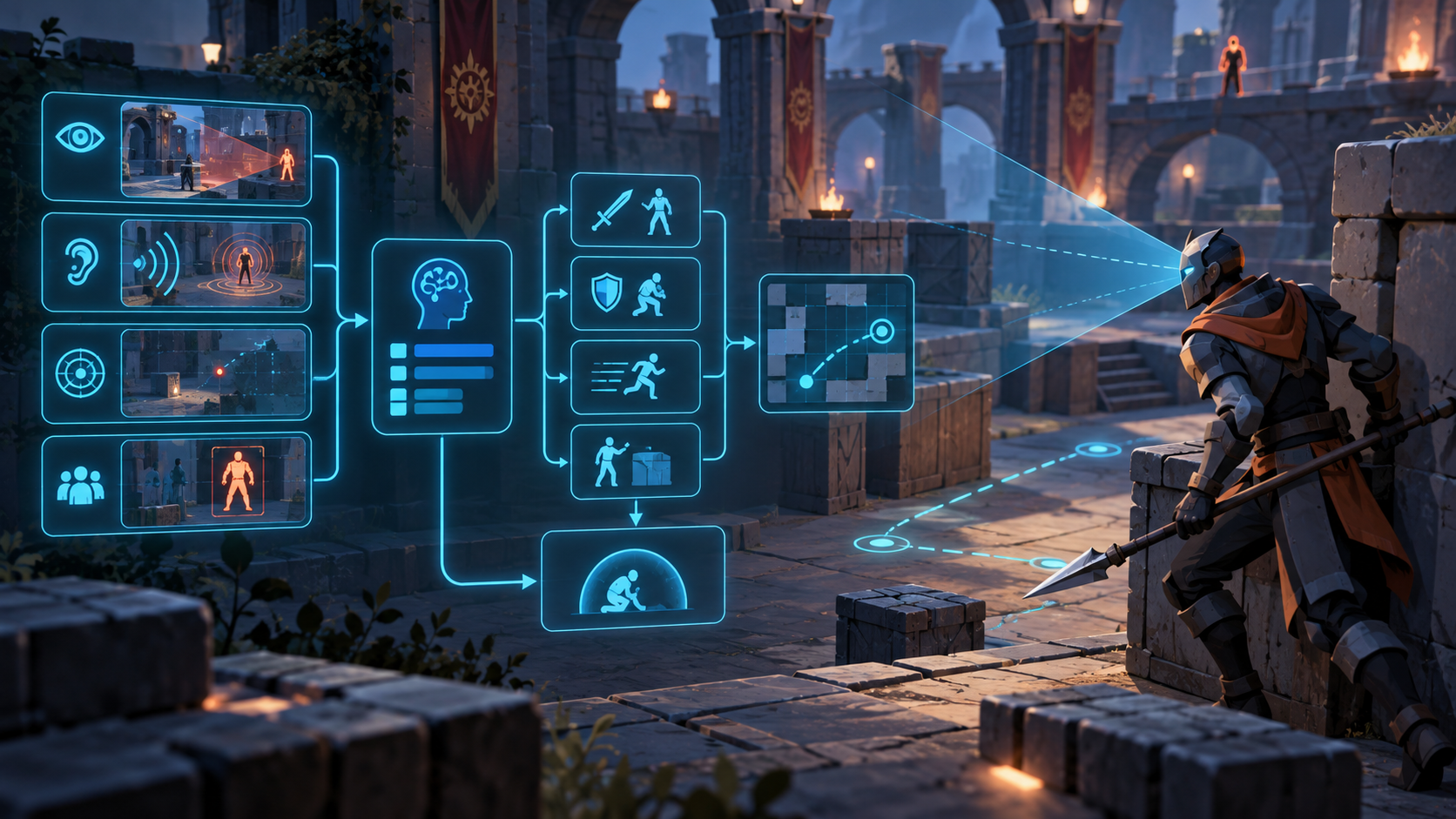
A robust NPC pipeline has distinct stages: perception determines what the character knows; state projection summarizes relevant facts; an action builder creates legal choices; JEV evaluates the decision; an executor runs the selected intent; and a フォールバック policy handles timeouts or invalid responses.
What should NPC state contain?
Include role, health, stamina, visible threats, target distance, cover candidates, ally needs, objective status, cooldowns, ammunition, inventory constraints, current action, and relevant memory. Exclude hidden information and raw engine objects. The state should describe what could change the next meaningful choice, not every object in the level.
Attack, retreat, heal, or explore?
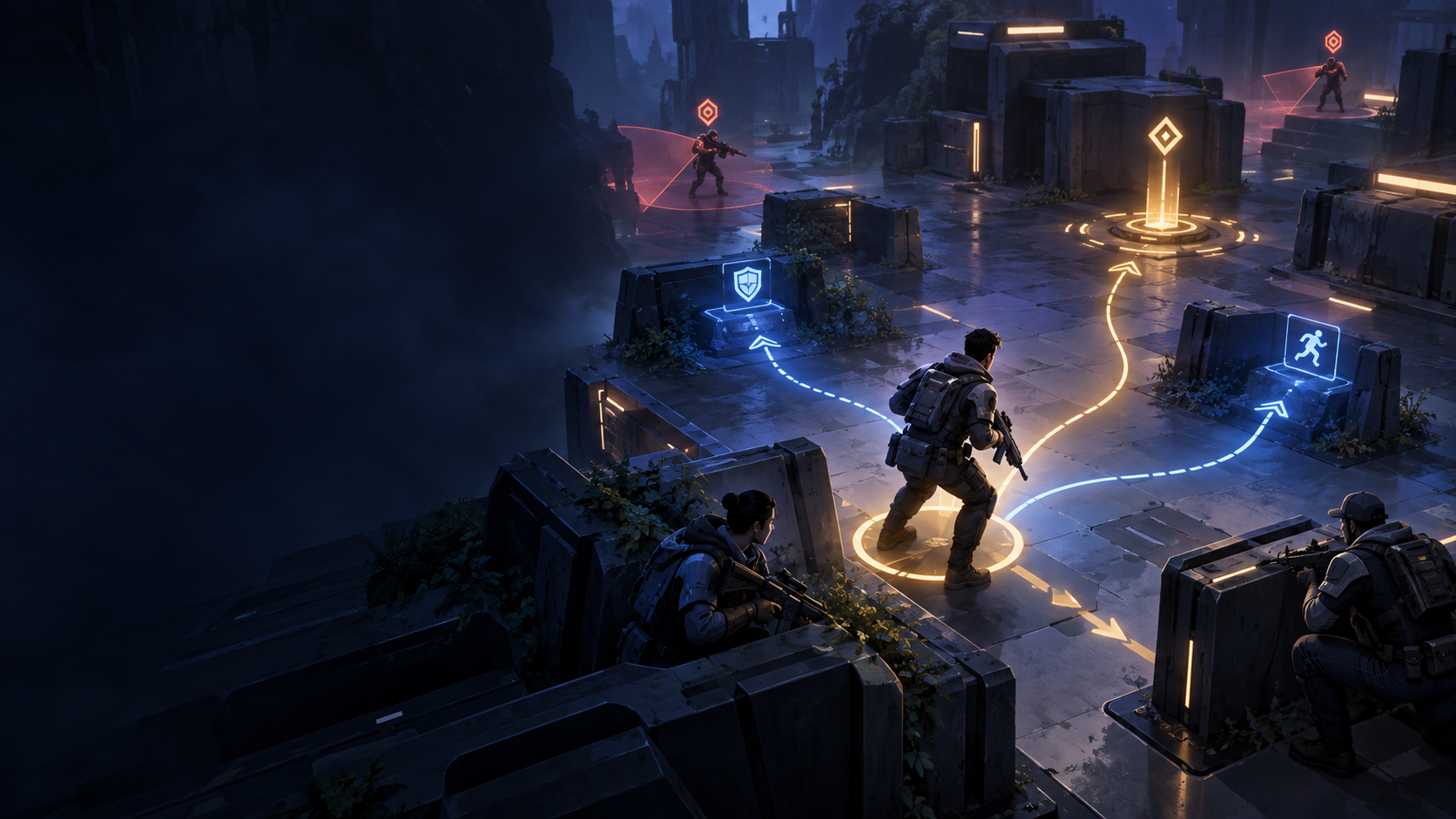
These choices expose real trade-offs. Attack may remove a threat but expose the NPC. Retreat may preserve the character but abandon an objective. Heal may help an ally while consuming a cooldown. Explore may reveal a route while increasing risk. The game defines hard preconditions; JEV helps compare legal options in context.
JEV and behavior trees
Behavior trees are strong at transparent sequences such as moving, waiting, retrying navigation, and playing an ability. JEV can select the intent that activates a branch while the tree executes the details. This keeps the model's contribution narrow enough to test and the execution path familiar.
JEV and finite-state machines
An FSM can keep explicit modes such as patrol, alert, combat, and flee. JEV can help choose a transition or high-level action inside a mode, but it should not silently create an unbounded state graph. Keep transitions observable and let deterministic code handle safety-critical changes.
How often should an NPC ask?
Use events and a bounded tactical timer. Reconsider when a threat appears, an action finishes, the objective changes, a target is lost, or a cooldown becomes available. Avoid per-frame calls. Low-level motion continues on the last validated intent while a late request falls back safely.
Fallbacks are part of NPC design
Choose フォールバックs by role and risk. A wounded companion can move to cover; a guard can hold the objective; a civilian can flee along an authored route; a boss can continue its current phase. Record the reason for every フォールバック so designers can distinguish a poor decision from a timeout or stale target.
How to evaluate a JEV NPC
- Does it receive only information it could perceive?
- Are the choices meaningful in the current situation?
- Can every returned action be validated and executed?
- Does it continue safely when the model is unavailable?
- Can the team replay the same state and inspect the outcome?
Role-specific decision contracts
Different NPC roles need different state and action vocabularies. A guard may choose patrol, investigate, call backup, pursue, or hold. A healer may choose heal, take cover, retreat, or assist. A civilian may choose hide, flee, seek help, or continue a routine. Reusing one universal prompt often makes the behavior vague; role-specific contracts make both testing and balancing clearer.
Short-term memory without hidden omniscience
An NPC can remember the last seen threat, an interrupted action, a recent ally request, or a known unsafe route. Store memory as explicit state with expiration and confidence. Do not turn memory into an unrestricted transcript that reveals facts the character could not know. The memory projection should explain why it can influence the next decision.
Measure behavior quality separately from validity
A valid action is not necessarily a good action. Track contract validity, tactical outcome, objective progress, survival, team support, player perception, latency, and フォールバック rate as separate metrics. A guard that always chooses a legal action but abandons the objective has a balance problem, not an API problem.
When JEV is not the right tool
Use authored logic for a fixed animation, a safety interlock, an exact tutorial beat, a server authority check, or a decision with only one possible answer. Use navigation for pathfinding and a behavior tree for multi-step execution. JEV adds value when several meaningful actions are legal and the best one changes with context.
NPC review checklist
- Can a designer explain the current state and candidate actions?
- Does the NPC act only on permitted perception?
- Are action transitions observable?
- Is the フォールバック believable for this role?
- Can a player understand the character's intent?
- Can QA replay the exact encounter?
For broader architecture, read JEV Game AI. For API details, see JEV API usage. For Unity, continue to JEV Unity tutorial.