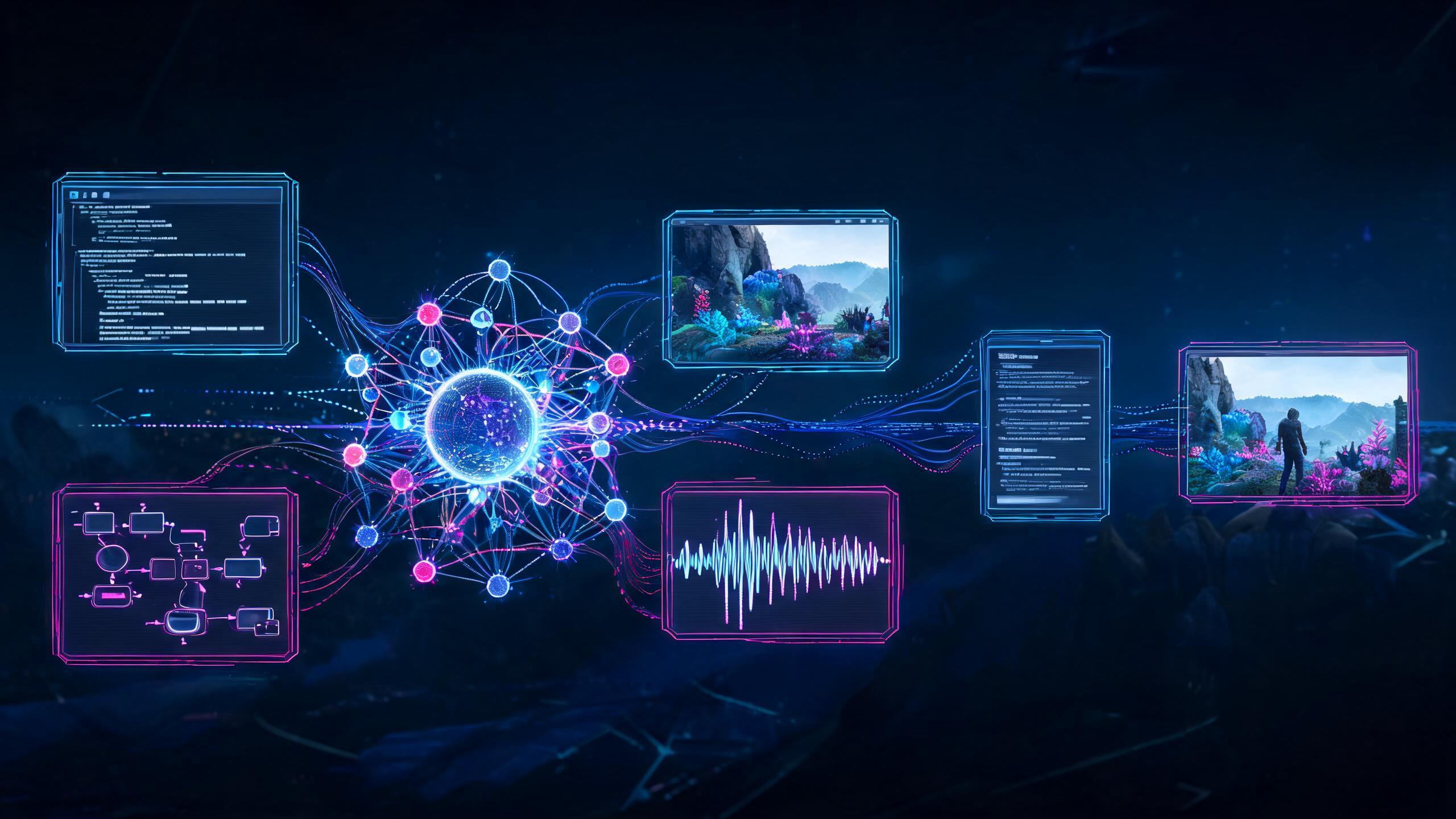
Visual guide for Latest AI Models for Unreal Engine Game Development (2026 Tracker)
Key Takeaways: Latest AI Models for Unreal Engine Game Development (2026 Tracker)
- latest ai models for unreal engine game development 2026: As of July 21, 2026, the current Unreal model watchlist includes GPT-5.6, Kimi K3, Claude Sonnet 5, Gemini 3.5, Muse Spark 1.1, and the newly released Inkling open-weight multimodal model. Kimi K3 still leads the exact-term seven-day US, UK, and Germany trend comparison, while Inkling is too new for a stable trend signal. None has a universal Unreal advantage: run the same source-controlled C++, Blueprint, log, planning, security, and recovery tests.
- This guide keeps the answer version-aware and testable: identify the owning Unreal systems or public evidence, validate the result, and keep native Unreal 5 game, browser preview, optimization, packaging, and download evidence separate from third-party model claims.
1. Current answer and July 21 data boundary
The latest useful AI-model list for an Unreal team is not a single leaderboard. As of July 21, 2026, GPT-5.6, Kimi K3, Claude Sonnet 5, Gemini 3.5, Muse Spark 1.1, and the July 15 Inkling release are current frontier or agentic candidates verified from first-party pages. Inkling also joins DeepSeek V4, Qwen3.6, GLM-5.2, MiniMax M3, Gemma 4, and Leanstral 1.5 in the separate open-weight or local-deployment evaluation. Seedance 2.0, Sora 2, Veo 3.1 Lite, Seedream 5.0 Pro, and Nano Banana 2 Lite belong in a media-reference evaluation. These groups solve different production jobs and should not be collapsed into one winner.
The July 21 SerpAPI Google Trends refresh used the same seven-day five-term frontier comparison in the United States, United Kingdom, and Germany. Kimi K3 averaged 23, 24, and 23 respectively; GPT-5.6 averaged 5, 8, and 2; Gemini 3.5 averaged 3, 1, and 1. Inkling AI did not yet produce a stable exact-term trend signal in a separate comparison. Values are normalized inside each group, so they indicate current relative search attention rather than adoption, quality, or Unreal capability.
2. Verified current frontier and agentic models
| Model | Verified status | Unreal-relevant evaluation job | Do not infer |
|---|---|---|---|
| GPT-5.6 | OpenAI release, July 9 | difficult C++ review, planning, tool use, and long task execution | native Unreal integration or automatic packaged-build correctness |
| Kimi K3 | Kimi release, July 16 | large-repository review, visual context, planning, and controlled coding tasks | that its browser 3D demo is an Unreal plugin |
| Claude Sonnet 5 | Anthropic release notes, June 30 | agentic coding, review, and tool-use baselines | access in every product, region, or plan |
| Gemini 3.5 | Google I/O 2026 update | multimodal and long-horizon comparison tasks | that every preview model ID is stable for production |
| Muse Spark 1.1 | Meta release, July 9 | tool use, computer use, coding, and multimodal evaluation | broad availability or Unreal-specific support |
| Inkling | Thinking Machines release, July 15; Apache-2.0 weights | multimodal evidence review, long repository tests, customization, and controlled coding | native Unreal integration, low hardware cost, or automatic packaged-build correctness |

Use vendor claims to choose tests, not to declare results. For example, a claim about long context justifies a repository-navigation test with hidden acceptance checks. A multimodal claim justifies a Blueprint screenshot and log-correlation test. A tool-use claim justifies a least-privilege action test with an audit log and rollback. None justifies granting write access to a real game repository before the model passes those gates.
3. Protect pages that already earn search traffic
The live Search Console export for the previous 24 hours recorded 6 clicks and 1,568 impressions across 159 Unreal URLs. The Kimi K3, UE 5.8, and MCP compatibility page produced 3 clicks from 7 impressions at an average position of 2.86. Its title, canonical, direct answer, and primary intent are therefore frozen in this expansion. This tracker links to that focused page instead of rewriting it or creating a near-duplicate Kimi compatibility article.
The same rule applies to the UE 5.8 FBX checklist, which earned one click from 13 impressions. New model pages must add a distinct decision job: release tracking, open-weight deployment, or media previsualization. They should not cannibalize proven import, MCP, or engine-release queries. This is also why the tracker uses model rows and links rather than publishing one thin page for every name.
4. Three reproducible Unreal evaluation slices
C++ defect slice. Give every model the same small plugin module, compiler error, relevant engine-version documentation, and test target. Require a patch, an explanation of ownership and lifetime, and a command list. Score compile success, test success, unsupported API claims, changed lines, and recovery from an intentionally misleading comment. Keep the repository disposable and compare diffs blind.
Blueprint and visual slice. Provide exported Blueprint graphs or approved screenshots, the corresponding log excerpt, and a precise symptom. Ask the model to trace execution without pretending it can inspect hidden pins or runtime state. Score whether it asks for missing evidence, keeps Blueprint and C++ boundaries clear, and proposes a reversible editor-side test. A confident answer based on unreadable pseudo-details is a failure.
Production-planning slice. Provide a representative feature brief, target hardware, team size, source-control policy, and acceptance date. Ask for a vertical-slice plan with gameplay ownership, content dependencies, performance checkpoints, packaging, and rollback. Score whether the plan names measurable gates and preserves the native Unreal validation boundary instead of promising that an AI output is already a shippable game.
5. Open-weight and media models stay separate
Open-weight models add questions that hosted frontier comparisons do not answer: what artifact was released, which license applies, whether a quantized runtime fits available memory, how updates are patched, and who owns security monitoring. The dedicated open-weight guide compares Inkling, DeepSeek V4, Qwen3.6, GLM-5.2, MiniMax M3, Gemma 4, Leanstral 1.5, and Kimi K3's announced weight release without calling unavailable weights local-ready.

Media models add a different boundary. A generated video can be a shot reference, storyboard, or approved final media, but it is not an editable Unreal level. The media guide compares Seedance, Sora, Veo, Seedream, and Nano Banana around camera intent, continuity, provenance, rights, and Sequencer recreation. Separating these intents reduces duplication and gives readers a concrete next decision.
6. Upcoming means announced, not rumored
The tracker records only dated first-party commitments. Kimi states that full K3 weights will be released by July 27, 2026, so the status is “announced,” not “available locally.” DeepSeek says legacy API names are scheduled to retire on July 24, 2026; that is a migration deadline, not a new-model rumor. Preview labels, model aliases, and deprecation dates are recorded separately because availability can change without a new model launch.
Unconfirmed names, leaked benchmarks, social screenshots, and “expected soon” articles do not enter the release table. When an official event occurs, update the source date, status, model ID, availability, and replacement guidance. Preserve the prior value in git so search snippets and operational decisions remain auditable.
7. Selection, routing, and refresh checklist
Start by naming one Unreal job and the artifact that proves success. Choose two or three models with verified access, then run the same input and rubric. Record model ID, date, effort or reasoning mode, tools, permissions, context, latency, token or run cost, output diff, test result, reviewer, and rollback. Route only the winning job; do not move every task to one model because it led an unrelated benchmark.
Refresh official release and lifecycle pages weekly while launches are active. Refresh exact-term trend comparisons with the same terms and window; changing comparison groups changes the scale. Review Search Console after publication and protect pages that earn clicks. Expand into a dedicated page only when a model has distinct search intent and enough first-party evidence to support a useful workflow rather than a copied release summary.
8. Example routing record for a small Unreal team
Suppose a three-person team has one gameplay programmer, one technical artist, and one designer. The programmer's first job is a C++ compilation and lifecycle review. The technical artist needs a Blueprint screenshot and log triage pass. The designer needs a two-week combat-prototype plan. Run every candidate on all three tasks, but route them independently: the best code patch does not automatically win visual diagnosis or planning.
For the code task, require the smallest compiling diff and a test command. For the visual task, require an evidence request when graph details are unreadable and a reversible editor test. For planning, require a playable promise, acceptance map, performance target, packaging checkpoint, and rollback. Record reviewer scores before revealing model names to reduce brand bias.
The resulting record might route model A to code review, model B to planning, and no model to direct editor actions. That is a valid outcome. Re-test the route when model IDs, effort settings, prices, policies, tools, or Unreal versions change. If the new result loses an accepted capability, keep the previous route or fall back to manual review instead of silently lowering the gate.
SEELE AI can generate a native Unreal 5 game, preview it in-browser, optimize and package it, and provide a downloadable game or packaged build for external publishing or paid Seele games. Sales are not guaranteed.
Official sources
- GPT-5.6 release
- Kimi K3 launch
- Claude release notes
- Google I/O 2026 Gemini update
- Muse Spark 1.1 release
- Inkling announcement
- Inkling model card
- Inkling for Unreal evaluation guide
- Open-weight model guide
- AI video model guide
- Kimi K3 UE 5.8 MCP test plan
FAQs
Which AI model is best for Unreal Engine in 2026?
There is no universal winner. Test the same C++, Blueprint, log, visual-review, planning, and recovery tasks, then choose by measured quality, latency, cost, privacy, and rollback.
Is Kimi K3 currently the hottest new model?
In the July 21 seven-day US, UK, and Germany exact-term comparison, Kimi K3 remained the strongest launch-attention signal. Relative trend does not prove adoption, quality, or superiority.
What is the newest model added to this Unreal tracker?
Inkling, released July 15 by Thinking Machines Lab, is the newest verified addition. It has open weights and multimodal inputs but no official Unreal integration.
Does a model need an Unreal plugin to be useful?
No. A model can help with review and planning through controlled files and screenshots, but editor actions require a separately verified integration and permission boundary.
How often should the tracker be refreshed?
Refresh official availability weekly during active launches, trend data on the same cadence, and immediately when a vendor announces retirement, pricing, licensing, or model-ID changes.
Are rumored model releases included?
No. Upcoming entries require a dated first-party announcement. Rumors, benchmark leaks, social speculation, and copied snippets stay outside the release table.
Can SEELE AI compile the recommended Unreal changes?
No. SEELE AI can help plan or prototype a direction, but native C++, Blueprint, plugins, cooking, packaging, and target-hardware validation remain Unreal game work.