An open zone needs a boundary and a reason to roam
An open-zone adventure RPG does not need a continent-sized map to feel exploratory. It needs a region the player can understand, more than one way to make progress, and a destination that makes those routes matter. The design document should show how the paths connect and what changes when the player reaches each location.
This template describes one small fictional region with a hub, two optional clue branches, a shared gate, and a beacon objective. It is designed to make the route logic concrete enough for a first implementation brief. The place names, paths, flags, and quest are invented examples, not a tested game. The prompt drafts have not been run, and no playable build or test result is included.
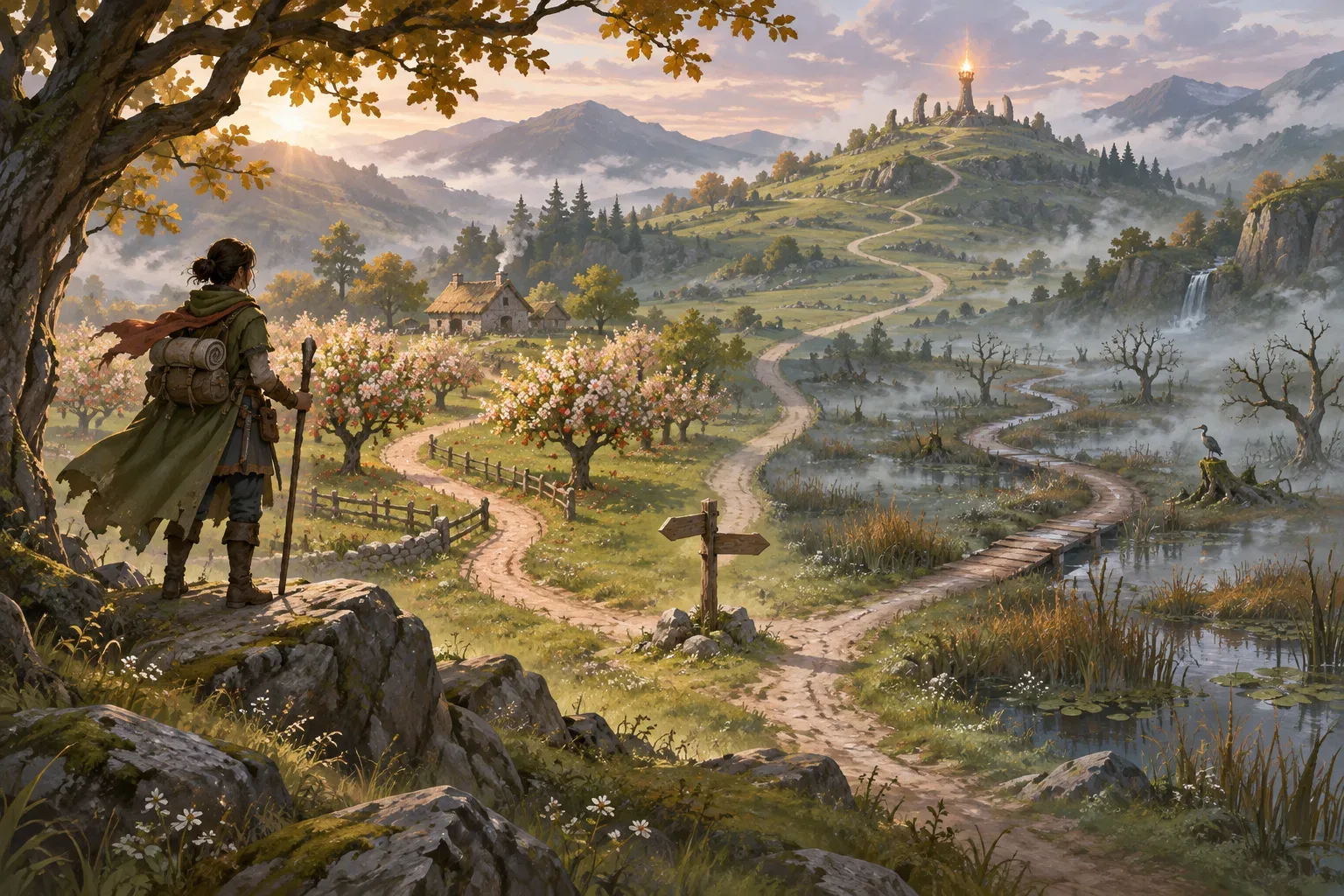
Begin the document with a player-facing sentence: “Find and restore the Skyglass Beacon, then return to Waypost to report what changed.” That sentence gives every location a job. The Waypost introduces the objective; the side routes offer information and a choice of approach; Wind Gate joins both branches; and the beacon completes the first quest milestone.
Now state what the slice leaves out. This example has no combat, crafting, inventory weight, day-night schedule, random encounters, or fast travel. Excluding them is not a judgment about the finished RPG. It keeps the initial route small enough that a creator can inspect navigation, state changes, and player feedback before widening the world.
Write the route graph before describing every landmark
List the locations and connections in a compact graph. A node is a place the player can enter and act; an edge is a traversable route. This simple graph is easier to validate than a paragraph that describes “a winding forest path that eventually reaches the mountain.”
Waypost (hub)
├── Amber Orchard ──┐
└── Glass Fen ──────┴── Wind Gate ── Skyglass Beacon
                                           │
                          locked return shortcut to Waypost
The fictional route inventory is:
- Waypost connects to Amber Orchard and Glass Fen.
- Amber Orchard and Glass Fen each connect to Wind Gate.
- Wind Gate connects to Skyglass Beacon.
- A direct Beacon-to-Waypost return shortcut starts locked.
Then document the branch rule. Discovering the clue in either the Orchard or the Fen opens Wind Gate. The clue is not consumed, and a player can explore the second branch before or after reaching the gate. That rule creates a meaningful route choice without making one side path a mandatory key hunt.
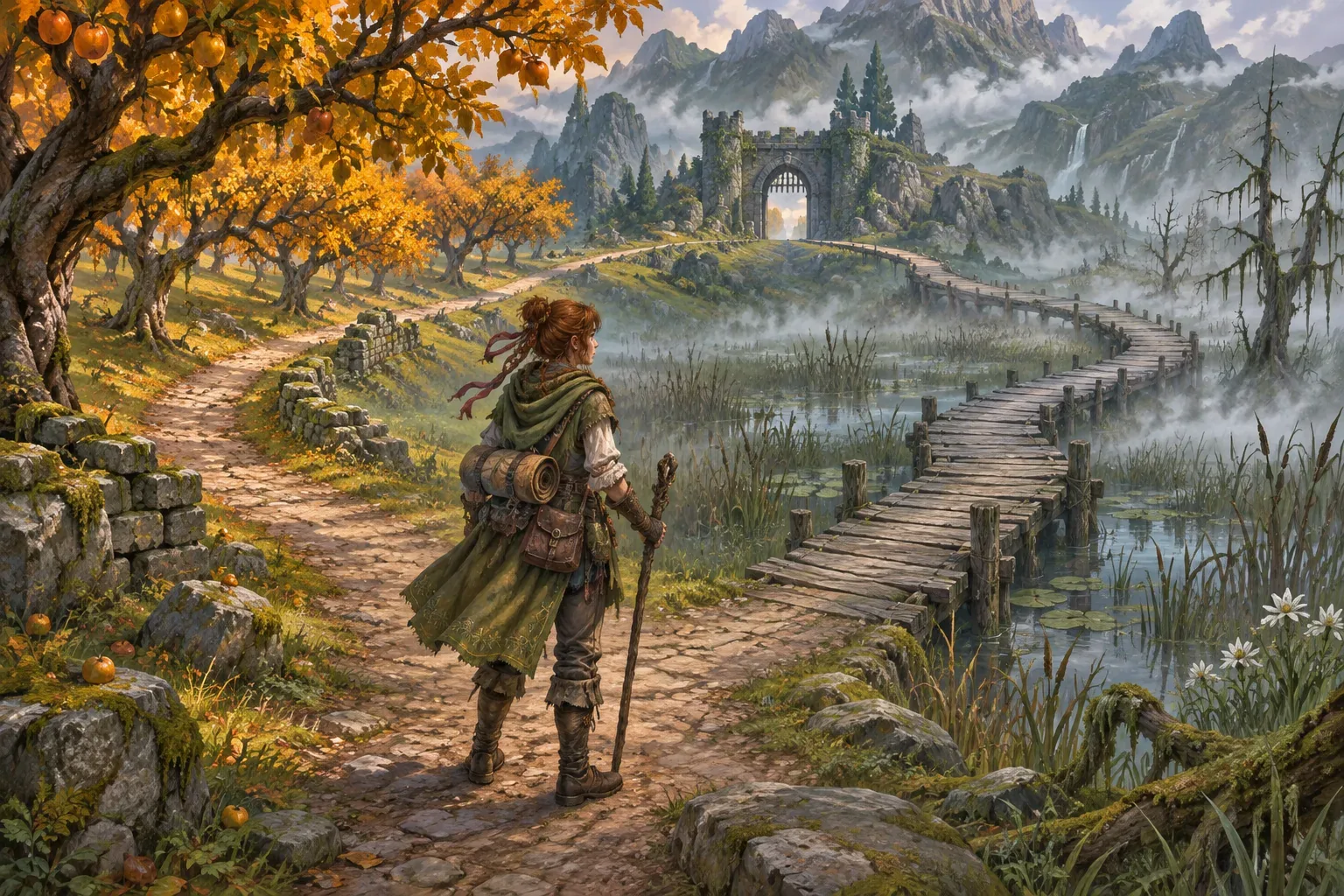
A small map also exposes edge cases. Can the player return to the hub before restoring the beacon? Is the gate still open if they leave and come back? Does the optional second clue remain available? Write the answers as route and state rules rather than expecting a builder to infer them from the map artwork.
Define quest state, transitions, and player feedback
Store quest progress in named flags. Each flag should have a trigger and a visible consequence. For this slice, begin with `orchardClue=false`, `fenClue=false`, `beaconRestored=false`, `returnShortcutOpen=false`, and `nextRegionRevealed=false`.
| Event | State change | Feedback to the player |
|---|---|---|
| Find the clue in Amber Orchard | `orchardClue=true` | A wind-carved mark points toward Wind Gate. |
| Find the clue in Glass Fen | `fenClue=true` | A reflected beacon pattern reveals the same gate route. |
| Approach Wind Gate with either clue | Gate becomes open | Stone bars lift; the requirement is named in a short line. |
| Restore Skyglass Beacon | `beaconRestored=true`; `returnShortcutOpen=true` | The beacon lights and a stair opens toward Waypost. |
| Report at Waypost after restoration | `nextRegionRevealed=true` | A map or NPC response points to the next region. |
The exact message is part of the design, not decoration. When the gate remains blocked, say that a clue is needed and point back toward the two branches. When it opens, show the gate changing. When the shortcut becomes available, make its entrance visible from the beacon side and confirm the destination. That feedback helps a player understand why the world changed.
Separate access from knowledge. The flags determine whether routes are available; character dialogue can reveal context without secretly changing those flags. If an NPC mentions the Beacon before the player finds a clue, that should not accidentally open the gate unless the design explicitly says so. A state table gives a later implementer one source of truth.
Use one record format for every location
A location template lets the map and quest document agree. Give each place a stable ID, a short purpose, neighboring nodes, entry conditions, the player’s immediate objective, state triggers, exits, and revisit behavior. For example:
{
  "id": "glass_fen",
  "role": "optional clue branch",
  "neighbors": ["waypost", "wind_gate"],
  "entryRequirements": [],
  "playerGoal": "Find the reflected beacon pattern",
  "stateChanges": ["fenClue=true"],
  "exitFeedback": "The pattern points to Wind Gate",
  "revisitBehavior": "Clue stays found; path remains traversable"
}
Use the same fields for the hub, the other branch, the shared gate, and the beacon. If two places use different rules, note why. This makes it possible to ask for one location at a time while preserving the same names and state variables across later prompts.
Keep narrative facts local and useful. A clue can explain why a path matters, but the first region does not need several pages of history. Give the player a clear immediate task, a clue that relates to the beacon, and a sign of progress when the state changes. Leave broader lore, factions, and additional regions as future work unless they affect this objective.
Check both branches with the same destination
Before implementation, hand-trace the route graph twice. In the first trace, travel from Waypost through Amber Orchard, set `orchardClue=true`, open Wind Gate, reach Skyglass Beacon, restore it, take the return shortcut, and report at Waypost. The expected final state is `orchardClue=true`, `fenClue=false`, `beaconRestored=true`, `returnShortcutOpen=true`, and `nextRegionRevealed=true`.
In the second trace, replace the Orchard with Glass Fen. The expected result is the same except `fenClue=true` and `orchardClue=false`. This catches a common logic error: implementing one branch as the real route and leaving the other as scenery. It also checks that either clue is sufficient and that reporting back—not merely reaching the beacon—reveals the next region.
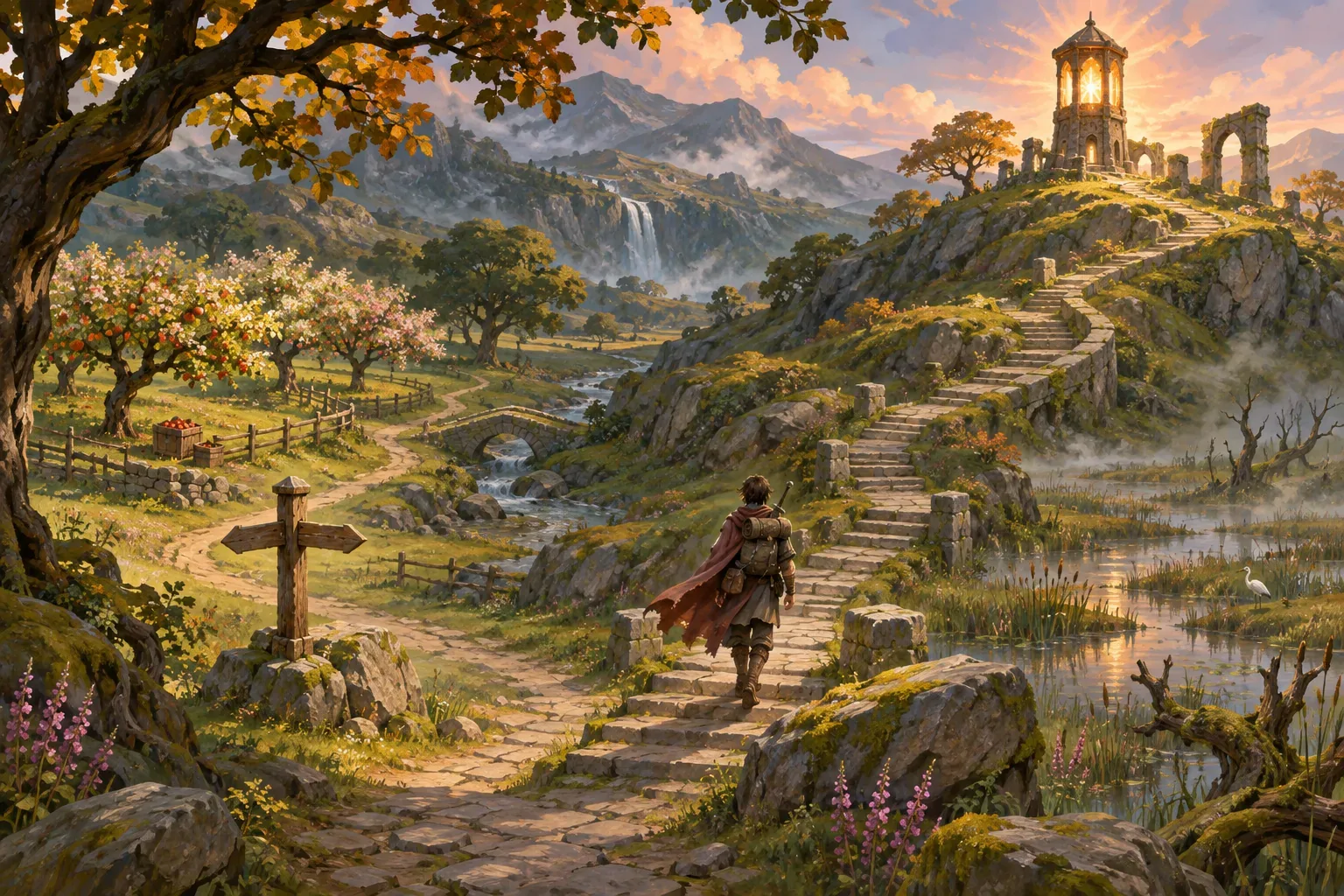
Turn those traces into acceptance checks: each side route can be entered and revisited; each clue updates only its own flag; either clue opens the gate; neither clue is consumed; the beacon can be restored once; the shortcut opens after restoration; and reporting at Waypost reveals the next region. Record expected states separately from observed states. An empty observation column means the check still needs to be run.
Turn the design document into staged prompt drafts
Keep one prompt focused on the region graph, one on quest state, and one on feedback. A final prompt can ask for the two route traces. This sequence is easier to inspect than a single request for an expansive RPG with a full world, cast, combat system, inventory, progression, and branching story.
Put stable names and rules directly in the prompt. Say that the region contains only the five listed locations; that the two clues use an OR gate; that the Beacon opens the return shortcut; and that talking at Waypost reveals the next region. Ask the builder to list unresolved assumptions instead of silently filling gaps. If later testing shows that players miss the branch choice, revise the route signposting or clue feedback rather than adding new regions immediately.
SEELE’s official AI RPG Maker page recommends beginning with a character goal, a quest objective, and a choice that changes what happens next, then keeping the route focused and checking consistency. That is general RPG-planning context; it does not verify this open-zone graph or promise these prompts will produce it. Explore the AI RPG Maker when you are ready to develop your own quest concept.
The example in this article remains a design exercise: no prompt was submitted, no game was generated, and neither route trace has been observed in a playable build. The template is ready to carry into a later creation and test pass, where the observed result can be compared with the documented state contract.
FAQ
What belongs in an open-zone adventure RPG design document?
Specify the player goal, region boundaries, locations and connections, available actions, quest states, character knowledge, progression gates, and testable acceptance checks.
How large should the first open-zone RPG region be?
Use enough locations to support a meaningful route choice, a shared objective, and a return path. The right size depends on the quest and is not a universal location count.
How do I describe a branching quest for an AI builder?
Name each branch, its locations and clues, the state it changes, where branches reconnect, and what feedback the player sees when a route is open or blocked.
Should both exploration paths be required to finish the first quest?
Only if collecting both is part of the intended challenge. A small milestone can let either clue path unlock the shared objective, then test that both routes work.
Is this open-zone RPG template tested in a playable game?
No. The region and quest are fictional design material. The prompt drafts are unrun, and no playable build or test result is included.