A nonprofit workshop can use a fictional scenario to make assumptions visible: what resources are available, what actions a team chooses, and which results the model shows. A cause-based simulation game template for nonprofit teams can help people compare options and surface questions for evaluation. A simulation is not a forecast, a community consultation, or proof that a program caused an outcome.
This guide uses Riverbend, a fictional neighborhood food access initiative. The organization, residents, resources, choices, and outputs are invented. No real people or program data are represented. Keep any real-world use separate from program eligibility, funding, or service decisions.
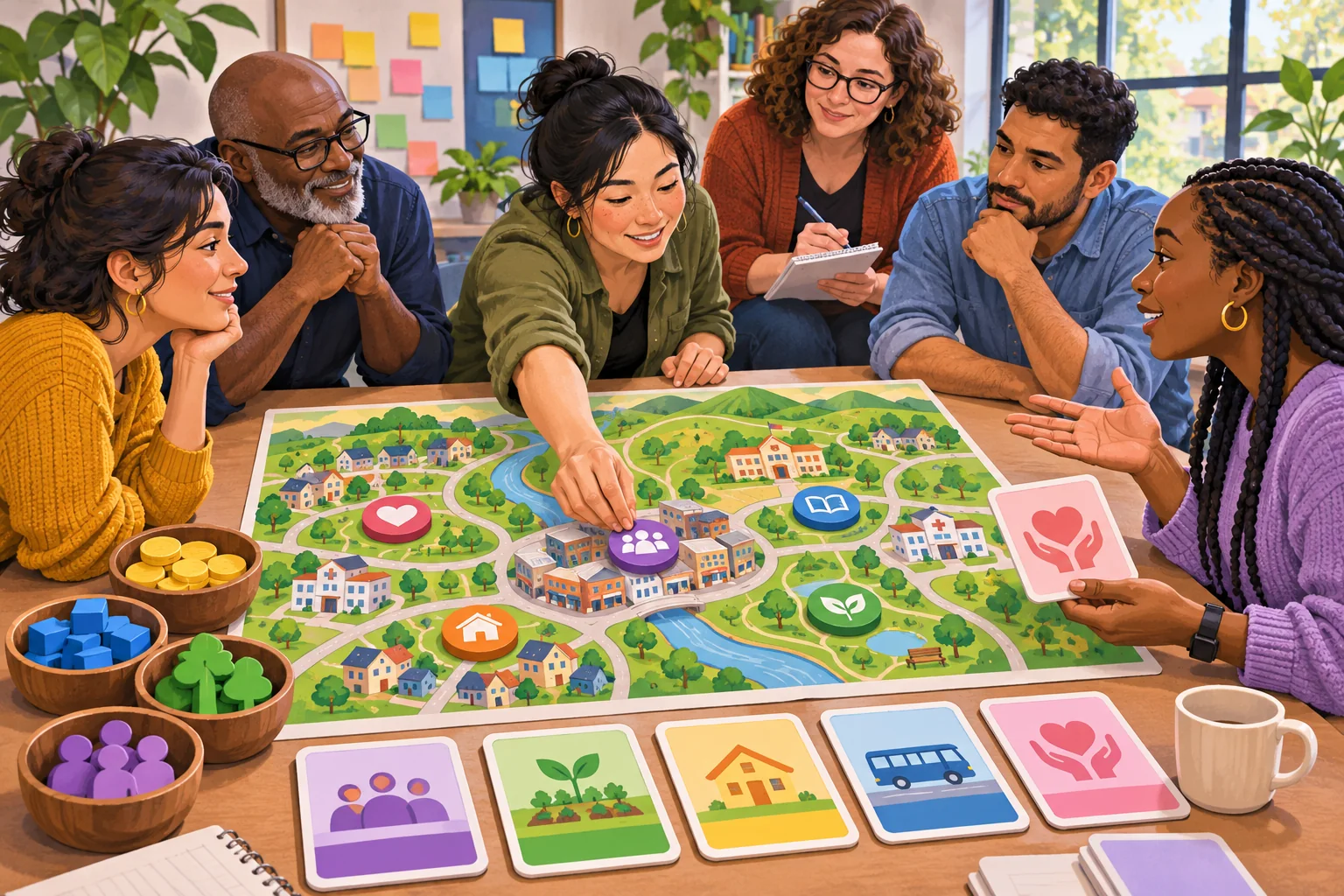
Set the purpose and boundary
Decide what participants should do: identify assumptions, compare options, spot missing information, or practice coordination. Avoid vague aims such as “solve food insecurity.” A short session can explore one decision within a larger issue, not represent the complexity of an entire community.
Write a boundary statement before designing the scenario. Name what the game can help a team discuss and what it cannot decide. For example: “This fictional exercise explores how volunteer hours and delivery routes affect a modeled distribution schedule; it does not estimate actual food access or determine who should receive services.”
Invite people affected by the issue to shape the discussion when appropriate, with consent, compensation, and safeguards. Do not use a simulation to stand in for lived experience. Explain who will see notes, whether participation is optional, and how a person can raise a concern or step out.
Map the intended change before adding game rules
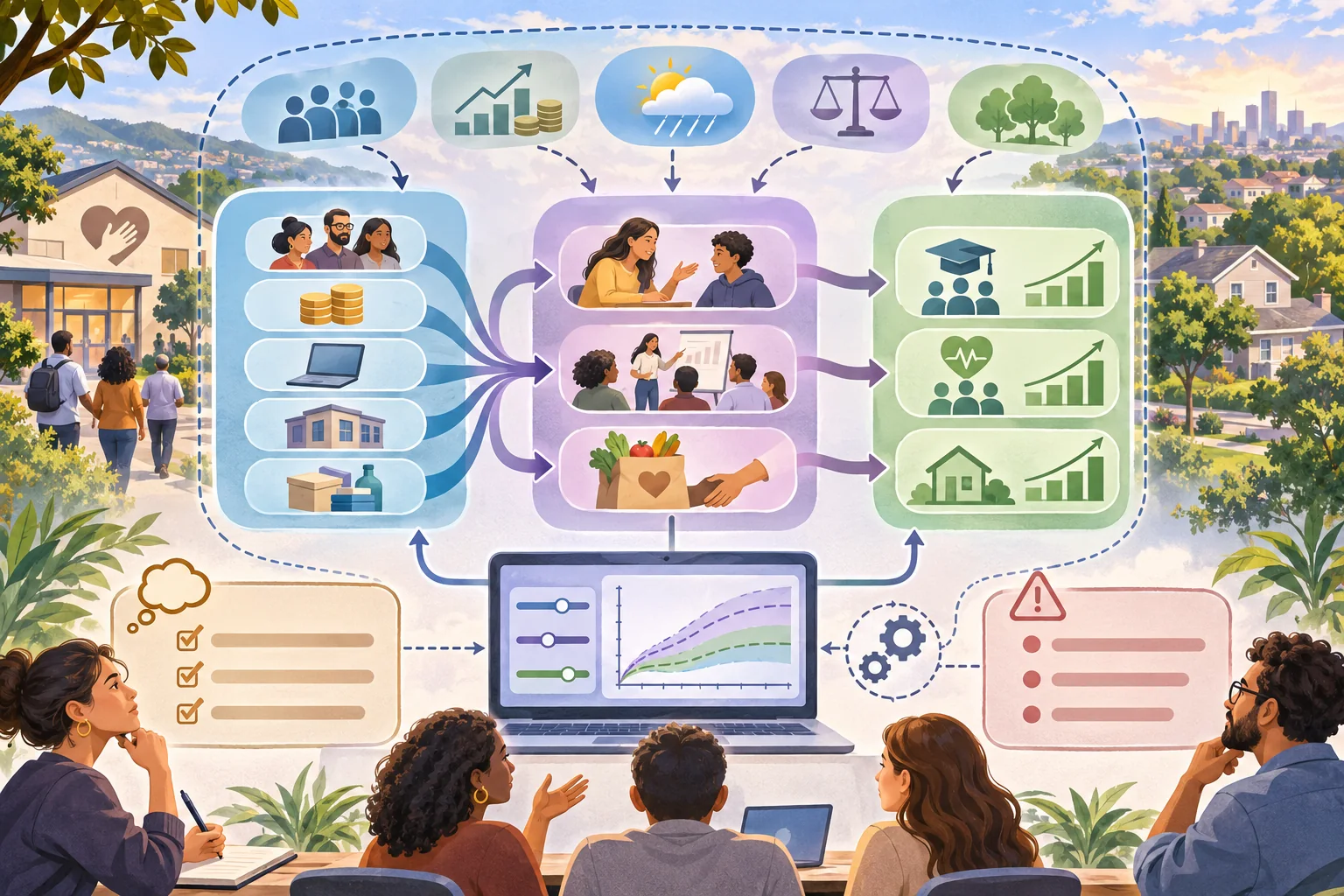
CDC describes a logic model as a depiction of activities and intended outcomes: how a program is supposed to work. It can help teams make their assumptions and sequence visible. It does not show that the relationships hold in practice. Evaluation asks what is happening and what evidence supports conclusions.
Sketch a simple chain for discussion: inputs → activities → outputs → short-term outcomes → longer-term outcomes. Add external conditions that could change the path, such as transport access, staffing, supply, language access, or policy. Mark which relationships are supported by existing evidence, which come from local experience, and which remain hypotheses.
Riverbend’s fictional map might connect volunteer hours to deliveries attempted, deliveries completed, and residents reporting that pickup is manageable. Each arrow requires assumptions: the route is accessible, food is available, timing fits, and residents want that service. Do not turn these illustrative links into an impact claim.

Build one decision loop
| Round | Facilitator presents | Team decides | Debrief question |
|---|---|---|---|
| Context | Fictional need and constraints | What information is missing? | Whose perspective is absent? |
| Resources | Staff, time, partner capacity | What can be allocated? | What tradeoff did we accept? |
| Action | Two or three response options | Which action is plausible? | Which assumption matters most? |
| Model response | Scenario-specific output | What would we observe next? | What did the model leave out? |
| Next question | Uncertainty or changed context | What evidence would help? | How would we study it? |
Use simple rules participants can understand. If one option costs more resources, show the assumption behind its modeled result. Avoid hidden formulas that create false authority. When the scenario changes, explain why and let people revisit the choice.
Separate roles by perspective, not by real-world status or identity. Use fictional role cards such as “route coordinator” or “data steward.” Do not assign participants to impersonate a marginalized group or ask them to disclose personal hardship to make the exercise feel authentic.
Make numbers illustrative and traceable
If a round uses values, label them as scenario parameters. Explain their units, source, and purpose. A made-up token count can support a conversation about tradeoffs, but it must not resemble measured program statistics. Consider using ranges or qualitative consequences when a precise-looking number adds no value.
Keep a model note with each parameter, who set it, what evidence informed it, and what remains unknown. Do not combine unrelated inputs into a single “impact score.” A game score can reward a design choice within the scenario; it cannot rank real communities or nonprofits.
Use AI for drafts with human review
AI can draft facilitator prompts, alternate scenarios, decision cards, or debrief questions. Ask for assumptions to be listed separately from facts. Review terminology, local context, safety, fairness, and accessibility with people who understand the issue. Do not put confidential client details, case notes, or identifiable community data into an unapproved tool.
Purpose: [discussion or planning question]
Fictional context: [clearly invented setting]
Inputs and actions: [resources, choices, units]
Assumptions: [explicit, reviewable statements]
Modeled response: [illustrative rule, not prediction]
Debrief: [uncertainty, missing perspectives, evidence needed]
Ask: identify hidden assumptions and unsafe framing.
Do not generate real impact claims or eligibility rules.
Keep an editor responsible for the final rules and content. Label AI-assisted drafts as drafts where useful, and independently verify any external factual statement before presenting it as fact.
Facilitate without turning the exercise into a decision system
Explain that participants may observe, pass, or leave the exercise. State whether notes are being taken and how they will be used. Give the facilitator a pause option and a private feedback route. If discussion surfaces real concerns, stop the game and handle them through the organization’s appropriate process.
Do not use game outcomes to allocate services, decide grants, screen applicants, or evaluate staff. The model deliberately simplifies. Its main value is to help a group ask better questions about relationships, context, and evidence.
Debrief the assumptions and evidence gaps
- Which input or rule drove the modeled result?
- What context or perspective was missing?
- Which relationship was supported by evidence and which was only assumed?
- What real observation would help us check the assumption?
- Who should be involved in shaping the evaluation question?
- What would make the exercise unsafe or misleading to repeat?
CDC evaluation guidance recommends identifying what evidence is needed to answer an evaluation question, including what data to collect, how, when, and from whom. Translate the debrief into a question and a feasible evidence plan. Do not treat the game’s internal model as collected evidence.
Document the scenario version, parameter choices, participant roles in general terms, and revisions needed. Do not publish identifiable comments without permission. Riverbend’s outputs are fictional and cannot support a claim about food access.
Test the facilitation plan before a workshop
Walk through the rules with a small internal review group. Check whether the purpose and limits are clear, whether all actions can be completed within the session, and whether the debrief distinguishes hypothetical outputs from evidence. Ask reviewers to flag language that sounds like a promise or blames people experiencing a structural problem.
Record actual feedback and changes. A walkthrough can reveal confusing instructions; it does not establish community validity or program effectiveness. If the workshop will involve affected groups, plan ethical participation separately from this fictional prototype and share how input will influence decisions.
Frequently asked questions
What is a cause-based simulation game?
It is a facilitated scenario where participants make choices about a social issue and see how a simplified model responds. It can help a team discuss assumptions, tradeoffs, and questions for further investigation. A simulation is not a forecast or evidence that an intervention will work in a real community.
How can nonprofits use a simulation game?
Teams can use a fictional scenario to surface assumptions, compare possible actions, and identify information gaps. Set a clear learning purpose, state what the model leaves out, and invite people with relevant lived or professional experience to review it. Do not use a classroom-style model to make real eligibility or funding decisions.
Can AI generate a cause-based simulation?
AI can draft scenario branches, role cards, debrief questions, or test cases. Humans must check context, fairness, factual accuracy, safety, and unintended framing. Do not put sensitive community data into an unapproved service, and do not describe simulated outputs as real program results.
How do you model cause and effect in a nonprofit game?
Start with an explicit theory of change: resources, activities, outputs, near-term outcomes, and longer-term outcomes, plus assumptions and context. CDC guidance describes logic models as intended relationships that can guide evaluation questions. Use the game to discuss those assumptions, then evaluate real effects with an appropriate design and credible evidence.
Can a simulation prove that a nonprofit program works?
No. A simulation runs according to its assumptions and rules; it does not establish what happened in a real program. CDC distinguishes a logic model describing intended relationships from evaluation evidence about how a program works or what effects occurred. Report modeled outputs as scenario results, not impact findings.
Need a structured starting point for a nonprofit workshop simulation? Explore the AI game creation workflow and adapt the scenario to your discussion boundaries.