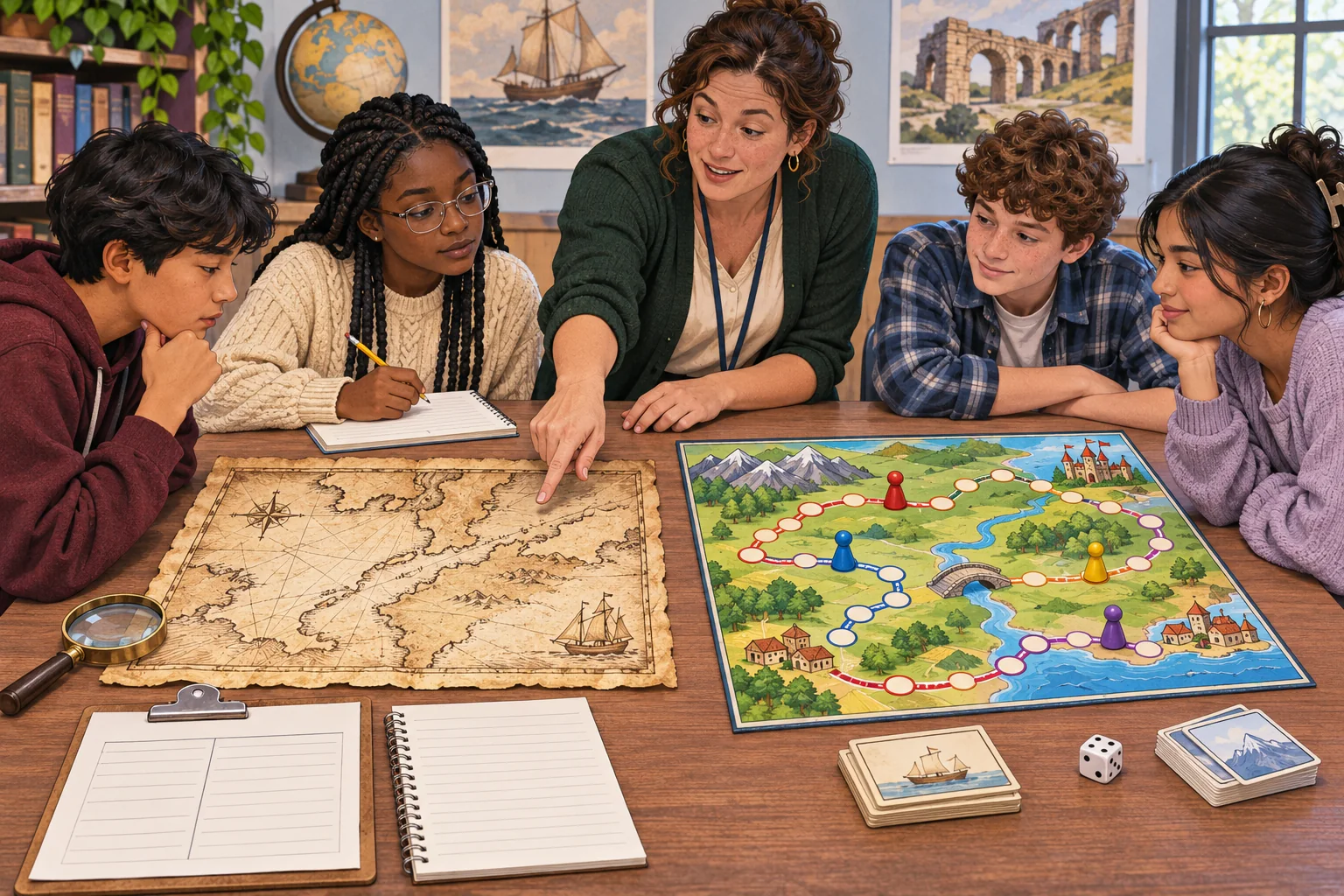
A classroom trade game can make a historical question tangible: what constraints shaped a route, which sources support a claim, and whose perspective is missing from the account? A good historical trade game template for history teachers lets students make a choice and then examine the evidence behind it. It keeps the model’s invented mechanics separate from the historical sources so play does not turn a simplified scenario into a false account.
This guide creates a source-led activity with editable routes, goods, events, and reflection prompts. Meridian and its network are fictional. Every price, travel time, resource, route condition, and game result is invented. The scenario is not evidence about any real historical trade system, and no students or classroom were tested. A teacher should replace or clearly juxtapose the model with approved sources before using it as a lesson.
Start with a historical question that needs evidence
Choose a question that students can investigate from available sources. For example: how might geography constrain a route? What does a trading record reveal about the choices of one merchant? Which people or activities appear in a map, and which are absent? State the period and region precisely once you select a real source. Do not use a generic “ancient trade” theme as if trade worked the same way everywhere.
The Library of Congress offers a Primary Source Analysis Tool and teacher guides that support observing, reflecting, questioning, and further investigation. Its guidance asks teachers to choose sources that fit the learning objective and to consider point of view, historical context, and comparison with other sources. That is an instructional method, not historical evidence for Meridian or proof that the game improves learning.
Choose the source before designing the game
Find a map, ledger, letter, image, or other document that supports the question. Record the source creator, date, place, format, intended audience or purpose when known, and collection link. Note what it can show and what it cannot establish by itself. A shipping record may preserve one institution’s transactions; it does not automatically represent all routes, people, or trade.
Let the source determine the game’s boundaries. If it names certain ports but gives no reliable travel time, do not invent exact historical durations. You can use a fictional “turn” system for play, but label it as a game mechanic and explain that it is not a period measurement. If students need prices or quantities to make choices, identify those values as synthetic unless a source supports them.
| Evidence field | Teacher records | Player sees |
|---|---|---|
| Source | Creator, title, date, collection, link | Readable excerpt or approved image |
| Observation | What is directly visible or stated | Details to inspect, not the answer |
| Inference | What a student may reasonably infer | A prompt to support the inference |
| Uncertainty | What remains unknown or contested | A question or missing evidence card |
| Game rule | Which mechanics are invented | Plain explanation of model limits |
Build one turn around a choice and a source note
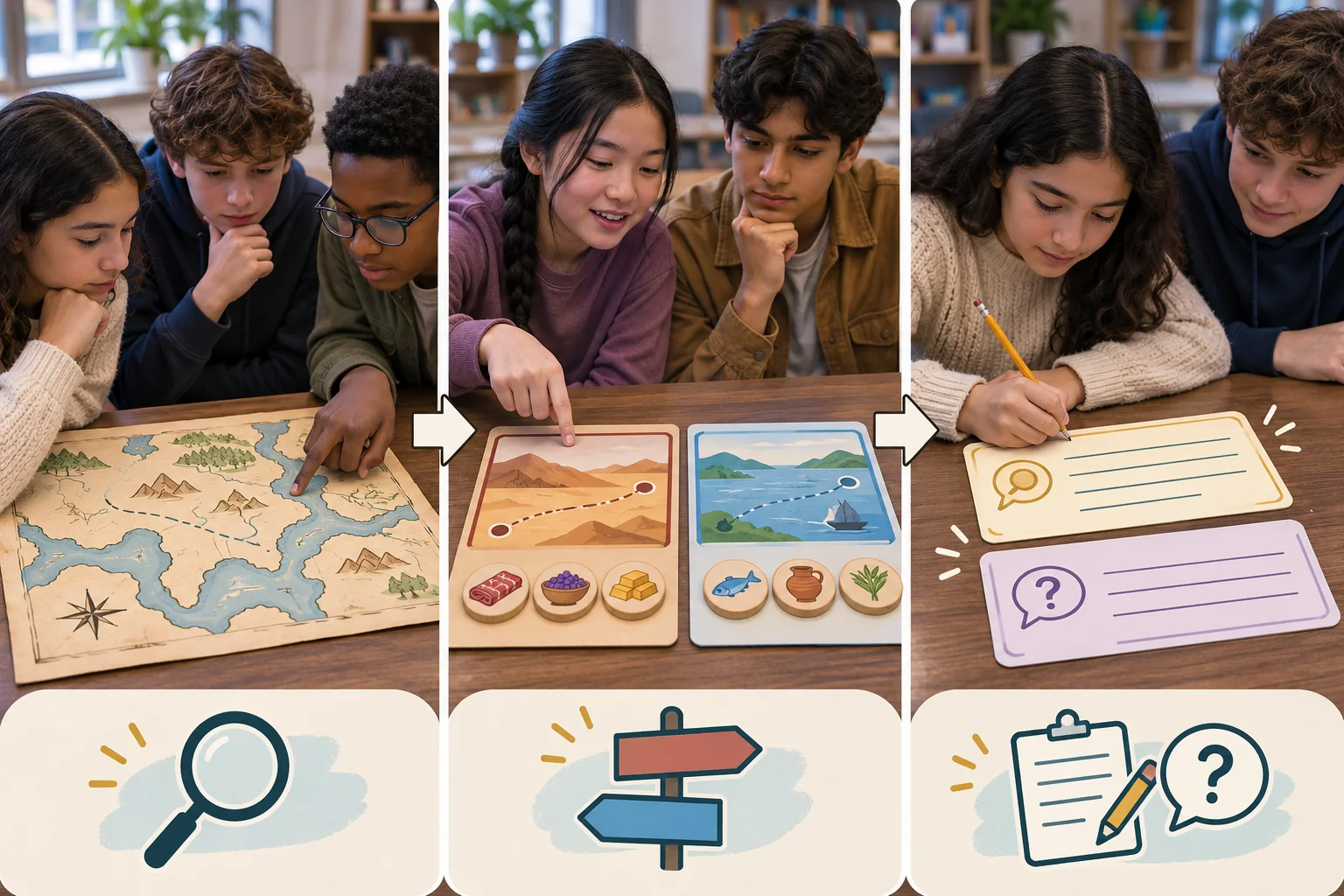
For the fictional Meridian example, a player chooses between two invented routes to move sample goods between ports. A constraint card changes the cost of the turn, then the player writes which clue from the source influenced the choice. Since Meridian and the numbers are fictional, the game does not claim to model a real economy. In a real lesson, the teacher would replace the prompt with a source-grounded decision and identify each simplified assumption.
Structure the turn so evidence is used before the outcome. The player observes the map or record, chooses a route, explains the reason, and sees a consequence within the model. Ask them to separate what the source shows from what the rule adds. A game can reward a carefully supported explanation even when students reach different route choices.
Period/region: [teacher selects and verifies]
Inquiry question: [one source-answerable question]
Primary source: [citation, collection link, excerpt or image]
Observation prompt: What do you see or read directly?
Choice: [two or more options consistent with the source]
Model rule: [invented mechanic, labeled as such]
Reflection: Which evidence shaped your choice? What remains uncertain?
Never label synthetic prices or travel times as historical measurements.
Use AI to draft alternatives from the teacher’s verified notes, not to fill missing history. Ask it to list claims that lack a supplied source, flag unfamiliar terms, and propose a counter-perspective. Then check every output. A fluent explanation can still mix regions, periods, or different trading systems.
Represent more than one perspective
Trade networks affected different people differently. A route-focused game can overemphasize merchants and cargo while omitting workers, local communities, taxation, coercion, environmental effects, or the people whose labor moved goods. Which perspectives belong in the lesson depends on the chosen period and evidence. Do not add a generic “perspective token” as a substitute for reliable context.
Ask whose voice the source preserves and who is absent. If you add a perspective card based on another source, cite it separately and explain why it belongs. Avoid inventing quotations or using a first-person student role that treats a real person’s experience as a game costume. When the source supports disagreement or uncertainty, let the activity retain that complexity instead of forcing one moral or economic score.
Let a score reflect reasoning, not historical “winning”
A game may use points to keep track of fictional resources, but the learning objective should remain visible. Consider separate checks for a source citation, clear reasoning, recognition of uncertainty, and respectful comparison of viewpoints. Do not equate the highest fictional profit with the “best” historical choice. A model’s reward system is a design decision, not a historical conclusion.
Provide a no-win or unresolved state when the sources do not support a single answer. Ask students what additional evidence they would seek. The final reflection can compare routes and assumptions rather than report a class winner. Make clear whether the result describes the model, a historical source, or the students’ interpretation.
Make historical sources and player choices accessible
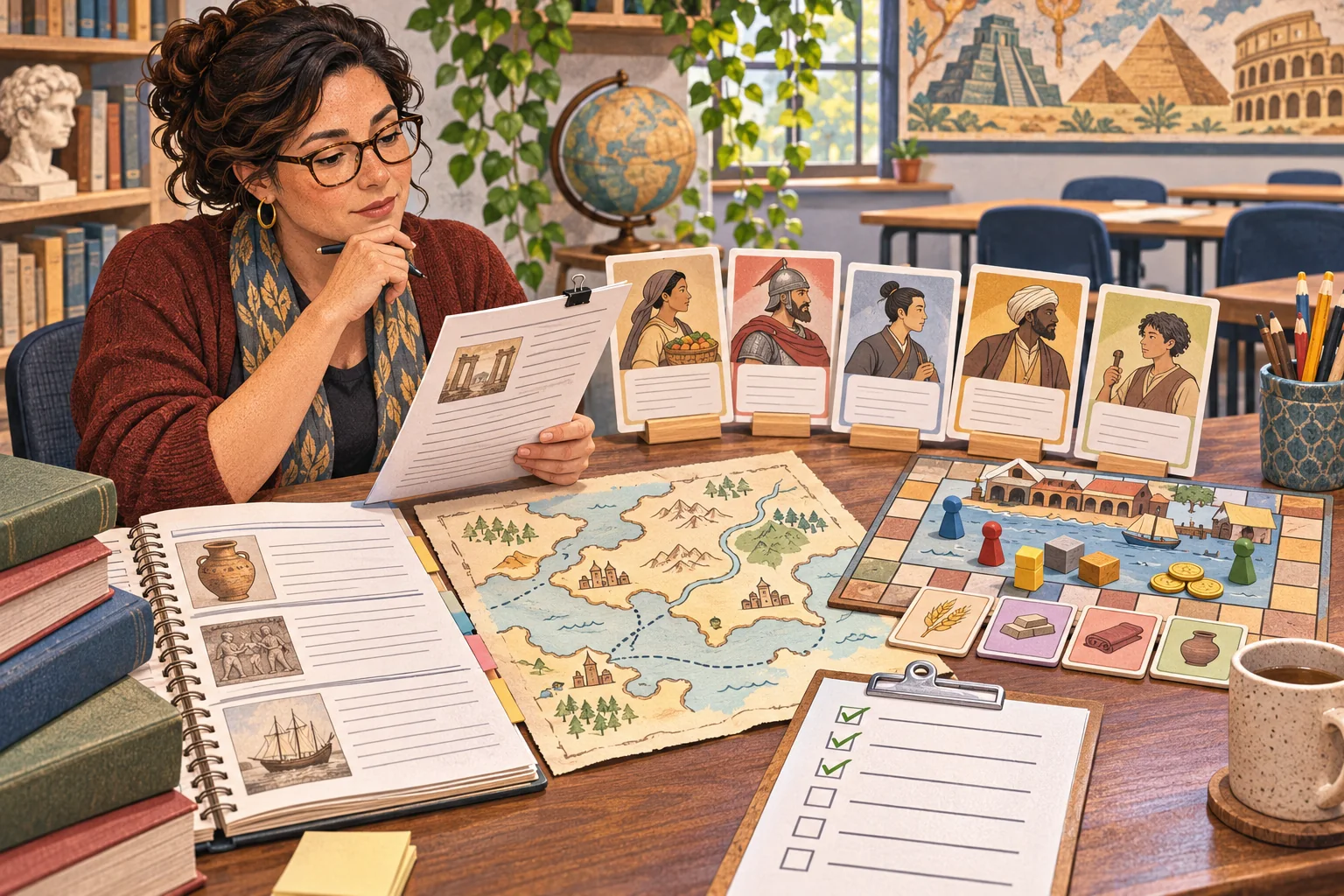
Provide a readable transcription or description where an image is hard to see. Preserve the source’s important features while marking any excerpt or crop. Use text labels, not color alone, to distinguish routes. Let students work individually, with a partner, or as a class if that fits the lesson. Do not require rapid movement or public performance to demonstrate understanding.
Check usage rights for any source image and follow the collection’s terms. A source available online is not automatically free for every reuse. If you use fictional sample documents for a local preview, label them prominently so no one mistakes them for archival material. Keep simulated screens clear of copied collection branding or fabricated citations.
Rehearse the content and mechanics separately
Review historical accuracy before technical flow. A history educator checks the source, context, period language, representation, and missing perspectives. A second reviewer can play every branch and look for missing states, contradictory rules, invalid input, reset behavior, and unclear outcomes. Record the build version and test result. This is a proposed plan; Meridian has not been built or tested with students.
- Can students identify the source and distinguish it from the game model?
- Does every historical statement link to a source with scope?
- Are invented values and mechanics labeled where students see them?
- Do choices reflect the selected question and source constraints?
- Are uncertainty and absent perspectives made discussable?
- Does the score avoid treating fictional profit as historical truth?
- Can students access the source and respond in more than one format?
- Can a teacher pause, reset, or skip the game if a source issue appears?
Capture what was reviewed, what was tested, and what remains open. A fictional walk-through or attractive mock map does not prove historical accuracy, student understanding, or classroom usability. If a real classroom pilot happens later, report its boundaries and actual evidence rather than generalizing from one use.
Package the game for reuse without carrying old assumptions
Keep the game engine separate from source content. The reusable mechanics define turns, choices, feedback, and reset. Each lesson supplies its own period, region, source set, terms, assumptions, and perspective notes. Version the source list and scenario together so a later revision does not leave an old citation attached to new content.
AI can speed up prompt drafting and help identify questions to investigate. The teacher decides which sources are suitable, whether the explanation is supported, and whether the game’s scoring distorts the lesson. Build from one source and one question, keep the model transparent, and let students question the game itself.
Frequently asked questions
What should a historical trade game teach students to do?
Focus on a historical reasoning action, such as comparing evidence about routes, goods, constraints, or points of view. Ask students to cite a source and distinguish what it shows from what the game assumes. A simplified classroom model can help structure inquiry, but it should not be mistaken for a complete or measured account of a historical economy.
How can AI help create a history trade game?
AI can draft scenario cards, route options, reflection prompts, and a facilitator guide from teacher-approved sources. It can also suggest questions about whose perspective is missing. Teachers must verify dates, places, goods, terminology, and source context, and reject invented claims. Label synthetic game mechanics and data clearly; an AI draft is not historical evidence.
How do primary sources fit into a trade game?
Use a primary source to give students something specific to observe, question, and interpret, such as a map, ledger, letter, or image selected by the teacher. Record its creator, date, purpose, and limits. The Library of Congress provides a student analysis tool and teacher guides for observing, reflecting, questioning, and investigating further; the source still needs historical context.
Should a history trade game reward profit or winning a route?
Choose rewards that match the learning goal. If students only maximize fictional profit, they may miss the historical question. Consider points for citing evidence, explaining uncertainty, and comparing perspectives. Make clear that invented prices or route outcomes are model choices and do not represent actual historical measurements.
How can I check a historical trade game before using it?
Review every source, date, place, route, good, and perspective; then play every branch and test the handout or interface. Check that students can cite evidence and distinguish it from a fictional rule. Ask a history educator to review the framing and test accessibility. Record what was actually reviewed or tested; a mock scenario is not classroom evidence.
For source-led lesson briefs and editable AI-assisted educator workflows, explore SEELE resources for educators.