Introduction
A cause-based simulation game lets a team explore choices, constraints and consequences through a bounded fictional scenario. It should help players ask questions rather than claim to model a real community or predict impact. Begin with one invented situation, a few transparent resources and an editable debrief template.
This guide uses Willowblock Garden, a fictional neighborhood garden-planning exercise. The volunteers, needs, resource counts and outcomes are invented. This is not nonprofit program advice, community research or impact evidence, and no playable simulation was built or tested.
Set a clear learning question
State what the team will discuss after the scenario. A useful question might be how limited water, volunteer time and garden space shape a fictional plan. Keep it open enough for different choices, but specific enough that players can compare consequences.
Prompt 1 — scenario brief
Design a fictional cause-based simulation called Willowblock Garden for a nonprofit team workshop. The scenario asks how a small invented neighborhood garden group allocates water tokens, volunteer hours and three planting plots. Define a discussion question, player roles, turn sequence, constraints, decision points, outcomes and reset. Use fictional placeholders; do not represent a real community or claim social impact.
Explain that the scenario simplifies a complex issue. Tell facilitators which assumptions are fictional and which discussion prompts should be revisited with real community input before any real program decision.
Introduce the scenario and its limits
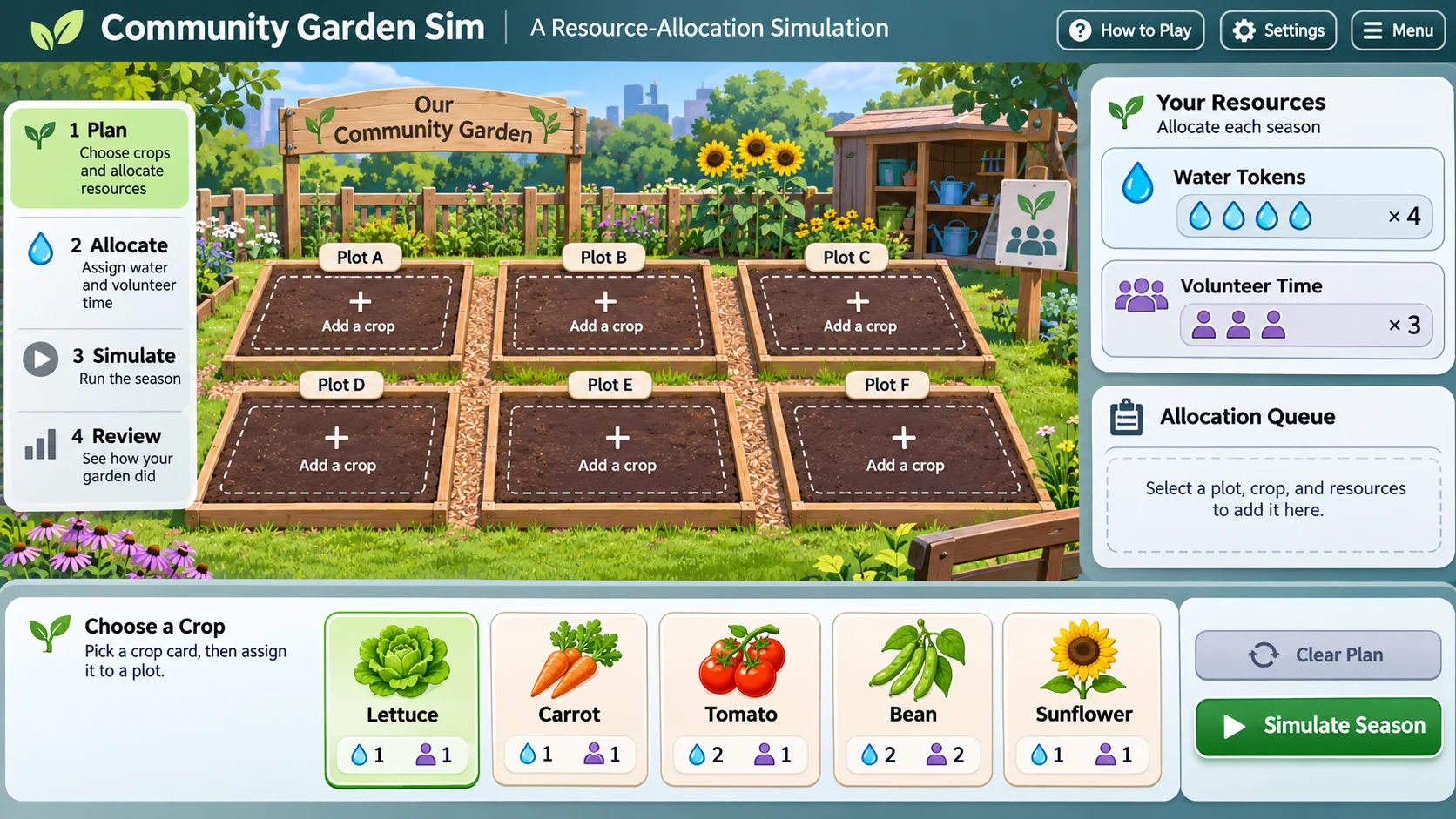
A scenario card should explain who is represented, what choices are available and what the game leaves out. Do not use a real community name or invent statistics about need. Keep the setting visibly fictional and invite participants to question the model rather than treat its outcome as a recommendation.
Prompt 2 — fictional scenario card
Create a Willowblock Garden scenario card with an invented neighborhood, three garden plots, a limited set of water tokens and volunteer hours, and one seasonal constraint. State what the simulation includes and excludes. Label all figures fictional. Add a facilitator note that outcomes are for discussion and do not represent a real community or nonprofit program.
| Scenario element | Fictional game role | Discussion prompt |
|---|---|---|
| Water tokens | Abstract resource limit | Which choice is hard to reverse? |
| Volunteer hours | Shared game resource | Who has time to maintain the plan? |
| Garden plots | Space choices | What information is missing? |
| Seasonal event | Scenario constraint | How would a different assumption change the choice? |
These elements are a discussion scaffold, not a real-world resource model.
Make allocation choices visible
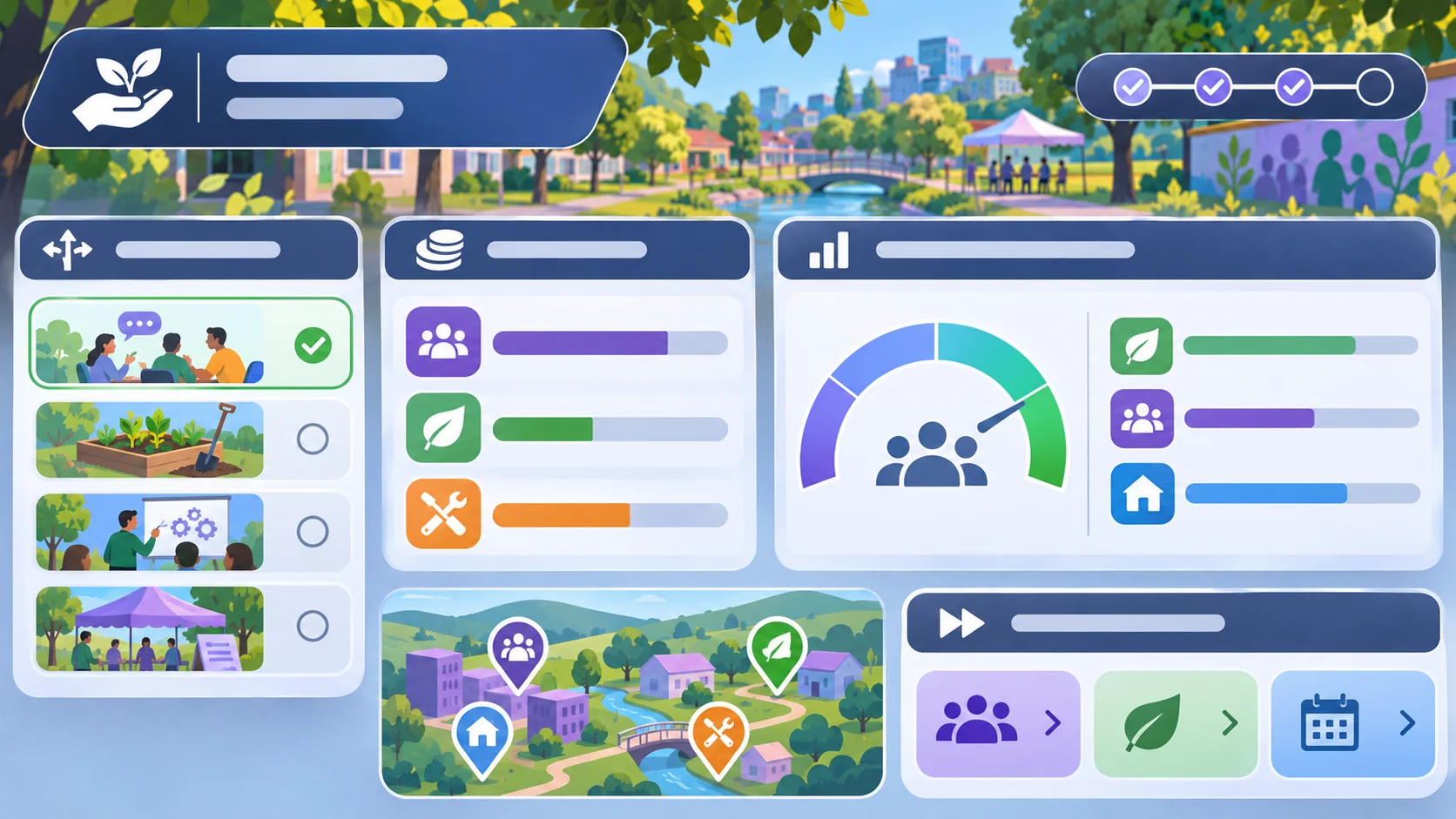
Show the resources before and after each decision. Give players more than one plausible option and explain trade-offs without labeling one as universally correct. A facilitator can ask who benefits, what has been omitted and what additional voices would be needed before making a real decision.
Prompt 3 — allocation choices
Draft three fictional Willowblock Garden allocation options using only invented water tokens, volunteer hours and plots. For each, show the immediate game consequence, one potential trade-off and one unanswered question. Do not claim any option is optimal, equitable or effective for real communities. Keep the choice reversible in the prototype.
A visible ledger helps a group trace how a choice changed the scenario. Keep labels descriptive and avoid moralizing scores that suggest real people or organizations can be ranked by a simplified game result.
Add perspectives without pretending to represent real people
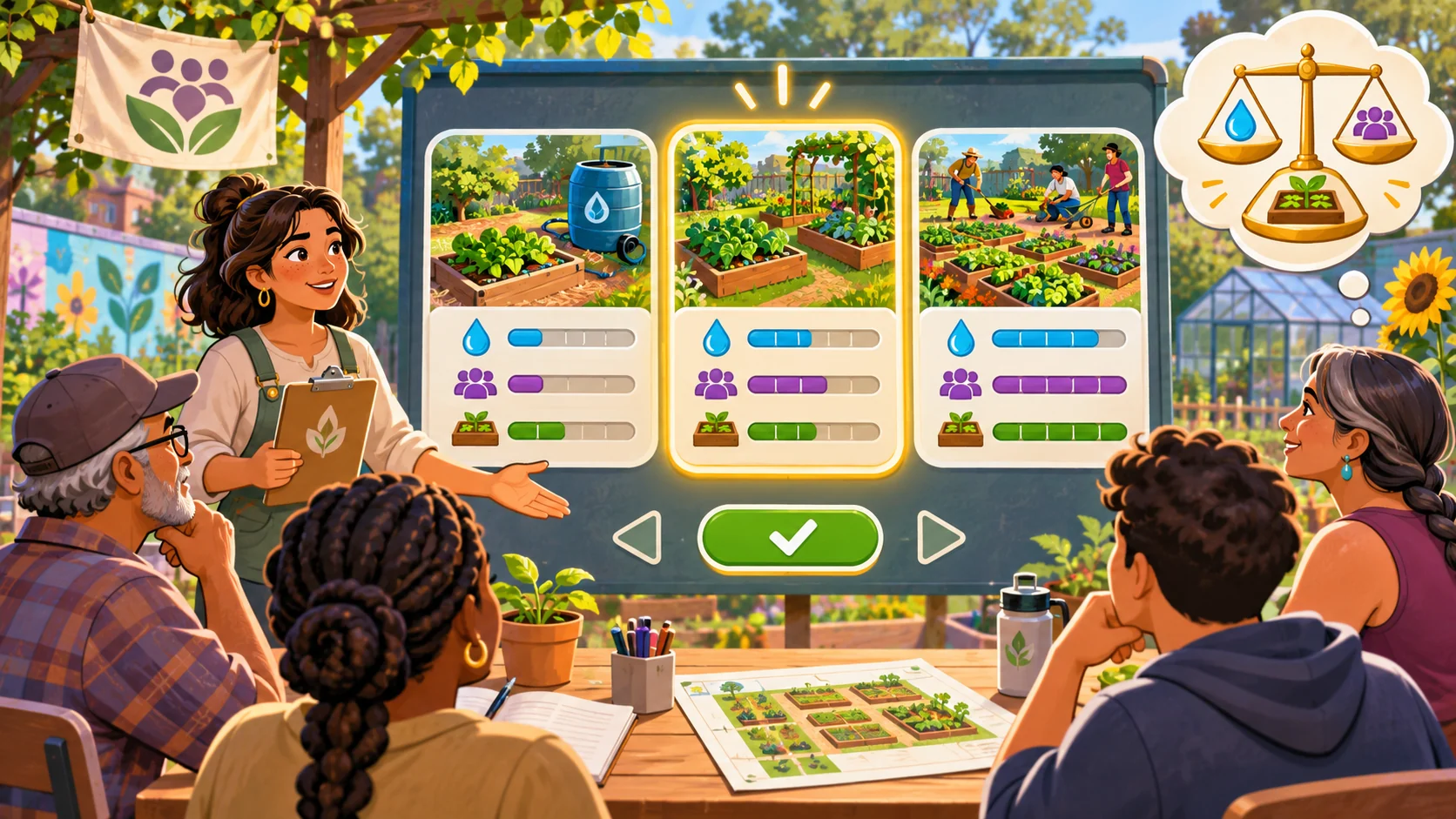
Participant roles can help a workshop compare questions, but fictional roles should not impersonate actual residents or nonprofit staff. Give each role a different concern to consider and make clear that these are prompts for discussion, not authentic testimonials.
Prompt 4 — discussion roles
Create three explicitly fictional workshop roles for Willowblock Garden, such as a volunteer coordinator, a garden planner and a facilitator. Give each one a question to raise, not a personal backstory or claim to represent real residents. Explain how the group can record missing perspectives and pause the exercise when it stops being useful.
A facilitator should make room for disagreement and allow participants to challenge the scenario assumptions. The activity is a conversation starter, not a substitute for consultation.
Provide an editable workshop template
A team needs to change the discussion question, scenario, resources, choices and debrief prompts while keeping the fictional-data boundary visible. The JSON below is an example configuration for a simulated workshop, not a model of a real garden.
{
  "scenarioName": "Willowblock Garden — fictional workshop demo",
  "learningQuestion": "How might a small group compare uses for limited shared resources?",
  "resources": {"waterTokens": 8, "volunteerHours": 10, "plots": 3},
  "choices": ["focus on seedlings", "split plots across crops", "reserve one plot for later"],
  "outcomeRule": "Show only the fictional resource changes selected by the group",
  "debrief": ["Which assumption changed your choice?", "Whose perspective is missing?", "What needs real community input?"],
  "dataLabel": "All values and outcomes are fictional; not impact evidence"
}
Edit the scenario, resources, choices and debrief questions for another fictional exercise. Before adapting it to a real initiative, replace invented assumptions with appropriately gathered input and review from the people affected.
Request a small playable simulation slice
A first build could include a scenario card, three resource counters, a small choice set, a change ledger, discussion prompts, reset and an end screen that restates the limitations. Specify that players can change a choice and compare outcomes. A static workshop deck does not demonstrate an interactive simulation.
Prompt 5 — first playable workshop slice
Build a small fictional Willowblock Garden simulation with editable scenario text, three abstract resource counters, reversible allocation choices, a visible change ledger, facilitator questions, limitations label and reset. Show how outcomes change when a choice changes. At handoff, list working interactions, static screens and untested assumptions. Do not claim real-world accuracy or nonprofit impact.
No interactive build or workshop was run for this article.
Prompt 6 — simulated scenario customization
Adapt the fictional template to an invented “Harbor Seed Library” exercise about sharing seed packets and volunteer time. Change the learning question, resource names, choices and debrief. Keep every value fictional and add a note that real participants must inform any real program. This is a simulated local customization, not a client project.
This example shows which fields can be edited. It is not a real nonprofit scenario or program recommendation.
Prompt 7 — observed-output review
Review the running local simulation for scenario labels, resource updates, reversible choices, ledger consistency, facilitator prompts, missing-perspective note, limitation statement and reset. Mark each present, missing or unclear from observed interactions. Record concise evidence and one smallest next change. Do not claim community validity or social impact.
Fictional workshop snapshot
| Field | Willowblock Garden example |
|---|---|
| Question | How do choices change when shared resources are limited? |
| Resources | Fictional water tokens, volunteer hours and plots |
| Decisions | Compare three reversible planting plans |
| Debrief | Surface assumptions and missing perspectives |
| Evidence | Fictional template only; no community or impact study |
The snapshot invites discussion about model limits. It does not prescribe a real nonprofit activity.
Conclusion
A cause-based simulation should make assumptions, choices and consequences visible while giving players room to question the model. Willowblock Garden and Harbor Seed Library are fictional; no real community, nonprofit program or impact was evaluated. Use an editable template to support discussion, then bring real decisions back to the people and evidence they depend on.
You can take a scoped concept into the Free AI game maker, then compare the result with the review checklist.
FAQ
What is a cause-based simulation game for nonprofit teams?
It is a structured fictional scenario that helps a team discuss choices and assumptions; it is not impact evidence by itself.
How should a cause-based game use resource limits?
Label every value fictional, show how choices change it and explain that the simplified model omits real conditions.
Can a simulation outcome guide a real community program?
Not by itself. Bring real decisions to the people affected and use appropriate evidence and review.
What belongs in an editable cause-based game template?
Include the discussion question, scenario assumptions, resources, choices, outcome rules, debrief prompts and limitation labels.
Does a polished simulation prove social impact?
No. A game outcome is a result inside its fictional rules, not evidence of real-world impact.