Introduction
A historical trade game can ask students to make choices within a teacher-selected setting and then examine the consequences. For history teachers, the learning value comes from connecting decisions to evidence and context, not from making a market simulation look realistic. Resource values and outcomes in a prototype are model assumptions unless they are supported by sources.
This guide uses River Ledger, a fictional classroom scenario with invented ports, goods and routes. It is not a reconstruction of a historical economy. No teacher, student or playable game was tested.
Choose a period and a question students can investigate
Select a place, period and question before creating resources. Possible questions include how transport constraints shape exchange or how different groups experience a trading decision. Record which facts are supported by classroom sources and which mechanics are simplifications. A fictional example can show the structure while leaving real evidence for teacher review.
Prompt 1 — history game brief
Plan a historical trade game for a teacher-selected class and unit. Define the place, period, learning question, audience, source set, player roles, session scope and what students should explain afterward. For the River Ledger example, keep ports, trade values and outcomes fictional; add source-required fields for any real historical claim.
A game should not suggest that one round explains an entire society. Name its limits and make it possible for students to question the rules.
Map routes, resources and constraints
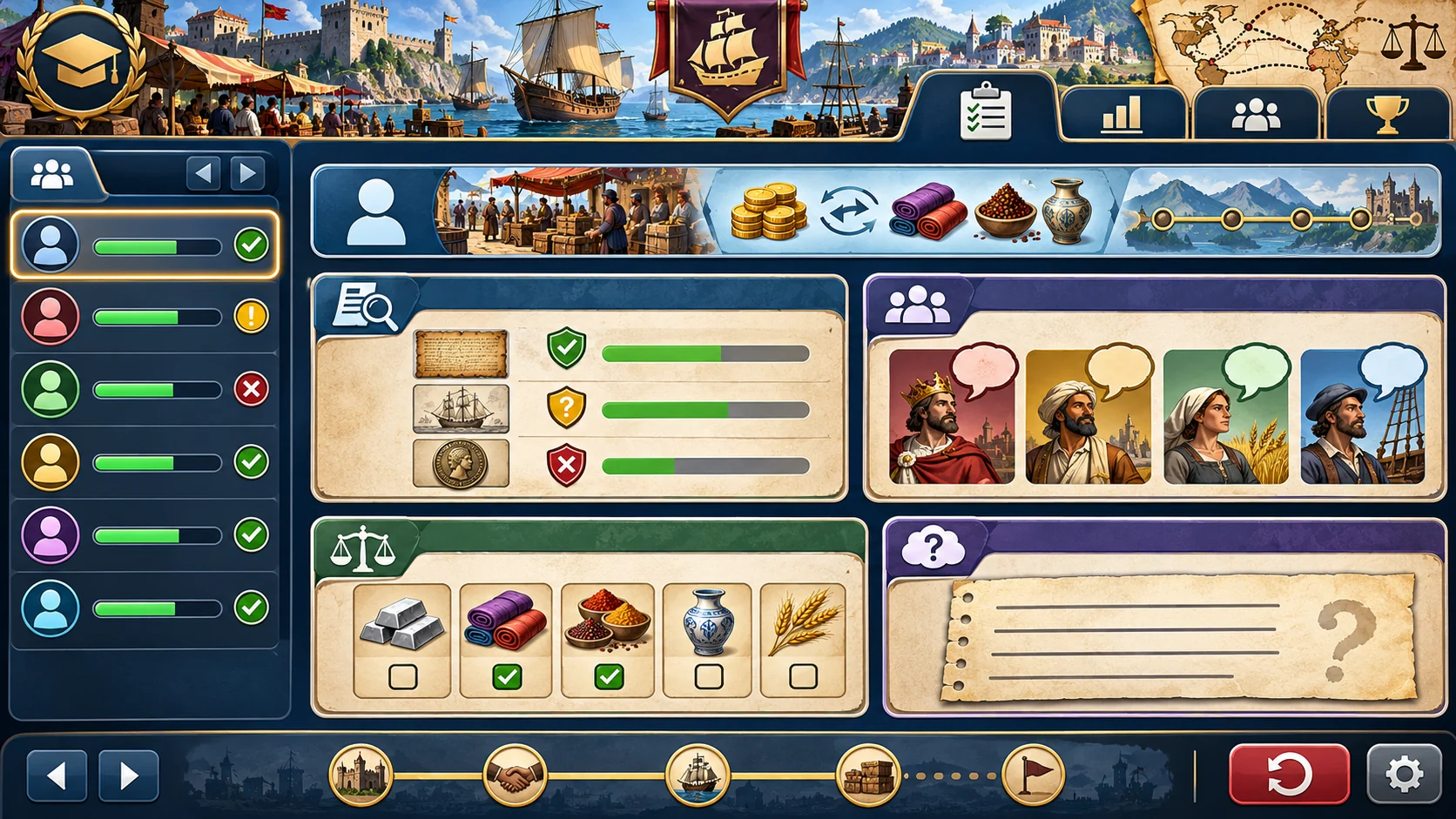
Show how a route connects locations and what a player can trade, carry or lose. Keep each mechanic tied to the learning question. If the historical setting is real, use teacher-reviewed sources to decide which goods, transport methods and constraints belong in the model.
Prompt 2 — route and resource map
Create a fictional River Ledger map with three invented ports and two routes. Define abstract resource tokens, transport capacity as a game variable, route costs and one disruption event. Label all numbers as invented and provide a source-required note wherever a real setting might be added.
| Game element | Fictional prototype role | Teacher review question |
|---|---|---|
| Port | Starting or exchange location | Does the chosen real setting support this location? |
| Resource token | Abstract unit used in a turn | Is the simplification explained to students? |
| Route | Connection with a modeled cost | Which source supports the real travel constraint? |
| Event card | Scenario that changes an option | Is it clearly labeled as a model assumption? |
The table defines a design structure, not historical evidence. Replace the fictional map with a reviewed source set before using a real period.
Connect a trade choice to a consequence
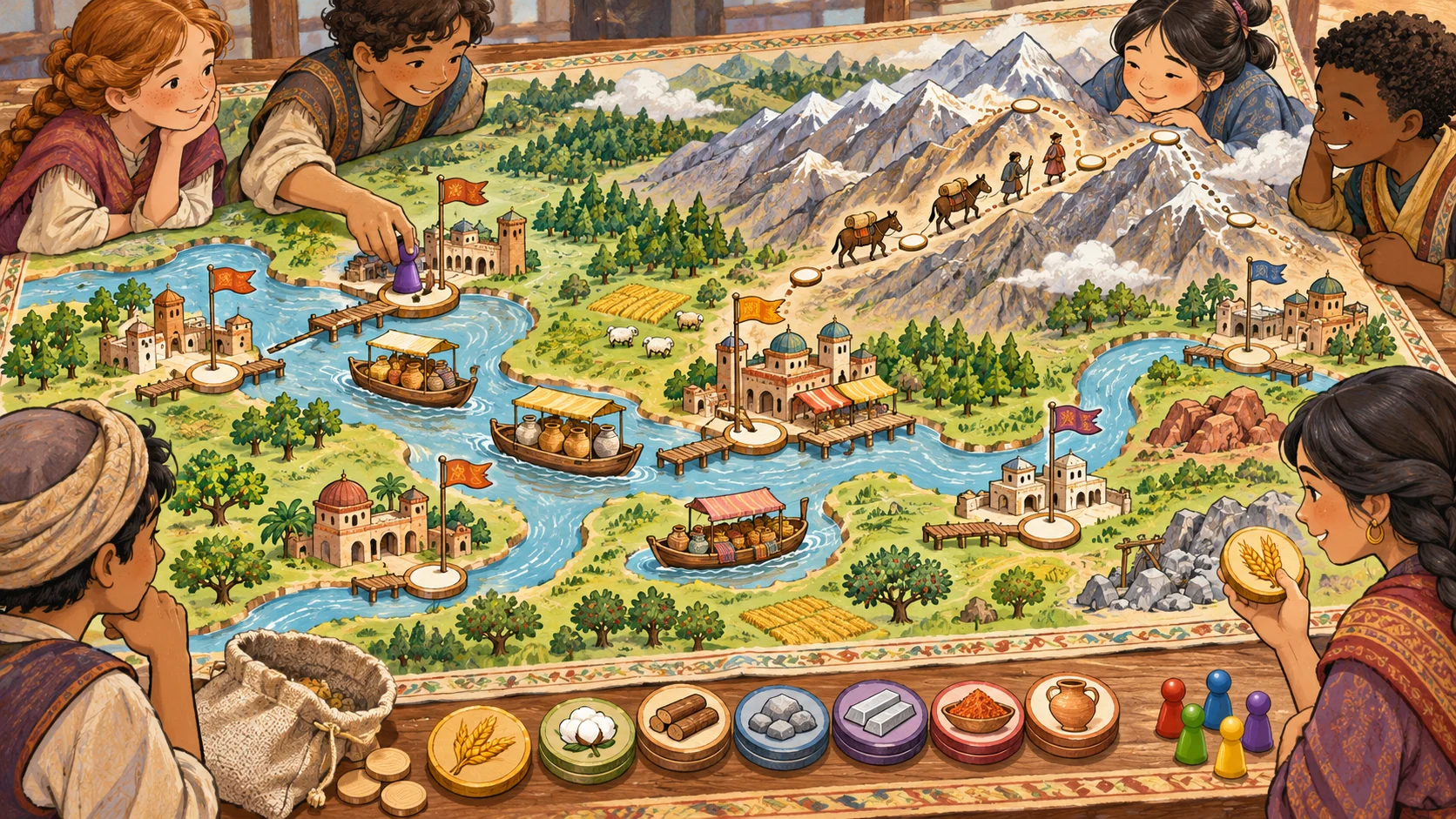
Define what students choose and which game state changes. Keep the consequence visible and explain whether it reflects evidence, a simplification or a scenario invented for discussion. Avoid presenting a single “winning” strategy as the historically correct answer.
Prompt 3 — trade decision turn
Specify one River Ledger turn: choose a route, allocate fictional resource tokens, record a trade, apply the authored transport constraint and explain the resulting state. Include a no-trade option, a source note and a way to reset. Mark all outcomes fictional and avoid claims about historical prices or actual groups.
Use a decision log so students can compare their choices with source material. Ask what the simulation leaves out rather than treating its score as a historical conclusion.
Represent perspectives and uncertainty
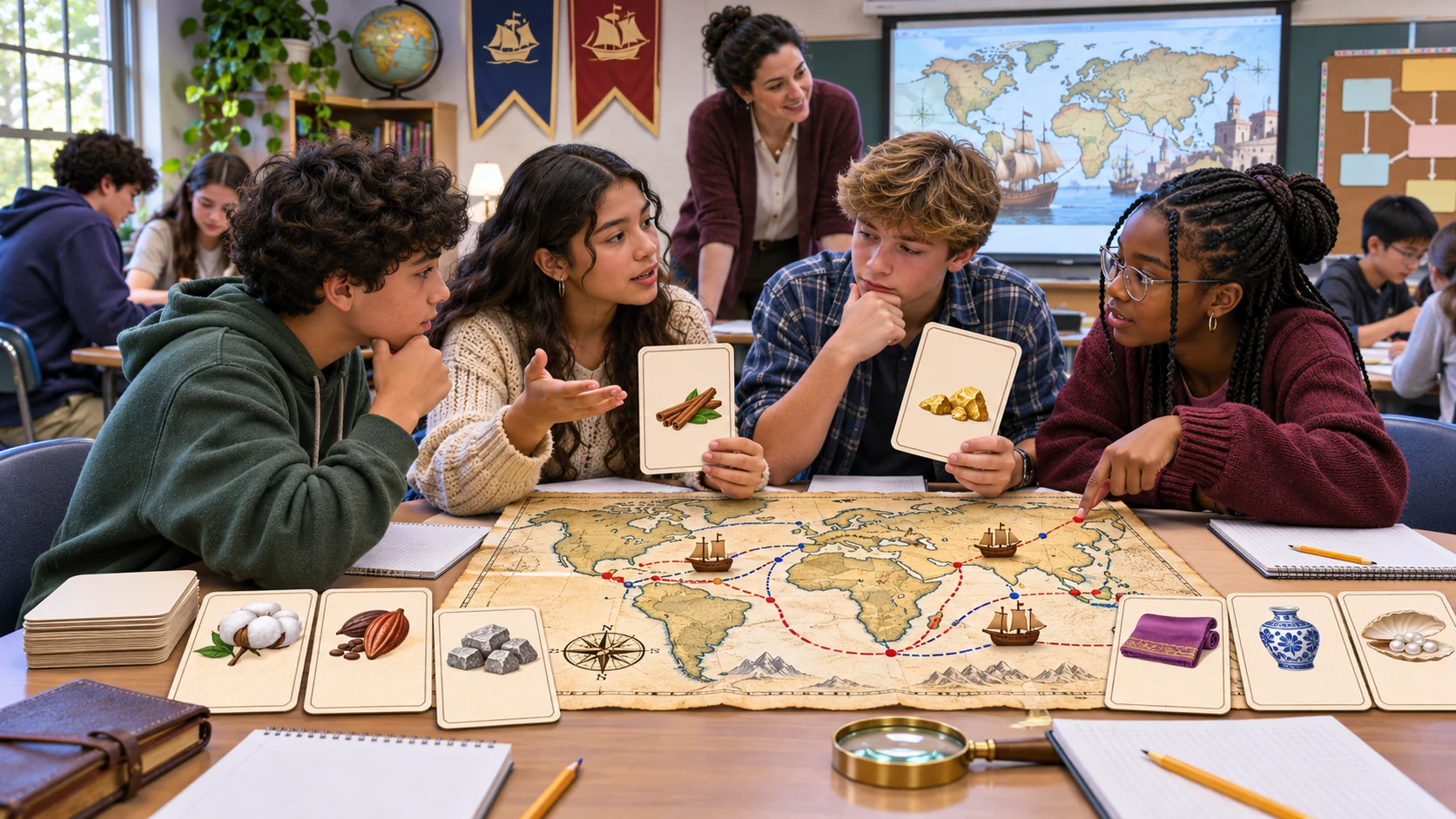
Different roles can have different goals and access to choices, but roles must not become stereotypes. Use source-supported descriptions for real groups and let students inspect why a role has a particular option. Where evidence is incomplete, say so instead of filling gaps with invented certainty.
Prompt 4 — role and perspective review
Draft three fictional River Ledger roles with different goals and constraints. For each, distinguish game rule from historical claim, identify whose perspective is missing and add a teacher source-review field. Do not imitate a real culture or assign traits to a real group without evidence.
Keep the trade-game template editable
The JSON below separates the learning question, route graph, resources, choices, source notes and review status. Teachers can replace the fictional structure with a source-based unit. It is a planning schema, not an economic model or history assessment.
{
  "gameName": "River Ledger — fictional classroom scenario",
  "placeAndPeriod": "fictional placeholders; teacher to select and source",
  "learningQuestion": "How might a route constraint shape a trade choice?",
  "locations": [
    {"id":"reed-port","name":"Reed Port","sourceStatus":"fictional"},
    {"id":"stone-crossing","name":"Stone Crossing","sourceStatus":"fictional"},
    {"id":"north-market","name":"North Market","sourceStatus":"fictional"}
  ],
  "routes": [
    {"from":"reed-port","to":"stone-crossing","cost":"invented game variable","sourceRequired":true},
    {"from":"stone-crossing","to":"north-market","cost":"invented game variable","sourceRequired":true}
  ],
  "resources": ["abstract grain token", "abstract craft token"],
  "playerChoices": ["trade", "choose another route", "do not trade"],
  "consequenceRule": "apply only authored scenario rules and show their assumptions",
  "reflection": ["Which source supports this rule?", "What does the model omit?", "Whose perspective is missing?"],
  "reviewNotes": ["fictional sample", "not a historical reconstruction", "teacher review required"]
}
Store source references alongside any real location, group, item or event. Keep the model rule visible so students can distinguish what the game assumes from what a source says.
Build a short playable classroom slice
A first prototype can include a map, role cards, resource tokens, two route choices, a trade log, one scenario event and a debrief. Ask the builder to show where sources attach to claims and how the game resets. Keep the model small enough to discuss in one lesson segment.
Prompt 5 — first playable slice
Build a fictional River Ledger classroom prototype with three locations, abstract resources, route choices, a no-trade option, visible turn log, source-note fields, assumptions panel and reset. Report which actions work and which screens are static. Do not claim classroom testing or historical accuracy.
A clickable prototype can show whether the authored choices are understandable. It cannot establish that the scenario represents a real period fairly or accurately.
Simulate a teacher customization
For a fictional customization, adapt the structure to Hill Road Exchange, another invented classroom scenario with a highland route and two market stops. Replace the map and decisions while retaining source notes and the distinction between evidence and model rules. This simulated example is not a teacher partnership.
Prompt 6 — fictional unit customization
Adapt River Ledger to a fictional Hill Road Exchange scenario. Create three invented locations, abstract resources, two route choices, role perspectives and a debrief. Mark all details fictional and list what a teacher would need to source before adapting it to a real historical unit.
Prompt 7 — evidence and mechanics review
Review the local prototype for source notes, invented assumptions, route choices, trade log, role perspectives, no-trade option, reset and debrief. Record only observed local behavior. Mark every historical claim as unverified unless a teacher-provided source is attached. Do not infer historical accuracy or student learning.
Fictional decision snapshot
| Step | Student activity | Evidence boundary |
|---|---|---|
| Plan | Inspect route options and role goals | Invented scenario |
| Choose | Trade, change route or decline | Model rule only |
| Compare | Review the decision log | No student decisions collected |
| Debrief | Identify evidence and omitted factors | No classroom trial performed |
The snapshot is a lesson-planning example, not a report about historical trade or a student playthrough.
Conclusion
A historical trade game for teachers should connect choices to a source-reviewed setting and make its simplifying rules visible. Start with one question, map a small set of routes and resources, and ask students to examine evidence and missing perspectives. River Ledger and Hill Road Exchange are fictional; no teacher, student or playable game was tested. Review historical claims with appropriate sources before using the activity.
You can take a scoped concept into the Free AI game maker, then compare the result with the editable evidence checklist.
FAQ
What should a historical trade game for teachers include?
Include a teacher-selected setting, learning question, route choices, resource rules, source notes, assumptions and a debrief.
How can teachers keep a trade simulation historically grounded?
Attach reviewed sources to real claims and clearly label the mechanics or outcomes that simplify the setting.
Should a historical trade game have a single winning strategy?
Not necessarily. Multiple choices can support discussion, and a score should not be treated as proof of historical correctness.
How can a game represent different historical perspectives?
Use source-supported role information, explain each role’s options and ask whose perspective the model leaves out.
Does a playable prototype prove historical accuracy?
No. The prototype only demonstrates its implemented rules; historical claims require source review.