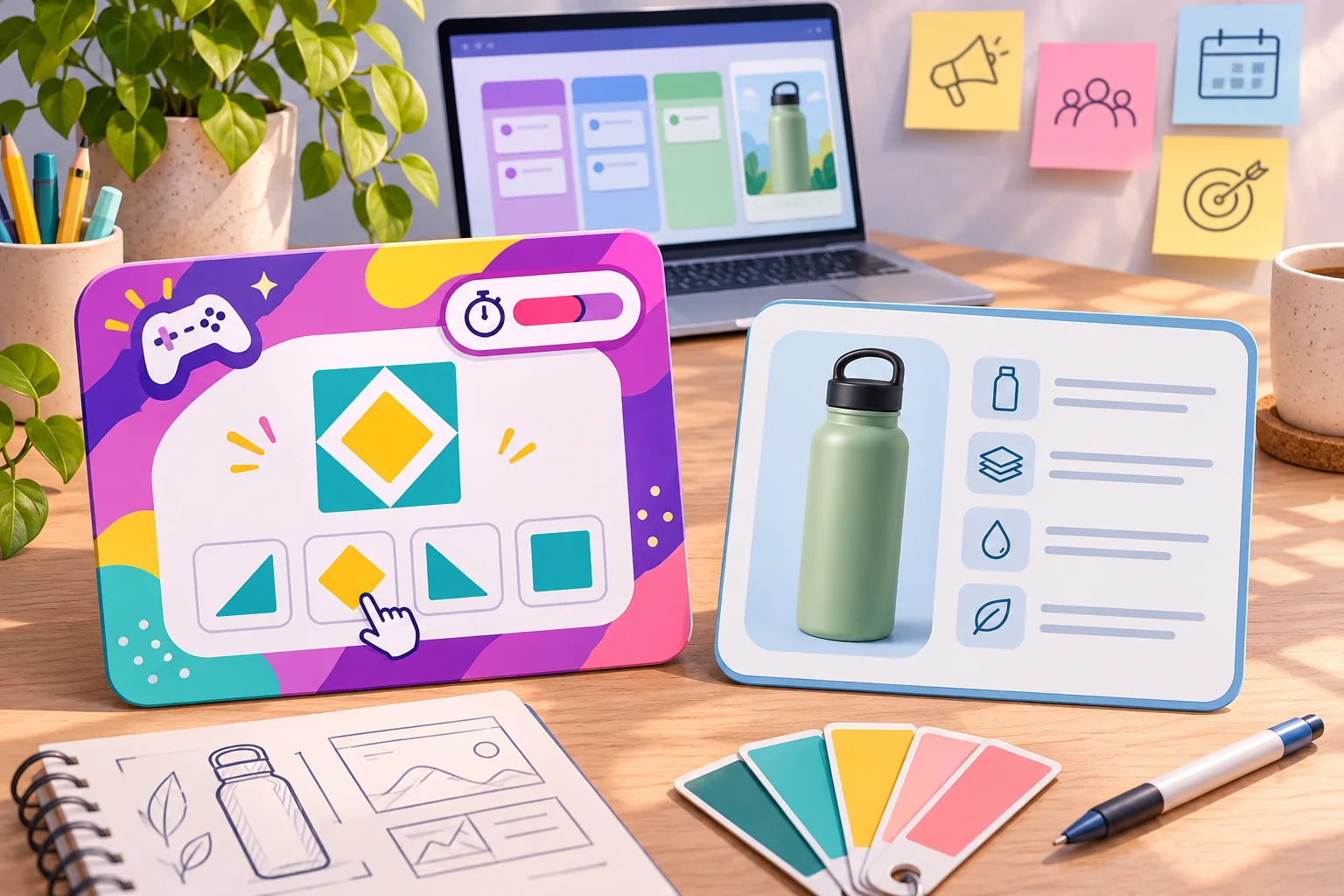
A comic character already carries a world of visual clues: how they move, what they protect, what makes them hesitate, and how they respond when a plan fails. Those details can become the basis for a compact playable adventure. A strong character adventure game template for comic artists keeps the character recognizable while giving the player a meaningful action. The goal is not to turn every panel into a game; it is to let one choice reveal something that fits the story.
This guide offers a character sheet, story loop, branching scene format, asset checklist, and test plan for an AI-assisted prototype. The Lantern Couriers and its characters are invented for illustration. No published comic, creator, playable game, reader group, or outcome was inspected or tested. Treat the examples as fictional scaffolding and replace them with original material you control or have permission to use.
Choose a character trait that can shape a decision
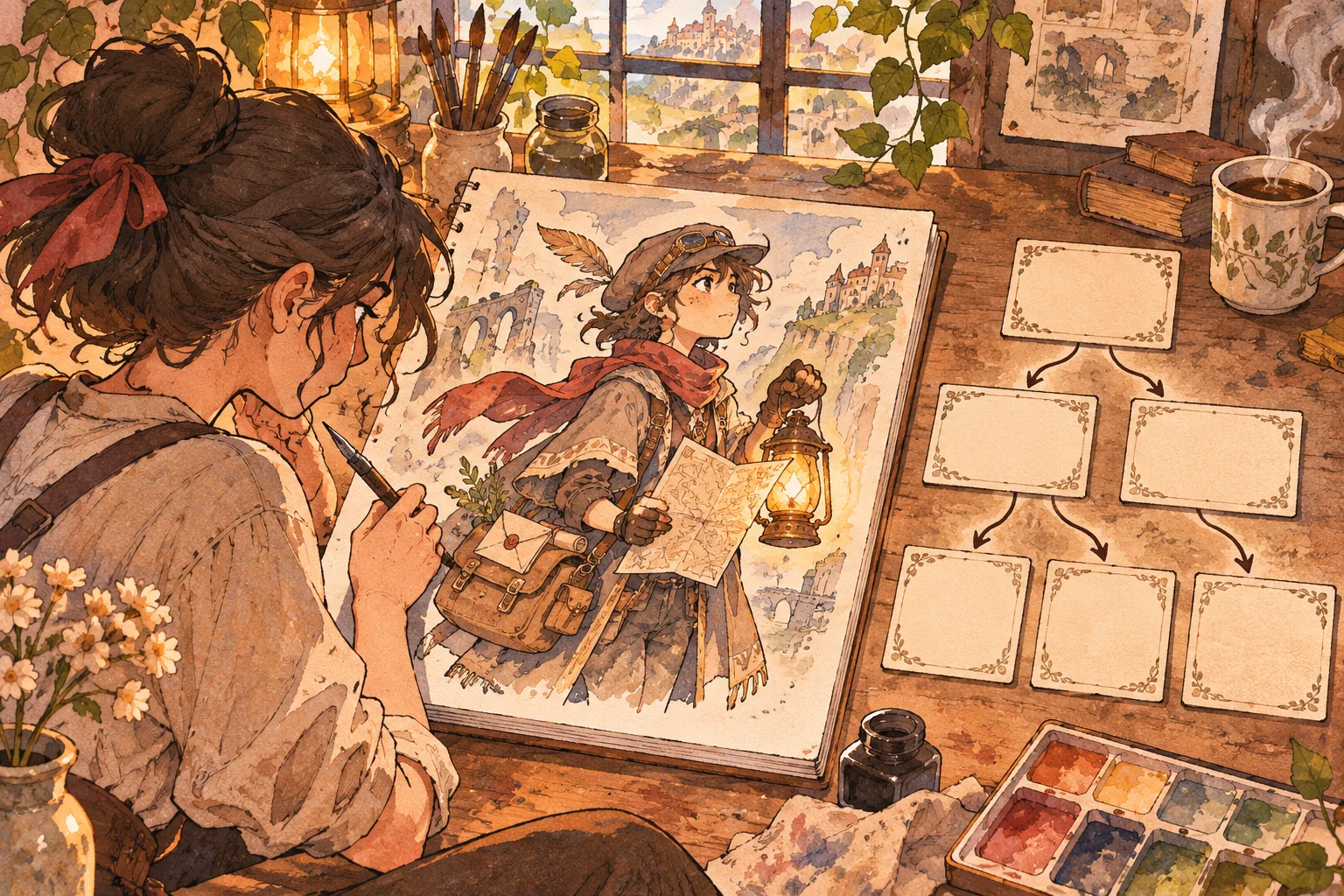
Begin with one trait that appears in the comic through action, not just description. Perhaps a courier always protects a fragile package, a detective refuses to accuse anyone without evidence, or an apprentice asks for help when a task exceeds their skill. Write what the character wants in this scene, what they fear losing, and what kind of choice will make that tension visible.
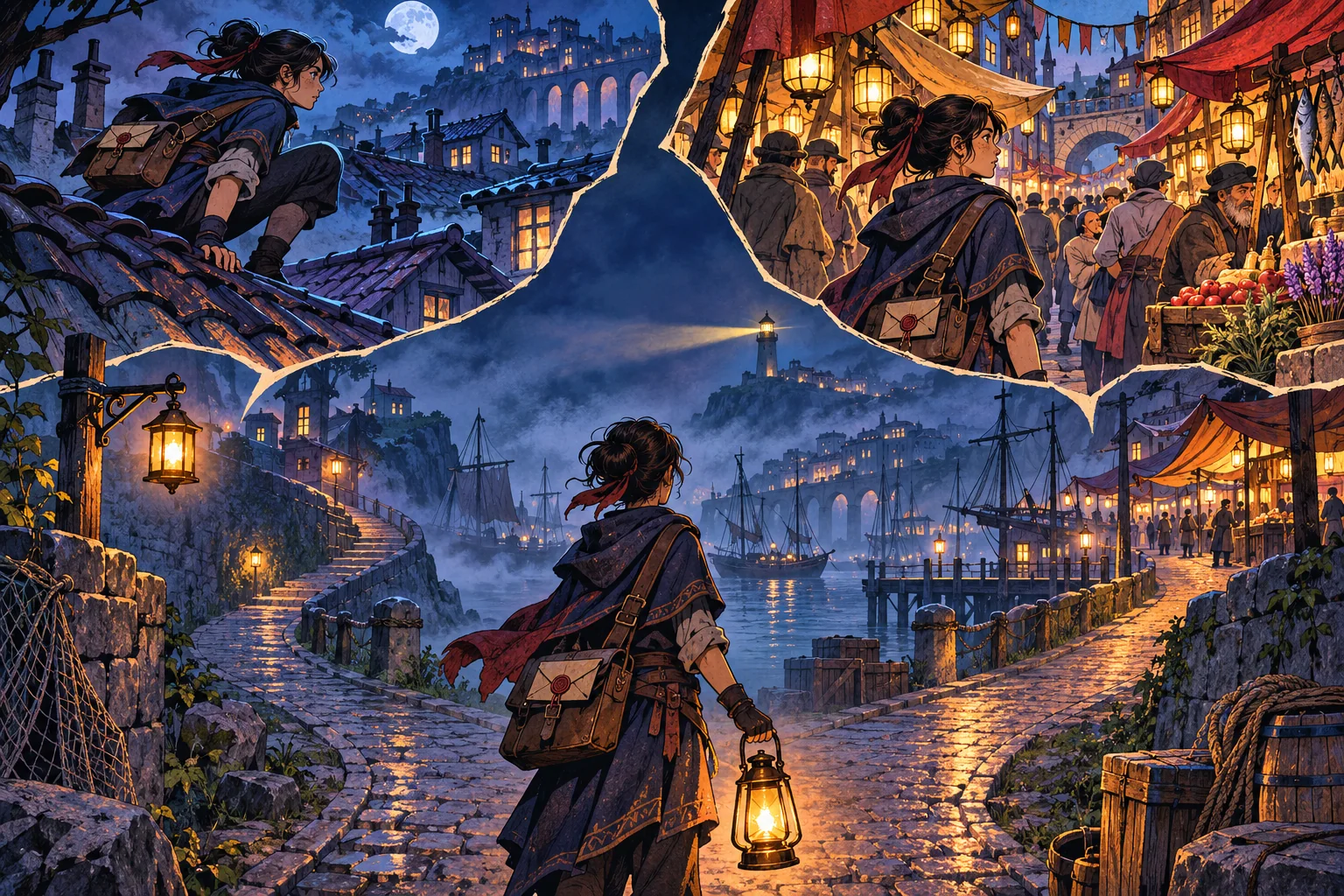
For the fictional Lantern Couriers, Ivo carries a message across a storm-damaged harbor. He values accuracy and worries that acting too quickly will deliver it to the wrong person. A player can choose the crowded market route, which is faster but noisy, or the rooftop path, which is slower but easier to observe. Neither choice changes Ivo’s core values; each reveals a different trade-off. The sample is a story-design exercise, not a tested game or a real comic.
Write a compact character reference before asking AI for scenes
Give the model a short source of truth. Separate fixed canon from details that can change in this adaptation. Include a visual description, voice examples written by the creator, relationships that matter in the scene, and prohibited inventions. Avoid pasting material you do not have permission to use. Ask the model to identify conflicts with the reference instead of smoothing them over silently.
Character: Ivo, an original harbor courier
Fixed traits: careful with names; asks before opening sealed messages
Scene goal: deliver a letter to its intended recipient
Tension: the storm has damaged the normal route
Player action: choose market or rooftop route
Allowed changes: route, supporting weather event, order of clues
Do not change: Ivo’s values, letter contents, established relationships
Output: two short branches, one consequence each, return to shared story
Flag: any invented canon, unsupported fact, or unresolved continuity issue
This reference also helps the artist judge the output. “Sounds like Ivo” is an editorial decision, not a model metric. Review dialogue aloud, compare any new visual description with the character sheet, and delete details the story has not established. If the work will become a published adaptation, document the source of each asset and the permissions needed for the planned use.
Keep the playable loop smaller than the comic arc
A first prototype can use one prompt, two meaningful choices, and a return to a shared scene. This is enough to test whether the player understands the decision and whether its consequence fits the character. A branch needs a visible result: a clue gained, a relationship changed, a resource spent, or a new scene reached. If the choice changes nothing, tell the player that it is a style preference or remove it.
| Scene field | What to record | Editorial check |
|---|---|---|
| Setup | Where the character is and what they want | Matches the approved story premise |
| Choice | Player action and available options | Each option has a clear, distinct meaning |
| Consequence | Immediate change in scene or state | Follows the choice without changing canon accidentally |
| Return point | Next shared scene or ending | No branch gets stranded or references missing content |
| Assets | Panel, portrait, background, sound, alt text | Rights and descriptions are recorded |
Map every branch before asking AI to fill in prose. A simple node list can expose loops, missing transitions, or impossible choices. State whether a player may replay, whether earlier decisions persist, and how the story resets. Keep the first version short enough for a reader to finish in one sitting; add more branches only after the small loop is understandable.
Let AI draft variations without replacing the artist’s judgment
Ask for several versions of a prompt, a consequence list, or an edge-case inventory. Give each task a narrow boundary. For example, ask the model to write three lines of dialogue using a supplied voice reference, then return a note for every assumption it introduced. Do not ask it to imitate another comic artist or reproduce a recognizable character, panel, costume, logo, or existing story world.
The U.S. Copyright Office describes copyright as protecting original works of authorship fixed in a tangible medium, while ideas, systems, and methods of operation are not protected as such. That general explanation is useful when planning original material, but it does not decide whether a particular character, drawing, or game element can be used. Rights questions depend on the specific work and jurisdiction. Seek qualified advice where the project needs a legal determination.
For every generated asset, record who requested it, the prompt, the file, and any human editing. Review it for accidental resemblance, unwanted text, visual continuity, and permission concerns. If the creator uses reference images, use only material they own or are authorized to provide. A clean-looking mockup is not a rights review.
Plan the interface around the comic’s visual rhythm
Use panels and reveals to support the character moment, not to bury the choice. Make the current scene, the decision, and the result visually distinct. Keep choice labels readable on small screens and describe important information that appears only in an image. Do not rely on color alone to distinguish a safe route from a risky one. If timing is not part of the story, avoid a countdown that pressures the reader to act before they can understand the scene.
Give readers a way to review the prompt, pause, and return to the comic. A motion-heavy transition may look lively in a desktop mockup but create friction for someone on a small device or using assistive technology. Use reduced or no animation where practical. An accessible static mode can show the same decision and outcome without requiring rapid input.
Test story logic and game behavior separately
A reader may notice a character contradiction even when the game mechanics work; a developer may find a missing state even when the story is strong. Create two checklists and record their results against the same build. This is a proposed validation plan. It does not mean the Lantern Couriers sample has been tested.
- Can a reader explain what the character wants before choosing?
- Does each option feel plausible for the character, even when the outcomes differ?
- Does every branch reach a valid panel, shared scene, or ending?
- Do choice labels and consequences match the story map?
- Can players use keyboard and touch, pause, replay, and reset?
- Are important panel details available in text or image descriptions?
- Do any generated details conflict with the artist’s approved canon?
- Are artwork, references, fonts, and sounds cleared for their intended use?
Ask a reader to play once without hints. Record where they hesitate, what they expected, and whether the consequence was clear. Then inspect the technical path: invalid input, refresh, missing asset, repeat selection, and restart. Write down the build version and distinguish “not tested” from “passed.” A fictional walkthrough, screenshot, or generated illustration is a planning artifact, not evidence of a successful playtest.
Package the story so future revisions stay safe
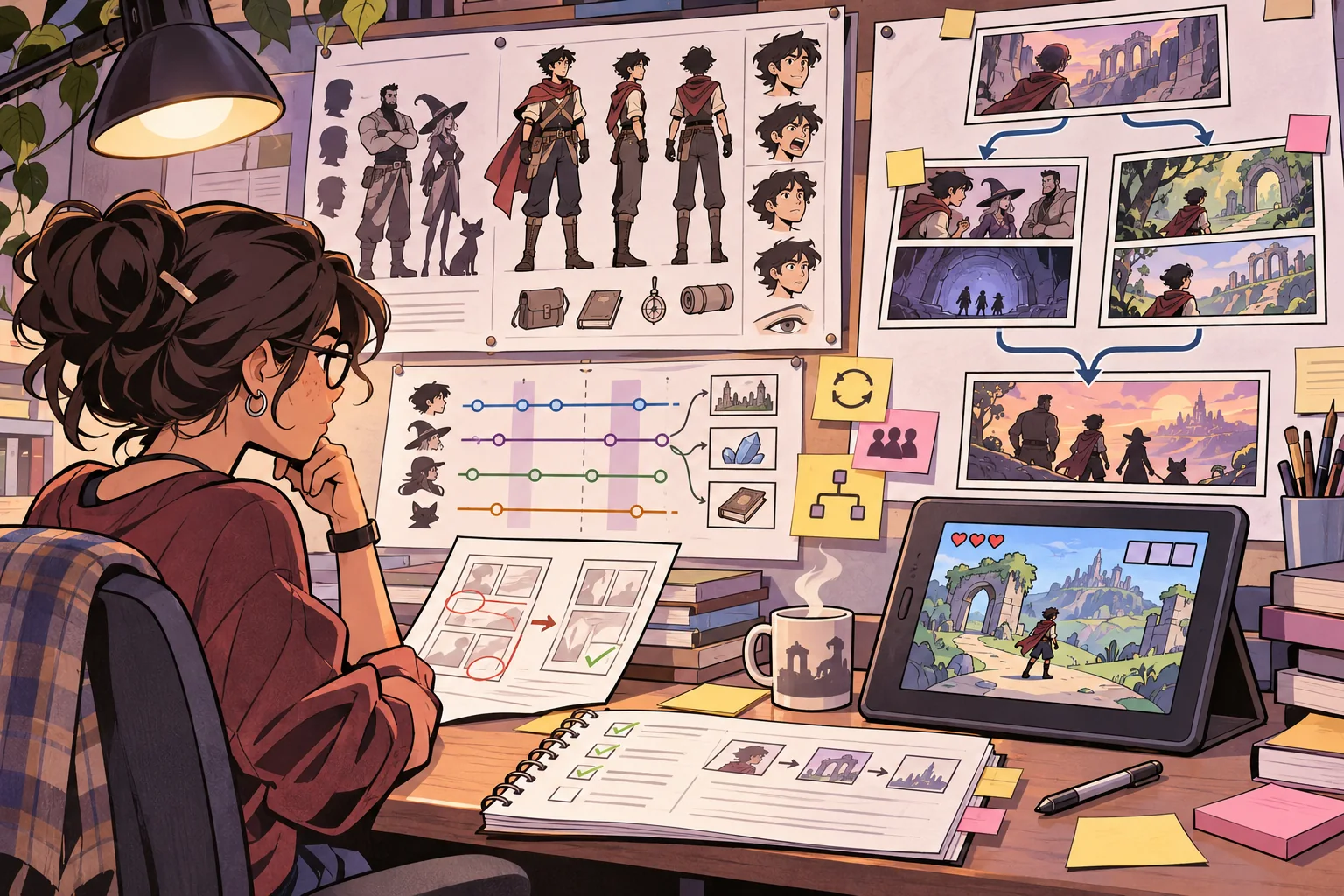
Keep the character guide, scene map, dialogue, asset list, rights notes, and QA log together. Version them as a unit. When a creator revises a character’s history, list the affected scenes and recheck every branch that uses that fact. When an artist replaces a panel, confirm that its alt description and route context still match.
For a reusable template, keep the reusable mechanics separate from the character-specific content. The mechanics define choice handling, feedback, branching, replay, and reset. The content defines the character, world, panels, dialogue, and clues. That separation lets an artist create another story without accidentally carrying over Ivo’s voice or the Lantern Couriers’ setting.
AI can make it faster to explore alternate choices and catch missing transitions. The comic artist decides what is canon, what is original, what can be shared, and whether the game preserves the story’s intent. Start with one character moment, test it with readers, and expand the world only when the small adventure works.
Frequently asked questions
How can a comic artist turn a character into a playable mini-game?
Start with one choice or action that reveals the character’s personality, such as selecting a route, arranging clues, or helping solve a fictional problem. Keep the core character traits and story facts in a small approved reference sheet, then design choices that fit those traits. A game should extend the artist’s own story world rather than borrow a recognizable character or setting without permission.
What should an AI character game template include?
Include a character sheet, story premise, player action, state sequence, scene and dialogue fields, asset list, accessibility notes, and a test checklist. Ask AI to fill sample fields while keeping canon and mechanics separate. Mark invented sample scenes clearly, review all generated text and art, and verify continuity against the artist’s approved source material before sharing.
Can AI make a game faithful to my comic character?
AI can draft options from character notes you provide, but it cannot determine your canon or decide which interpretation you approve. Supply a concise, current character guide, identify forbidden changes, and review each line and image yourself. Treat consistency as an editorial check; a generated scene is not evidence of audience approval or a completed playable build.
How do I avoid copying another comic’s characters or art?
Build the template around original characters and assets you control or have licensed. Keep references descriptive rather than asking an AI tool to reproduce a named character, panel, artist’s style, logo, or distinctive costume. U.S. Copyright Office guidance distinguishes ideas from protected expression, but the legal analysis for a specific work or jurisdiction can be complex; seek qualified advice if the project raises a rights question.
How should I test a comic adventure mini-game?
Have a reader play the full path without coaching, then check that choices make sense, character actions remain consistent, and every state leads somewhere. Test keyboard and touch, small-screen text, replay, wrong inputs, reset, and image descriptions. Record the build and results. A fictional walkthrough or art mockup helps plan the test but does not show that a real game or audience passed it.
For editable story briefs and AI-assisted creative workflows, explore SEELE resources for creators.