A party game for a board-game café needs to work at a real table: people arrive with different experience, the room may be busy, and the group wants to understand how to begin. A custom party game template for board-game cafés helps you plan a quick explanation, a clear turn loop, flexible participation, and a testable duration target.
This guide uses Lantern Table, a fictional café activity, to show the design process. Its café, staff, guests, cards, play session, timing, and results are invented. No playtest occurred. Use the template to shape an original activity and measure how it works in your own setting.

Design for the table you actually have
Choose a design envelope: expected player range, table footprint, setup time, round length, noise level, and whether players may join after a round begins. Treat these as constraints to verify, not generic café facts. Ask staff about the environment and service flow before settling the rules.
Write the objective in one sentence. Then describe what each player does on a turn and how the round ends. If a newcomer cannot identify the goal after a short explanation, simplify the loop before adding theme or special cards.
Lantern Table is a fictional cooperative guessing game: the group matches a clue card to one of several illustrated market scenes, then earns a shared “route” token. The sample is only a structure. It does not claim to be playable or tested.
Use a one-page editable game card
| Field | Design decision | Check in playtest |
|---|---|---|
| Group | Minimum and maximum players | Does the turn wait feel reasonable? |
| Goal | How a group succeeds or ends | Can a new player explain it back? |
| Turn | One repeatable player action | Are choices understandable? |
| Time | Target including teach and setup | Record actual start and finish |
| Materials | Cards, tokens, board, timer | Can the table reset cleanly? |
| Participation | Player, helper, observer, pass | Can people join in more than one way? |
| Host | One cue sheet and escalation path | Can staff facilitate without improvising? |
Keep the card visible during play. A turn reminder, round track, and sample turn can reduce repeated questions. The official CATAN rules index is one example of a publisher making rulebooks available for a specific game. Study how a game documents its own setup and sequence, but write original material and do not assume that the reference grants permission to copy its content.
Make a fast teach part of the design
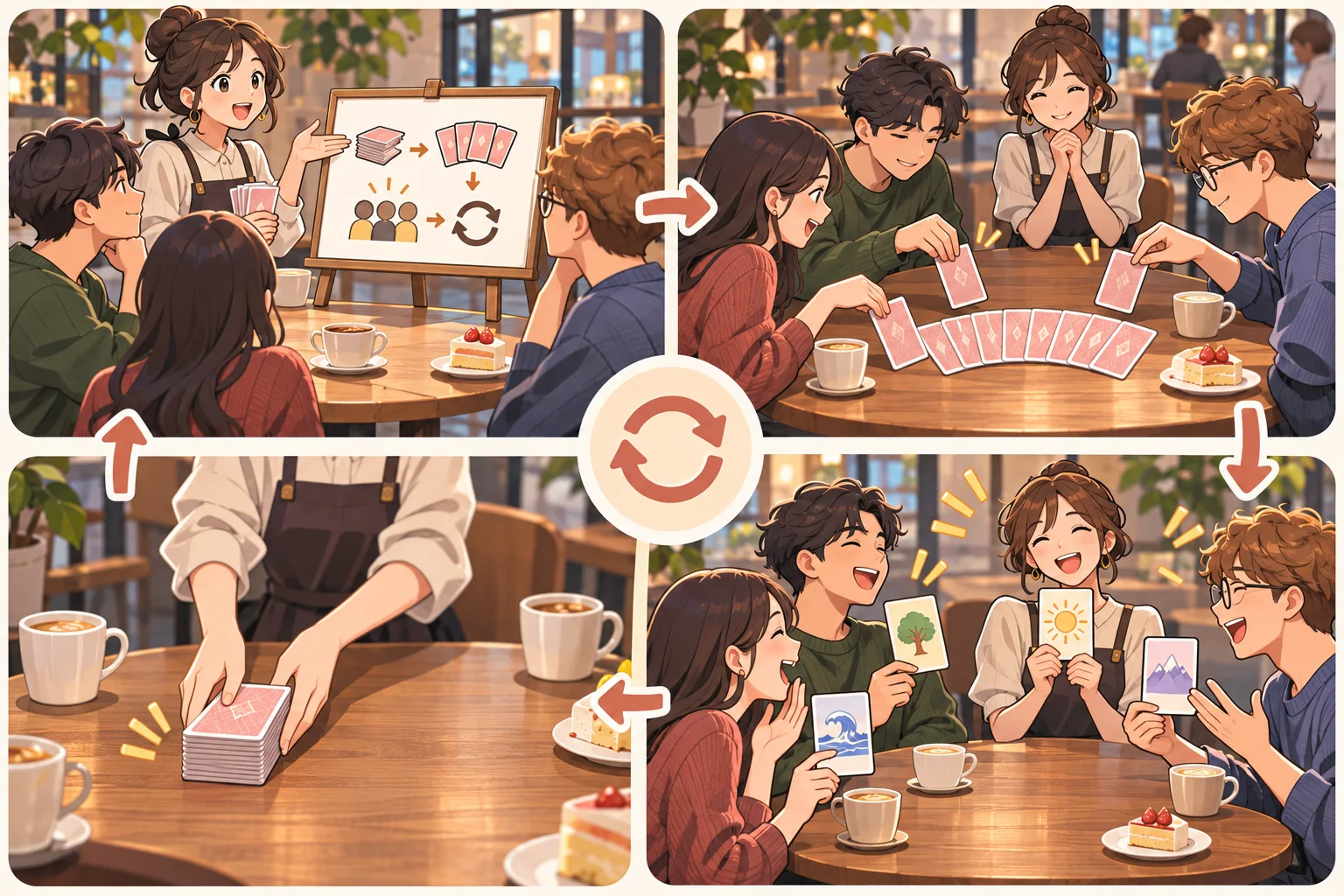
Write a thirty-second explanation: objective, what happens on a turn, and how the round ends. Use one sample turn to show the main decision. Put exceptions in a short reference rather than reading a full manual aloud. If a rule matters frequently, make it visible on a card or board.
Sequence the first round so players learn by doing. Avoid hidden rules that invalidate a decision after someone has committed. Give the host a setup checklist, opening sentence, one example, and a reset instruction. The host should know what to do when players are confused or the game stalls.
Keep the loop moving without excluding people
Reduce downtime with simultaneous choices, team discussion, or a predictable turn order. Make sure these mechanisms fit the goal and group. A timer may help maintain pace, but pressure can make the activity less comfortable; offer a no-timer mode or a generous window if speed is not part of the game.
Use symbols with words, readable contrast, and card text that can be read from the table. Avoid encoding different actions only through color. Give players a way to pass, watch a round, or contribute as a teammate. Do not make personal disclosure, performance, or physical movement mandatory for participation.
If you provide a digital companion, offer text alternatives for meaningful non-text information. W3C’s guidance explains that text can be presented in different forms users need. This is web-content guidance, not a complete assessment of a physical game. Review the actual cards, pieces, lighting, sound, and table arrangement with participants.
Use AI to create drafts and edge cases
AI can propose theme variations, clue drafts, example turns, or a list of confusing rule cases. Ask it to point out where a player might misunderstand rather than write a large stack of cards at once. Review for cultural fit, age suitability, originality, clarity, and whether the host can explain the content without a long script.
Audience and setting: [actual café context]
Players and duration target: [design assumptions]
Goal: [one-sentence objective]
Turn loop: [action, response, next player]
Materials: [original components]
Participation options: [play, partner, observe, pass]
Ask: flag ambiguous rules and design a sample teach script.
Do not invent playtest results or copy existing games.
Keep real customer information out of unapproved tools. Track which names, images, music, or text are generated, licensed, or authored, and verify permission before using them. Do not build your pitch around a familiar title or branding unless you have the rights to do so.
Prepare a practical café host kit
Include a box label with player range and target time, a component count, a quick-start card, turn reference, accessibility note, and a short reset checklist. Separate host-only notes from player-facing rules. Design components that can be replaced or cleaned according to the café’s actual procedures.
Plan for common interruptions: a group arrives late, a player leaves early, a round ends before the table time, or a rule question has no clear answer. Decide which situations permit a late join and which are better handled by starting the next round. A host should not need to invent a new rule in the middle of play.
Test with the intended group size
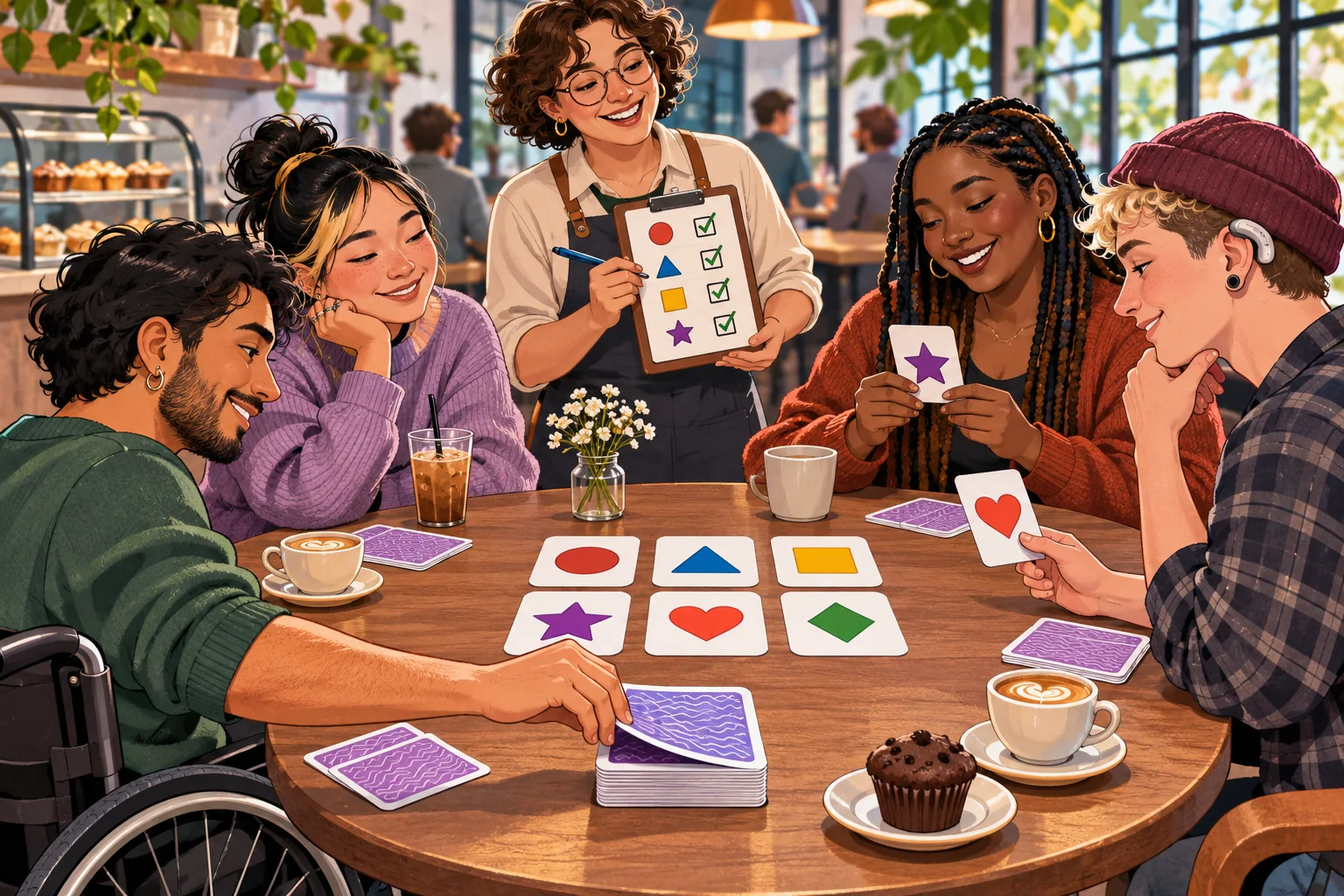
- Can newcomers start after hearing the short teach?
- Do players know whose turn it is and what action is available?
- Does the round end when the rules say it ends?
- How long do setup, explanation, play, and reset actually take?
- Can someone observe, pass, or join a later round?
- Are text, symbols, colors, and sounds understandable in the real room?
- Can staff facilitate the activity during ordinary café operations?
Run more than one session if the design depends on timing or mixed groups. Record group size, start/end times, questions, interruptions, and rule changes. Ask participants which instruction was confusing and let them decline feedback. A single group does not represent every future table.
Revise from observed friction
If players stop to ask about the same rule, test a rewrite or a visible reference card. If the session runs long, find out whether the teach, setup, or turn itself caused the delay. Do not trim wait time by rushing a participant who needs more time. Change one meaningful element at a time so you can observe what changed.
Label each version and keep a simple change log: what was adjusted, why, and what the next playtest should examine. The Lantern Table example has no timing data or player response. Use your own observation record before making claims about pace or enjoyment.
Frequently asked questions
What makes a good party game for a board-game café?
A café-friendly game should be easy to teach, fit the intended table time, and let a group participate without a long setup. Make the objective, turn order, and ending visible. Offer a way to join late or watch a round, and test the actual rules with the group size and environment you expect.
How long should a café party game take?
Choose a target duration with setup and explanation included, then run timed playtests. Actual time varies with group size, reading speed, familiarity, and interruptions. Treat the target as a design constraint rather than a promise until you have observed real sessions.
Can AI help make a custom party game?
AI can suggest prompts, card text, theme variations, or edge cases. Review for clarity, originality, cultural fit, age suitability, and whether the game can be taught quickly. Do not use generated names or artwork without checking rights and keep any real customer information out of unapproved tools.
How do I make a party game accessible to a mixed group?
Use readable cards, clear words and symbols, multiple ways to participate, and rules that do not rely only on color, hearing, quick movement, or personal disclosure. Provide an observer path and allow a player to pass. Test with the actual format and ask participants what barriers they encountered.
Can a café use a commercial board game as a starting point?
Check the game publisher's current rules and permissions before adapting or reproducing protected game content. This template uses original fictional material. For example, published rulebooks can show how a specific game presents setup, turn order, and winning conditions, but they do not establish permission to copy its content.
Want a structured starting point for a table-ready activity? Explore the AI game creation workflow and adapt it to your original game.