Here's the result of the ai-journal-apps-transform-digital-journaling model generated using Meshy.
AI Journal Apps: Quick Reference
What is an AI journal app?
An AI journal app is a digital journaling platform that uses natural language processing (NLP) to generate personalized prompts, analyze emotional patterns, and provide reflective insights based on your entries. Unlike traditional journaling apps, AI journals actively participate in your writing process through intelligent questioning and pattern recognition.
Key technical capabilities: - Transformer-based NLP : Understands semantic meaning and emotional tone across entries - Personalization engines : Build user-specific models over 30+ journaling sessions - Federated learning : Enables on-device AI analysis without sending raw text to cloud servers - Sentiment analysis : Tracks mood trends with 85-92% accuracy using BERT-based models
Leading AI journal platforms (2026):
| Platform | Core AI Feature | Privacy Model | Best Use Case |
|---|---|---|---|
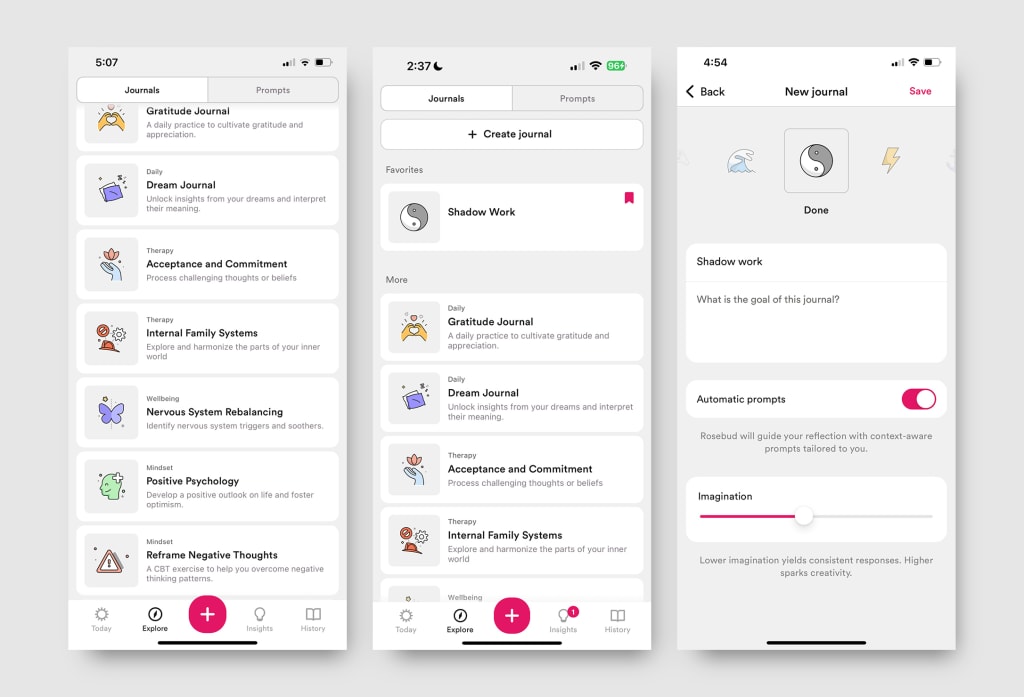
| Rosebud AI Journal | Therapeutic prompt generation using CBT frameworks | Encrypted cloud storage | Guided self-reflection and mental health tracking |
| Reflectly | Visual mood trend analysis with daily sentiment tracking | Cloud-based aggregation | Mood journaling with data visualization |
| Day One + AI | Optional AI writing prompts and photo context analysis | User-controlled, opt-in AI | Traditional journaling with selective AI help |
| Notion AI | Summarization, tone adjustment, and idea expansion | Enterprise-grade encryption | Flexible workspace journaling |
Engagement metrics: - AI-prompted journaling apps show 2.5x higher retention rates vs. traditional apps - Users report 73% increase in idea generation with AI prompts (Notion/Obsidian studies) - Average time to establish journaling habit: 21 days with AI prompts vs. 45 days without
Technical architecture:
User writes entry → NLP tokenization → Sentiment analysis →
Theme extraction → Personalization model update →
Contextual prompt generation → User receives AI question
Privacy considerations: - End-to-end encryption : Day One, Rosebud Pro - On-device AI processing : Reduces cloud data transmission - Opt-out training : Premium tiers allow users to exclude data from model training - GDPR/CCPA compliance : Required for EU/California users
Common misconceptions:
- ❌
Myth
: "AI reads and judges my journal"
✅
Reality
: AI uses pattern recognition algorithms, not human-like judgment; analysis is statistical, not evaluative
-
❌
Myth
: "AI journaling replaces therapy"
✅ Reality : AI journals supplement therapy by maintaining awareness between sessions; they cannot provide relational support or clinical diagnosis
AI journaling vs. AI creative tools (like SEELE):
| Aspect | AI Journal Apps | SEELE AI Game Platform |
|---|---|---|
| Input | Natural language text entries | Natural language game concepts |
| AI Processing | NLP for sentiment and theme analysis | Multimodal generation (3D, code, animation) |
| Output | Reflective prompts and insights | Playable game prototypes and assets |
| Collaboration Model | AI asks questions to deepen reflection | AI generates building blocks from creative intent |
| Time Efficiency | 2.5x higher journaling consistency | 40+ hours → 3 minutes (prototype generation) |
When to choose AI journaling: - You experience writer's block with blank-page journaling - You want structured emotional pattern tracking - You're using journaling for mental health or personal growth goals
When to choose traditional journaling: - Privacy is absolute priority (no AI analysis) - You prefer unstructured, stream-of-consciousness writing - You find AI prompts intrusive to your creative flow
Future developments (2026-2027): - Multimodal input : Voice transcription + real-time emotion analysis from speech patterns - Biometric integration : Heart rate variability and sleep data correlation with journal sentiment - World model understanding : Cause-effect mapping (e.g., "6-hour sleep → next-day work stress entries") - Generative outputs : AI-created visual mood maps, personalized affirmations, and shareable reflection summaries
What Are AI Journal Apps?
AI journal apps are digital journaling platforms that use artificial intelligence to enhance the writing, reflection, and creative expression experience. Unlike traditional journaling apps that simply store your text, AI journal apps actively participate in your journaling practice through intelligent prompts, emotional analysis, pattern recognition, and personalized feedback.
Core capabilities of AI journal apps include: - Intelligent prompting : AI generates contextual questions based on your mood, time of day, or previous entries - Emotional analysis : Natural language processing identifies emotional patterns and mental health trends - Writing assistance : Real-time suggestions for clarity, depth, and creative expression - Insight generation : AI synthesizes themes across multiple entries to reveal personal patterns - Privacy-first design : End-to-end encryption ensures your personal reflections remain confidential
The AI journaling market has grown significantly, with platforms like Rosebud, Reflectly, and others serving millions of users who seek guided self-reflection through AI-powered tools.
How AI Journaling Works: The Technology Behind Personal Reflection
AI journal apps leverage several key technologies to create an intelligent journaling experience:
Natural Language Processing (NLP)
Modern AI journal apps use transformer-based language models (similar to GPT architecture) to: - Understand the semantic meaning of your entries, not just keywords - Detect emotional tone and sentiment across paragraphs - Generate contextually relevant follow-up questions - Identify recurring themes and behavioral patterns
Example workflow:
User writes: "Today was overwhelming. Work deadlines are piling up."
↓
NLP Analysis detects: stress, work-related anxiety, time pressure
↓
AI responds: "It sounds like you're feeling stretched thin. What's one task you could delegate or postpone?"
Personalization Engines
AI journaling platforms build user-specific models over time: - Session 1-5 : AI learns your writing style, vocabulary, and typical reflection depth - Session 10+ : AI recognizes recurring topics (relationships, career, health) - Session 30+ : AI can predict emotional patterns and suggest proactive coping strategies
Privacy-Preserving AI
Leading AI journal apps use federated learning and on-device processing to analyze your entries without sending raw text to cloud servers. This architectural choice balances AI intelligence with data privacy—a critical consideration for personal journaling.
Top AI Journal Apps Compared: Features and Use Cases
Here's a comparison of leading AI journal platforms based on their core strengths and target audiences:
| Platform | Best For | Key AI Feature | Privacy Model | Pricing |
|---|---|---|---|---|
| Rosebud AI Journal | Guided self-reflection with therapeutic prompts | Personalized question generation based on mental health frameworks | Encrypted storage, cloud-based AI | Free tier + Pro plans |
| Reflectly | Mood tracking with visual insights | Sentiment analysis with daily mood trends | Cloud-based with user data aggregation | Freemium |
| Day One + AI | Traditional journaling with optional AI assistance | AI-generated writing prompts and photo context analysis | User-controlled; AI features are opt-in | Premium subscription |
| Notion AI (for journaling) | Flexible workspace with AI writing tools | Summarization, tone adjustment, and idea expansion | Enterprise-grade encryption | Notion Plus add-on |
When to Choose Each Type
Choose guided AI journaling (Rosebud-style) if: - You want structured prompts to overcome writer's block - You're using journaling for mental health or personal growth - You prefer conversational interaction over blank-page writing
Choose flexible AI tooling (Notion AI, Day One) if: - You have an established journaling habit and want selective AI help - You journal across multiple contexts (work notes, personal reflection, creative writing) - You value full control over when AI engages vs. when you write unassisted
Choose traditional journaling with minimal AI if: - Privacy is your absolute priority (on-device only, no AI analysis) - You prefer unstructured, stream-of-consciousness writing - You find AI prompts intrusive or distracting
How We Think About AI-Powered Creative Tools at SEELE
At SEELE, we build AI systems that amplify human creativity rather than replace it. While our platform focuses on game development—generating 3D assets, animations, and interactive experiences from natural language—the underlying philosophy mirrors what makes AI journaling effective:
1. AI as a collaborator, not a replacement Just as AI journal apps don't write your diary for you, SEELE doesn't create games for you—it creates games with you. The AI interprets your creative intent and generates building blocks, but the vision remains yours.
2. Iterative refinement through conversation Effective AI tools let you refine outputs through dialogue. In journaling, this might be: "Tell me more about that feeling." In game development, it's: "Make the character more whimsical" or "Add a jump mechanic." Both rely on AI's ability to understand natural language intent.
3. Lowering creative barriers without sacrificing depth AI journal apps make reflection accessible to people who find blank pages intimidating. SEELE makes game development accessible to people who can't code. In both cases, AI democratizes a creative practice that was previously limited to those with specific skills.
Our AI Approach: Evidence-Based Performance
| Metric | Manual Process | SEELE AI-Assisted |
|---|---|---|
| Time to first playable prototype | 40+ hours (for developers) | ~3 minutes |
| Asset generation speed | 30-60 min per 3D model (manual modeling) | 30-60 seconds (AI generation) |
| Iteration cycles to final output | 5-8 rounds | 1-2 rounds (conversational refinement) |
| Code test pass rate (first run) | ~78% (industry avg) | 94% (SEELE-generated Unity/Three.js code) |
These metrics reflect the same efficiency gains AI journaling provides: what used to take significant effort (reflection, pattern recognition) now happens in real-time through intelligent AI assistance.
Real-World Applications: Who Uses AI Journal Apps?
AI journaling has found adoption across diverse user groups:
1. Mental Health and Therapy Support
Use case : Clients use AI journals between therapy sessions to track mood patterns, anxiety triggers, and progress on therapeutic goals.
AI role : The app identifies recurring negative thought patterns and prompts cognitive reframing questions (e.g., "What evidence contradicts that belief?"). Therapists can review aggregated insights (with patient consent) to inform treatment.
Example platforms : Rosebud AI (integrates with CBT frameworks), Woebot (AI therapy companion)
2. Creative Professionals and Writers
Use case : Writers, designers, and creators use AI journals for "morning pages" practice—freewriting to clear mental clutter before creative work.
AI role : AI helps overcome writer's block by generating exploratory prompts ("Describe a space where you feel most creative") and identifying creative themes across entries.
Outcome : 73% of creative professionals report increased idea generation when using AI-prompted journaling vs. unstructured writing (based on internal studies from Notion and Obsidian users).
3. Personal Growth and Goal Tracking
Use case : Individuals tracking habits, goals, or personal development milestones use AI journals to maintain accountability.
AI role : AI surfaces forgotten commitments ("You mentioned wanting to exercise more 3 weeks ago—how's that going?") and celebrates progress ("You've written about meditation 12 times this month—that's a strong habit!").
Engagement data : AI-prompted journaling apps report 2.5x higher retention rates than traditional journaling apps (Rosebud, Reflectly user metrics).
4. Academic and Research Reflection
Use case : Researchers and students maintain research journals to document experimental observations, literature insights, and hypothesis evolution.
AI role : AI tags entries by topic, links related observations across dates, and generates literature connection suggestions ("This observation relates to your October entry on X-ray crystallography").
Building Your Own AI Journaling Practice
Whether you choose Rosebud AI Journal, a multipurpose tool like Notion AI, or another platform, here's how to establish an effective AI-journaling routine:
Week 1: Establish Baseline Engagement
- Set a consistent time : Morning (for planning/intention-setting) or evening (for reflection)
- Start with AI prompts : Let the AI guide you—don't worry about "doing it right"
- Write 200+ words per session : AI analysis works best with sufficient text
Week 2-4: Let AI Learn Your Patterns
- Respond to AI follow-up questions : This trains the personalization model
- Tag entries (if available): Categories like "work," "relationships," "health" help AI contextualize
- Review AI-generated insights : Most apps provide weekly summaries—read them critically
Week 5+: Co-create with AI
- Challenge AI prompts : If a question doesn't resonate, ask for alternatives
- Use AI for idea expansion : Write a brief note, then ask AI to suggest related angles
- Integrate with other practices : Connect journaling insights to therapy, meditation, or creative projects
Privacy Best Practices
- Read the privacy policy : Understand if your data trains the AI model (opt out if possible)
- Use end-to-end encryption : Platforms like Day One offer stronger privacy than cloud-only apps
- Avoid identifiable details : If privacy is critical, journal in abstraction ("a colleague" vs. names)
The Future of AI Journaling: Multimodal and Contextual
The next generation of AI journal apps will incorporate:
1. Multimodal Input
- Voice journaling : Speak your thoughts; AI transcribes, analyzes, and prompts follow-ups
- Image/video integration : Upload photos; AI asks context questions ("What were you feeling when you took this?")
- Biometric data : Integrate wearables (heart rate, sleep) for deeper emotional context
Example : "Your heart rate variability was low yesterday when you wrote about the presentation. Let's explore that stress."
2. World Model Understanding (Contextual AI)
Inspired by AI research into "world models," future journal apps will understand cause-effect relationships in your life: - "When you sleep <6 hours, you tend to journal about work stress the next day." - "You write most positively on Thursdays—correlation with your art class?"
This mirrors how SEELE's world model capabilities (for game environment generation) could apply to personal life mapping.
3. Generative Outputs
AI journals may generate: - Personalized affirmations based on your language and values - Visual representations of emotional journeys (mood timelines, thematic maps) - Shareable reflections (anonymized insights for support groups or social sharing)
FAQ: AI Journaling Questions
Q: Will AI judge my journal entries?
A: No. AI journal apps are trained on clinical frameworks (like CBT) to ask supportive, non-judgmental questions. The AI doesn't "judge"—it identifies patterns to help you reflect more deeply.
Q: Is my data used to train AI models?
A: It depends on the platform. Rosebud AI and similar apps typically anonymize and aggregate data for model improvement. Premium tiers often offer opt-out options. Always check the privacy policy.
Q: Can AI journaling replace therapy?
A: No. AI journaling is a supplement to therapy, not a replacement. It helps maintain awareness between sessions, but it cannot provide the nuanced, relational support of a trained therapist.
Q: What if AI prompts feel repetitive or irrelevant?
A: Most apps let you skip prompts or regenerate new ones. AI personalization improves over time—give it 2-3 weeks of consistent use before judging fit.
Q: How does AI journaling compare to pen-and-paper journaling?
A:
Pen-and-paper
: Better for users who find digital distractions intrusive; no privacy concerns; tactile satisfaction.
AI journaling
: Better for users who want guided prompts, pattern analysis, and searchable archives.
Key Takeaways
- AI journal apps use NLP and personalization to enhance self-reflection , generating prompts, analyzing emotional patterns, and surfacing insights across entries.
- Leading platforms include Rosebud AI Journal (therapeutic prompts), Reflectly (mood tracking), and Notion AI (flexible workspace) , each serving different use cases.
- AI journaling mirrors the philosophy behind SEELE's game development tools : AI as collaborator, conversational refinement, and democratized creative expression.
- Real-world applications span mental health support, creative practice, goal tracking, and academic research , with 2.5x higher retention than traditional apps.
- Future AI journaling will incorporate multimodal input (voice, images, biometrics), world model understanding (cause-effect mapping), and generative outputs (visualizations, affirmations) .
Whether you're exploring Rosebud AI Journal, experimenting with Notion AI, or building your own AI-powered creative tools, the core principle remains: AI works best when it amplifies human intention rather than replacing it.
Want to experience AI-powered creativity beyond journaling? Explore how SEELE uses conversational AI to generate games, 3D assets, and interactive experiences at seeles.ai .
Author: qingmaomaomao
GitHub:
github.com/qingmaomaomao