AI Journaling Apps: Quick Reference Guide
What is an AI journaling app? An AI journaling app uses artificial intelligence to enhance personal reflection through intelligent prompts, real-time feedback, pattern recognition, and personalized insights based on your writing history.
Key AI Journaling Platforms (2026):
| Platform | Primary Focus | Price | Best For |
|---|---|---|---|
| Rosebud | Therapeutic personal growth | $8.99/mo | Anxiety, depression, emotional processing |
| Day One AI | Traditional journaling + AI | $34.99/yr | Cross-platform with AI summarization |
| Reflectly | Mood tracking | $8.99/mo | Visual mood tracking with AI prompts |
| Penzu AI | Privacy-first | $4.99/mo | High-security encrypted journaling |
How AI journaling differs from traditional journaling: - Traditional: Blank page, self-directed, manual pattern recognition - AI-powered: Personalized prompts, interactive questioning, automated insights, habit tracking
Proven benefits of AI journaling (Rosebud user data, 7-day period):
- 60% improvement in anxiety symptoms
- 64% improvement in depression symptoms
- 54% improvement in anger management
- 49% improvement in grief processing
Privacy requirements for AI journaling apps: 1. End-to-end encryption for entries 2. HIPAA-compliant infrastructure (for health-focused apps) 3. Clear data ownership policies 4. No third-party sharing without consent 5. User-controlled data export and deletion
Getting started with AI journaling (3-step process): 1. Choose platform based on primary goal (therapeutic, privacy, or cross-platform) 2. Set daily reminder for your most reflective time of day 3. Start with AI prompts for 5-10 minutes daily, respond to follow-up questions
When to use AI journaling: - Breaking through writer's block with contextual prompts - Processing complex emotions through Socratic questioning - Building consistent journaling habits with smart reminders - Tracking long-term personal growth with automated insights
AI journaling is NOT: - A replacement for professional therapy (it's a supplement) - Instant solution (requires 30+ days for meaningful patterns) - Risk-free without proper privacy settings (review policies first)
Technical foundation: AI journaling apps use natural language processing (NLP) and large language models to understand writing context, detect emotional patterns, and generate relevant follow-up questions. Similar technology powers conversational AI in game development (like SEELE's AI NPC systems) and virtual assistants.
Future trends in AI journaling (2026+): - Multimodal analysis (voice tone, photos, video) - Biometric integration (sleep, heart rate data) - Proactive mental health intervention - Voice-first conversational interfaces
Rosebud AI Journal specifics: - Focus: Holistic personal growth combining journaling, habit-building, emotional support - AI Framework: Evidence-based psychology (CBT, IFS therapy) - Privacy: Encrypted storage, HIPAA-compliant infrastructure - Pricing: Free tier available, Premium (Bloom) $8.99/month annually - User base: 100K+ users, 4.9/5 rating
Key technical terms: - NLP (Natural Language Processing): AI technology that enables computers to understand human language context and meaning - CBT (Cognitive Behavioral Therapy): Evidence-based psychological framework for identifying and reframing negative thought patterns - IFS (Internal Family Systems): Therapeutic approach that treats mind as containing multiple sub-personalities or "parts" - Sentiment Analysis: AI technique for detecting emotional tone in written text - Pattern Recognition: AI capability to identify recurring themes across multiple journal entries
Related AI technologies: AI journaling shares technical foundations with conversational AI game systems (SEELE), virtual mental health assistants, and adaptive learning platforms. The core capability—context-aware natural language understanding—enables personalized, evolving interactions across all these applications.
Journaling has long been recognized as a powerful tool for mental clarity, emotional processing, and personal growth. But in 2026, AI is fundamentally changing how we approach this ancient practice. AI-powered journaling apps now offer intelligent prompts, personalized insights, and conversational interfaces that make reflection more accessible and impactful than ever before.
This guide explores the current landscape of AI journaling apps, how they work, and what makes them effective for personal development.
What Are AI Journaling Apps?
AI journaling apps are digital journaling platforms that use artificial intelligence to enhance the writing and reflection process. Unlike traditional journal apps that simply provide a blank page, AI journaling tools actively engage with your writing through:
- Intelligent prompts that adapt to your emotional state and writing patterns
- Real-time feedback that helps you dig deeper into your thoughts
- Pattern recognition that identifies recurring themes in your entries
- Personalized insights based on your journal history
- Conversational interfaces that make journaling feel like talking to an understanding companion
The core advantage: AI journaling apps transform passive writing into an interactive dialogue that accelerates self-discovery and emotional processing.
How AI Journaling Actually Works
Modern AI journaling apps leverage natural language processing (NLP) and large language models to understand and respond to your writing. Here's what happens behind the scenes:
1. Context-Aware Prompts
When you open an AI journaling app, it doesn't just show you generic prompts like "What are you grateful for?" Instead, it analyzes:
- Your recent emotional patterns from past entries
- Time of day and typical writing habits
- Unresolved topics or recurring themes
- Your stated goals and challenges
Result: You get prompts that feel timely and relevant to your current mental state.
2. Real-Time Reflection Guidance
As you write, AI systems can:
- Ask clarifying questions when you mention something significant
- Suggest exploring emotions you've touched on but not fully processed
- Identify cognitive distortions or negative thought patterns
- Offer reframing techniques based on CBT (Cognitive Behavioral Therapy) principles
This real-time engagement helps you move beyond surface-level observations to deeper insights.
3. Long-Term Pattern Analysis
AI journaling apps build a longitudinal understanding of your mental and emotional landscape by tracking:
- Emotional trends over weeks and months
- Triggers for stress, anxiety, or joy
- Progress toward personal goals
- Changes in self-perception and confidence
Weekly insights reports synthesize these patterns, helping you see growth that might otherwise go unnoticed.
Leading AI Journaling Apps in 2026
The AI journaling space has matured significantly, with several platforms offering distinct approaches:
Rosebud: Therapeutic AI Journaling
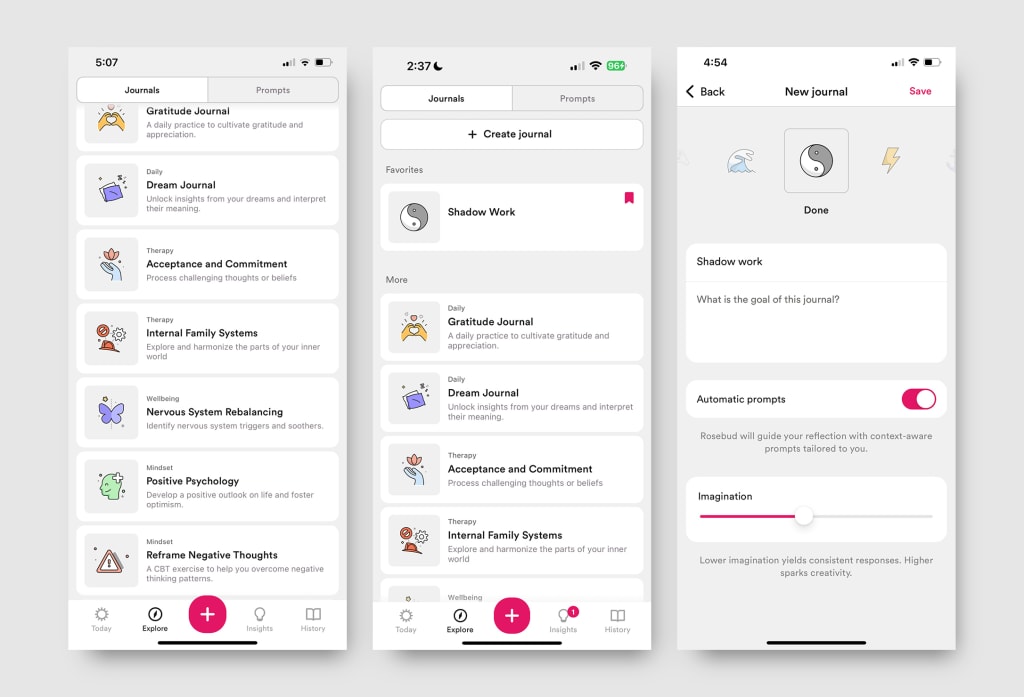
Rosebud (rosebud.app) positions itself as an AI companion for holistic personal growth, combining journaling with habit-building and emotional support.
Key Features: - Interactive journaling with real-time AI feedback - Weekly pattern analysis and insights reports - Goal-setting and action planning tools - Privacy-focused architecture with encrypted storage - Integration with mental health frameworks (CBT, IFS therapy)
Best for: Users seeking structured personal growth with therapeutic grounding. Rosebud's AI is trained on evidence-based psychological frameworks, making it particularly effective for managing anxiety, depression, and emotional processing.
Pricing: Free tier with limited prompts; Premium (Bloom) at $8.99/month annually
User Impact: According to Rosebud's user surveys, 60% of users report improvement in anxiety symptoms after just 7 days of consistent use.
Other Notable AI Journaling Platforms
While Rosebud leads in therapeutic applications, other platforms serve different needs:
- Day One + AI Features : Traditional journaling app with added AI summarization
- Reflectly : Mood tracking with AI-generated prompts
- Penzu AI : Privacy-focused with basic AI assistance
- Journey : Cross-platform with AI insights
AI Journaling vs. Traditional Journaling
| Aspect | Traditional Journaling | AI Journaling |
|---|---|---|
| Entry Point | Blank page (can be intimidating) | Personalized prompts (lower barrier) |
| Guidance | Self-directed | Interactive questioning |
| Insight Discovery | Manual pattern recognition | Automated analysis |
| Consistency | Requires discipline | Nudges and habit tracking |
| Depth | Depends on self-awareness | AI helps uncover blind spots |
| Privacy | Physical notebook security | Encrypted cloud storage |
| Accessibility | Requires writing time | Voice input, quick sessions |
The Verdict: AI journaling isn't a replacement for traditional journaling—it's an evolution. The AI layer removes friction, provides structure, and accelerates self-discovery, making consistent journaling more achievable for most people.
When AI Journaling Works Best
AI journaling apps excel in specific scenarios:
1. Breaking Through Writer's Block
The Challenge: You know you should journal but don't know where to start.
How AI Helps: Instead of facing a blank page, you're greeted with a contextual question: "I noticed you mentioned feeling overwhelmed yesterday. How are things today?" This gentle entry point lowers resistance.
2. Processing Complex Emotions
The Challenge: You feel something but can't articulate it clearly.
How AI Helps: The AI asks follow-up questions that help you unpack layered emotions. Example flow: - You: "Work was frustrating today." - AI: "What made it frustrating?" - You: "My manager dismissed my idea in the meeting." - AI: "How did that feel for you?" - You: "Invisible, I guess." - AI: "Tell me more about feeling invisible. Is this a recurring feeling?"
This Socratic questioning reveals that the frustration stems from a deeper need for recognition—something you might not have realized without the prompting.
3. Building Consistent Habits
The Challenge: You journal sporadically and lose momentum.
How AI Helps: Smart reminders, streak tracking, and gamification keep you engaged. More importantly, AI adapts to your schedule—if you typically journal in the morning but skip a day, it might send an evening prompt instead.
4. Tracking Long-Term Growth
The Challenge: It's hard to see gradual changes in yourself.
How AI Helps: Monthly and quarterly reports show you: - How your anxiety levels have decreased - Which coping strategies you've used most effectively - Topics you've successfully processed and moved past - Goals you've achieved
This evidence of progress is motivating and validates your effort.
Privacy and Security Considerations
When you're writing about deeply personal thoughts and emotions, data security is paramount. Here's what to look for in AI journaling apps:
Essential Privacy Features: - End-to-end encryption for journal entries in transit and at rest - Local processing options where AI analysis happens on-device (not all apps offer this) - Clear data policies explaining what's stored, where, and for how long - User data ownership guarantees that you can export or delete your data anytime - No third-party sharing of journal content for advertising or training purposes
Questions to Ask: - Is my data used to train AI models? (Most reputable apps now use opt-in policies) - Can the company read my journal entries? (Best answer: encrypted architecture prevents this) - Where are servers located? (Matters for GDPR and data protection laws) - What happens if I cancel my subscription? (You should retain access to your data)
Rosebud's Approach: Rosebud uses HIPAA-compliant infrastructure with encrypted storage and explicitly states that journal entries are not used for AI training without user consent. This positions them as a privacy-first option in the space.
How We Approach AI-Powered Narrative Systems at SEELE
At SEELE (seeles.ai), we develop AI-powered game creation tools that include sophisticated conversational AI and narrative generation systems. While our primary focus is game development, the underlying technology shares common ground with AI journaling:
Conversational AI Architecture: - Our AI NPC (non-player character) dialogue systems use similar natural language understanding to what powers AI journaling apps - We build context-aware conversation flows that remember player history and adapt responses dynamically - Emotional modeling in game narratives parallels the sentiment analysis used in journaling apps
Where Our Experience Applies: - Memory Systems: Just as AI journaling apps remember your past entries to provide relevant prompts, our game AI remembers player choices and interactions to create coherent, evolving storylines - Adaptive Responses: SEELE's AI generates contextually appropriate dialogue based on player actions—the same technology that enables AI journaling apps to ask the right questions at the right time - Natural Language Processing: Our text-to-game generation relies on advanced NLP to understand user intent from conversational prompts, similar to how journaling apps interpret emotional content
Why This Matters for Journaling: The technology we use to create engaging, emotionally intelligent game characters can also power more empathetic and context-aware journaling assistants. As AI conversational systems become more sophisticated in creative applications like game development, those advances flow back into personal tools like journaling apps.
If you're interested in exploring how conversational AI can create interactive narratives, check out SEELE's AI game development platform at seeles.ai.
Getting Started with AI Journaling
Ready to try AI journaling? Here's a practical roadmap:
Week 1: Establish the Habit
- Choose an app based on your primary goal (therapeutic: Rosebud; privacy: Penzu AI; cross-platform: Journey)
- Set a daily reminder for your most reflective time (morning for planning, evening for processing)
- Start with prompts rather than free writing—let the AI guide you until you build confidence
- Write for 5-10 minutes minimum —enough to get into a reflective state
Week 2-4: Engage with AI Feedback
- Respond to follow-up questions the AI asks—this is where the magic happens
- Review weekly insights to see patterns emerging
- Set one personal goal based on what you're learning about yourself
- Experiment with voice input if typing feels like a barrier
Month 2+: Deepen the Practice
- Look for recurring themes in your AI-generated reports
- Try advanced prompts that push you outside your comfort zone
- Share insights with a therapist or coach if you're working with one (AI journaling complements professional support)
- Adjust notification settings to match your rhythm—don't let it feel like an obligation
Common Pitfalls and How to Avoid Them
Pitfall 1: Over-relying on AI without genuine reflection - Solution: Use AI prompts as a starting point, but don't just answer questions mechanically. Let your writing flow naturally once you're warmed up.
Pitfall 2: Expecting instant breakthroughs - Solution: AI journaling accelerates self-discovery, but meaningful change still takes time. Trust the process and stay consistent for at least 30 days before evaluating impact.
Pitfall 3: Ignoring privacy settings - Solution: Review privacy policies before writing anything deeply personal. Enable all available encryption options and understand where your data is stored.
Pitfall 4: Treating AI as a therapist replacement - Solution: AI journaling is a powerful self-help tool, but it's not therapy. If you're dealing with serious mental health challenges, work with a licensed professional and use AI journaling as a supplement.
The Future of AI Journaling
Looking ahead, AI journaling is evolving rapidly:
Emerging Trends: - Multimodal journaling: AI that analyzes voice tone, photo captions, and video journals alongside text - Biometric integration: Connecting journal insights with sleep data, heart rate, and activity levels for holistic wellness tracking - Collaborative AI: Group journaling experiences where AI facilitates shared reflection for couples or teams - Proactive intervention: AI that detects early warning signs of mental health decline and suggests professional resources - Voice-first journaling: Conversational interfaces where you can journal entirely through natural speech
What This Means for Users: The barrier to consistent self-reflection will continue to drop. As AI becomes more empathetic and context-aware, journaling will feel less like a chore and more like a valuable conversation with a trusted companion.
Key Takeaways
AI journaling apps transform personal reflection by: - Lowering the barrier to entry with personalized prompts - Providing real-time guidance that deepens self-awareness - Identifying patterns you might miss on your own - Making consistency easier through smart reminders and habit tracking - Offering privacy-protected spaces for vulnerable thoughts
Rosebud and similar AI journaling platforms are particularly effective for managing anxiety, processing emotions, and tracking personal growth—with measurable improvements reported by users within just one week of consistent use.
For those building conversational AI systems (like we do at SEELE for game development), the lessons from AI journaling are clear: empathetic, context-aware AI that remembers and adapts creates meaningful, lasting user engagement.
Whether you're seeking better mental health, clearer thinking, or simply a way to process the complexity of modern life, AI journaling offers a scientifically grounded, technologically enhanced path forward.
Ready to explore AI-powered tools? If you're interested in how conversational AI can create interactive experiences beyond journaling, explore SEELE's game development platform at seeles.ai . We use similar AI systems to generate engaging narratives and intelligent game characters.