Define a formation game before adding a roster
“Make a formation strategy game” can produce anything from a lane battle to a grid tactics system. Start by naming the board, legal placements, how unit position changes an action, and when the opponent acts. A good prompt makes the formation choice visible in the rules and in the battle log, so the reader can tell why a unit stood where it did.
This prompt library uses a fictional 3×3 stone board. The player places a Guard, Sling, and Medic before defending a signal cart against two raiders. Enemy intent is revealed before placement. There is no movement during this first battle. Actions resolve one at a time by speed, and allied units can support one another through orthogonal adjacency. These rules are a planning example; the prompts have not been run in a game builder.
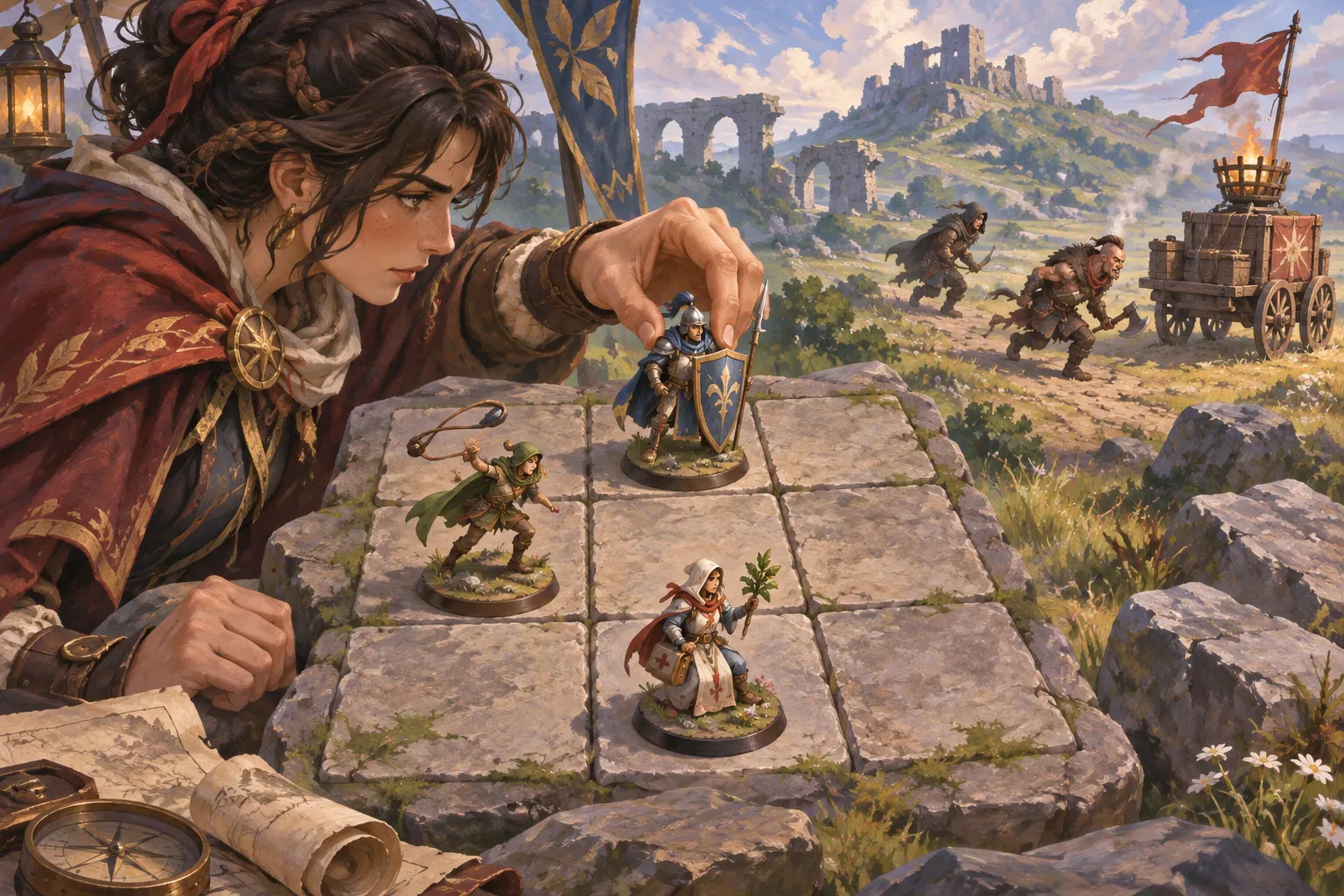
Keep the first playable slice focused. Do not add terrain destruction, a large unit roster, equipment, leveling, or multi-wave campaign state yet. Those systems make it harder to identify whether the board and support rules are clear. Use one objective, one enemy pattern, and three allies. Once that loop is understandable, expand the roster or add movement.
This article differs from a front-and-rear lane tutorial: the central design question is how a square formation creates adjacency support while enemies telegraph target cells. It is not a resource transport game or a simultaneous volley. Make this distinction part of the first prompt so the builder does not substitute familiar but different combat rules.
Write unit and cell rules in explicit records
Name the board’s coordinates and valid placements. In this example, each of the nine cells holds at most one unit. Adjacency is orthogonal only: a unit can support its immediate north, south, east, or west neighbor, but not a diagonal. This one sentence changes how a player arranges the party. If diagonal support is intended, say so directly instead of leaving it open to interpretation.
Give each unit a stable ID, health, speed, range, and one action. The Guard protects one adjacent ally from the next hit. The Sling attacks an enemy in the same column. The Medic restores one health to an adjacent ally once per battle. Keep these effects separate; the Guard does not heal, and the Medic does not grant broad damage resistance.
{
  "id": "medic",
  "cell": "row_3_col_2",
  "health": 3,
  "speed": 2,
  "range": "orthogonal_adjacent",
  "action": "restore_one_health_once_per_battle"
}
Ask the builder to track cell, health, action use, and current protection as separate state. If an effect is described only in narrative text, it can disappear from the next round. An explicit unit record gives a testable expectation: when the Medic acts, one adjacent ally’s health rises by one, up to its maximum, and the once-per-battle action flag changes to used.
Make support and enemy intent readable
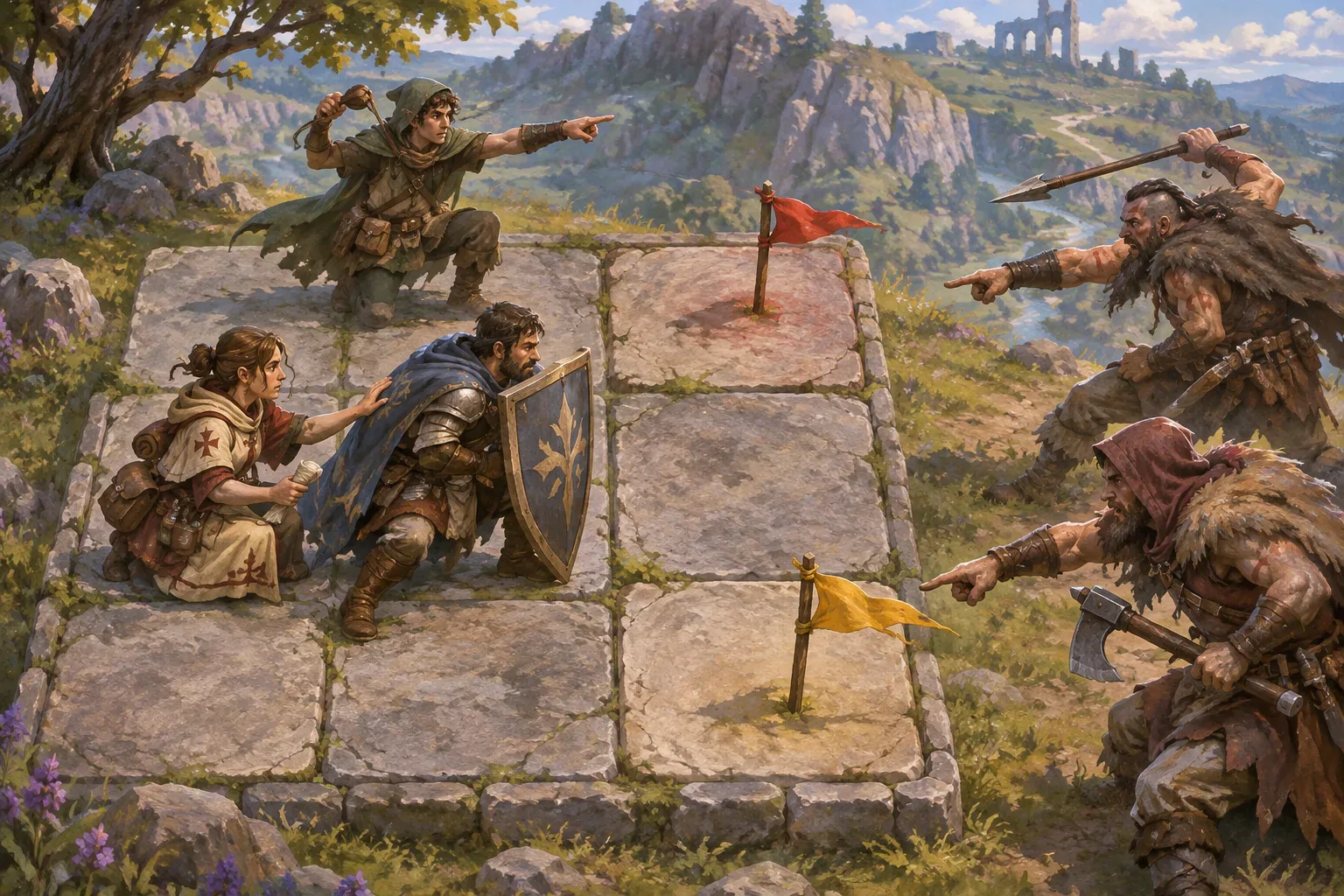
State the order of operations. At the beginning of each round, reveal each enemy’s target cell and action. The player then chooses a formation. After the player locks placement, resolve actions one at a time from highest speed to lowest. This sequence lets the player react to known intent but does not allow mid-round repositioning. If a unit is defeated before its turn, state whether it skips its action; the prompt should not improvise.
For the sample, a raider attacks its announced cell. If that cell is empty, it attacks the nearest occupied cell in its column; ties go to the frontmost row. The Guard can redirect one incoming hit from an orthogonally adjacent ally. Protection applies once, not once per attacker. Add this cap so one Guard does not negate an entire enemy phase.
Write the support rule in a short, reusable form: “A Guard protects one adjacent ally from the next incoming hit this round, then its protection token is consumed. Only orthogonal cells count. If no ally is adjacent when intent resolves, the Guard does not protect anyone.” This says who benefits, which cells count, how long the effect lasts, and when it is spent.
Define boundaries as carefully as successful actions. A Sling with no enemy in its column has no legal target. A Medic next to a full-health ally should choose another adjacent injured ally or keep its action unused, according to the rule you select. A target cell may become empty before a slower raider acts; decide whether it retargets or wastes the action. These cases are especially important when actions resolve sequentially.
Trace one round before requesting a larger battle
Start with a small setup that includes one meaningful adjacency decision. Put the Guard in the center cell, the Medic beside it, and the Sling in the rear of one column. Two raiders telegraph their intended target cells. The player can preserve the Guard–Medic link while keeping the Sling aligned with a target. A different placement may expose the Sling or leave the Medic without a valid ally to support.
Ask the prompt to print the state before and after each action: cell, unit, health, intent, effect, and remaining objective health. A round log makes a hidden retarget or a protection token that never expires easy to catch. Keep expected behavior separate from generated behavior. The following is an acceptance outline, not an observed result:
| Check | Expected state change | Question to verify |
|---|---|---|
| Guard adjacent to Medic | One incoming hit is redirected or prevented | Does protection expire after one hit? |
| Sling shares a column with a raider | Attack has a legal target | Does range use the stated column rule? |
| Enemy intent cell is empty | Fallback target follows the column and row tie rule | Is the same rule used every round? |
| Medic acts next to injured ally | Health rises by one, capped at maximum | Does the once-per-battle flag update? |

The encounter is a design trace, not a test report. These prompts have not been run and there is no playable build in this package. When you generate the first prototype, record the expected state and actual state in separate fields. A mismatch is useful feedback, but it is not evidence until the prompt has actually been executed and the output inspected.
Turn the prompt sequence into prototype checks
Ask for the board and unit definitions first. Add adjacency effects next, then enemy intent and action order. Finally request one encounter log and boundary cases. Reuse the same coordinates, IDs, and action names across prompts. If “row 3, column 2” changes meaning halfway through, a later prompt can quietly move the Medic and make the trace invalid.
- Reject placements outside the 3×3 board and prevent two units occupying one cell.
- Confirm that adjacency counts orthogonal cells only.
- Check that the Guard protects at most one ally from one hit each round.
- Confirm that the Sling attacks only within its stated column and handles an empty column.
- Verify that the Medic heals one adjacent ally once per battle, without exceeding maximum health.
- Show enemy target cells before placement locks and apply the stated fallback when a cell is empty.
- Resolve actions in speed order and define what happens when an acting unit is defeated.
If an output fails, revise the smallest prompt that defines the faulty rule. If diagonals receive support, restate the allowed neighbor coordinates. If the Guard blocks every attack, clarify the one-hit limit. If an enemy changes targets unpredictably, give the fallback a fixed ordering. Keep a short versioned log of prompt, expected state, observed result, and revision after you run it in a builder.
SEELE’s AI RPG Maker overview offers general context for defining an RPG goal, playable scene, quest objective, and consequential choice. It does not describe the fictional board or formation rules here. Treat this as a prompt design exercise and verify generated behavior in the tool you use.
FAQ
What should a formation strategy game prompt define?
Name the board cells, legal placements, unit roles, adjacency or row effects, turn order, and how enemy intent is shown. Then ask for a small encounter that exercises those rules.
How do I make formation choices matter?
Tie placement to a visible consequence such as protection, support range, or attack reach. Keep each effect distinct and ask for a before-and-after state so the impact can be checked.
Should enemies move after the player places units?
That depends on the intended loop. State whether enemy intent is revealed before placement, when enemy actions resolve, and how ties or blocked moves work.
How many units should a first formation prototype use?
Use only enough units to demonstrate the placement rule and one or two tactical tradeoffs. A small roster makes invalid cells, target priorities, and action order easier to inspect.
Were these formation strategy prompts tested in a playable game?
No. The board, unit roles, and encounter are fictional planning material. The prompts are unrun drafts and no playable build or test results are included.