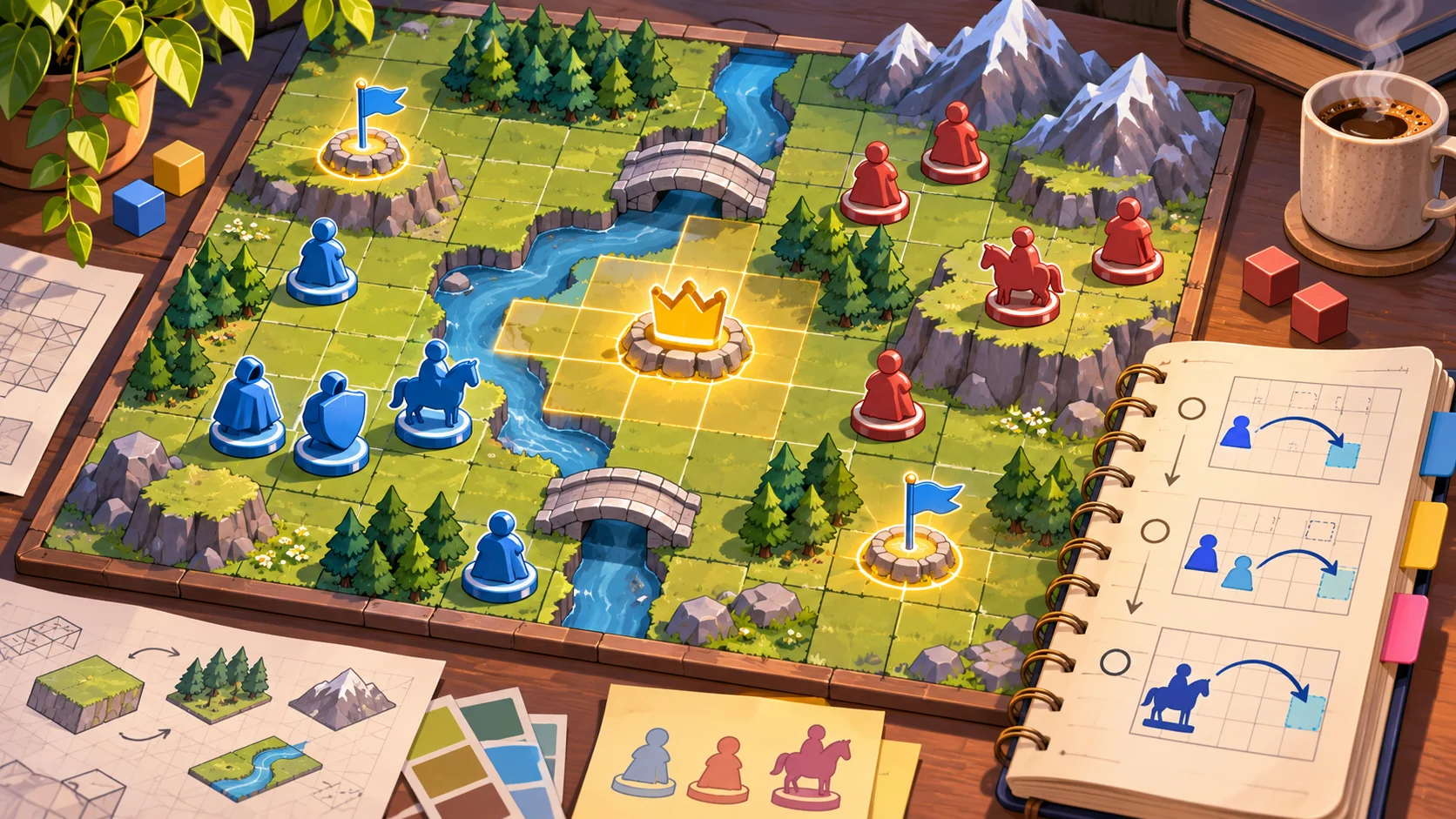
Define a compact arena before removing the grid
Removing square cells changes how a tactics game measures movement, range, and obstacles. A prompt that says “make combat gridless” leaves the builder to decide how far a character can move, what counts as a valid target, and how a pillar affects an attack. Define those rules first, then test them in a small encounter.
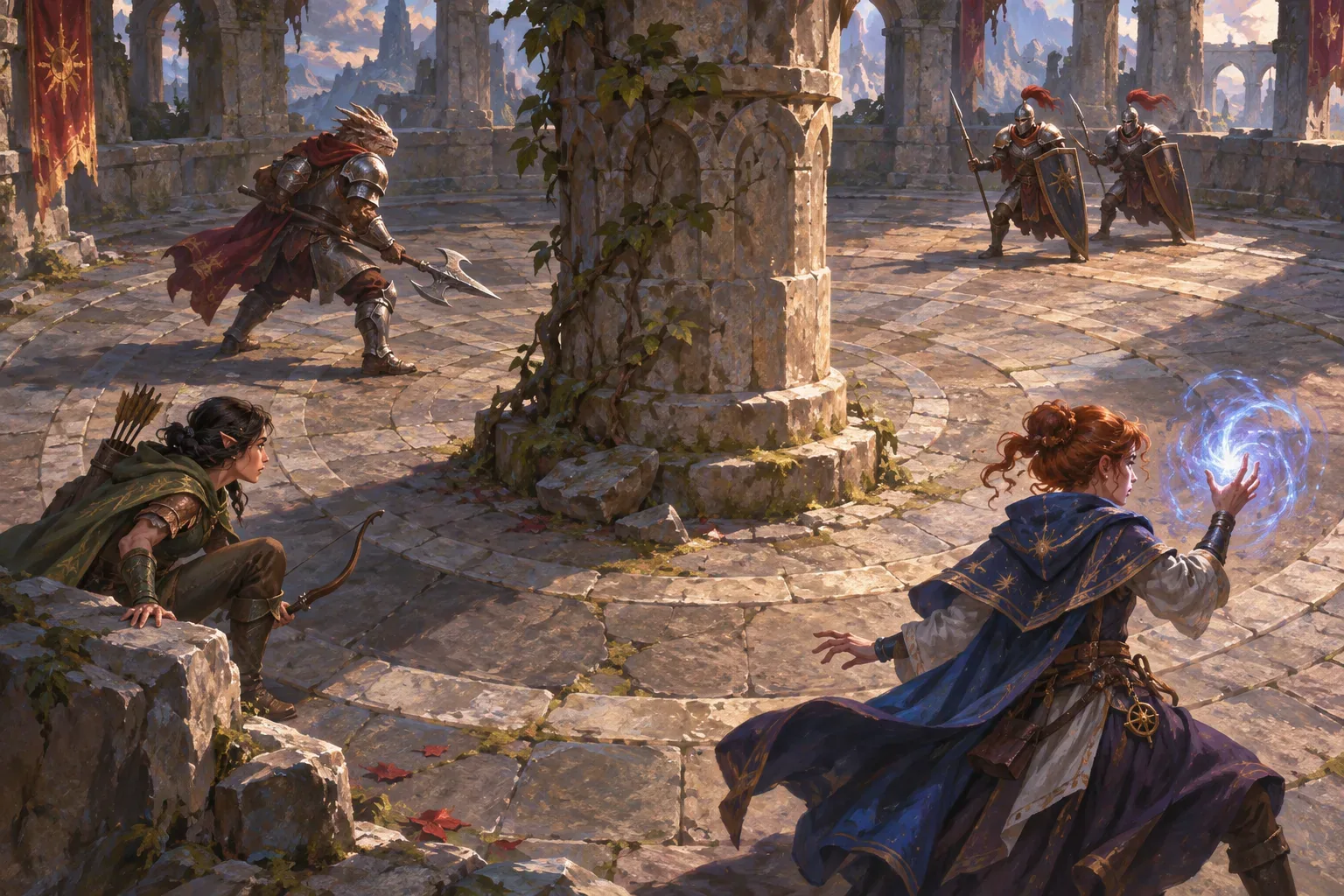
This fictional example uses a circular stone arena, three player characters, and two sentries. Each unit has a position expressed as x/y coordinates within the arena boundary. There is no hidden square grid. A waist-high pillar blocks line of sight when the straight segment between attacker and target crosses its footprint. The scene focuses on measured movement and action points; it does not add elevation, cover bonuses, or complex terrain.
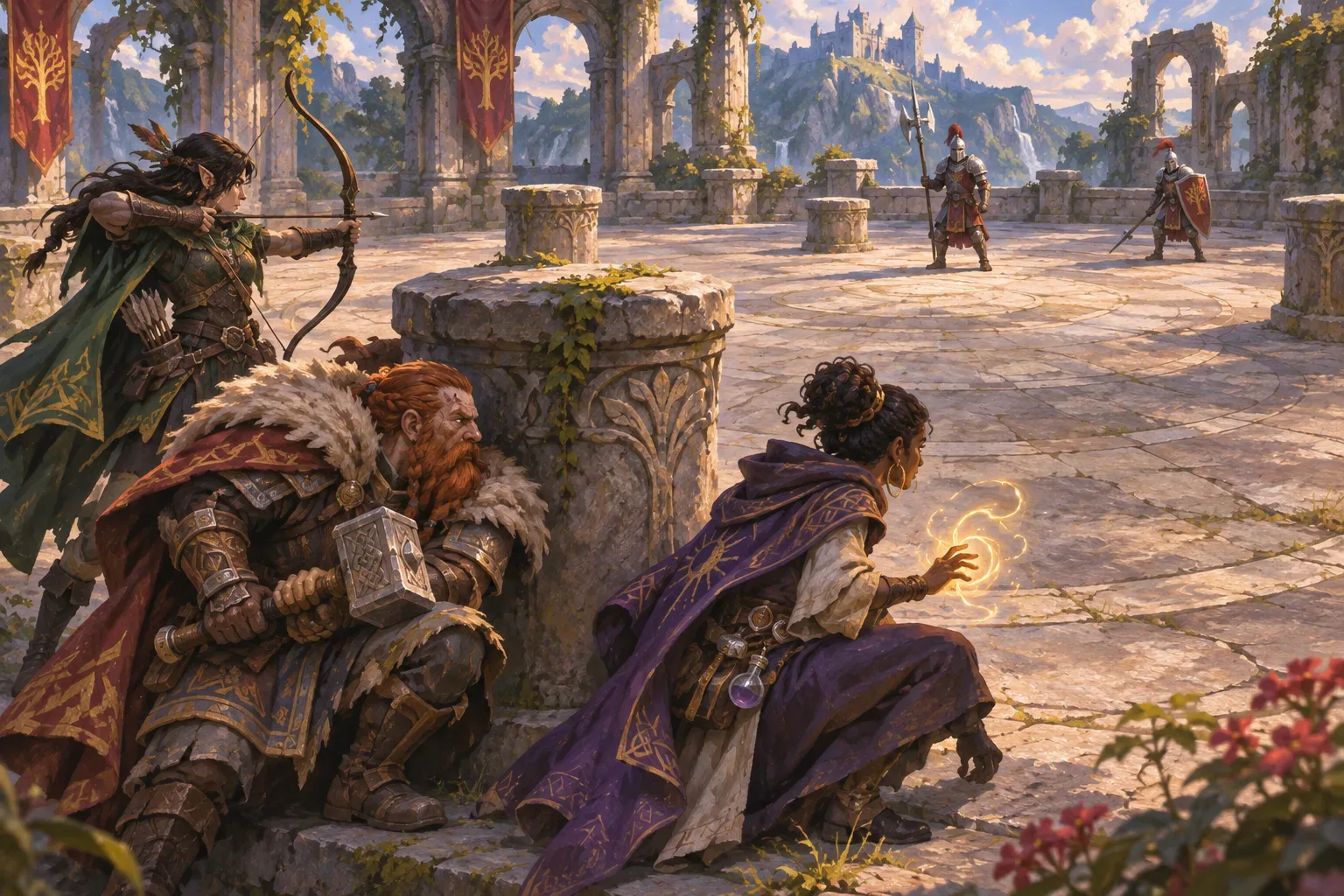
Set the goal as well as the geometry. For the first slice, the party must disable the two sentries and reach an exit marker. The purpose is to make position matter: a Scout can move around the pillar to create a clear shot, while a slower Vanguard can hold the near side. Keep the map small enough that the reader can follow each move and see why the line of sight changed.
Start with a coordinate convention. Treat the center of the arena as (0,0), use the same unit for all distances, and state the arena boundary. Each player character receives two action points per round. Movement costs one point for each three distance units, while an attack or support action costs one point. These values are fictional and chosen to make the sample trace easy to inspect.
Specify movement, attack range, and line of sight
Give each unit a movement limit and an attack range. The Vanguard moves up to four distance units and attacks within two. The Scout moves up to six and attacks within five. The Medic moves up to five and heals within three. A character cannot exceed its movement limit, leave the arena, or spend more action points than it has. Do not let movement continue at no cost after the budget runs out.
Use one distance rule consistently. In this example, measure straight-line distance between unit centers. If the player can move around a pillar, calculate the path length along the route they choose; do not measure through the obstacle. The prompt should ask the builder to show start point, end point, and movement cost so a player can check the calculation.
{
  "id": "scout",
  "position": {"x": 4, "y": -2},
  "movementLimit": 6,
  "attackRange": 5,
  "actionPoints": 2
}
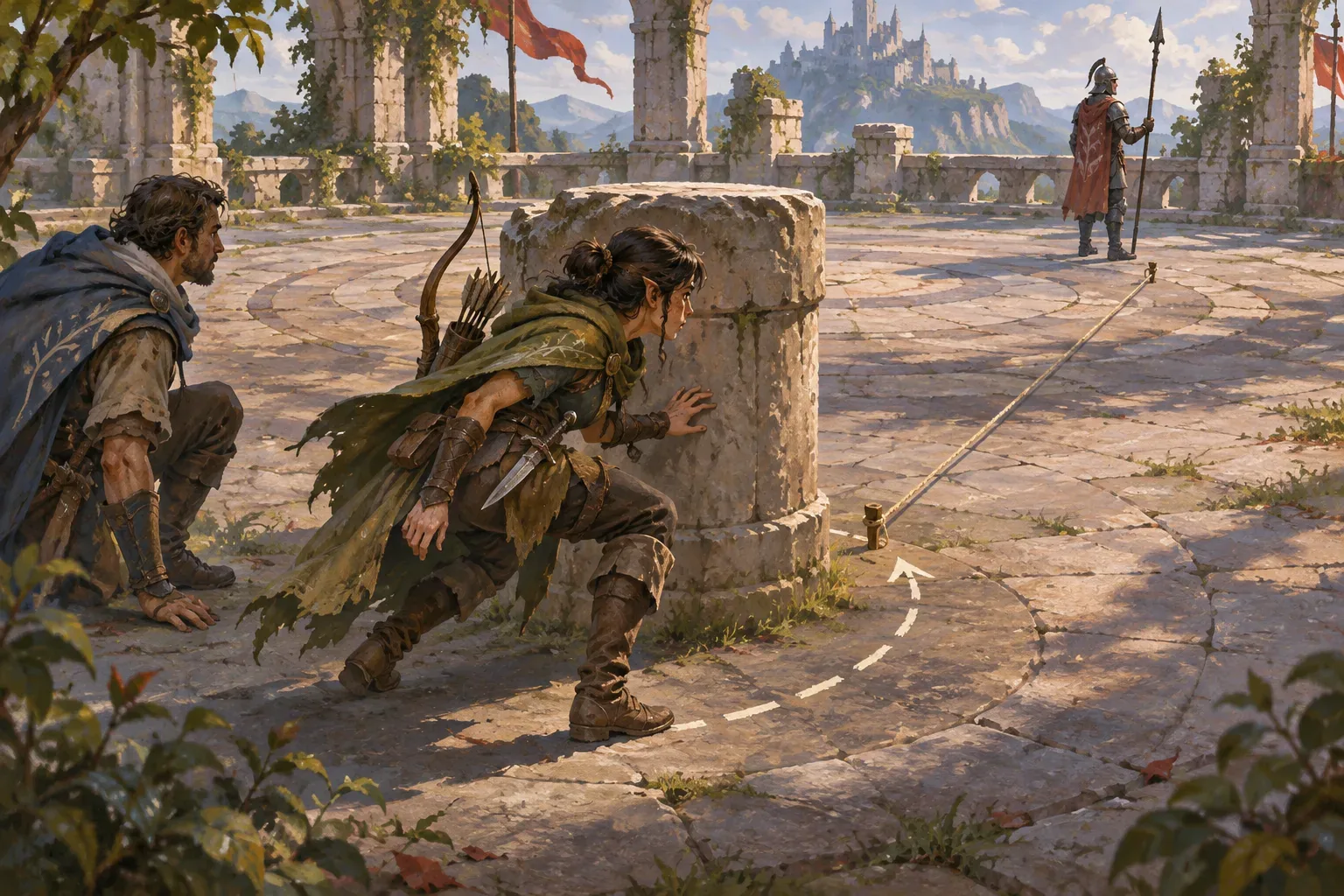
Line of sight is a separate question from range. An enemy can be within five units and still be hidden by the pillar. Define the obstacle as a fixed footprint in the arena. Draw a straight segment from the attacker to the target; if that segment crosses the footprint, the attack is blocked. The example does not grant partial cover or damage reduction. Keeping the rule binary makes it easier to verify before adding more detailed geometry.
Ask for boundary cases explicitly. If a unit ends exactly at the arena edge, is the position legal? What if an attack distance equals the range exactly? What if the pillar touches the line but does not cross it? Choose a consistent rule and use it for every action. Avoid vague words like “near” and “close enough” unless they map to a number.
Set action costs and the resolution order
Action points help gridless movement stay bounded. Each unit starts a round with two. Movement spends one point per three distance units, rounded up; attacks and heals each cost one point. A move of four units therefore costs two points, leaving none for an attack that round. If the player chooses a four-unit move, the system should not permit an attack for free.
Resolve player actions in the order the player chooses, deducting costs immediately. A blocked attack spends no action point and explains that the pillar obstructs the shot. A legal attack spends one point and resolves damage. After all player units finish, sentries act. Each sentry targets the nearest visible character; if two are equally near, select the unit with the alphabetically first stable ID. Deterministic ties keep the initial encounter reproducible.
Separate a unit’s position, health, action points, and status effects. If a unit is defeated, it cannot move or act. When a sentry targets, compare only visible characters. A sentry with no visible target holds position. State this instead of adding an improvised attack through the pillar or an unannounced movement rule.
Trace a tactical turn with fixed positions
Before asking for a full build, request a trace that includes a clear shot, a pillar-blocked shot, and an attempted move beyond the boundary. Give every unit a starting position. For example, the Scout begins behind the pillar, moves around it within the nine-unit limit, and checks line of sight to a sentry. The Vanguard remains near the center, while the Medic stays within healing range of an injured ally.
Ask the output to list each unit’s position before and after movement, action points remaining, distance to target, line-of-sight result, and any health change. Then resolve the sentries’ target selection. This makes it possible to catch a range calculation that ignores the obstacle or an action point that was not deducted. The table below is an acceptance plan, not an observed play result:
| Action | Expected check | State to inspect |
|---|---|---|
| Scout moves around pillar | Path stays inside arena and within movement budget | Start, end, path length, action points |
| Scout attacks sentry | Target is within five units and visible | Range, pillar intersection, health |
| Vanguard shoots through pillar | Attack is blocked with no cost | Line-of-sight explanation, unchanged action points |
| Unit attempts to leave arena | Invalid move is rejected | Position stays within boundary |
This trace is hand-designed expected behavior. These prompts have not been run and no playable build or test output is included. When you generate a prototype, put expected results and actual results in separate columns. A mismatch can then guide a targeted prompt revision without being confused with a successful test.
Turn the prompt sequence into prototype checks
Build in layers: coordinate space and arena boundary first; movement budget second; attack range and pillar line of sight third; then enemy targeting and health. Reuse the same coordinates, action names, and distance units across prompts. Ask for a log after each action rather than a narrative summary that hides intermediate state.
- Confirm all starting positions are inside the circular arena.
- Check that movement distance is measured consistently and never exceeds the unit limit.
- Verify each movement, attack, and heal spends the stated action points.
- Test an attack at exact maximum range and one just outside it.
- Confirm a segment crossing the pillar footprint blocks line of sight.
- Check that blocked attacks do not spend action points and explain why.
- Verify sentries target the nearest visible character and resolve ties by stable ID.
- Reject out-of-bounds movement without changing position.
If a result is wrong, edit only the relevant prompt. If movement costs are rounded inconsistently, state that costs round up. If the pillar blocks attacks but not movement, keep those rules separate. If sentries target through obstacles, specify that target selection uses the same visibility test as player attacks. Add elevation or cover only after the simple movement loop behaves as intended.
SEELE’s AI RPG Maker overview provides general context for starting with a character goal, playable scene, quest objective, and meaningful choice. It does not document gridless movement or this tactical system. Treat it as broad RPG planning context, then verify any generated rules in your chosen builder.
FAQ
What should a gridless tactics game prompt define first?
Define the play area, movement measurement, action budget, attack range, and how players identify valid targets. A small encounter can then show how position changes an action.
How can gridless movement stay fair?
Use a consistent distance rule, clear movement costs, and a visible way to measure range. State how obstacles block movement or attacks and what happens at a boundary.
Should a gridless tactics game use free movement or fixed steps?
Either can work if the prompt makes movement cost and stopping conditions explicit. This example uses measured movement within a fixed action budget rather than unlimited free placement.
How do I test line of sight in a prototype?
List the attack origin, target point, intervening obstacles, and range. Check clear, blocked, and boundary cases separately before adding complex cover or elevation.
Were these gridless tactics prompts tested in a playable game?
No. The arena, movement rules, and encounter are fictional planning material. The prompts are unrun drafts and no playable build or test results are included.