Introduction
A hotel-management game prompt should connect room status, guest needs and staff assignments to visible choices. If rooms never become unavailable, assignments have no limits or guest feedback does not change, the management theme becomes decorative. A small prototype can show one shift and make the tradeoffs easy to inspect.
This guide uses Harborlight House, a fictional boutique hotel with a small team and one busy afternoon. Its room inventory, guest requests, staff roles and satisfaction values are invented game variables, not operating advice or measured outcomes. No prototype has been generated or playtested for this article.
Define the shift loop
Start with the cycle the player repeats: review arrivals, assign available staff, prepare rooms, respond to requests and close the shift. State which choices advance time and what counts as a completed shift. Keep the first milestone to a small floor and a few guest requests rather than a full hotel chain.
Prompt 1 — hotel-management brief
Design an original hotel-management game prototype called Harborlight House. The player manages one small boutique hotel through a single afternoon shift. Define the goal, room states, guest requests, staff availability, task assignment, feedback and shift end condition. Use fictional abstract values. Keep the first milestone to one floor and a small team; do not claim the rules reflect real hotel operations.
A clear brief distinguishes what the player controls from what the simulation updates. Decide whether the player directly assigns tasks, sets priorities or hires staff. Avoid asking for all three systems before one shift is understandable.
Connect room status with guest requests
A room can be vacant, occupied, being prepared or blocked by a fictional maintenance task. Define how a room changes state and what the player sees before assigning it. Guest requests should have visible priorities and a response state, but avoid hidden failure timers that punish players without warning.
| Game state | Example player information | Possible choice |
|---|---|---|
| Room occupied | Not available for a new arrival | Queue a future assignment |
| Room being prepared | Assigned staff and task progress | Reassign only if the rule allows it |
| Guest request open | Request type and priority | Accept, defer or decline with feedback |
| Room ready | Ready marker and assigned arrival | Confirm the room or review another task |
Prompt 2 — rooms and requests
Define four fictional room states and three guest-request types for Harborlight House. For each state, show what the player can see and which actions are legal. Let the player accept, defer or decline a request with a clear response. Do not use real guest data or hidden penalties. Explain when a room becomes available again.
Make staff assignments readable
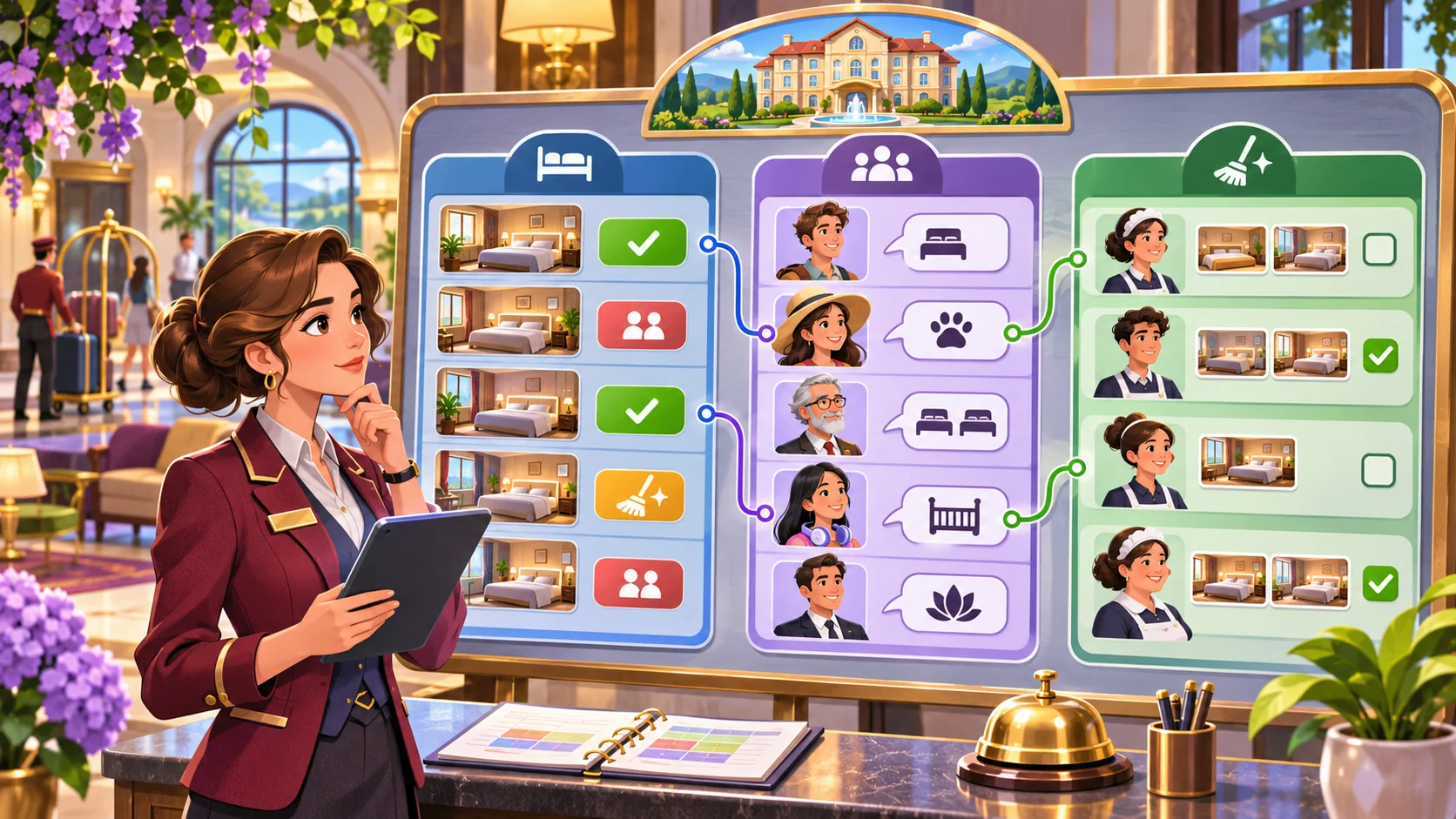
A management decision needs a constraint. Show which roles are available, what tasks they can take and how assigning one task affects the rest of the shift. A simple capacity model can make scheduling choices legible without simulating every detail of hotel work.
Prompt 3 — staff and task allocation
Create three fictional staff roles for Harborlight House and a small list of shift tasks. Show role availability, task duration as editable placeholder units, and what capacity remains after each assignment. Prevent overlapping work unless the player explicitly reschedules it. Show room status and guest-request priority before confirming. Treat all values as untested game settings, not real staffing guidance.
| Assignment | Constraint | Player feedback |
|---|---|---|
| Prepare a room | Uses one available role until complete | Room status and expected game-time cost |
| Respond to a request | Competes with another open task | Request state and remaining capacity |
| Reassign staff | Original task pauses or transfers by explicit rule | Before/after schedule shown |
Give guest feedback a clear cause
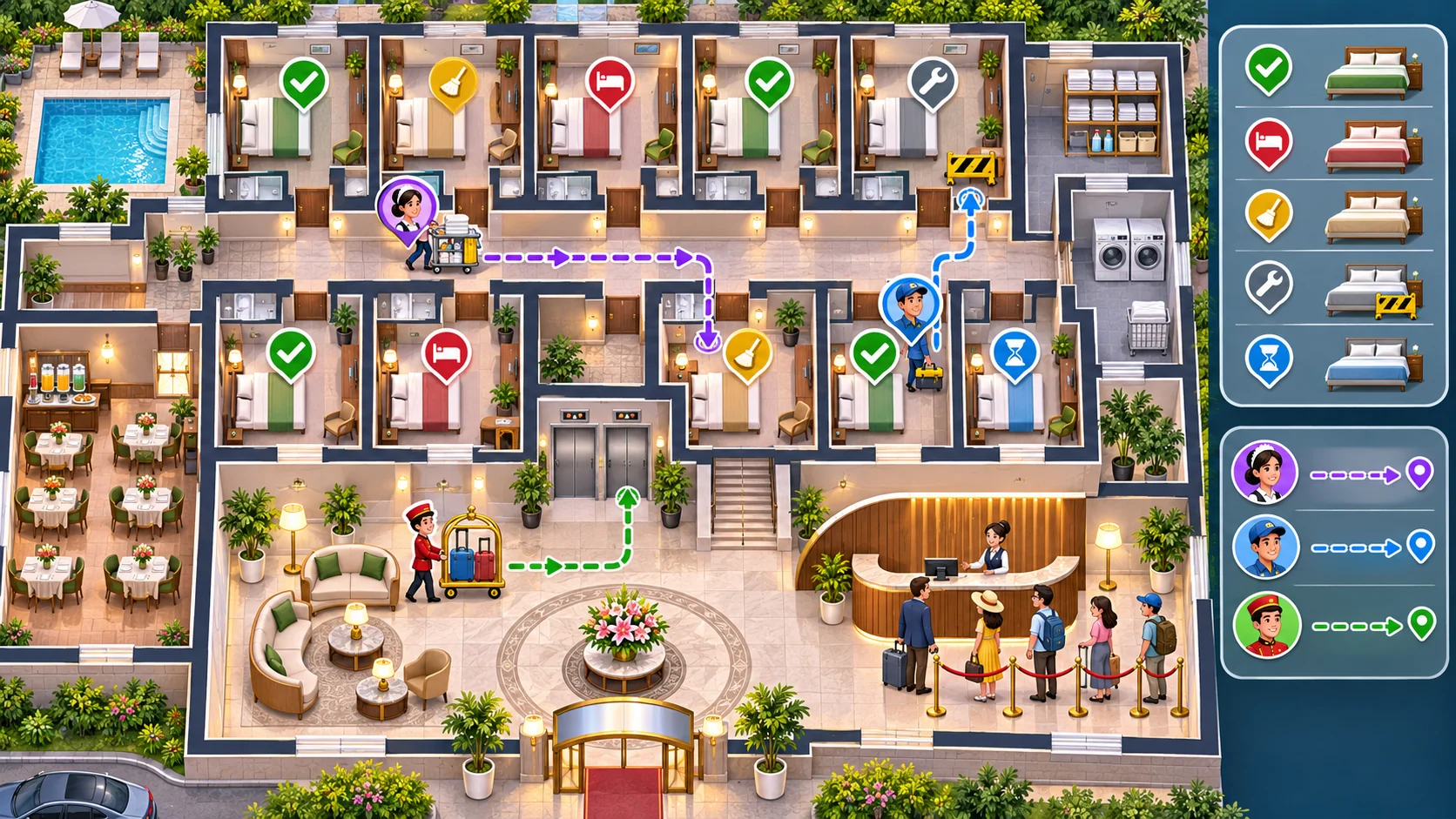
Guest satisfaction should respond to visible game events. If a score changes, show whether it followed a completed request, a delay or a room assignment. Let the player understand how to recover. A single feedback marker or short message can be more useful than a complicated hidden rating system in the first build.
Prompt 4 — guest feedback and shift summary
Define a simple guest-feedback system for the Harborlight House prototype. Show which visible events change the feedback state, how the player sees the reason and what recovery choice remains. At shift end, summarize room readiness, open requests, completed tasks and unresolved issues. Do not use unexplained scores or imply that the model predicts real guests.
Request a focused playable shift
Ask for one complete cycle with a few rooms, a small team, visible assignments, guest requests and a shift summary. Exclude reservations across multiple days, pricing optimization, loyalty accounts, a large staff roster and a hotel chain. A narrow build makes it easier to verify the interactions that support the management loop.
Prompt 5 — prototype build
Build a first playable Harborlight House shift with four rooms, three fictional staff roles, a few guest requests, task assignment, room-state updates, visible capacity, cause-and-effect feedback, a shift summary and reset. Use placeholder art and fictional values. Show why an assignment is unavailable. At handoff, list working interactions, placeholders and unverified items. Do not describe a static hotel dashboard as playable.
A mockup can show a schedule but cannot establish that staff assignments or room states change. Open the actual output and verify task selection, availability, room updates, request response, feedback, summary and reset. This article’s Harborlight House example was not run.
Fictional shift snapshot
This snapshot is an illustrative design state, not a real service plan.
| Field | Fictional planning value |
|---|---|
| Working title | Harborlight House |
| Scenario | One afternoon shift on a small floor |
| Staff | Three abstract roles with limited task capacity |
| Player loop | Review requests → assign tasks → update rooms → close shift |
| Feedback | Short reason-linked status markers |
| First milestone | Four rooms, a few requests and a visible summary |
| Excluded | Revenue optimization, loyalty system, multi-day calendar and real guest data |
Review the generated output
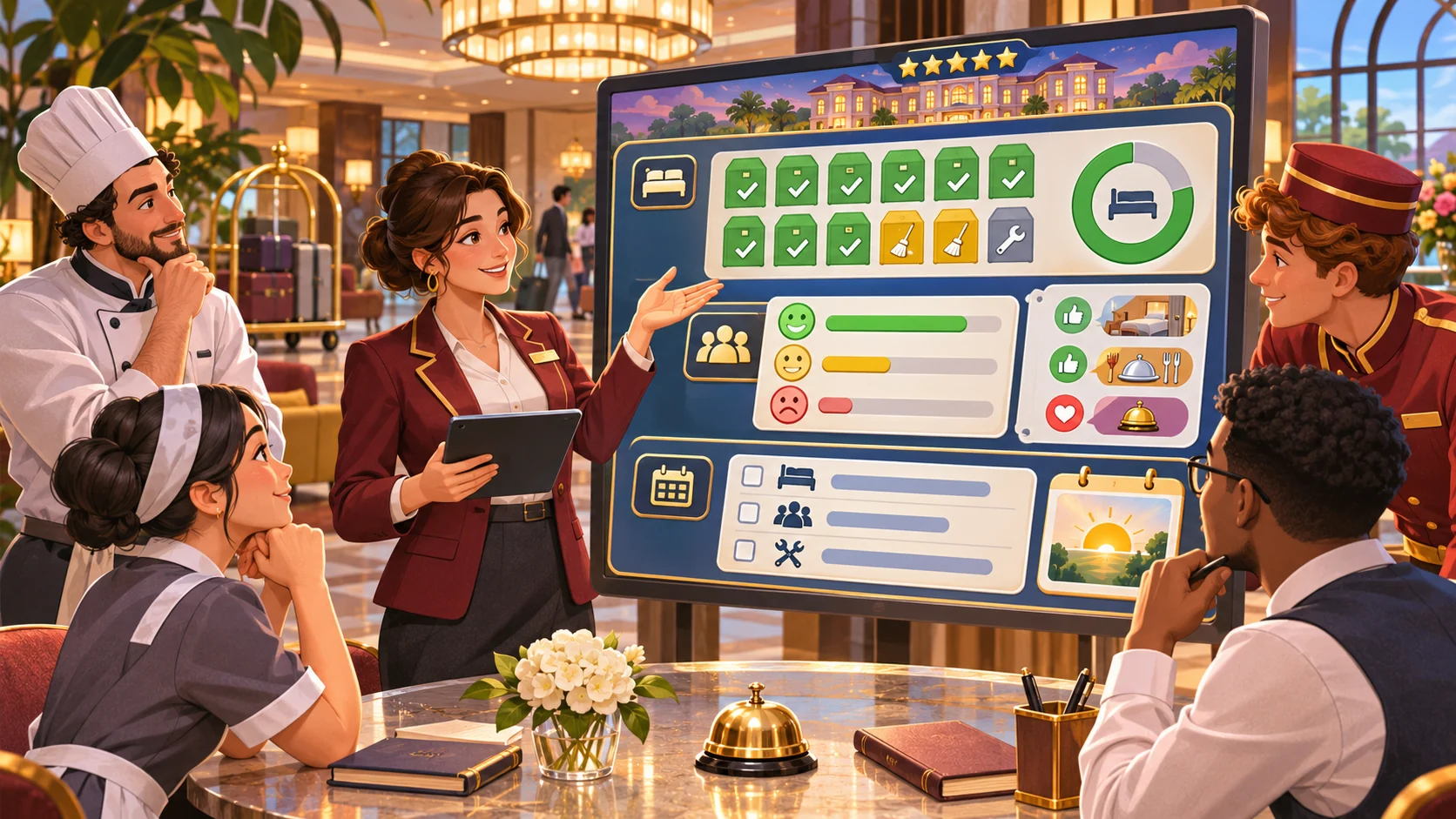
Check whether the game makes its schedule and consequences visible. Record only what you can observe. If an assignment button is present but room state never changes, mark the interaction missing. If feedback changes without a clear reason, mark it unclear and request one focused fix.
Prompt 6 — implementation review
Review the running Harborlight House prototype for room availability, staff assignment, task progress, request handling, feedback reasons, shift summary and reset. Mark each present, missing or unclear based only on the actual interaction. Quote the evidence and suggest the smallest next change. Do not claim the system models real hotel work or has been tested unless that is true.
Keep simulation claims proportional to evidence. A fictional example can explain a design pattern, but it does not validate staff capacity, guest satisfaction or real-world operations.
Conclusion
Hotel-management prompts should connect room states, requests, staff capacity and guest feedback in one reviewable shift. Harborlight House is a fictional design exercise with untested values. Build a narrow prototype, verify the actual state changes and describe placeholders honestly.
You can take a defined concept into the Free AI game maker, then compare the result with the checklist above.
FAQ
What should AI prompts for a hotel-management game specify?
Define room states, guest requests, staff roles, assignment limits, task progress, feedback causes, shift completion and first-build exclusions.
How can a hotel game make staff scheduling meaningful?
Show available roles, task requirements and remaining capacity before confirmation, then make the assignment change a visible room or request state.
Should a hotel simulation use real guest or staffing data?
A fictional prototype can use abstract values. Do not present invented values as operational recommendations or use real guest data without a clear need and authorization.
How should guest satisfaction change in a management game?
Tie each change to an observable event and explain the cause. Keep the first system simple and allow the player to understand recovery options.
Does a hotel-management mockup prove its systems work?
No. Check assignments, room states, request handling, feedback and the shift summary in the actual output before calling it playable.