Introduction
A logistics-management game needs visible links between deliveries, routes and capacity. If a vehicle can take every parcel, routes have no tradeoff or delivery status never changes, the management theme stays decorative. A small prototype can show one dispatch cycle and let players understand why a route choice matters.
This guide uses Parcel Bay, a fictional neighborhood delivery game with one hub, a few vehicles and several stops. Its packages, routes, capacity values and shift results are invented. They are game variables, not real logistics advice, and no prototype was built or tested for this article.
Define the dispatch loop
Start with one cycle: review incoming jobs, group stops, assign vehicles, dispatch routes, update delivery states and review the shift. State what advances time and what counts as completion. Keep the first slice to one small map and a few delivery requests rather than a regional network.
Prompt 1 — logistics brief
Design an original logistics-management prototype called Parcel Bay. The player runs a small neighborhood delivery hub for one shift. Define incoming jobs, route planning, vehicle capacity, dispatch, delivery status, exceptions and shift review. Use fictional abstract values, not operational forecasts. Limit the first milestone to one hub, a small map and a few routes.
A clear brief states what the player knows before dispatch. Show package count, stop order, route distance or time as simple game measures. If a delivery can be deferred, state what changes and how the player sees it.
Make route choices and tradeoffs visible
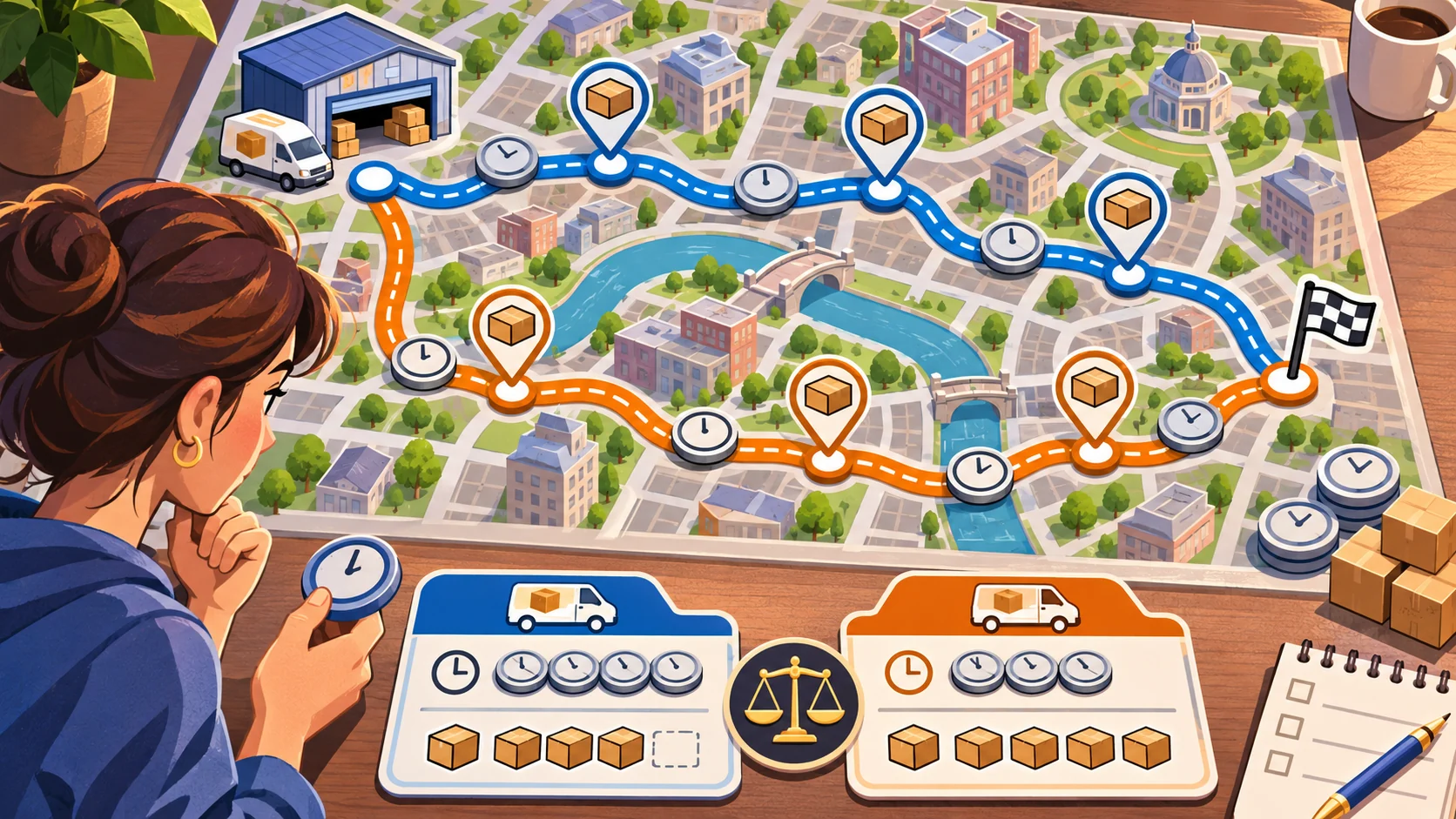
A route choice should compare useful options: fewer stops, a longer route, a capacity constraint or a delivery window. State which facts are known before the player chooses and whether routes can be changed after dispatch. Avoid real-world traffic claims or invented savings percentages.
Prompt 2 — route planner
Create a small fictional neighborhood map for Parcel Bay with one hub and [number] delivery stops. Offer two routes with different stop order and abstract travel-time costs. Show which parcels fit the selected vehicle and what remains in the queue. Let the player compare routes before dispatch. Label all times as untested game values.
| Route state | Player sees | Possible decision |
|---|---|---|
| Planned | Stop order, parcel count and abstract time | Dispatch or revise |
| Capacity full | Which parcels are assigned and which remain | Use another vehicle or defer a job |
| In transit | Current route progress and next stop | Continue or return by an explicit rule |
| Delivered | Completed stop and remaining queue | Review the next assignment |
Connect vehicles and capacity
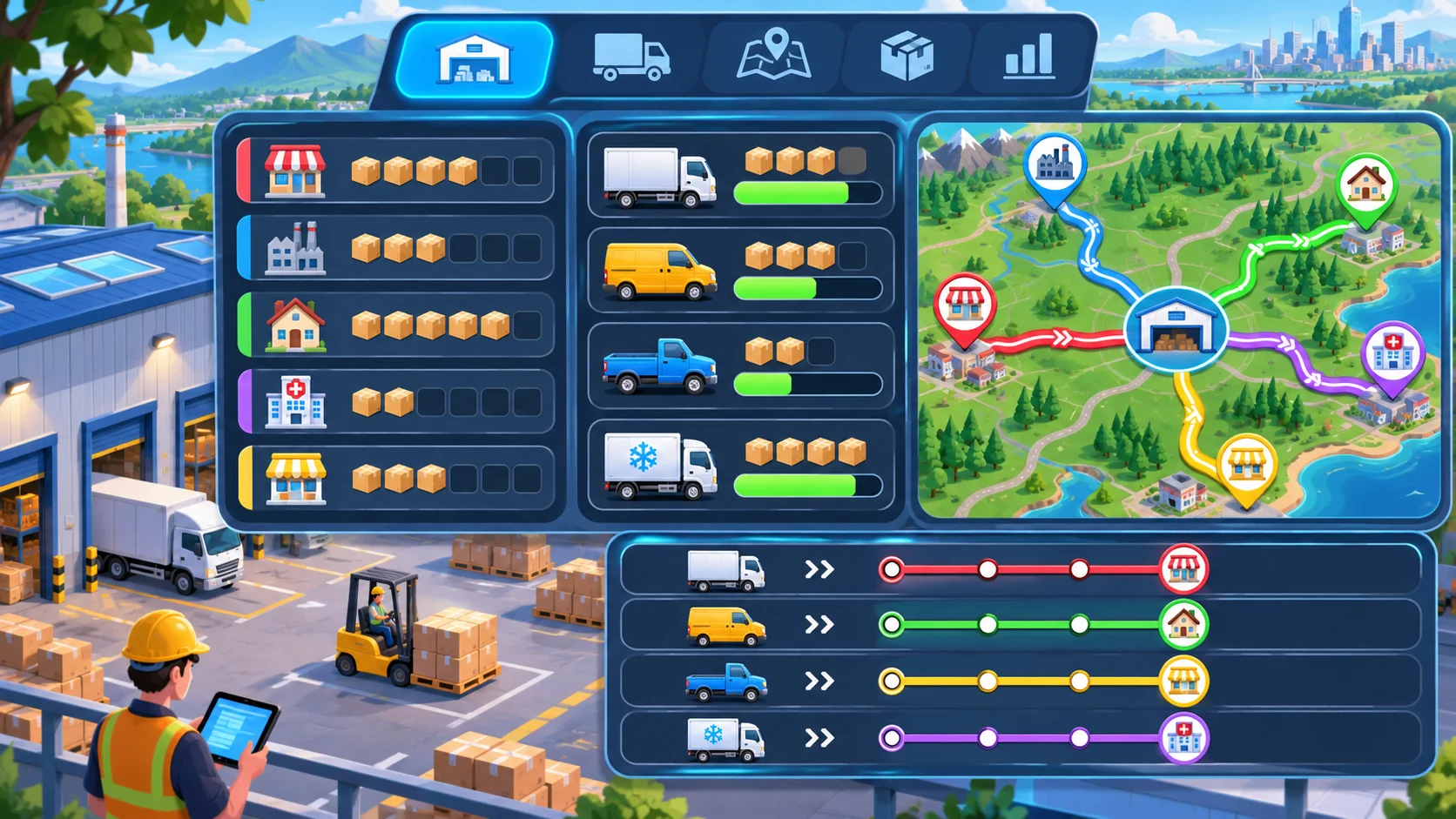
Capacity is meaningful when the player sees what uses it. Define whether the limit is parcel slots, a simple weight unit or a generic capacity meter. Show the amount before assignment and make the blocked state clear. Keep vehicle types and upgrades out of the first version unless they change the core route decision.
Prompt 3 — vehicle and dispatch rules
Define two fictional vehicle types for Parcel Bay with different abstract capacities. State how a parcel uses capacity, what happens when a route exceeds the limit and whether the player can split a route. Show the remaining capacity before confirmation and explain any blocked assignment. Do not model real vehicle payload or safety requirements.
A simple queue can connect available jobs with the route board. When the player assigns a package, update the queue and vehicle load at the same time. If one value changes without the other, identify which state is authoritative.
Define exceptions without hidden punishment
A management loop needs a response when a stop cannot be completed. Let the player see the reason, choose a retry or defer action and understand whether the rest of the route continues. Avoid unexplained penalties or an automatic loss that appears without warning.
Prompt 4 — delivery status and exceptions
Define delivery states for Parcel Bay: queued, assigned, in transit, delivered and deferred. For each, list the visible status, legal next action and effect on the route. Add one fictional exception that the player can resolve by retrying or deferring. Explain the result before confirmation. Keep all consequences within the game and do not present them as real courier guidance.
Request one playable dispatch shift
Ask for a small complete cycle with one hub, a few jobs, two vehicle types, route comparison, capacity feedback and a shift summary. Exclude staff rostering, pricing, fleet purchases, customer accounts and real-time traffic. One shift gives a reviewer enough states to inspect.
Prompt 5 — prototype build
Build a first playable Parcel Bay dispatch shift with one hub, a compact neighborhood map, a few fictional packages, two vehicle types, route comparison, visible capacity, dispatch, delivery-state updates, one retry/defer exception, shift summary and reset. Use placeholder art and untested game values. At handoff, list working interactions, placeholders and unverified items. Do not present a static route dashboard as playable.
A map image does not demonstrate that dispatch changes the queue. Open the actual output and verify assignment, capacity, route progress, delivery status, retry/defer and summary. Parcel Bay was not generated or tested for this article.
Fictional shift snapshot
This is an illustrative game state, not an operating plan.
| Field | Fictional planning value |
|---|---|
| Working title | Parcel Bay |
| Hub | One neighborhood depot |
| Vehicles | Two abstract capacity profiles |
| Player loop | Group jobs → assign capacity → choose route → review statuses |
| Exception | One stop can be retried or deferred |
| First milestone | One shift, a few routes and a summary |
| Excluded | Real traffic data, pricing, fleet purchasing and customer accounts |
Review the running output

Record only observed changes. If an assigned package remains in the queue, mark synchronization missing. If the route moves but delivery status does not update, mark the state unclear. Ask for one focused repair before adding map size or more vehicle types.
Prompt 6 — implementation review
Review the running Parcel Bay prototype for job queue, parcel assignment, vehicle capacity, route comparison, dispatch, route progress, delivered/deferred states, exception handling, shift summary and reset. Mark each present, missing or unclear based only on actual interactions. Quote evidence and suggest the smallest next change. Do not claim delivery efficiency or real-world accuracy unless measured.
Conclusion
Logistics-management prompts should connect queued jobs, route choices, vehicle capacity and delivery states in one visible shift. Parcel Bay is a fictional design exercise with untested values. Request a narrow build, verify each state change and label mockups honestly.
You can take a defined concept into the Free AI game maker, then compare the result with the checklist above.
FAQ
What should AI prompts for a logistics-management game include?
Define incoming jobs, route choices, vehicle capacity, dispatch, delivery states, exceptions, shift completion and first-build exclusions.
How can a logistics game make routing meaningful?
Offer visible route differences, such as stop order or abstract travel time, and show how each affects vehicle capacity and queued jobs.
Should a prototype use real delivery times or traffic data?
Use clearly labeled fictional values unless real data is specifically needed and verified. Do not present invented game measures as forecasts.
How should a logistics game handle a failed delivery?
Show the reason, available next actions and consequences before confirmation. Keep the state update consistent with the route and queue.
Does a route-planning mockup prove dispatch works?
No. Verify package assignment, capacity, route progress and delivery-state changes in the actual output before making a playable claim.