A mech shooter gets more interesting when weapons ask different things from the same chassis. A heavy shot can hit hard but raise heat; a cheaper pulse can finish a target while the rail system cools down. Prompts should connect weapon costs, battery recovery, heat lockouts, and enemy timing so the combat log tells the same story as the animation.
The loadout and five-turn fight below are fictional design examples. These prompts are unrun drafts; no playable build or tested result is claimed.
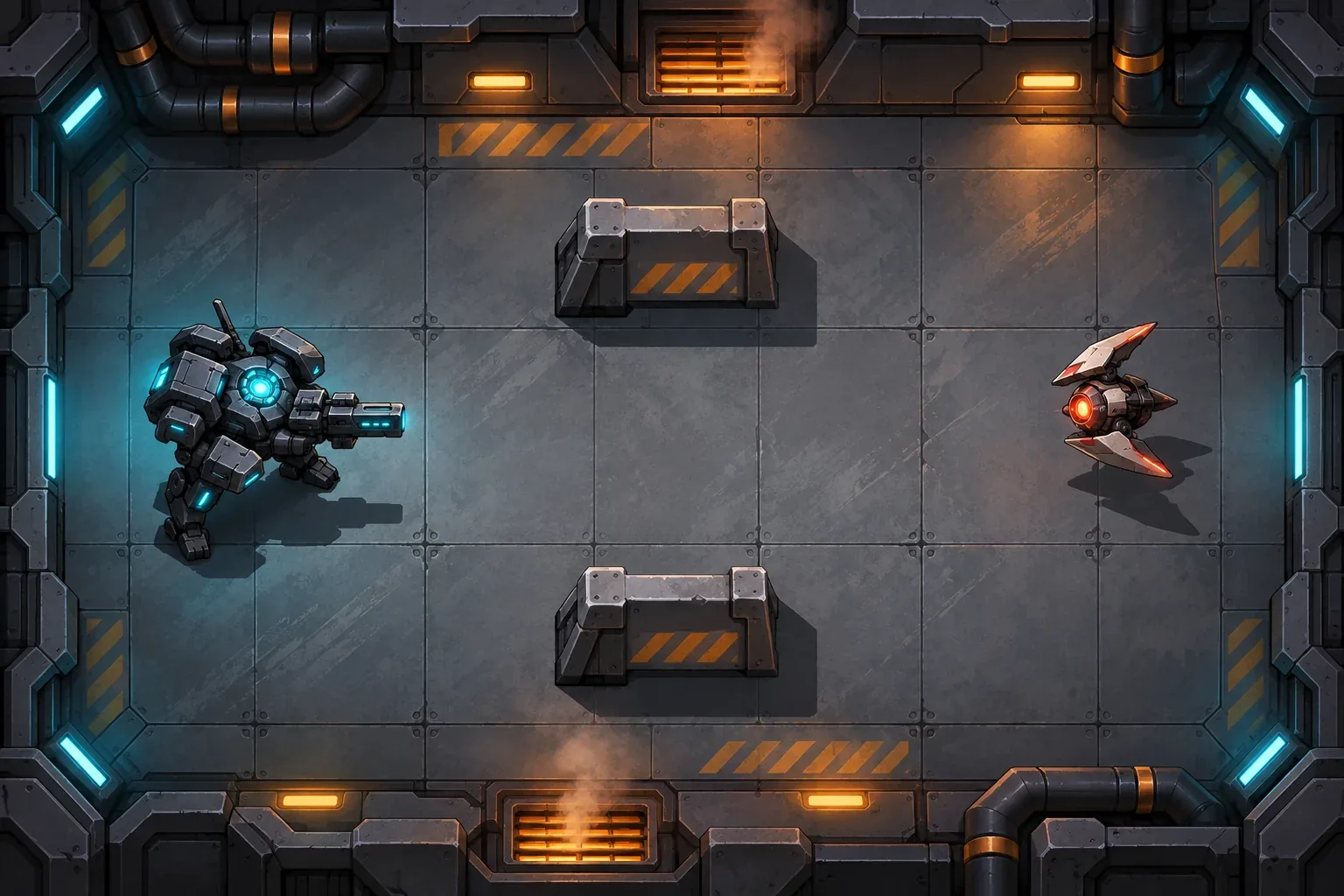
Define the mech loadout contract
Start with one chassis, two weapons, and three resources: pilot armor, battery energy, and heat. Set the caps and recovery rules before asking for more gear. In this fictional design, the battery starts at 6 and cannot exceed 6. The core restores 2 energy after each player action, while heat cools by 1.
| Weapon | Energy cost | Damage | Heat added | Use rule |
|---|---|---|---|---|
| Rail | 3 | 4 | 2 | Locked at action start when heat is 4 or higher |
| Pulse | 1 | 2 | 1 | Available when energy is at least 1 |
The Rail weapon is the high-cost option: it removes more enemy armor but consumes battery and moves the chassis toward a lockout. Pulse deals less damage, costs less energy, and still adds heat. Neither option is automatically best. Give the player enough information to see the trade before firing: current energy, current heat, and why an unavailable weapon is locked.
Keep heat capped at 5. At the beginning of an action, check whether heat is 4 or higher; if so, Rail is unavailable for that action. After the player's shot, a surviving drone responds for 1 damage. Then apply the core's +2 energy, capped at 6, and cool heat by 1. State this sequence once and use it for every weapon so players can predict what the next turn will allow.
Connect resource changes to turn order
Resource rules are easier to verify when the turn has named phases: check weapon availability, pay energy, apply damage and heat, let a surviving enemy respond, then restore energy and cool. A defeated enemy does not attack. This order means the player's shot can end the fight before an enemy response, while recovery still happens after any surviving response.
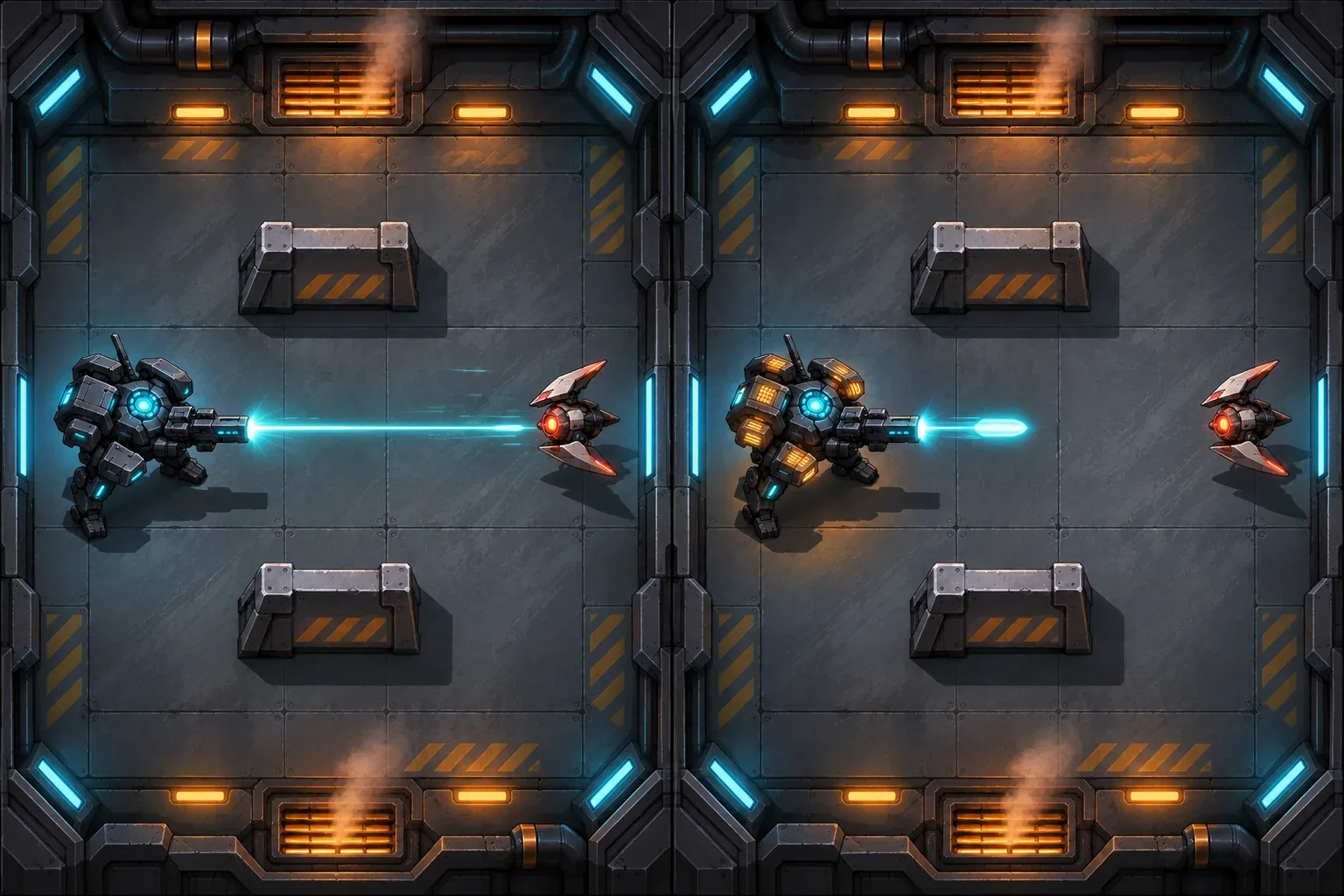
Separate the resource changes in the log. If the UI only shows the final number, it can be hard to tell whether a weapon spent energy before or after the core restored it. A short log such as “Rail −3 energy; drone −4 armor; drone fires; core +2; heat −1” reveals the order and makes a discrepancy easier to locate.
For the first prototype, avoid adding armor penetration, misses, critical hits, heat damage, or weapon upgrades. Each extra modifier adds another branch to the ledger. Once the simple loop is predictable, introduce one new modifier and check the same turns again.
Walk through a fictional five-turn fight
Use one durable drone to make the heat threshold matter. It starts at 18 armor and deals 1 damage after each player action if it survives. The pilot has 7 armor. The trace is hand-calculated, not observed in a game.
| Turn | Player action | Drone armor | Energy after recovery | Heat after cooling | Pilot armor |
|---|---|---|---|---|---|
| 1 | Rail: 4 damage | 18→14 | 6−3+2 = 5 | 0+2−1 = 1 | 7→6 |
| 2 | Rail: 4 damage | 14→10 | 5−3+2 = 4 | 1+2−1 = 2 | 6→5 |
| 3 | Rail: 4 damage | 10→6 | 4−3+2 = 3 | 2+2−1 = 3 | 5→4 |
| 4 | Rail: 4 damage | 6→2 | 3−3+2 = 2 | 3+2−1 = 4 | 4→3 |
| 5 | Pulse: 2 damage | 2→0 | 2−1+2 = 3 | 4+1−1 = 4 | stays 3 |
At the start of turn 5, heat is 4, so Rail is locked. Pulse is still affordable and defeats the drone before it can respond. The pilot finishes at 3 armor, 3 energy, and 4 heat. The win has a cost: the pilot has lost armor and cannot fire the heavy weapon on that final turn. That makes the heat rule part of the combat decision rather than a decorative meter.
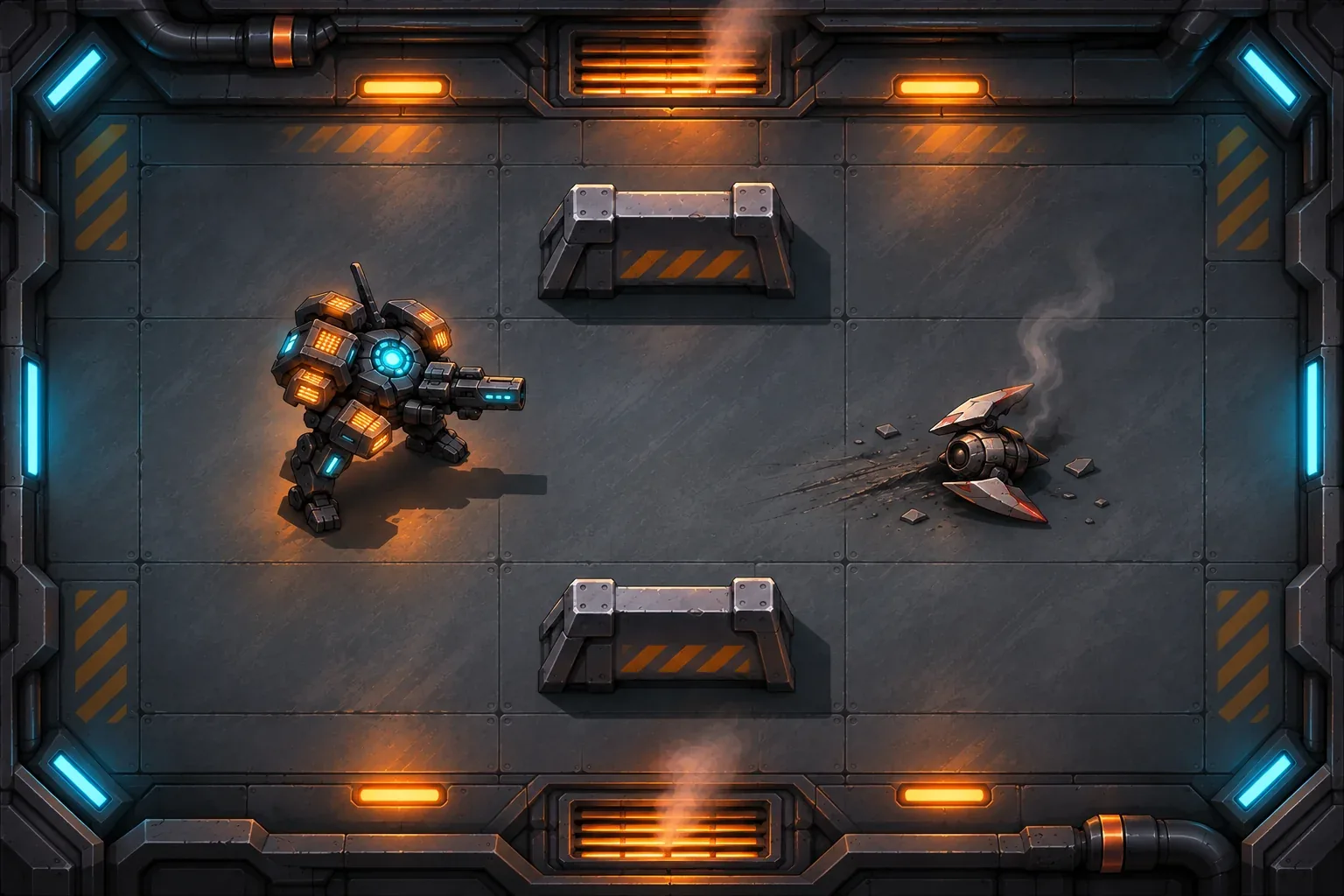
When checking a future build, compare expected and observed values separately. If heat shows 5 instead of 4 after turn 4, inspect whether cooling happened before the enemy action or twice in the same turn. If the drone attacks after reaching zero armor, check whether the enemy response reads the updated state. The ledger identifies what to inspect; it is not evidence that the implementation has passed.
Stage prompts and acceptance checks
Build the prompt in stages so a missing cost is easier to catch. First describe the chassis and two weapons, then add enemy timing, then run the scenario checks. Add visual polish after the loadout rules are fixed.
Prompt 1: define the loadout
Create a compact top-down mech shooter in one industrial arena. The pilot starts with 7 armor and a battery at 6 energy, maximum 6. The core restores 2 energy after each player action up to the cap. Heat is capped at 5 and cools by 1 after each action. A Rail shot costs 3 energy, deals 4 damage, and adds 2 heat; it is locked if heat is 4 or higher at the start of the action. A Pulse shot costs 1 energy, deals 2 damage, and adds 1 heat. Show armor, energy, and heat after every action. Add no other weapons or status effects.Prompt 2: connect the enemy response
Keep all loadout values unchanged. Add one drone with 18 armor. Resolve the player's weapon first; then, if the drone is still alive, it deals 1 damage. A defeated drone does not respond. After that response, restore 2 energy up to the cap of 6 and cool heat by 1. Return a turn log that lists weapon availability, energy spent, damage, enemy response, recovery, and final values. Do not reorder phases.Prompt 3: check the five-turn trace
Using the exact setup, prepare expected and observed columns for four Rail shots followed by a Pulse shot when Rail is locked. Start at energy 6, heat 0, pilot armor 7, and drone armor 18. Keep energy recovery at +2 and heat cooling at -1 after every action. Confirm that Rail is locked at the start of turn 5 when heat is 4, Pulse can still be used, and the drone reaches zero before responding. Do not label any check as passed unless it was actually run.These prompts are unrun drafts. When you adapt them, keep the exact prompt, tool, date, output, and revision. In the playable build, check energy caps, action-start lockouts, enemy response timing, and reset values. Record observed values beside expected values; do not silently change the ledger to match a surprising output.
- Cost check: each weapon subtracts the stated energy exactly once.
- Heat check: heat stays within 0–5 and cools once after each action.
- Lockout check: Rail is unavailable at action start with heat 4 or higher.
- Enemy check: a living drone deals 1 damage after the player action; a defeated drone does not.
- Reset check: pilot armor 7, energy 6, heat 0, and drone armor 18 are restored.
SEELE's official AI Game Maker page describes prompt-based 2D and 3D game creation, browser testing of a playable first version, and follow-up refinement. That is general product context; it does not verify the mech loadout, the fictional five-turn encounter, or the unrun prompts here.
Mech-shooter prompt FAQs
What resources should a mech-shooter prototype track?
Start with pilot armor, battery energy, and chassis heat. Define each weapon's energy cost, heat added, damage, cooling, and lockout before adding more gear.
How should a game handle overheating?
Use a visible threshold and state when it is checked. In this fictional example, the Rail weapon is locked at the start of an action when heat is 4 or higher, while Pulse remains available if energy allows.
Why include two weapons in the first loadout?
A heavy Rail shot and a cheaper Pulse shot make an energy-and-heat tradeoff easy to see. Add more options after costs and recovery are consistent.
When should the enemy respond?
State the order clearly. In the example, the player action resolves first, then a surviving drone deals 1 damage before energy recovery and heat cooling. A defeated drone does not attack.
Are these prompts or combat values tested?
No. The prompts are unrun drafts and the five-turn ledger is a fictional hand-calculated example. No playable result or test pass is claimed.
Make your own mech shooter
Start with one chassis, two weapons, one target, and a log that shows each resource change. Check when heat locks the heavy option and what the lighter weapon lets the player do next. For general creation context, explore the SEELE AI Game Maker, then adapt these draft prompts and verify your own mech loop in a playable prototype.