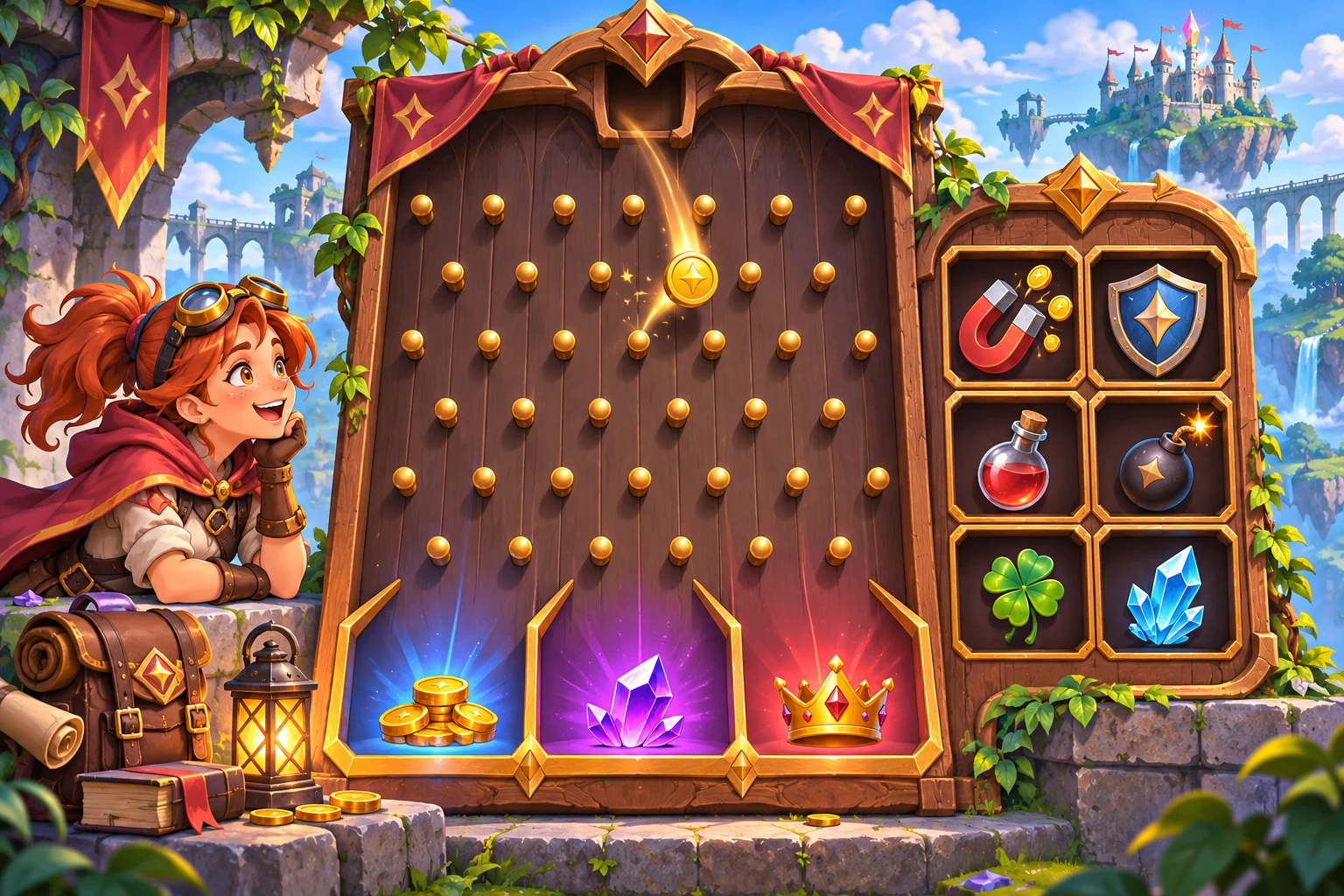
A Plinko roguelike needs more than a board and a score multiplier. Its first version has to make three things legible: where a drop can start, how a ball moves through the pegs, and what the landing pocket changes in the run. If those rules are mixed together, a lucky-looking path can hide a broken score rule or an untested probability assumption.
The prompt sequence below uses a deliberately small fictional design: one five-row board, three pockets, six drops across two boards, and one relic choice between boards. It gives you a compact brief to adapt, plus a paper trace you can use to check the scoring rules. The prompts have not been run, and the landing path is illustrative rather than measured physics or odds.
1. Define the board and run before adding content
Start by stating the shape of a run, not a list of upgrades. For this example, each board lasts three drops; the full run has two boards and six drops. The score begins at zero, carries between boards, and the target is 16 points. The player wins if the final score reaches that target after the sixth drop. A run also ends early if a drop cannot be resolved, which should be treated as an error state during implementation rather than silently awarding points.
These numbers are design inputs, not a claim that six drops is balanced. Their purpose is to make a small vertical slice: one board, one repeated action, one transition, and one clear success check. If the first build cannot explain why a score changed, extra relics and board variants will only make debugging harder.
Prompt 1 — establish the run contract
Create a short Plinko roguelike prototype with one vertical peg board, three landing pockets, and six total drops split into two boards of three drops each. Start at 0 points and set the run target to 16. Carry score from Board 1 to Board 2. After the sixth resolved drop, show Win when score is at least 16 and Loss otherwise. Keep the run to these two boards. Do not add flippers, ball saves, shops, extra board layouts, or unlisted scoring bonuses. Show the current board, drop number, score, and target.This prompt gives the first draft an end condition. It also rules out controls borrowed from pinball. In a Plinko-style loop, the player chooses a launch lane and watches gravity and peg collisions determine the landing pocket. There is no flipper timing action in this design.
2. Separate launch choices from random outcomes
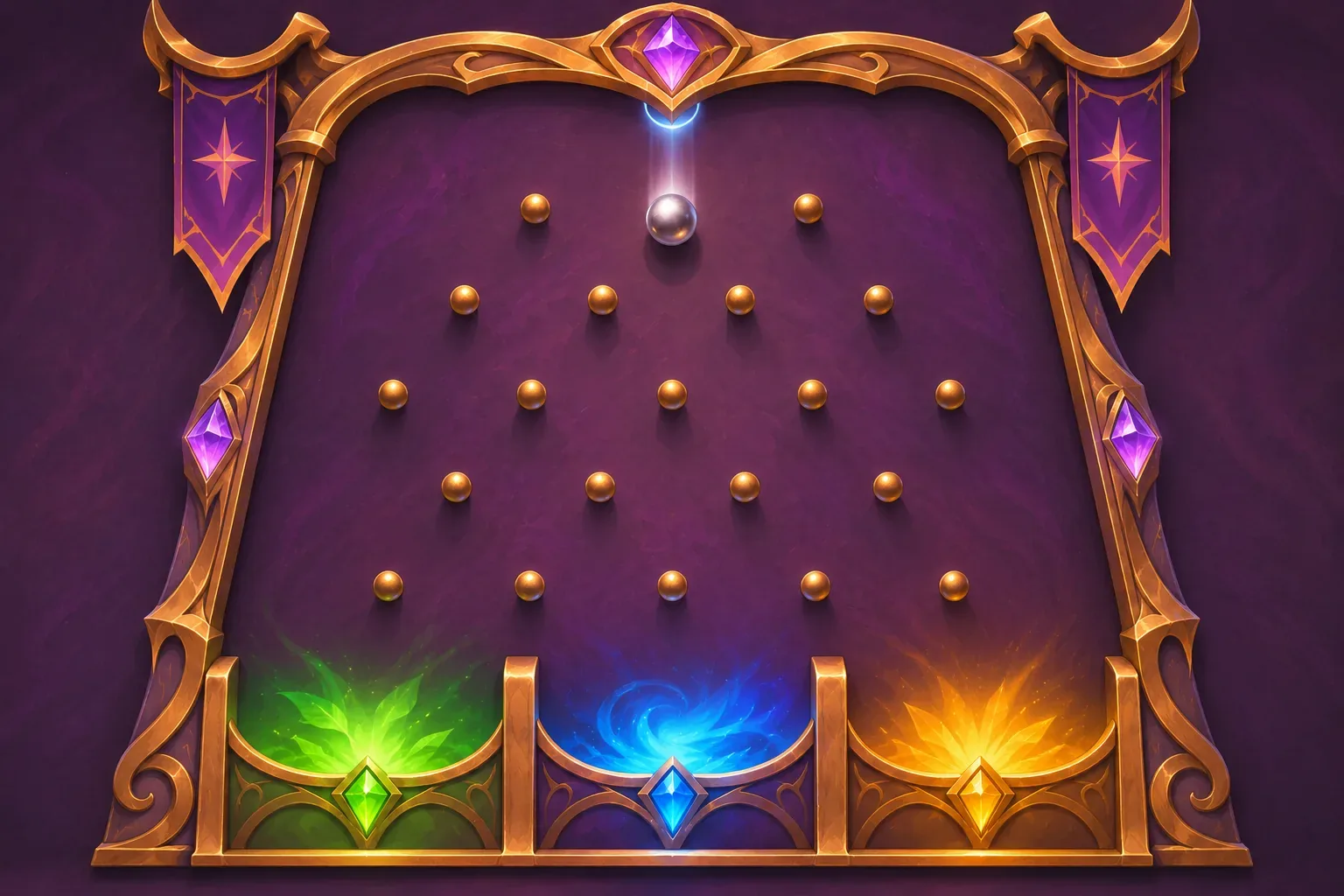
Give the player a meaningful decision before the ball falls. The example uses three launch lanes—left, center, and right—and five staggered peg rows. A landing in one of three bottom pockets banks a fixed score: left is 1, center is 2, and right is 4. Record both the lane chosen and the pocket reached. That small log makes it possible to inspect a run without confusing the player’s decision with the board’s response.
Do not write “the right lane usually reaches the gold pocket” until a playable version has been run enough times to support that statement. A sketch, a hand trace, or an image cannot establish a probability distribution. At the design stage, specify the expected behavior and the evidence you plan to collect; leave odds open.
Prompt 2 — define a readable drop
Use one fixed visible board with five staggered rows of pegs and three launch lanes across the top. Before every drop, ask the player to choose Left, Center, or Right. Let the ball descend under gravity and resolve peg collisions until it reaches exactly one bottom pocket. Award and bank Left 1 point, Center 2 points, or Right 4 points. After each drop, show the chosen lane, final pocket, points earned, and updated total. Keep launch choice, physical motion, and pocket reward as separate pieces of state. Do not claim that any lane has a measured chance of reaching a pocket.| Layer | What it controls | What to record |
|---|---|---|
| Launch choice | The lane the player selects before release | Chosen lane for each drop |
| Board motion | Gravity and peg collisions after release | Seed and collision path in a future build |
| Pocket reward | Points banked when the ball settles | Final pocket and payout rule applied |
| Relic state | One payout override during Board 2 | Selected relic and active board |
This separation tells you where to look when a run feels wrong. A lane decision can be clear even while collisions are unpredictable; a reward can be too generous even when the path is readable. Keeping a small ledger makes those two problems diagnosable.
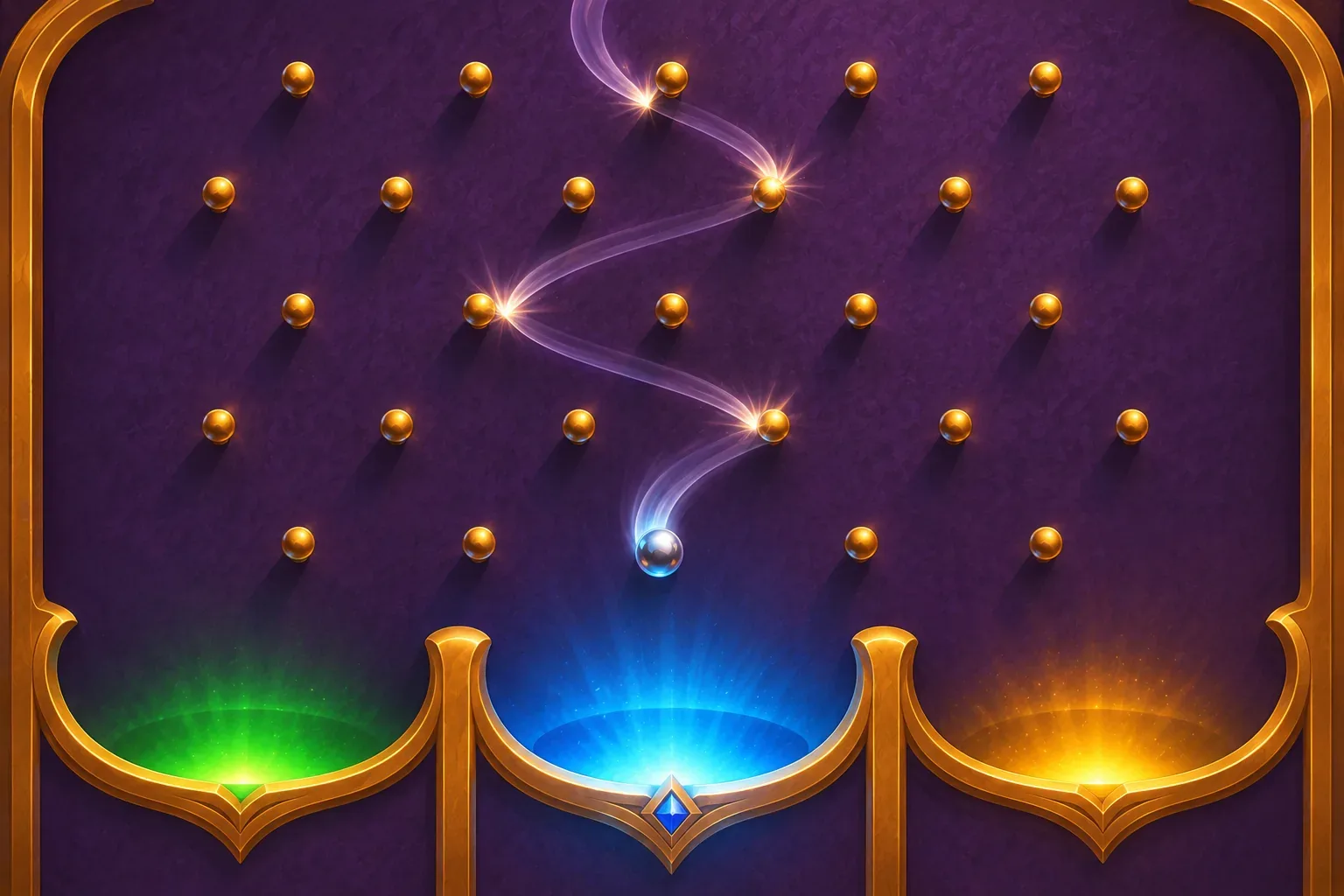
Separating those pieces makes later tuning safer. If a landing feels too predictable, you can adjust the peg collision model or randomization while keeping the score table unchanged. If the score curve feels flat, you can tune pocket payouts without changing how the ball moves. A designer can then ask whether a change improved the game, instead of wondering which of several bundled rules caused the difference.
3. Let one relic change one rule
A roguelike choice should alter the next decision in a way the player can see. Here, the transition after Board 1 offers exactly two relics. Center Sigil changes the center pocket payout from 2 to 4. Left Stash changes the left pocket payout from 1 to 3. The player chooses one, keeps the score already earned, and carries that relic into Board 2. Neither relic moves pegs or changes collision rules.
That boundary matters. If an upgrade changes both pocket rewards and ball motion, you cannot tell whether a new result came from a larger payout or a different landing distribution. A first prototype is easier to reason about when an upgrade changes one named value, has one activation point, and persists for a stated duration.
Prompt 3 — make the between-board choice explicit
When the third drop on Board 1 resolves, pause before Board 2 and display exactly two relic choices. Center Sigil changes only the Center pocket payout from 2 to 4 for Board 2. Left Stash changes only the Left pocket payout from 1 to 3 for Board 2. Ask the player to choose one relic; apply it to all three drops on Board 2, then keep it for the rest of this six-drop run. Preserve the current score. Do not move pegs, alter gravity, change collisions, or add a third relic. Show the selected relic and the changed payout before the first Board 2 launch.
4. Trace the rules with a complete example
Before asking for more content, run a simple arithmetic trace on paper. It will not tell you whether the ball physics work, but it can expose missing score updates, relic timing errors, or an unclear win check.
For this fictional path, Board 1 lands Left, Center, then Right. Those pockets award 1 + 2 + 4, bringing the score to 7. At the transition, the player chooses Center Sigil. Board 2 then lands Center, Right, and Left. The center payout is now 4, so the second board adds 4 + 4 + 1 = 9. The final score is 16, meeting the target exactly.
| Drop | Payout | Total | |
|---|---|---|---|
| Board 1 · 1 | Left | 1 | 1 |
| Board 1 · 2 | Center | 2 | 3 |
| Board 1 · 3 | Right | 4 | 7 |
| Board 2 · 1 | Center with Center Sigil | 4 | 11 |
| Board 2 · 2 | Right | 4 | 15 |
| Board 2 · 3 | Left | 1 | 16 · Win |
This is a chosen example sequence, not a simulated run. The sequence does not imply that these pockets are likely, evenly distributed, or controllable. Its only purpose is to verify the scoring arithmetic and the point at which the relic takes effect.
Prompt 4 — show the state trace
Use this hypothetical landing sequence only to audit state: Board 1 lands Left, Center, Right. The player selects Center Sigil. Board 2 lands Center, Right, Left. Show the score before and after each drop, the payout rule used, when the relic is selected, and the final target check. Expected final total is 16. Label this as a hand-authored example, not output from a playable build and not evidence of pocket probabilities. If the displayed arithmetic differs, identify the exact transition where it changes.5. Test motion and probability in the future build
When you have a playable version, inspect the ball path separately from the score system. Confirm that the ball starts in the chosen lane, moves through the intended peg field, reaches one pocket, and triggers exactly one payout. Check what happens when it catches on a peg, touches a wall, or crosses a pocket boundary. These are implementation checks to run, not results this article claims to have observed.
For probability, log a fixed random seed and enough drops to compare pocket frequencies across repeated runs. Keep the board layout, launch lane, seed, and upgrade state in the record. If you compare two designs, change one variable at a time. A dozen attractive concept images cannot substitute for those measurements; neither can the six-row paper trace above.
Prompt 5 — request useful test instrumentation
For the playable test build, add a developer-only drop log with run seed, board number, drop number, launch lane, peg collision sequence, final pocket, payout, relic state, and total score. Add a repeatable mode that can run a batch of drops from a fixed seed and summarize pocket counts by lane. Keep the batch summary separate from player-facing game UI. Do not describe pocket frequencies as balanced or representative until the recorded test conditions and sample size are reviewed.| Question | Evidence to collect | What it can support |
|---|---|---|
| Does a chosen lane resolve cleanly? | Launch lane, seed, collision path and final pocket for each drop | Reproducible path debugging for the tested build |
| Does scoring match the design? | Pocket, active relic, payout and before/after score | Rule correctness for each recorded transition |
| How often does each pocket occur? | Repeated drops grouped by lane, fixed seed policy and sample count | Observed frequencies for those exact conditions only |
| Did an upgrade change the right thing? | Matched runs with the same board and launch inputs, before and after relic | Whether the payout changed while motion rules stayed fixed |
Use a small acceptance checklist when inspecting the result: each launch resolves once; each resolved drop reaches one pocket; the score changes by that pocket’s current payout; the selected relic activates only on Board 2; the run ends after six drops; and the target comparison uses the final banked score. If a check fails, revise its owning rule instead of adding an exception elsewhere.
6. Iterate while keeping the brief stable
Once the core loop is clear, change one layer at a time. You might first tune the board’s peg spacing, then test how launch-lane choice feels, then compare pocket values, and finally add more relics. Keep a short change note for each revision: what changed, which behavior you expected to move, and what you observed in the build. If the score table changes, update the paper trace too.
SEELE’s official Free AI Game Maker page describes starting with a plain-English idea, creating a playable first version, testing it in a browser, and refining it with follow-up prompts. That describes the general product workflow; it does not verify this Plinko design or guarantee a particular physics result. To explore your own version, visit the Free AI game maker, then compare any generated result with the rules and tests you intended.
FAQ
What should a Plinko roguelike prompt define first?
Define the board, peg layout, launch choices, number of drops, pocket rewards, run end condition, and what upgrades persist between boards.
How should a Plinko roguelike handle randomness?
Specify the physics and random seed behavior, then test many drops before describing probabilities. A hand-written landing sequence is an example, not measured odds.
How do relics affect a Plinko run?
State when a relic is offered, how many choices appear, which pocket or rule it changes, and whether the effect persists for the rest of the run.
What is a useful Plinko roguelike prototype size?
Use a small board, a few pocket types, a short run, and one between-board choice. Add more pegs, relics, and randomness only after drop and score state work.
Were these Plinko roguelike prompts tested in a playable build?
No. The board, pocket rewards, relics, and drop sequence are fictional planning material. The prompts are unrun drafts and no playable build or measured probability results are included.