Define the Twin Aperture room
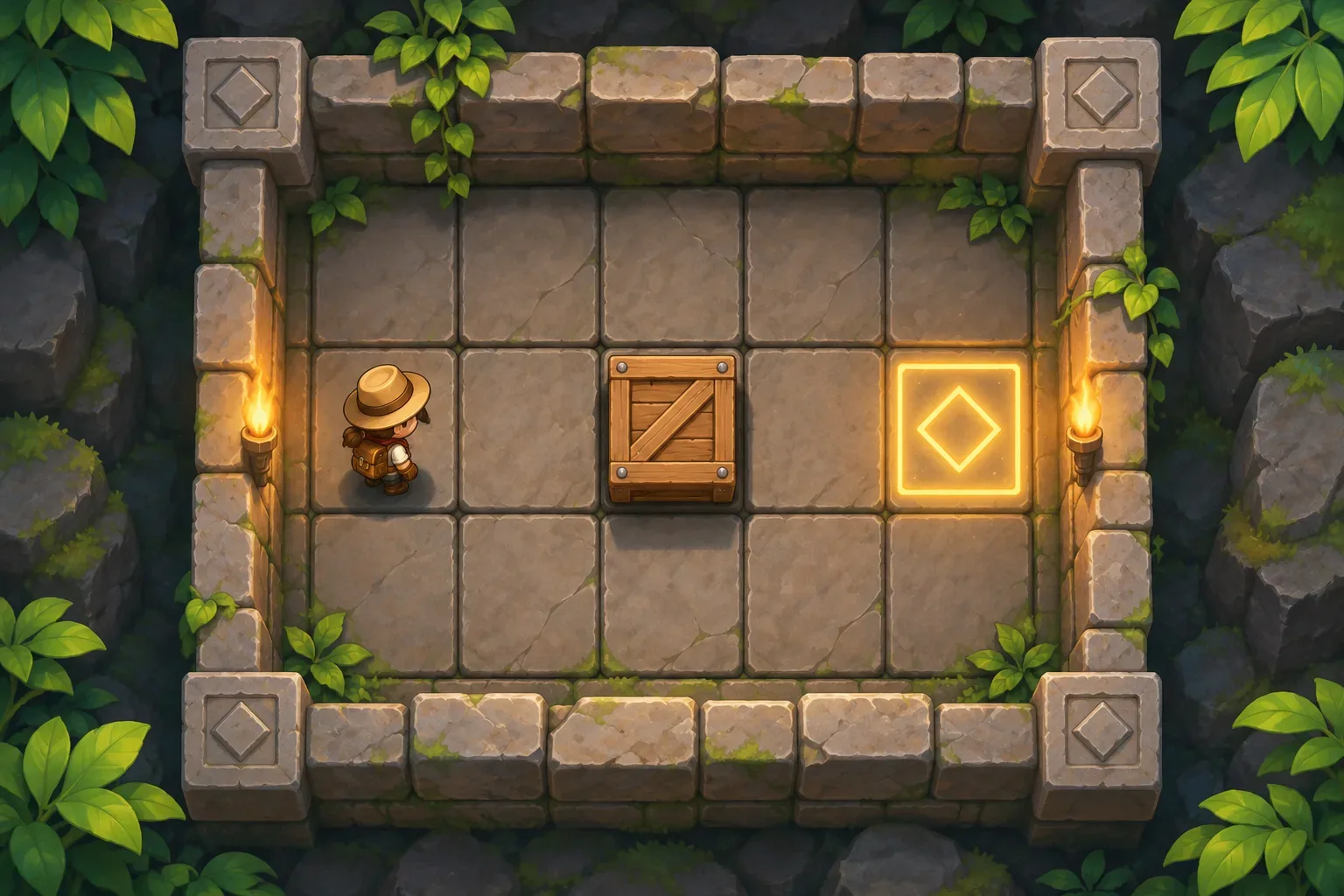
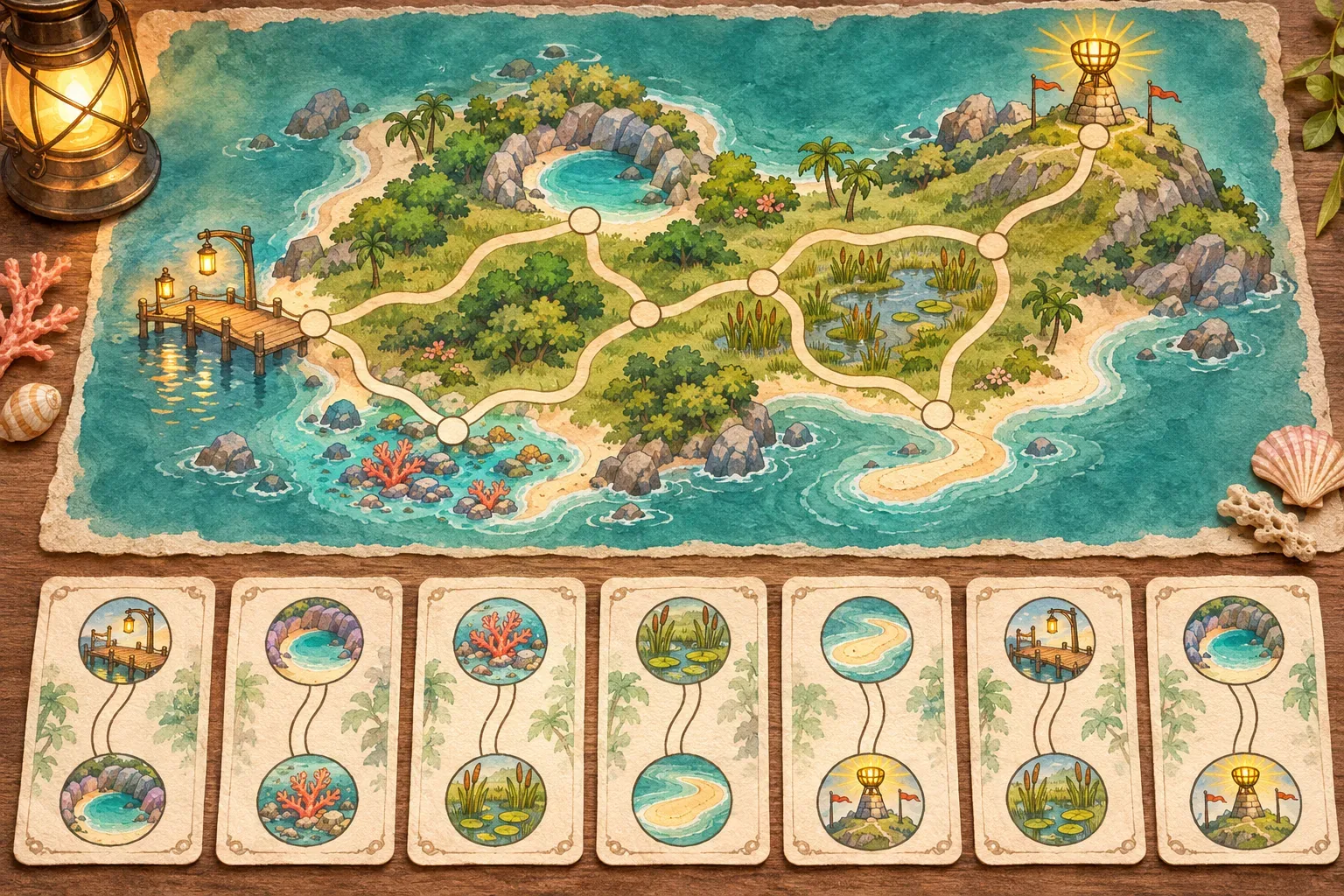
A portal puzzle prompt needs an exact rule for where the player exits and what happens if that cell is occupied. Twin Aperture uses paired fixed gates on an 8-by-5 grid. The player starts at (1,5), a prism key sits at (6,1), and the exit is at (8,1). The run has a twelve-move limit.
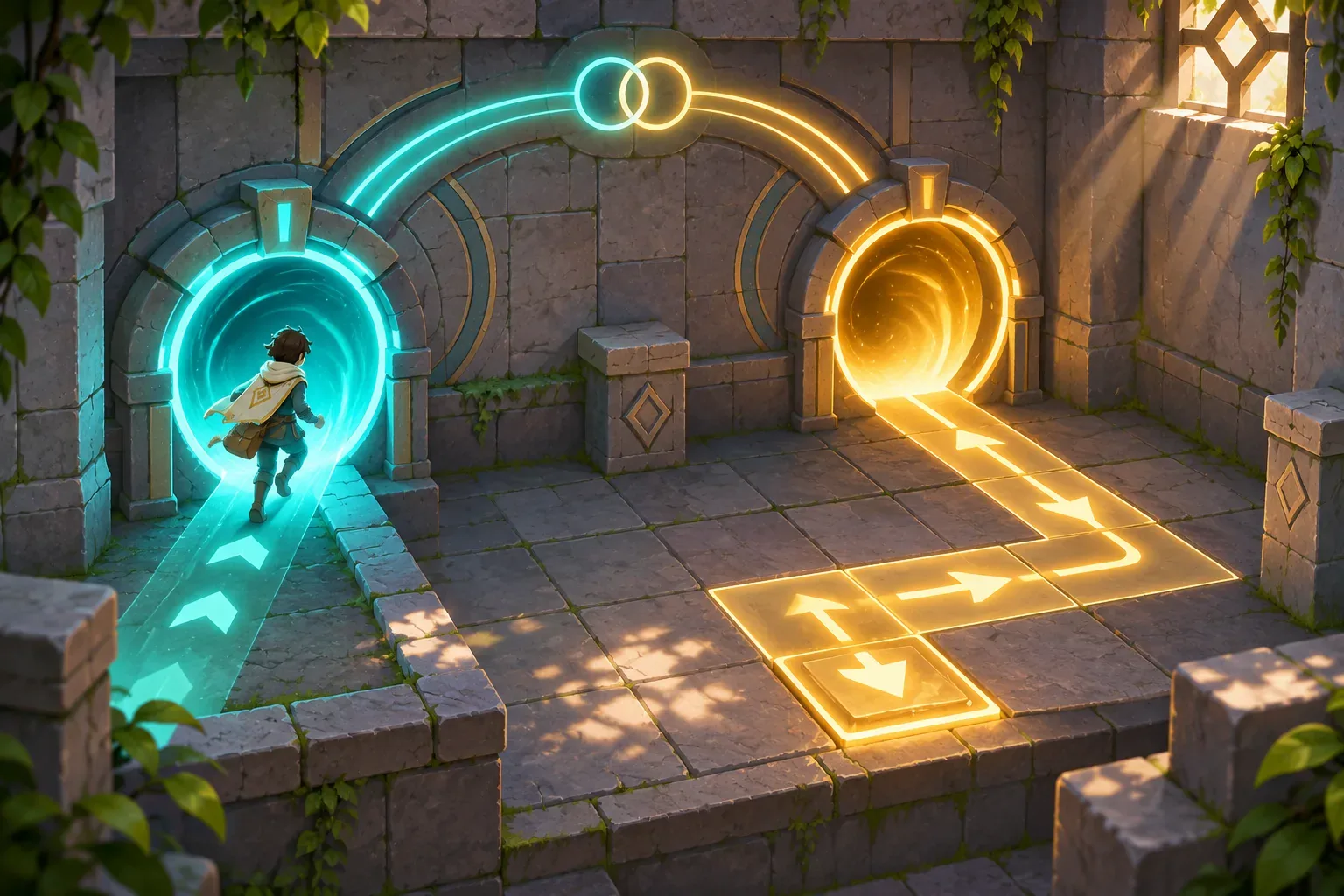
Portal A is at (3,4) and Portal B at (6,2). Each has a cardinal facing direction. Entering one portal sends the player to the open cell directly in front of its paired portal; the player faces the paired portal's direction. The teleport consumes the same one move as the entry step.
The player can rotate B 90 degrees clockwise by Interact while within Manhattan distance two. A remains fixed. Normal Step moves one orthogonal cell into an open tile. A portal exit outside the board or blocked by a wall rejects the entry and leaves the player at the original cell.

Resolve portal direction and destination
Portal pairs are bidirectional, but their destination uses the facing of the exit portal. The pair does not preserve momentum because movement is turn-based. Interact changes B's orientation but does not move the player. The interface should show both orientations and preview the destination cell before entry.
The player must collect the key before entering the exit. Reaching the exit without it does not win. The player loses if the move counter exceeds twelve. Restart restores player position, both portal orientations, key state and move count.
Separating entry from destination makes the system easier to check than a vague “step through a portal” instruction. The prompt can test all four orientations and the blocked-cell case before adding multiple pairs or movable portals.
Trace the example
Suppose Portal B faces north. Entering A sends the player to the open cell at (6,1) and sets facing north; if this is the key tile, the key is collected on arrival. If B is rotated clockwise to face east, the same entry instead places the player at (7,2) facing east.
If the cell directly east of B is blocked, entering A while B faces east is rejected. The player remains on the approach tile, the move counter does not increase, and the key state stays unchanged. This makes the blocked destination observable and avoids an undefined teleport into a wall.
The example is a fictional rule trace, not a tested level. A later build should log the source portal, exit portal orientation, candidate destination, occupancy and move counter for every teleport.
Write the six prompts
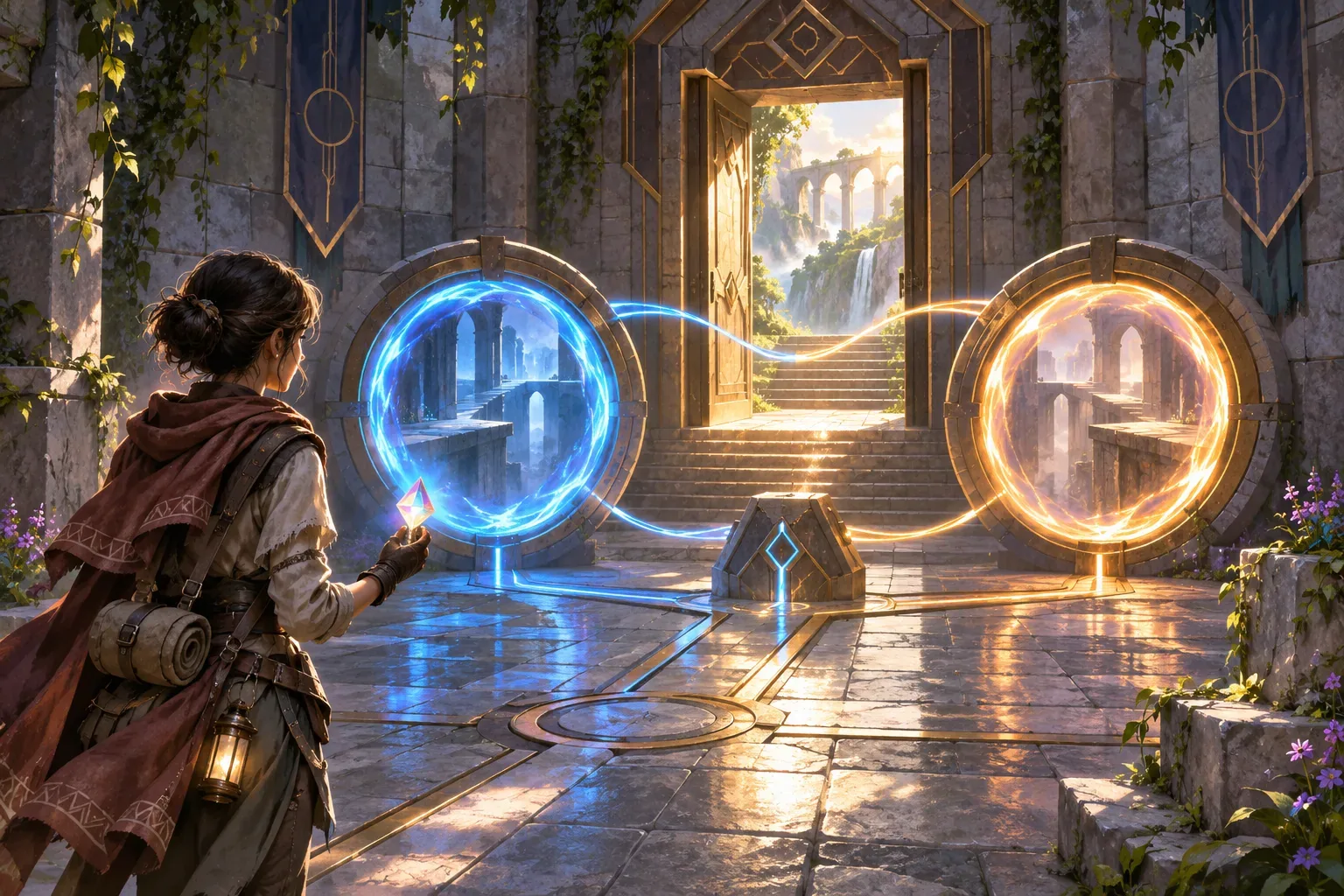
Use one prompt per design decision so later checks have a clear source of truth. These drafts describe Twin Aperture; they have not been run and do not represent a generated playable game.
Prompt 1: place the grid and portal pair
Create an 8×5 grid. Player starts (1,5), Portal A at (3,4), Portal B at (6,2), key at (6,1), exit at (8,1), and limit 12 moves. Both portals have cardinal facing.Prompt 2: map entry to an exit tile
Entering either portal exits on the open cell directly in front of its paired portal. Set player facing to the exit portal direction. Portal traversal uses one move and does not preserve momentum.Prompt 3: add one orientation control
Allow Interact to rotate Portal B clockwise by 90 degrees when player is within Manhattan distance2. Portal A stays fixed. Display orientation and candidate exit cell.Prompt 4: reject invalid destinations
If the destination is blocked or out of bounds, reject entry and leave player/move count unchanged. Step moves one open orthogonal tile.Prompt 5: define key, exit and limit
Collect the key before entering the exit to win. Exceeding 12 moves loses. Restart resets position, orientations, key and move count.Prompt 6: prepare future checks
For future checks log portal pair, facing, destination, occupancy, player and move count. Test four orientations, blocked exits, bidirectional entry, key lock, move limit and Restart. Do not report unobserved checks as passed.SEELE’s official page describes general plain-English prompting, a playable first version, browser testing and refinement; it does not verify Twin Aperture. See Free AI game maker for workflow context only.
Prepare future build checks
Record the source portal, destination portal, direction vector and candidate tile around every entry. Check each orientation, a blocked destination, both travel directions, the key gate and the move counter. These are future checks, not passed tests. Record the before and after state so a later build can be compared with the specification.
| Future check | Expected rule | Evidence to capture |
|---|---|---|
| Destination mapping | Exit one open cell in front of paired portal | Facing vector and destination |
| Orientation | B rotates clockwise; A stays fixed | Before/after direction |
| Blocked exit | Reject without moving or counting | Occupancy and state snapshot |
| Bidirectional pair | Either portal routes to the other | Source and destination IDs |
| Goal/reset | Key gates exit; Restart restores pair | Key, move count and orientation |
No real game run, browser test or measured result is available for this fictional example. The illustrations are original concept art and are not screenshots.
Frequently asked questions
What should a portal puzzle prompt define?
Specify portal pairing, exit position, facing, blocked destinations, action cost and the goal.
Does Twin Aperture preserve momentum?
No. It is turn-based; entering a portal uses one move and sets facing from the exit portal.
How does Portal B rotate?
Interact rotates it 90 degrees clockwise when the player is within Manhattan distance two.
Were the portal prompts tested in a playable game?
No. Twin Aperture is a fictional specification and the destination trace is not observed gameplay.
What happens if the exit tile is blocked?
The portal entry is rejected, and the player and move counter remain unchanged.