Define the route-chain puzzle
A solo card puzzle does not need a score total or a growing deck to make a choice matter. In a route-chain puzzle, each card connects one place to another. The player chooses the order, and the exit location on one card must match the entry location on the next. The objective is to reach one destination within a fixed number of cards.
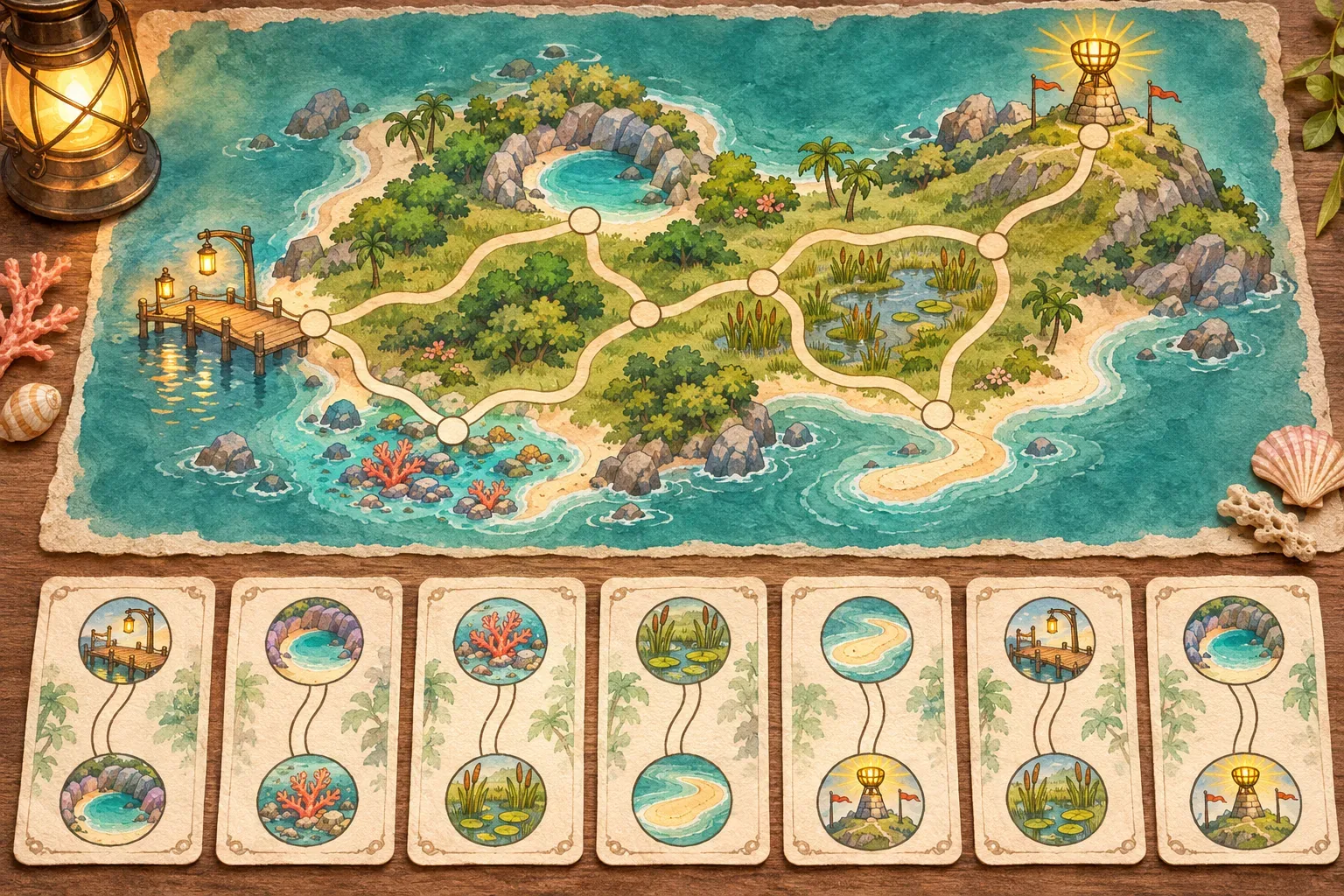
This guide uses the fictional Lantern Route puzzle. Start at Lantern Pier and use exactly four cards from a fixed hand of seven to reach Signal Beacon. The cards are unique and cannot be reused. There is no draw pile, shuffle or shop, so the player can inspect the entire route problem before making the first move.
Lantern Route is an authored design example, not an existing or tested game. The six prompts in this article have not been run, and no playable build or measured test result is included. The images are concept art for the proposed map and card mechanic; they are not screenshots or evidence of product output.
This prompt library differs from a numeric lane puzzle such as How to Make a Solo Card Puzzle with AI, where cards are placed into lanes and their ranks must sum to targets. Here, ranks do not matter; only the direction and endpoints matter. It also differs from a shop-run card game: there is no currency, purchase, upgrade or run economy.
Keep the first rules contract small. State the start location, the four-slot limit, the matching rule, card-use limits, legal moves, dead-end result and exact win condition. If those are explicit, a reader can trace a route without guessing how the hand or map changes.
Make each card a directed link
Give every card an entry place and an exit place. The entry must match the current location before the card is legal. When played, the card advances the route to its exit and is marked used. The complete hand below includes two ways to reach the marsh and one tempting loop back toward the start.
| Route card | Entry | Exit | Role in the puzzle |
|---|---|---|---|
| A | Lantern Pier | Reef | Only opening link |
| B | Reef | Cove | First route toward Marsh |
| C | Cove | Marsh | Completes the first valid chain |
| D | Marsh | Signal Beacon | Final link to the goal |
| E | Reef | Sandbar | Alternate branch from Reef |
| F | Sandbar | Marsh | Reconnects the alternate branch |
| G | Cove | Lantern Pier | Dead-end loop after card A is used |
Only four cards may be placed. The remaining cards stay visible in hand, face up. Each is used at most once. A card with the wrong entry place is not selectable; it does not change the current location or consume a slot. If no unused card begins at the current location before slot four, the result is Dead End. After exactly four cards, the route wins only if its current location is Signal Beacon; otherwise show Route Incomplete.
A restart returns the route to Lantern Pier, clears the four slots and marks all seven cards unused. Because the deal is fixed, the player can repeat the same puzzle and compare another ordering. Do not silently reshuffle or replenish cards: that would create a different problem and change what the prompts are asking the game to build.
Choose a legal next card
The first move is forced. Only card A begins at Lantern Pier, so it takes the route to Reef. At Reef, the player can choose B to go to Cove or E to go to Sandbar. This is the main branch. Both can still reach Marsh and Beacon in the remaining slots, so the player is choosing a route rather than guessing a hidden answer.
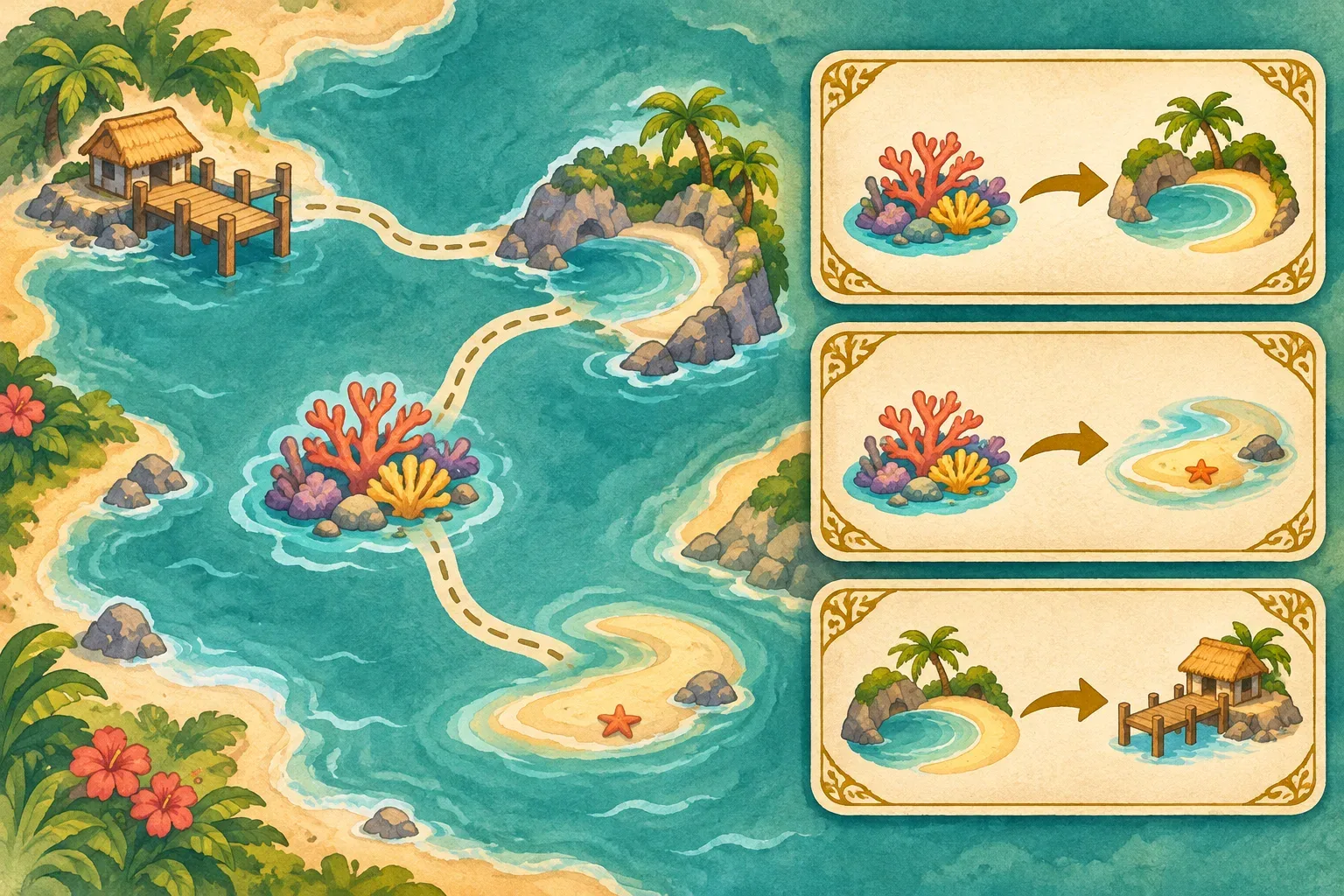
At Cove, card C continues to Marsh. Card G returns to Lantern Pier. If the player takes G after using A and B, the route is Pier → Reef → Cove → Pier. The only card that leaves Pier is A, and it has already been used. No unused card can continue the path, so the run ends as Dead End before the fourth slot.
This behavior should be stated directly in a prompt. It is not enough to say “make invalid cards unavailable.” The game also needs a rule for what happens when every remaining card is unusable at the current location. An immediate dead-end result gives the player a reason and preserves the route state for review.
Trace two solutions and a dead end
There are two authored four-card paths from the pier to the beacon. Each uses unique cards and follows every endpoint. A third path is legal for three moves but cannot continue. The table follows current location after each card.
| Slot | First solution | Alternate solution | Dead-end route |
|---|---|---|---|
| Start | Lantern Pier | Lantern Pier | Lantern Pier |
| 1 | A: Pier → Reef | A: Pier → Reef | A: Pier → Reef |
| 2 | B: Reef → Cove | E: Reef → Sandbar | B: Reef → Cove |
| 3 | C: Cove → Marsh | F: Sandbar → Marsh | G: Cove → Pier |
| 4 | D: Marsh → Beacon | D: Marsh → Beacon | No unused card starts at Pier |
| Result | Victory at Signal Beacon | Victory at Signal Beacon | Dead End after the third card |
The two successful routes share the first and final cards, but differ at Reef. In the alternate line, Sandbar connects back to Marsh, so the fourth card can still reach the beacon. The dead-end branch demonstrates why a legal move can still lead to failure later: the choice from Cove is allowed, but it consumes the only card that would have reopened the route to the beacon.
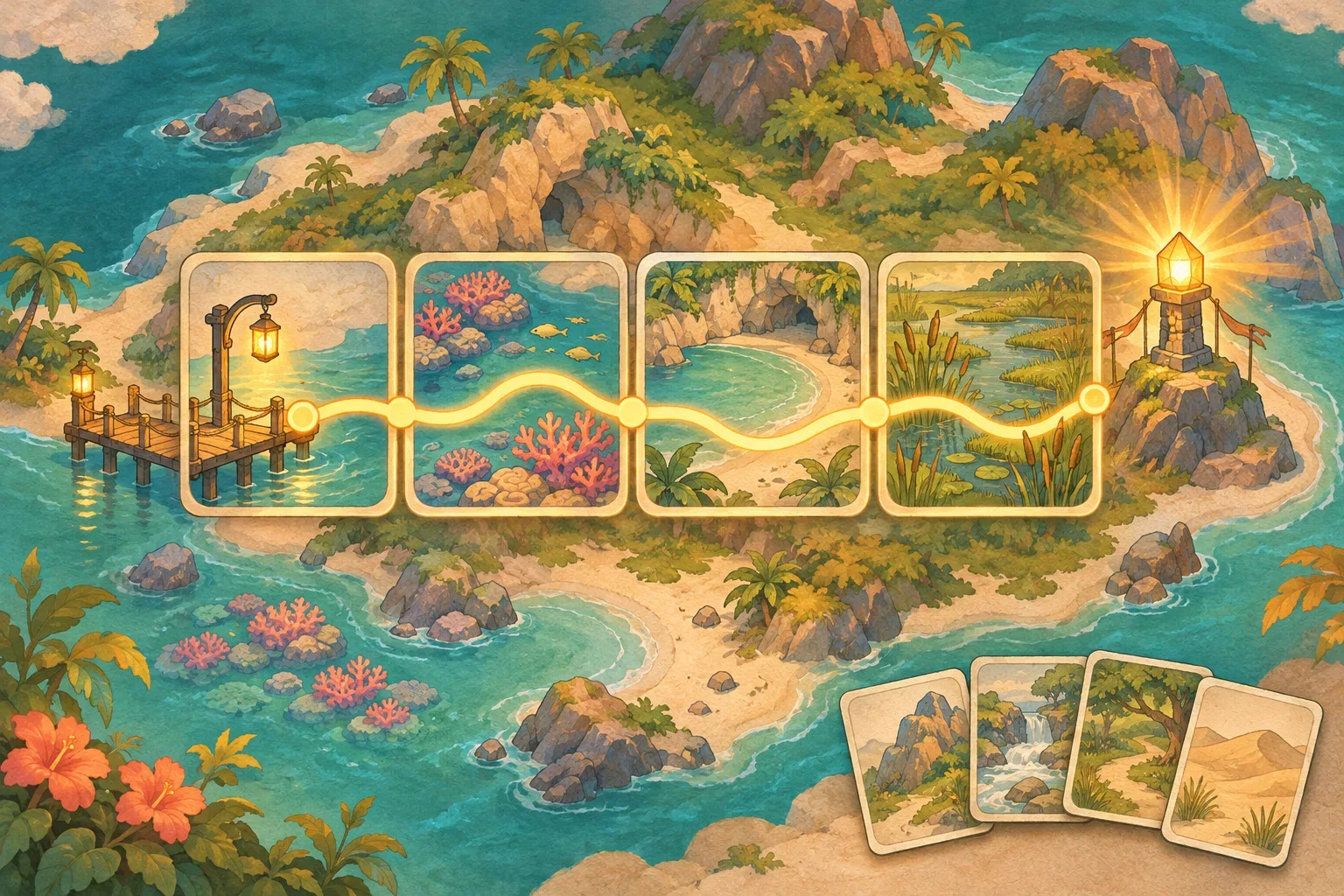
These are hand-resolved design traces, not observed gameplay. They show that the written rules admit two solutions and one dead end. They do not show whether players understand the symbols, whether the puzzle is fun, or whether a generated build follows the rules.
Write the six prompts in order
Build the brief in stages: define the objective, describe the cards, specify legal moves, determine how the puzzle ends, trace paths, then list future checks. The full prompts below are drafts for Lantern Route and have not been run.
Prompt 1 — frame the goal
Create a deterministic solo card puzzle called Lantern Route. Start the route at Lantern Pier. The player must place exactly four unique route cards in sequence to reach Signal Beacon. Keep the fixed hand visible and the path on a small map. Do not add arithmetic targets, shops, currency, upgrades, random draws, combat or a second objective.Prompt 2 — define route cards
Give each card one entry location and one exit location. Use these seven cards: Pier→Reef, Reef→Cove, Cove→Marsh, Marsh→Beacon, Reef→Sandbar, Sandbar→Marsh, and Cove→Pier. Each card is unique and can be used once. Show card endpoints with simple icons and always display the current route location.Prompt 3 — define legal moves
Start at Lantern Pier with all seven cards available and four empty route slots. A card is legal only when its entry location matches the current location. On play, place it in the next slot, mark it used, and advance to its exit location. Do not allow a fifth card. If no unused card can continue before slot four, end in Dead End.Prompt 4 — define completion and Restart
After the fourth card, show Victory only if the current location is Signal Beacon. If four cards are used and the route ends elsewhere, show Route Incomplete. Restart clears the row, restores all seven cards and returns the current location to Lantern Pier. Keep all unused cards visible.Prompt 5 — request route traces
Trace two fictional hand solutions: Pier→Reef→Cove→Marsh→Beacon using the first four chain cards; and Pier→Reef→Sandbar→Marsh→Beacon using Pier→Reef, Reef→Sandbar, Sandbar→Marsh, Marsh→Beacon. Also trace Pier→Reef→Cove→Pier, which dead-ends because the only Pier→Reef card was already used. Label these as authored rule traces, not observed game output.Prompt 6 — prepare future checks
For a future playable build, record the current location, selected card, entry match, used-card state, slot number, exit location and terminal result. Check no card reuse, legal and illegal endpoint matching, both four-card solutions, the dead-end branch, the slot limit and Restart. Do not say the checks passed unless an actual build is inspected.For each prompt response, compare the current location and used-card set with the route table. If card G incorrectly becomes available after returning to Pier, ask for the used-card rule to be restated. If the alternate Sandbar route ends early, inspect the entry/exit mapping for card F before changing the puzzle goal.
For general prompt-to-game workflow context, SEELE describes starting with a plain-English idea, generating a playable first version, testing it in a browser and refining it with follow-up prompts on its Free AI game maker page. This source describes a general workflow only; it does not verify Lantern Route or any result. Free AI game maker is a relevant place to explore a game idea, with any resulting behavior reviewed directly.
Prepare future build checks
If a playable version is built later, record the route location before and after each selected card, whether its entry matched, whether the card was already used, which slot was filled and the terminal result. That log will show if the game incorrectly allows a card to be replayed or fails to identify a dead end.
| Future check | Expected behavior in this design | Evidence to capture later |
|---|---|---|
| Entry matching | Only a card starting at the current location is legal | Current location, card endpoint and legal-move list |
| No reuse | A played card stays used for the rest of the route | Used-card state before and after selection |
| Four-slot limit | No fifth card can be placed | Slot count and action availability after slot four |
| Terminal states | Beacon after four cards wins; other location fails; no continuation is Dead End | Path, final location and terminal label |
| Restart | Return to Pier with seven unused cards and four empty slots | State immediately before and after Restart |
These checks are a plan, not passed test results. The fixed hand and endpoint rule make the intended routes inspectable on paper; the actual interface and behavior still need review if a game is created. Do not report the prompt as successful or the puzzle as playable until that evidence exists.
Frequently asked questions
What should an AI prompt define for a solo card puzzle?
Define what each card represents, how cards connect, whether cards can be reused, the move limit, the exact goal, and what happens when a path cannot continue.
How can cards create a route puzzle?
Give each card an entry and exit location. A legal next card starts at the current location, so card order determines whether the route reaches its destination.
Should a solo card puzzle include a draw pile?
Not in every first version. A fixed visible hand can make route choices easier to inspect before adding shuffle, draw timing, or deck-building rules.
How many cards should a first route-chain puzzle use?
Use a small fixed hand with a few legal branches and at least one clear dead end. This fictional example uses seven cards and four route slots.
Were these solo card puzzle prompts tested in a playable build?
No. The route cards and traces are fictional design material. The prompts are unrun drafts; no playable build or observed test result is included.