Frame the supply problem
A siege strategy game can lose its tension when every route is available and every assault has the same cost. A useful first prompt gives the player a limited supply store, a few fortified approaches and a deadline. The decision then becomes concrete: which route can be afforded now, and is it worth spending a round to replenish supplies before committing?
This guide uses a fictional scenario called Dunmere Approaches. An attacking force begins with four supply units and four rounds to capture any two of three routes to a distant keep. Old Road is the least expensive and returns one supply after it is captured. Causeway costs more, while North Switchback is heavily defended and costs the most. The keep itself remains intact; the first prototype is about securing approaches, not running a second gate-breach system.
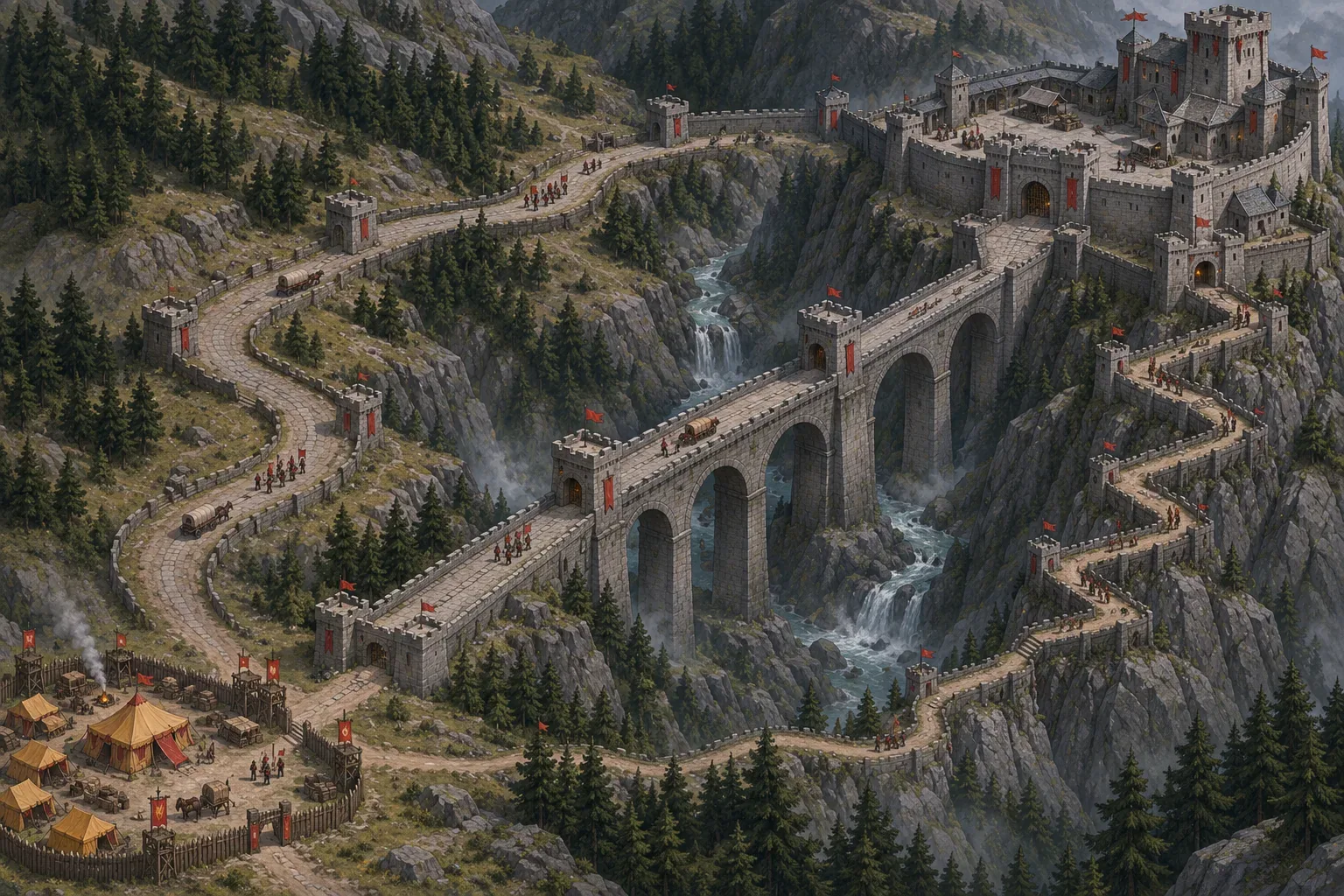
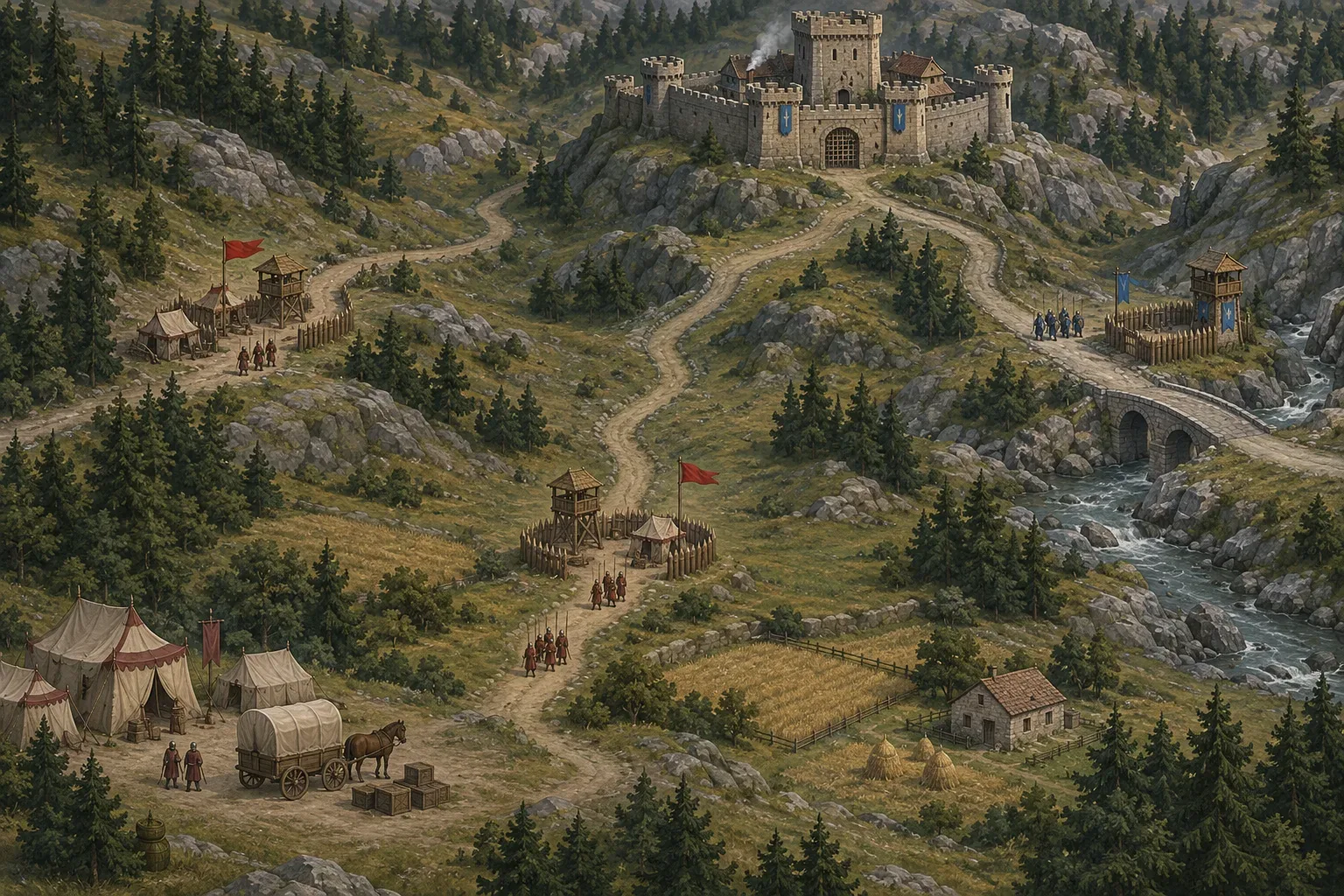
Dunmere Approaches is an authored design example, not an existing game. The six prompts below are drafts and have not been run. The route costs and traces are fictional rule calculations, not game output, measured balance or playtest evidence. The illustrations are strategy-game concept art, not screenshots.
This prompt library has a different center from two related siege topics. How to Make a Siege Strategy Game with AI focuses on the timing of artillery, gate repair and a one-use signal flare at one gate. How to Make a Siege Strategy Game with Negotiation Between Battle Rounds Using AI centers on bargaining in the intermission. Dunmere instead asks the player to allocate supplies across three persistent routes. It has no artillery, gate-integrity clock, repair phase, flare or negotiation phase.
Keep the first playable specification deterministic. In version one, route costs stand in for each approach's defenses. Capturing a route is permanent. There is no dice roll or enemy response between orders. That makes it possible to reason about supply arithmetic before adding combat outcomes, unit losses or a larger campaign map.
Make each route a costed choice
Write the route table before composing dramatic narration. Each entry needs a name, a supply cost, a starting state and any effect after capture. Only Old Road returns one supply; the reward happens after paying the assault cost and cannot raise the stock above six.
| Approach | Starting defense | Assault cost | After capture |
|---|---|---|---|
| Old Road | Defended, uncaptured | 2 supplies | Return 1 supply, up to the cap of 6 |
| Causeway | Defended, uncaptured | 3 supplies | Remain captured; no supply bonus |
| North Switchback | Defended, uncaptured | 4 supplies | Remain captured; no supply bonus |
The supply total starts at four and cannot exceed six. Forage adds two and uses the round's single order. Assault spends the selected route's cost, captures it and also uses the round. The player wins immediately after capturing a second route. If round four ends with fewer than two controlled approaches, the operation fails.
Mark illegal actions explicitly. The interface should not offer an Assault when supplies are short or the route is already held. If a command is requested anyway, reject it before deducting supply and explain the reason. That distinction prevents a bad click or malformed prompt response from quietly consuming a round or changing the store.
A useful state summary shows round, supplies and all three route flags together. The player should be able to see whether Old Road's reward has already been applied, whether a route is still available, and how many rounds remain. Do not hide those values inside a paragraph of story text.
Resolve orders in a fixed sequence
At the start of a round, show the current state and allow exactly one order: Forage or Assault. Forage adds two supply up to the cap and ends the round. Assault is available only for an uncaptured route whose cost can be paid. Deduct the cost, mark the route captured, apply its route reward if there is one, then check for victory. After a non-winning order, advance the round. After round four, check for failure.
Keep the order of these steps in the prompt. If the game advances the round before checking victory, the player might see a failed deadline after capturing the second route. If it pays Old Road's reward before charging the assault, the player effectively attacks it for one instead of two supplies. A simple before-and-after trace can catch these errors in a future build.
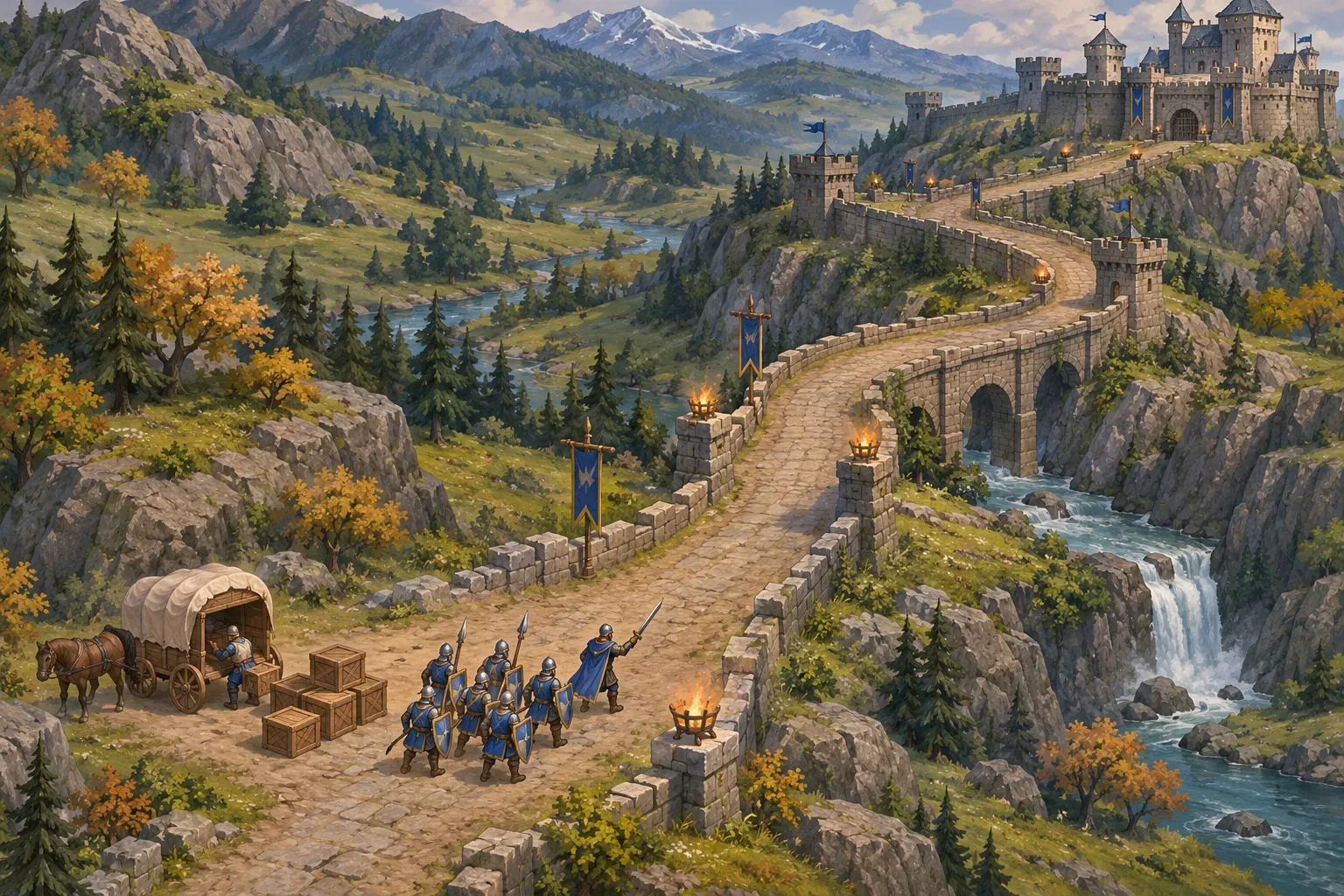
The supply wagon and squad in this concept frame illustrate the two parts of the decision: stores are finite, and an assault needs a planned commitment. The image does not show a measured route cost or a tested interface. Keep numerical values in the rule table and future state log, where their order can be checked precisely.
The simplest opening trace is to Assault Old Road. Spend two from the starting four, leaving two, then receive its one-supply reward to finish with three. If Causeway is next, spend the remaining three and hold two routes. This line wins in round two without Forage. A longer plan can use Forage to afford the more expensive North Switchback.
Trace two campaigns and one wasteful plan
Write down every order and store value before asking for additional systems. These traces use only the authored supply rules. They are not observed game output or evidence that the game is balanced.
| Round | Order | Supply change | Routes held after order | Result |
|---|---|---|---|---|
| 1 | Assault Old Road | 4 − 2 + 1 = 3 | Old Road | Continue |
| 2 | Assault Causeway | 3 − 3 = 0 | Old Road, Causeway | Victory |
| 1 | Forage | 4 + 2 = 6 | None | Continue |
| 2 | Assault Causeway | 6 − 3 = 3 | Causeway | Continue |
| 3 | Forage | 3 + 2 = 5 | Causeway | Continue |
| 4 | Assault North Switchback | 5 − 4 = 1 | Causeway, North Switchback | Victory |
| 1 | Forage | 4 + 2 = 6 | None | Continue |
| 2 | Forage | 6 stays at cap | None | Continue |
| 3 | Assault North Switchback | 6 − 4 = 2 | North Switchback | Continue |
| 4 | Forage | 2 + 2 = 4 | North Switchback | Siege Failed |
The first plan captures two routes quickly because Old Road replenishes one unit after its cost. The second spends two rounds foraging and uses the full deadline to take a three-supply route and the four-supply switchback. The final plan wastes a round foraging at the cap; it reaches North Switchback but finishes with only one route. This makes the round limit meaningful without inventing random combat or an enemy turn.
These hand calculations let a reader check the intended state progression. They do not establish that players will find the decision interesting, that the costs are balanced, or that software has implemented the rules. Those questions require a future playable build and evidence from inspecting it.
Write the six prompts in stages
Start with the operation and add state rules before mapside detail. Full prompt drafts are below and in the package's prompt library. They are unrun examples, not output from SEELE.
Prompt 1 — establish the operation
Create a deterministic single-player siege strategy game called Dunmere Approaches. The attacker has four rounds to capture any two of three fortified routes to a keep. Keep the map fixed and readable. Use no random combat, gate integrity, artillery repair phase, signal flare, diplomacy, casualties or hidden enemy response in version one.Prompt 2 — define supplies and order timing
Start with 4 supplies and set the maximum to 6. At the start of each round, offer exactly one order: Forage or Assault. Forage adds 2 supplies up to the cap and ends the round. Assault spends the selected route's cost, captures that route if it is affordable and uncaptured, then ends the round. An unaffordable or already-captured route is unavailable and does not consume the round. Do not allow more than one order per round.Prompt 3 — define the approaches
Set Old Road assault cost to 2 and grant 1 supply immediately after capturing it, up to the cap of 6. Set Causeway cost to 3 and North Switchback cost to 4. Each route begins defended and uncaptured. Captured routes remain held. The objective is any two captured routes by the end of round 4. Show supply, current round and all route states before and after an order.Prompt 4 — define operation end and Restart
After each order, check whether two routes are held. If so, end in Victory. If round 4 ends with fewer than two routes held, end in Siege Failed. If supply is insufficient for a selected Assault, prevent the order before spending anything. Restart restores supply to 4, clears all captures and returns to round 1.Prompt 5 — request hand-resolved plans
Trace a fast plan: Assault Old Road (4 to 2, then its +1 reward to 3), then Assault Causeway (3 to 0); two routes are held in round 2. Trace a resource-heavy plan: Forage (4 to 6), Assault Causeway (6 to 3), Forage (3 to 5), Assault North Switchback (5 to 1); win in round 4. Also trace a failed plan: Forage twice (4 to 6, then remain at 6), Assault North Switchback (6 to 2), then Forage (2 to 4), ending round 4 with one route held. Label all as hand-calculated fictional rule traces, not game output or balance results.Prompt 6 — prepare future build checks
For a future playable build, log round, order, route, supply before and after, route state and terminal result. Check the 6-supply cap, Old Road reward timing, one order per round, unaffordable-route prevention, captured-route lockout, both winning plans, the failed round-4 trace and Restart. Do not report checks as passed until an actual build is inspected.Review one discrepancy at a time. If the Old Road reward is missing, correct the reward timing without altering the other costs. If two routes are held but Victory does not appear, inspect the end-condition check before adding more routes or combat. Keep all authored assumptions in the rules table so that a revision does not silently create a second version of the scenario.
For general prompt-to-game workflow context, SEELE describes starting with a plain-English game idea, generating a playable first version, testing it in a browser and refining it with follow-up prompts on its Free AI game maker page. That page supports the general workflow only; it does not validate Dunmere's supply rules or any result. Free AI game maker is a relevant place to explore a game concept, with any resulting behavior checked directly.
Prepare checks for a future build
When a playable version exists, record round, chosen order, route, supply before and after, capture state and terminal result. Check both a fast and a resource-heavy successful plan, the failed capped-forage plan, and actions at the route and supply limits. Keep the record tied to a build version so that design intent is not mistaken for observed behavior.
| Future check | Expected behavior in this design | Evidence to capture later |
|---|---|---|
| Supply cap | Forage adds 2 but never raises stock above 6 | Before/after value at supply 5 and 6 |
| Route affordability | Unavailable assault does not spend supply or consume a round | Selected route, current store and state after rejection |
| Old Road reward | Pay 2 first, then return 1 up to the cap | Supply before, cost, reward and final value |
| Victory and deadline | Second capture wins immediately; fewer than two after round 4 fails | Round, route flags and terminal label |
| Restart | Restore 4 supplies, round 1 and three uncaptured routes | State immediately before and after Restart |
These checks are proposed for a future build and are not marked as passed. The design's value at this stage is that a reader can follow the finite supply budget and see why each round matters. The official product page describes a general workflow for prompt-based game creation and browser testing; it does not verify this siege system.
Frequently asked questions
What should an AI prompt define for a siege strategy game?
Define the attacker or defender role, the map, available supplies, order costs, round sequence, victory condition, deadline, and what happens when an order cannot be paid for.
How can supplies create strategic choices in a siege game?
Give each assault route a clear cost and let another action replenish a limited store. The player must plan which routes fit the remaining supplies and rounds.
How many assault routes should a first siege prototype use?
Start with a few routes that have distinct costs and readable defenses. This fictional example uses three routes and asks the player to capture any two.
Should a siege strategy prototype include random combat?
Not necessarily. A deterministic first version can expose route costs, supply timing, and the deadline before adding uncertain combat outcomes.
Were these siege prompts tested in a playable build?
No. Dunmere Approaches and its supply rules are fictional design material. The prompts are unrun drafts; no playable result or observed siege test is included.