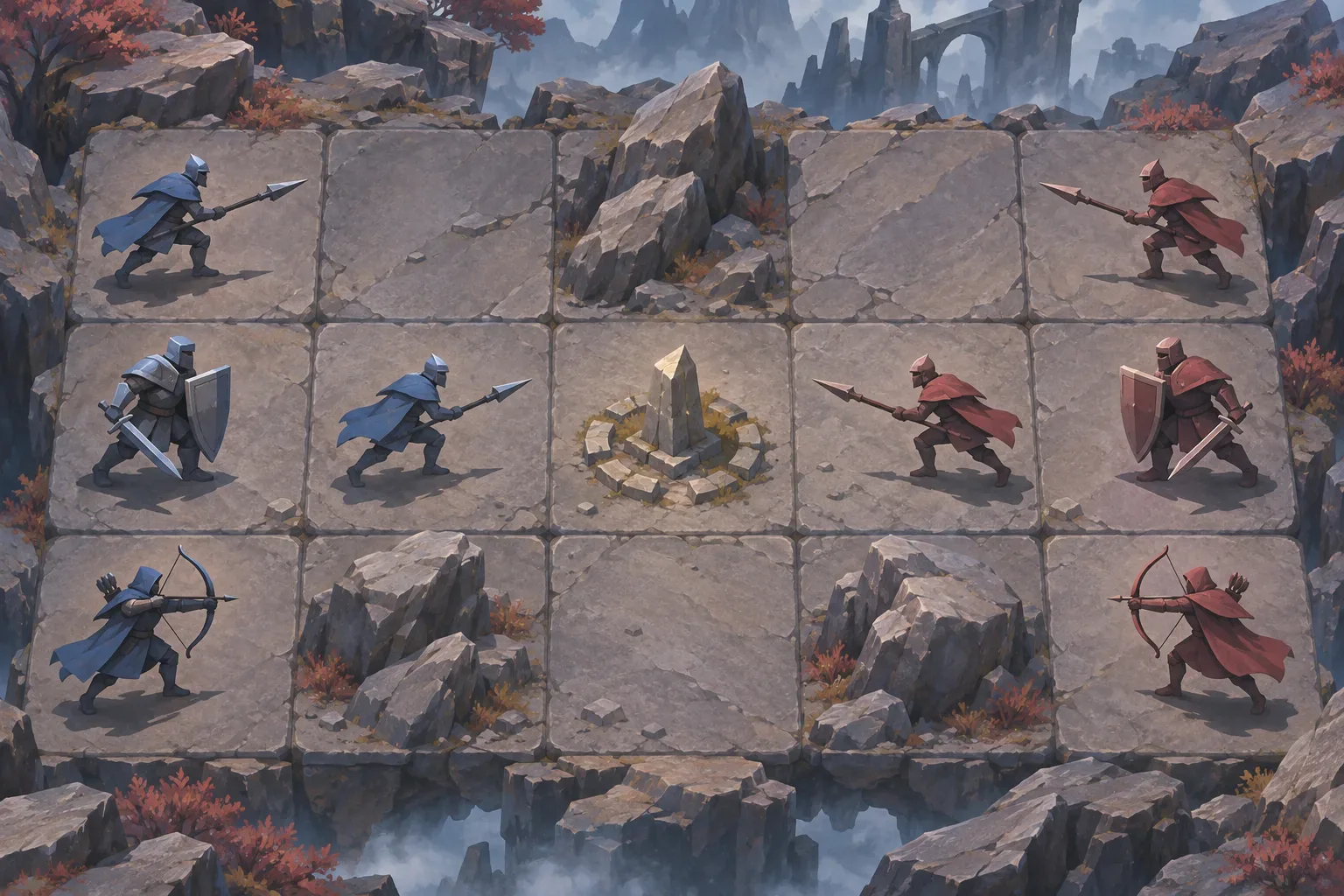
Set up the summoner duel
A summoner RPG needs allies that change the fight. If a summon only follows the hero and adds decoration, the player has little reason to consider mana, timing or team composition. Give each companion a defined combat role, then make the turn order show when that role matters.
This guide uses a fictional arena duel called Hollow Bell. A summoner faces one stone Warden and can call either an Ember Fox that deals damage or a Shellback that softens incoming attacks. The player has two active slots and three rounds to win. The values below are authored design rules and hand-calculated traces; the prompt drafts are unrun. There is no playable result or observed balance evidence. The images are concept illustrations, not game screenshots.

Keep this first version narrow: one arena, one enemy, two ally types, a shared mana pool and a short deadline. N4155 explores a guild that sends teams on separate missions; Hollow Bell instead keeps the companions beside the player in one battle. It has no guild, mission dispatch, settlement loop or recruitment queue.
Write the combat sequence before adding lore. The player takes one action, allies act, the Warden attacks if still alive, and mana recovers between surviving rounds. This order makes it clear whether a newly called Fox can strike immediately and whether defeating the enemy prevents its next attack.
Make summon costs and roles explicit
Start with values that can be followed without hidden modifiers. The table names each resource, its cap and the consequence of spending it. Keep the summon actions mutually exclusive for the turn: call one affordable ally into an open slot or Focus to regain mana.
| Rule | Hollow Bell value | Resolution |
|---|---|---|
| Player | 5 HP; starts with 3 mana; mana cap 3 | At 0 HP, defeat |
| Warden | 6 HP; attacks for 2 | At 0 HP, victory before its next attack |
| Active slots | 2; summoned allies persist | No summon action if both are occupied |
| Ember Fox | Costs 2 mana; deals 2 damage | Attacks every ally phase, including its summon round |
| Shellback | Costs 1 mana; guard value 1 | Reduces each Warden attack by 1 while active |
| Round limit | 3 rounds | If Warden survives round 3, defeat |
Mana is shared. After a surviving round, recover 1 mana up to the cap of 3. Focus also adds 1 mana up to that cap, but uses the round's one action. In this scenario the starting pool is full, so Focus is useful only after spending mana. Stating the cap prevents repeated recovery from quietly creating an unlimited resource.
The two roles create a tradeoff. A Fox starts reducing Warden HP at once but does not protect the player. Shellback lowers every enemy hit by one, yet it does not bring the Warden closer to defeat. Because the deadline is fixed, a team that stays safe can still lose by failing to deal enough damage.

Make the action order unambiguous: the summoner chooses one action; all active Foxes attack; Shellback guard is applied to the Warden's attack; then the Warden attacks if it has HP left. If its HP reaches zero during the ally phase, end the fight before incoming damage. This prevents a winning strike and an enemy strike from resolving in an arbitrary order.
Resolve one round at a time
Use a consistent state line after every action: round, player HP, mana, active allies, Warden HP, damage dealt and incoming damage. The example begins at player HP 5, mana 3 and Warden HP 6. A summoning action pays its cost immediately, and the new ally joins that round's ally phase.
Calling the Fox costs 2 mana, leaving 1 before recovery. It deals 2 damage, dropping the Warden from 6 to 4. Since the Warden remains, it attacks for 2 and the player drops from 5 to 3. The round ends and mana recovers by 1 to 2. In round two, calling Shellback spends the remaining 1 mana. The existing Fox deals 2, taking the Warden from 4 to 2. Shellback reduces the next hit to 1, leaving the player at 2 HP. Between rounds, mana returns to 1.
In round three, the Fox attacks again and reduces Warden HP from 2 to 0. The Warden does not attack because victory is checked immediately after ally damage. The player finishes at 2 HP. This is a manual trace of the stated rules, not a captured game state. The victory illustration is an invented scene rather than evidence that a build produced this outcome.
| Timing point | What changes | What to verify later |
|---|---|---|
| Summon action | Pay cost; occupy one open slot | Unaffordable summons and full slots are rejected |
| Ally phase | Every active Fox deals 2 | A newly summoned Fox acts immediately |
| Guard and attack | Shellback lowers Warden damage to a minimum of 0 | Guard applies once to each enemy attack while active |
| Terminal check | Warden at 0 wins before its attack; player at 0 loses | No extra enemy hit after a winning ally phase |
| Between rounds | Recover 1 mana up to 3 | Round 3 deadline is checked after combat |
Trace team compositions
Compare team orders against the same initial state. Fox then Shellback wins by round three: early damage makes progress while the second summon reduces the last two attacks. Fox then Fox is faster because the second Fox adds another 2 damage before the Warden can respond. Shellback then Fox survives but misses the deadline.
| Team order | Round 1 | Round 2 | Round 3 / result |
|---|---|---|---|
| Fox → Shellback | Warden 6→4; player 5→3 | Warden 4→2; guarded hit leaves player at 2 | Fox deals 2; Warden reaches 0 before attack. Win at 2 HP. |
| Fox → Fox | Warden 6→4; player falls to 3 | Two Foxes deal 4 before Warden acts | Warden reaches 0. Win at 3 HP. |
| Shellback → Fox | Warden stays at 6; guarded hit leaves player at 4 | Warden falls to 4; player falls to 3 | Warden remains at 2. Deadline defeat at player 2 HP. |

The slower order is not a contradiction: Shellback keeps the hero healthier, but it spends the first round without reducing enemy HP. The deadline makes damage timing matter. If a future version changes when allies attack, when mana recovers or whether the summoning round counts, these traces must be recalculated rather than reused as proof.
For each trace, keep the arithmetic visible. Fox then Shellback deals 2 in each of three rounds, exactly enough to remove 6 Warden HP. Fox then Fox deals 2 in round one and 4 in round two, defeating the Warden before its second attack. Shellback then Fox deals only 0, 2 and 2; the enemy ends at 2 HP. Each line follows one fixed order and uses the same starting values.
Write the six prompts in sequence
Give the model a stable rules foundation before requesting polish. These six drafts isolate the battle scope, resources, ally roles, order, sample traces and future checks. They have not been run; they are prompts to adapt, not a claim of playable output.
Prompt 1 — frame the duel
Create a deterministic single-player summoner RPG battle called Hollow Bell. The summoner faces one stone Warden in a three-round arena duel. Include two summon types, a shared mana pool and two ally slots. Do not add a guild, mission dispatch, settlement, recruitment queue, random damage or a wider campaign in version one.Prompt 2 — define state and resources
Start the player at 5 HP and 3 mana, with mana capped at 3. The Warden starts at 6 HP. Set a maximum of two active summon slots and a three-round limit. Track all values visibly. Restart restores player HP 5, mana 3, Warden HP 6, empty summon slots and round 1.Prompt 3 — define summon roles
Ember Fox costs 2 mana and deals 2 damage each ally activation while active, starting in the round it is summoned. Shellback costs 1 mana and reduces the next Warden attack by 1 damage each round while active. Summons persist through the battle. Do not give them extra abilities or change their roles.Prompt 4 — set turn order
Once per round, choose Summon one affordable ally into a free slot, or Focus to gain 1 mana up to 3. After the action, all active Foxes attack and Shellback reduces incoming damage by 1. If Warden HP reaches 0, win immediately before it attacks. Otherwise Warden attacks for 2 minus Shellback guard, to a minimum of 0. If player HP reaches 0, lose. Recover 1 mana after a surviving round, up to 3. Lose if Warden remains after round 3.Prompt 5 — trace team compositions
Trace Fox then Shellback: Round 1 Warden 6 to 4, player HP 5 to 3, mana returns to 2; Round 2 Warden 4 to 2, player HP 3 to 2 after guard; Round 3 Fox deals 2 and wins before the Warden attacks, player HP 2. Trace Fox then Fox: Round 1 Warden to 4 and player to 3; Round 2 two Foxes deal 4 and win before attack, player HP 3. Trace Shellback then Fox: player HP 5 to 4, then 3, then 2; Warden ends at 2 after round 3, so defeat. These are fictional hand calculations, not observed results.Prompt 6 — prepare future build checks
For a future playable build, log round, player action, mana before/after, active summons, Fox damage, guard, Warden attack, HP totals and terminal state. Check slot limits, mana costs, recovery cap, summon timing, both winning teams, the losing order, attack timing, deadline and Restart. Do not mark any check passed until an actual build is inspected.For general workflow context, the official SEELE page describes turning a plain-English idea into a playable first version, browser testing and follow-up prompts. It does not document Hollow Bell, guarantee a particular combat feature or verify any result in this article. See Free AI game maker for the general workflow.
Prepare future build checks
When a playable version exists, test each rule with a recorded state before and after the turn. The expected outcomes below come from the fictional rules contract. They are a checklist for future inspection, not completed tests.
| Check | Expected behavior | Evidence to capture later |
|---|---|---|
| Mana and slots | Reject unaffordable summons and any summon into two occupied slots | Mana, active allies, selected action and response |
| Summon timing | A newly called Fox attacks during that ally phase | Warden HP before and after the phase |
| Guard | Active Shellback reduces each Warden hit by 1, minimum 0 | Base attack, guard amount and player HP change |
| Victory timing | Warden reaching 0 prevents its next attack | Ally damage, terminal state and player HP |
| Deadline and restart | Surviving round 3 loses; Restart restores all initial values | Final round state and reset state |
Only mark a check passed after inspecting a real build. Record the game version, route or actions, observed state changes and any mismatch. The design example has enough detail to guide those checks, but it cannot establish that a generator or implementation follows the rules.
Frequently asked questions
What should an AI prompt define for a summoner RPG?
Define summon costs, active slots, ally roles, when allies act, resource recovery, attack timing, and the win and defeat conditions.
How can summoned allies have different roles?
Give each ally a distinct rule that changes battle decisions. In this fictional duel, Ember Fox adds damage while Shellback reduces incoming damage.
How many summons should a first RPG prototype include?
Start with a small roster and limited active slots. The example uses two summon types and two slots so their timing can be traced clearly.
Why does summon order matter in a battle?
Order changes when damage and protection begin. Calling Shellback first can preserve HP but delay enough damage to miss a fixed round limit.
Were these summoner RPG prompts tested in a playable build?
No. Hollow Bell and its combat rules are fictional design material. The prompts are unrun drafts, and no playable result or observed test is included.