A rail shooter feels readable when the route, target movement, and firing window agree. A prompt that asks for “fast arcade action” leaves those relationships open. A better brief names the camera path, player controls, target lane, projectile speed, and what counts as a hit. You can then compare a generated build with an expected trace instead of judging the result by spectacle alone.
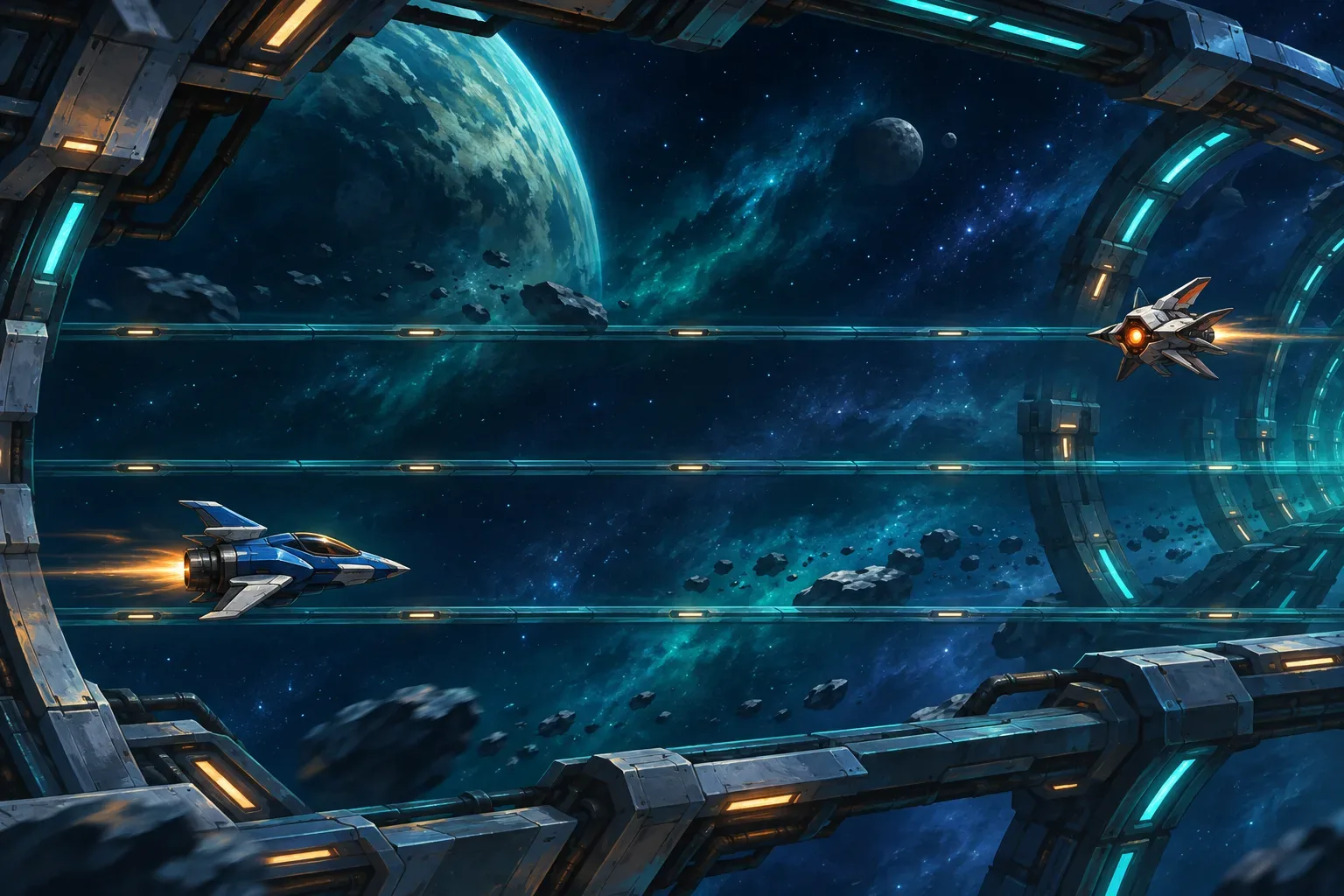
This example uses a fictional side-on corridor with three lanes and one approaching drone. Its values are design choices for explaining a prompt; they are not measurements from a running game. The prompts below are drafts that have not been run, and no playable output or test result is included.
Define the rail-shooter contract
Start by limiting the prototype to one route and one encounter. Here, the camera stays on a guided horizontal path. The player chooses among lower, center, and upper lanes; each lane change takes half a second. The first drone approaches along the upper lane. The weapon fires a bolt along the same path, and a shot can damage a target only when both occupy the same lane and their positions overlap.
That rule gives the prompt a small, testable center. It avoids mixing free-flight controls, aim assist, upgrades, enemy formations, and scoring into the first request. Those systems may belong in a later version, but each introduces more states to diagnose if the initial encounter behaves unexpectedly.
| Rule | Fictional value | Why state it |
|---|---|---|
| Simulation step | 0.1 seconds | Makes the timing trace discrete and repeatable. |
| Lane change | 0.5 seconds per adjacent lane | Defines when the player can align with a target. |
| Target approach | Starts 10 units away; moves toward the firing point at 2 units/second | Defines the target’s position over time. |
| Projectile | Starts at 0; moves outward at 8 units/second | Lets you estimate the meeting time. |
| Damage and cadence | Drone has 2 HP; each aligned hit deals 1; shots are 0.5 seconds apart | Connects aim, timing, and encounter length. |
For this hand example, update the target and projectile positions over the same fixed step, then check for overlap. Keep the units consistent and the damage event separate from movement. That way, the article’s arithmetic can be checked without implying that a particular engine uses the same collision implementation.
Calculate the first intercept
The player begins in the center lane and switches to the upper lane. The transition completes after five 0.1-second steps. At t=0.5 seconds, the target has moved from distance 10 to distance 9. The first shot is fired at that moment. Because the bolt and target move toward one another, their closing speed is 8 + 2 = 10 units per second.
The gap is 9 units, so the expected meeting time after launch is 9 ÷ 10 = 0.9 seconds. That is nine simulation steps. At the meeting, the projectile has traveled 8 × 0.9 = 7.2 units outward. The target has traveled 2 × 0.9 = 1.8 units toward the player, from 9 to 7.2. Both positions therefore match at t=1.4 seconds in this fictional trace.
| Shot launched | Target distance at launch | Expected impact | Distance at impact |
|---|---|---|---|
| t=0.5s | 9.0 units | t=1.4s | 7.2 units |
| t=1.0s | 8.0 units | t=1.8s | 6.4 units |
The second shot begins 0.5 seconds after the first, at t=1.0. The target has moved one more unit and is now 8 units away. The same closing speed gives an exact 0.8-second intercept: at t=1.8, both objects are at distance 6.4. That second aligned hit removes the drone’s remaining HP in the fictional rules. The clean alignment is intentional; a real build may use a collision radius or swept collision that should be stated and observed separately.
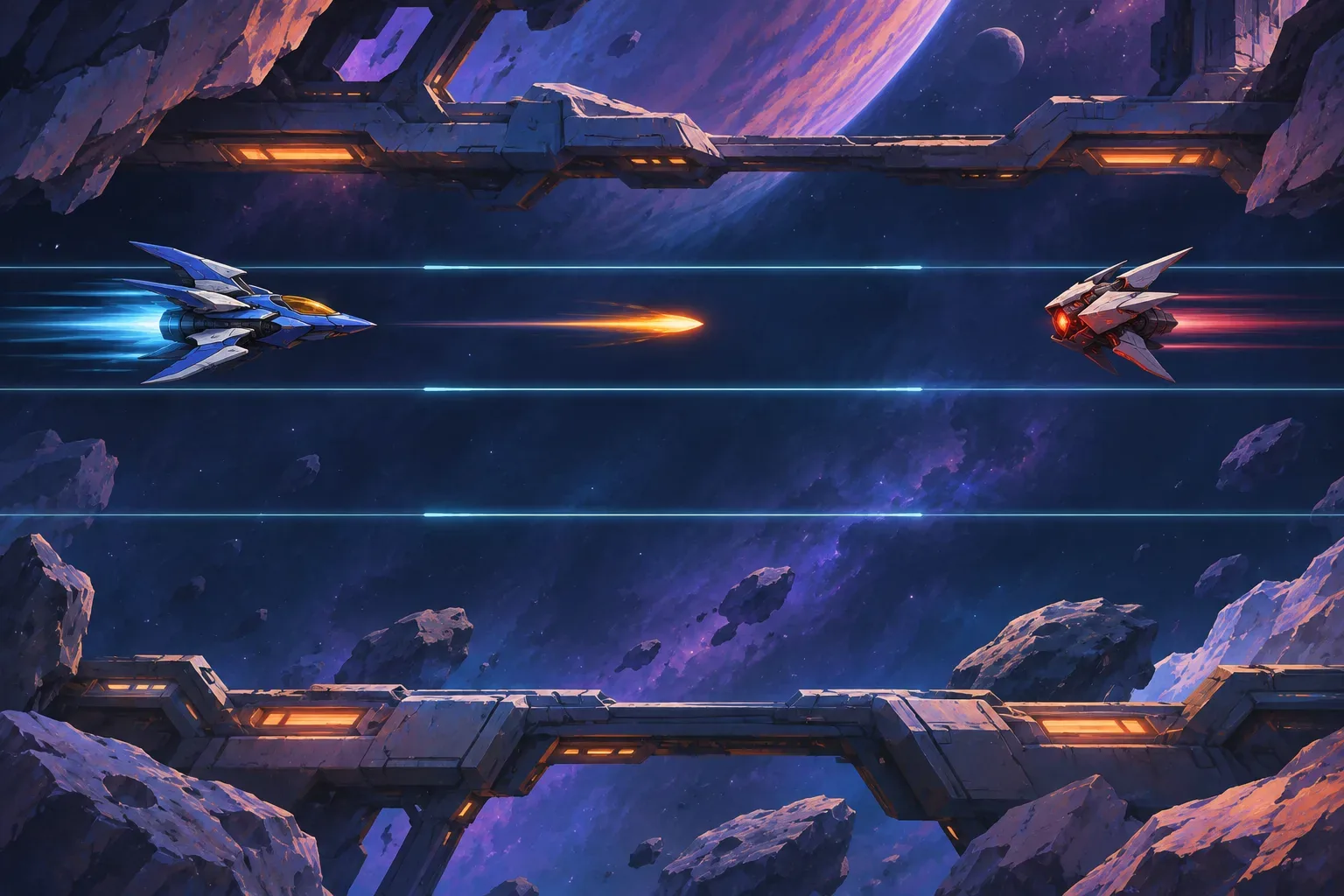
There is a useful distinction between the formula and a discrete collision check. Both example intercepts land exactly on the tenth-second update in the hand trace. A real build may use collision radii or swept collision, so ask which rule it implements and record observed behavior separately. The prompt should ask the builder to state which behavior it implements. Do not quietly change the expected trace to match a result you have not observed.
Build prompts in stages
Prompt one should establish the route and player controls. Ask for the guided camera, three lanes, and a half-second lane transition. Request one target-free corridor first so that you can inspect movement and boundaries. Avoid adding a boss or weapon upgrade before the basic lane switch is clear.
Prompt two adds one target and one weapon. Specify the drone’s starting distance and approach speed, the projectile speed, the fixed update step, lane matching, health, damage, and firing interval. Ask for the display to show target distance and current lane during development. That readout is a proposed review aid, not proof that the values are already working.
Prompt three asks for an expected trace beside observed behavior. The expected values are the table above. The observed column should remain empty until someone runs the build and records what happened. If an observed contact occurs a step later, record the actual frame, object positions, collision method, and whether lane transition or shot cadence changed the setup.
Prompt four adds feedback and reset behavior while keeping the movement and hit rules fixed. A short target burst should make a successful hit visible without hiding the corridor. Reset should restore the player to the center lane, the drone to distance 10 with 2 HP, the simulation clock to zero, and remove outstanding bolts. This gives a repeatable starting state for later checks.
Keep each prompt narrow enough that a revision has a clear cause. If a target is hit in the wrong lane, change the lane-matching requirement and inspect that result before adding a second enemy. If the first shot timing is unclear, add a position readout; do not simultaneously alter the speed, fire interval, and collision radius.
Review a playable build
- Confirm the camera follows one guided route and does not introduce unrequested free movement.
- Time a center-to-upper lane transition and record whether firing is allowed during the transition.
- Record target and bolt positions every 0.1 seconds around the first expected contact at t=1.4.
- Fire from a mismatched lane; note whether the shot passes through without damage.
- Check that the second aligned hit removes the 2-HP target once and that no later projectile damages a removed target.
- Reset while a bolt is in flight and verify the initial lane, target distance, HP, clock, and projectile set.
These checks are a plan, not completed test evidence. The source topic asks for prompts that have actually been run and for a playable result. This local draft does not satisfy that part of the request: it has no generated game build, and no prompt was executed. Keep that status visible when reviewing or reusing the page.
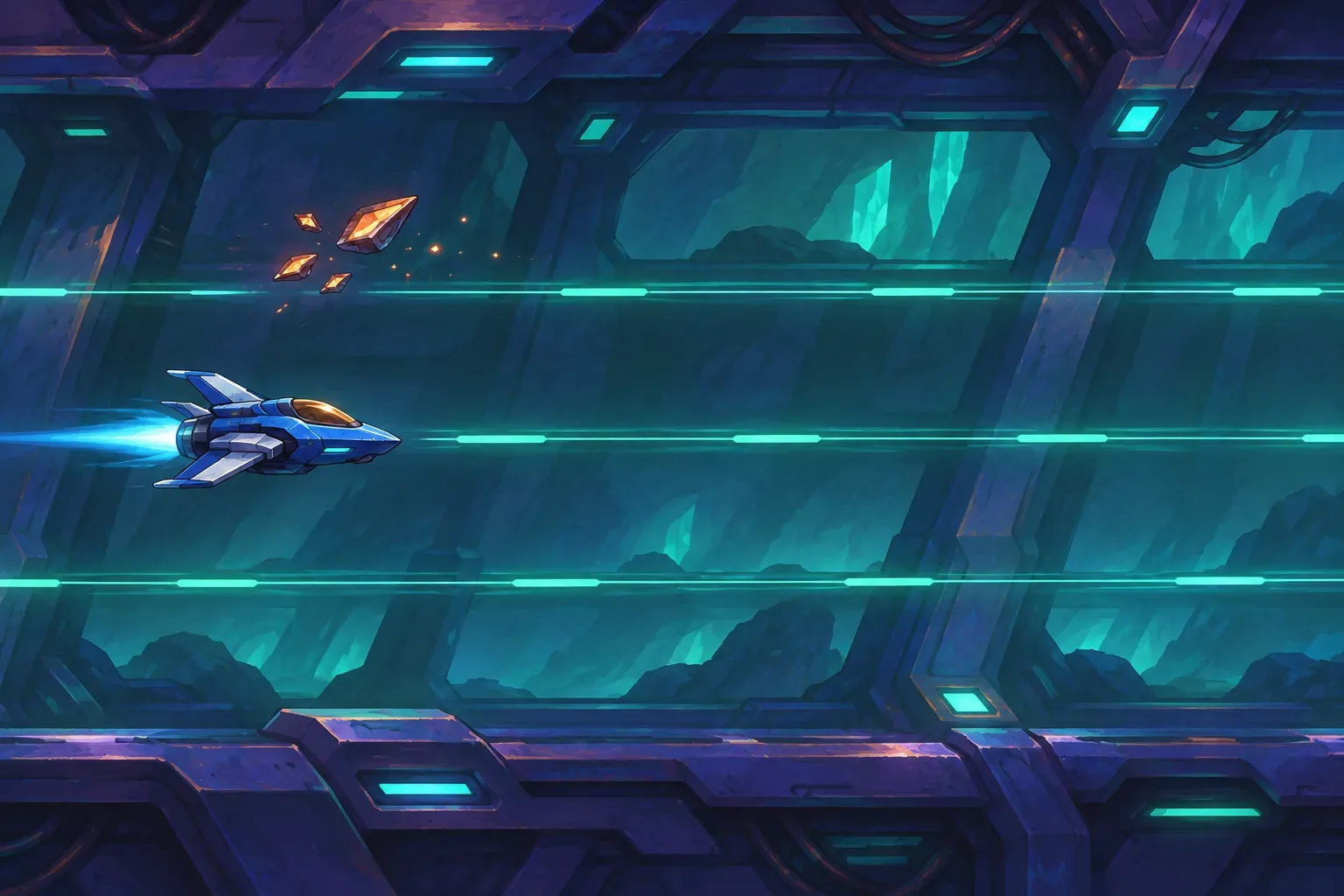
SEELE’s AI Game Maker page describes starting with a text prompt, testing an initial playable version in a browser, and refining it with follow-up prompts. That is general product context; the page does not verify this rail-shooter specification or its calculations.
Frequently asked questions
What should an AI prompt for a rail shooter define first?
Set the camera path, player control limits, lane or aiming rules, target route, shot speed, and hit condition. The first prompt should establish one encounter before adding waves or upgrades.
How can I estimate when a shot will hit a moving target?
Measure the gap when the shot launches and add the two speeds when they move toward each other. In this fictional example a 9-unit gap closes at 10 units per second, so impact occurs after 0.9 seconds.
Should a rail shooter use free aiming or fixed lanes?
Either can work. Choose one for the first prototype and specify it clearly. This example uses three discrete lanes so target alignment is a simple, visible rule.
How do I stop an enemy route from feeling unfair?
Give each target a readable entry point, lane, travel speed, and safe response window. Then check the route against player movement and firing cooldown in a playable build.
Are these prompts or shot timings tested in a playable game?
No. The prompts are unrun drafts and the timing example is fictional arithmetic. No generated build, observed hit, or playtest result is claimed.