A reverse tower-defense game flips the usual planning role. The player guides an attacking unit through a course while automated defenses try to stop it. The route is the strategy: take a faster path that hits harder, or choose a slower lane that preserves more health. A small map can make that decision visible before adding a full campaign.
The map, units, damage values, and outcomes below are fictional design examples. The prompt sequence is unrun; no playable build or tested result is claimed.
Define a route and escape goal
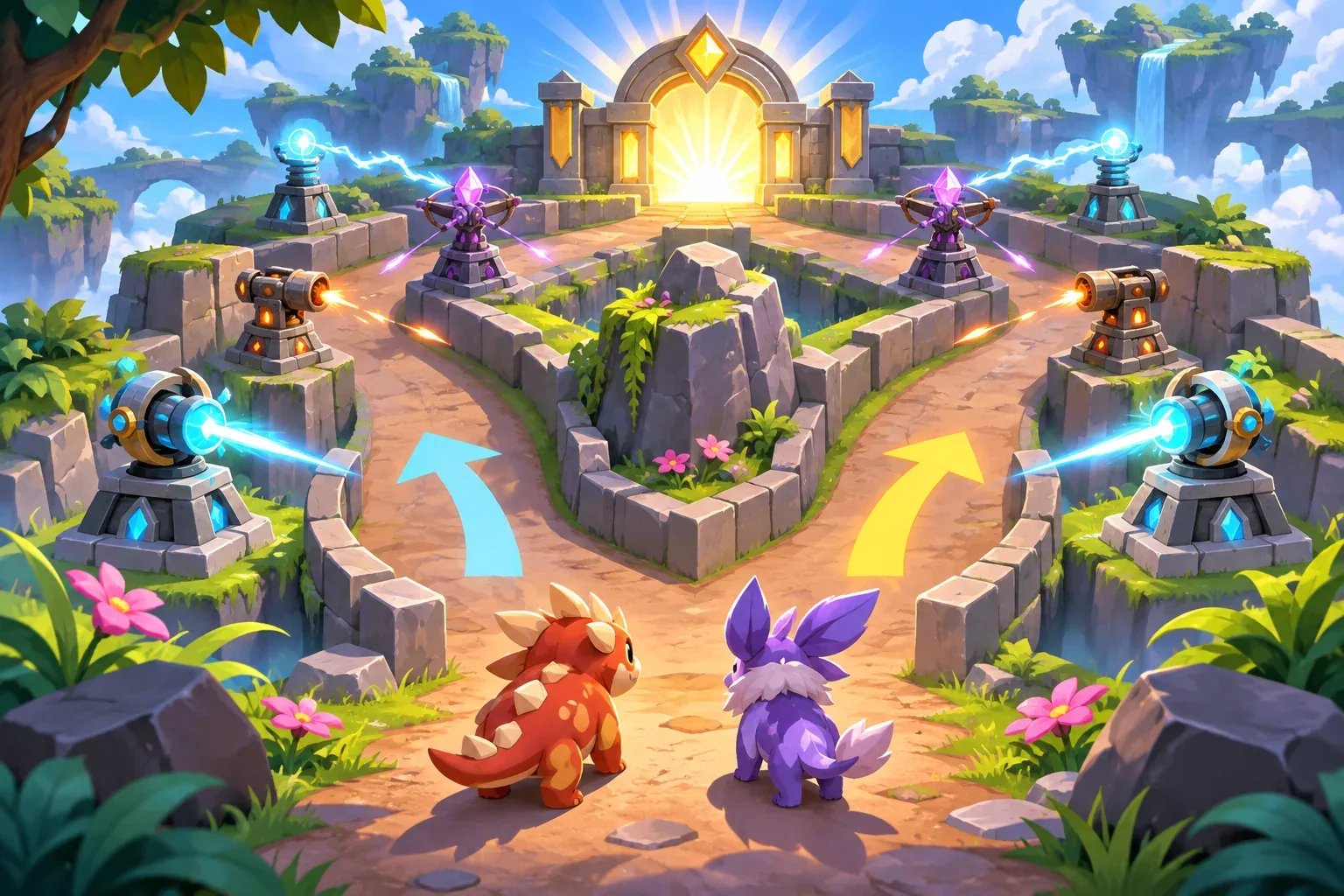
Use one short directed map: Entry leads to a Fork, where the player chooses North or South. Both branches reach a Merge and then an Exit. Place one automated defense on each branch and one at the merge. The player's goal is to guide both attackers to the exit with at least one HP, earning a time bonus if they finish within three ticks.
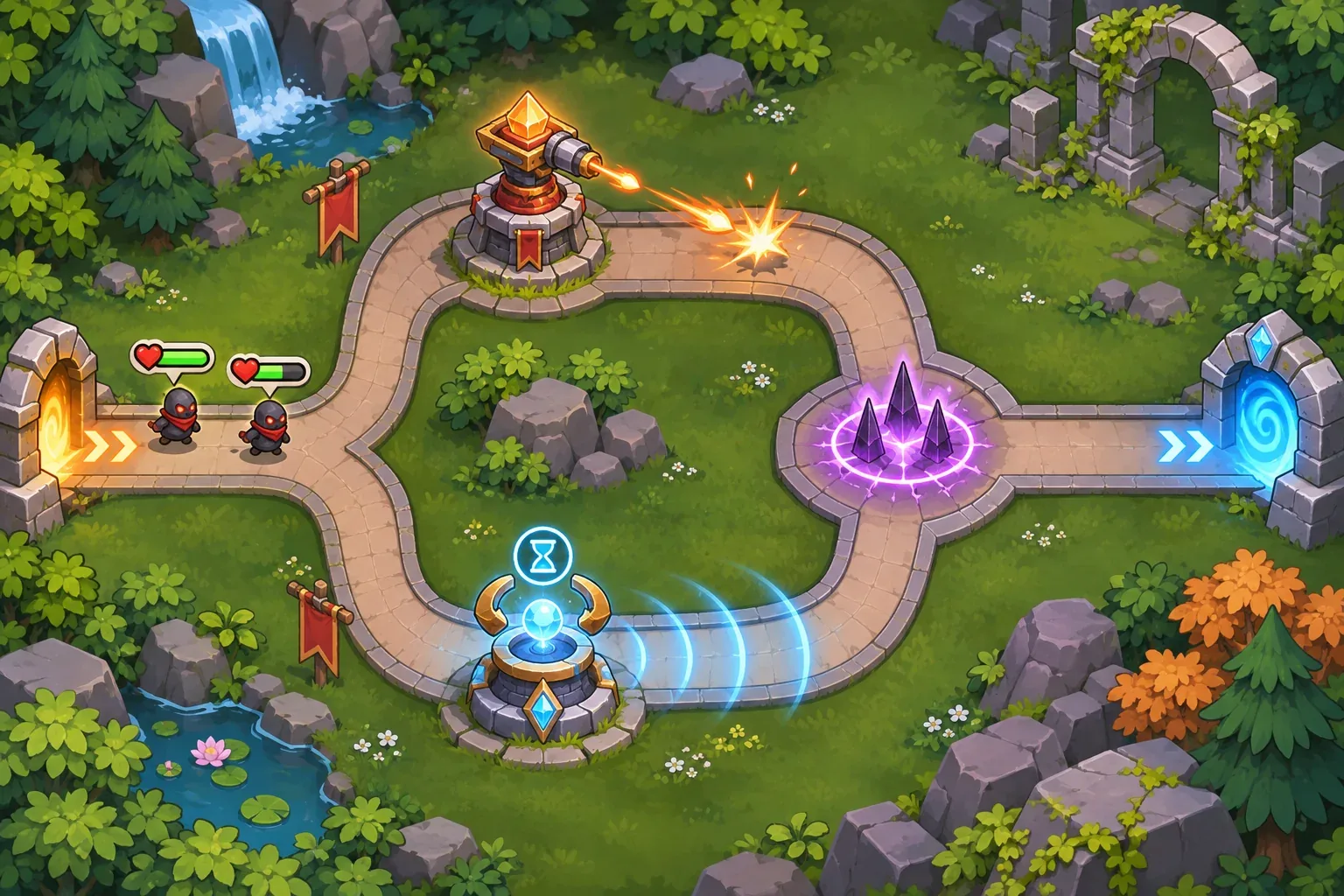
Define how movement and defense timing work. Each attacker advances one node per tick unless a status effect delays it. A defense triggers once when a unit enters its node. The North Sentry deals 2 damage. The South Pulse deals 1 damage and applies Slow for one tick. The Merge Barricade deals 1 damage when a unit arrives. If HP falls to zero, that unit is stopped and does not reach the exit.
| Map node | Effect | Player decision |
|---|---|---|
| Entry | Start of route | Choose an attacker order |
| Fork | North or South | Weigh damage against time |
| North Sentry | 2 damage once | Take a direct but costly lane |
| South Pulse | 1 damage and one slow tick | Trade time for less damage |
| Merge Barricade | 1 damage once | Plan enough remaining HP |
| Exit | Surviving units escape | Meet the survival goal |
Keep attacker stats distinct. A Runner starts at 5 HP and values speed. A Shieldbearer starts at 8 HP and can better absorb damage, but takes one extra movement tick when slowed. Do not imply that the player controls tower placement in this version; defenses are fixed while the attacker chooses the route.
Make defense effects predictable
Show the route and next defense before the player commits. When a unit enters a defense node, apply its effect, update HP or status, and then check whether the unit continues. A status effect should have a clear duration. In this example, Slow delays movement by exactly one tick; it does not add hidden damage or persist for the entire route.
Also separate route completion from scoring. The survival objective checks that both attackers reach Exit with positive HP. A three-tick time bonus is separate; a slowed unit may still escape and satisfy the main objective even if the bonus is missed. This distinction gives the game room for optional mastery without turning the basic goal into a moving target.
A trigger record can keep the rules auditable:
{
  "unit": "runner",
  "node": "north_sentry",
  "triggerCount": 1,
  "damage": 2,
  "hpAfter": 3
}
Make the trigger count part of the state. If the unit loops back through a node, decide whether the defense fires again or remains spent. For the first prototype, a single pass through a directed route keeps each effect easy to reason about. Add loops only after the basic path resolves correctly.
Trace two attackers through the map
The Runner chooses North. It starts at 5 HP, takes 2 damage at the Sentry, then 1 at the Merge Barricade. It reaches the Exit with 2 HP. The Shieldbearer chooses South. It starts at 8 HP, loses 1 at the Pulse, and receives a one-tick Slow. At the Merge, it loses another 1 and reaches the Exit with 6 HP after the delay.
| Attacker | Start HP | Route effects | Exit HP | Ticks | Goal |
|---|---|---|---|---|---|
| Runner | 5 | North Sentry −2; Merge −1 | 2 | 3 | Escapes |
| Shieldbearer | 8 | South Pulse −1; Merge −1; slow +1 tick | 6 | 4 | Escapes; misses time bonus |
The example shows why route choice is more than selecting a color. The Runner reaches the exit quickly with less health, while the Shieldbearer takes an extra tick but keeps a larger margin. This is a hand-calculated fictional design case, not a tested level or balance claim. Use it to check that defense damage happens once per node entry and Slow changes movement timing only.
Stage prompts and verify route state
Start the prompt sequence with the directed map, objective, and two attacker profiles. Add fixed defense effects only after the path is clear. Then ask for a route-choice display that shows expected damage, status duration, current HP, and exit requirements. If the output treats Slow as extra damage or fires the Sentry on every tick, correct that rule before adding waves or upgrades.
Create a compact fictional reverse tower-defense game. The player guides two attackers from Entry to Exit through a Fork, North/South branches, a Merge, and the exit. Runner starts at 5 HP; Shieldbearer at 8 HP. North Sentry deals 2 damage once on node entry. South Pulse deals 1 damage and applies exactly one extra movement tick. Merge Barricade deals 1 damage once. Each unit moves one node per tick unless slowed; a unit at 0 HP stops. The goal is both units reach Exit with positive HP; award an optional bonus if both finish within 3 ticks. Show route, triggers, HP, status, and ticks after every step. Do not add tower placement or random damage.These are unrun prompt drafts. If you use them, keep the prompt text, tool, date, output, and correction together. A diagram can explain the intended route, but it cannot prove that a game builder produced a working path or correctly applied damage.
SEELE's official AI Game Maker page describes text-based game creation, browser testing, and follow-up iteration. That is general product context; the prompts here have not been run and no reverse tower-defense output is claimed.
- Path check: both branches connect to Merge and Exit.
- Trigger check: each defense applies only on its defined node entry.
- Status check: Slow adds one movement tick, not extra damage.
- Survival check: a unit at zero HP cannot escape.
- Scoring check: survival goal and time bonus are evaluated separately.
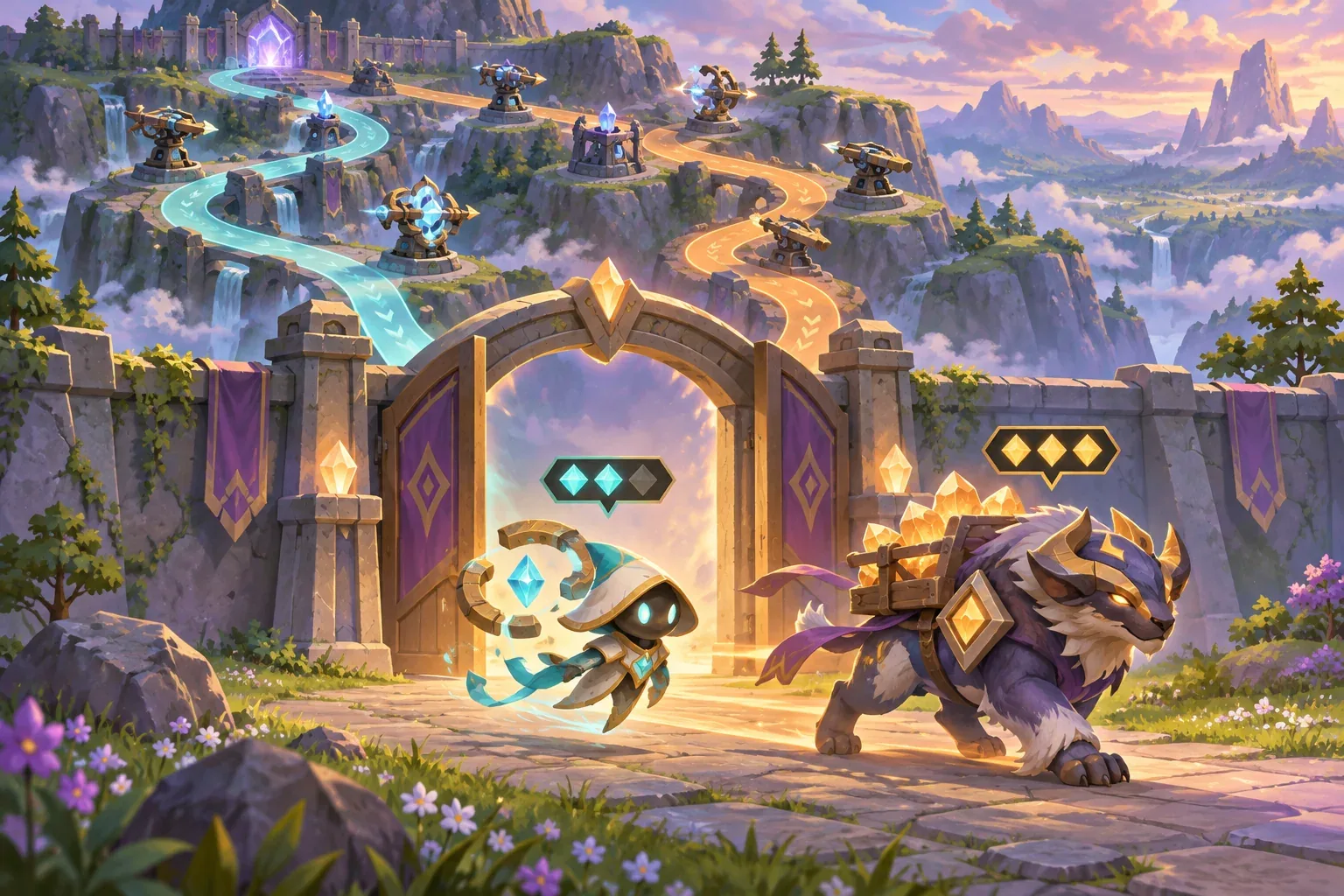
Once the baseline route works, add one new branch or one defense type. Keep the same survival condition and change one trigger at a time. That makes it possible to see whether the new obstacle creates a route decision or merely adds damage.
Reverse tower-defense prompt FAQs
What makes reverse tower defense different?
The player guides attackers through a defensive course instead of building the defenses. The route and timing become the central choices.
How many routes should a first level have?
One fork with two branches is enough to compare damage and delay. Add loops or more branches after the trigger rules are stable.
How should defense effects resolve?
Define whether a defense triggers on node entry, on every tick, or on a cooldown. Show the trigger count and state change so the player can predict it.
Can a slowed attacker still win?
Yes, if the main goal is survival and the unit reaches the exit with positive HP. Keep an optional speed bonus separate from the escape condition.
Are these prompts or route outcomes tested?
No. The prompts are unrun drafts and the route values are a fictional hand calculation. No playable result is claimed.
Make your own reverse tower-defense game
Start with one fork, two attackers, and a few defenses whose effects trigger at clear points. Track HP, status, and ticks after each node, then add complexity one rule at a time. For general creation context, explore the SEELE AI Game Maker and adapt this unrun draft to your own level idea.