A spellcasting shooter can turn elemental effects into a decision system: spend a shared resource on a fast single spell, or pair elements for a stronger combined hit. A prompt that only says “add cool spell combos” leaves the costs, timing window, target rule, and damage bonus undefined. Spell out those values first so you can inspect a small encounter before layering on more elements.
This example uses a fictional focus meter, an Ember spell, a Frost spell, and one target. It works through the focus and damage math, then gives staged prompts for a later build. The figures are design assumptions, not real measurements. These prompts are unrun drafts; no playable game or test result is included.
Define the spell contract
Begin with one small room, one stationary drone, and two elements. Focus has a maximum of 6 and begins full. It regenerates at 1 focus per second, in 0.25-second steps, before a new cast is checked. Ember costs 2 focus and deals 3 damage. Frost costs 2, deals 2 damage, and slows the target for 1 second.
A combination happens when the player casts the other element within 0.5 seconds of the previous element, and both projectiles hit the same target. The second impact adds a 2-damage Steam bonus. This rule keeps each spell’s base effect visible while giving the pair a separate payoff. It also leaves concrete questions for the prompt: Does the timing window start on cast or impact? Does a miss preserve the combo? This example starts the window on cast and requires both hits to land on the same target.
| Spell or rule | Fictional setting | What it makes explicit |
|---|---|---|
| Focus | 6 maximum; starts at 6 | Shared resource budget. |
| Regeneration | 1 focus/second, checked every 0.25 seconds before casting | Resource timing and order. |
| Ember | Cost 2; 3 damage | Base effect and cost. |
| Frost | Cost 2; 2 damage; 1-second slow | Different effect and cost. |
| Combination | Different element within 0.5 seconds; +2 damage on second hit | Pairing window and bonus. |
Set the target at 7 HP for the worked example. That means one Ember hit is not enough. One Frost hit is not enough either. A successful pair can deal 3 + 2 + 2 = 7 total damage, so the bonus makes a visible difference without hiding what each element contributed.
Trace focus and damage
At t=0, the player casts Ember. The resource falls from 6 to 4 and the spell deals 3 damage. At t=0.25, one regeneration step adds 0.25 focus, bringing the meter to 4.25. The player casts Frost, paying 2 and leaving 2.25 focus.
The Frost projectile lands on the same target 0.25 seconds after Ember was cast, inside the 0.5-second combination window. Its base hit deals 2 damage and the Steam bonus adds 2 more. The expected total is 3 + 2 + 2 = 7, enough to defeat the fictional 7-HP drone. The focus value after the second cast remains 2.25. No focus is refunded for the combination.
| Time | Event | Focus | Expected damage |
|---|---|---|---|
| t=0 | Cast Ember; spend 2. | 6 → 4 | 3 |
| t=0.25s | Regenerate 0.25, cast Frost for 2. | 4 → 4.25 → 2.25 | 2 base + 2 Steam bonus |
| After second hit | Same target receives both impacts in the combo window. | 2.25 | 7 total; target reaches 0 HP |
These values describe an expected design trace, not observed combat. A playable version could apply regeneration at a different point in a frame, count the combo window from impact, or let the first spell hit a different target. Ask the build to expose its event order and record the actual result before claiming that the prompt works.
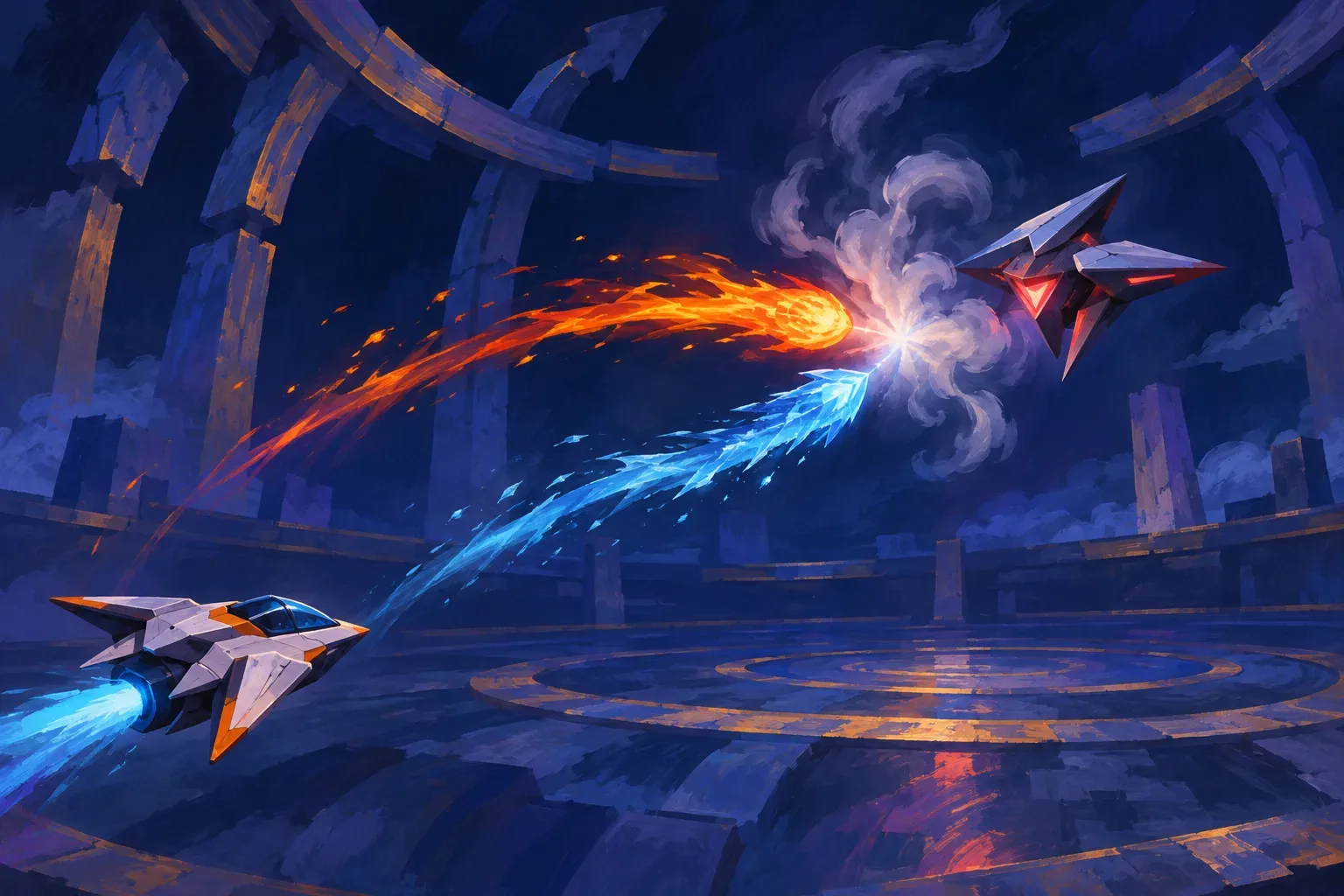
One important balancing choice is that the combo bonus belongs to the second impact, while the first spell still deals its own damage. If both casts hit separate targets, this brief gives no Steam bonus. If the first projectile misses, the result is unresolved by the sample and should be decided in a later rule rather than silently assumed.
Stage the prompts
Prompt one creates the arena and resource meter. Ask for one player, one stationary target, a focus cap of 6, and regeneration at 1 per second in 0.25-second steps before cast checks. Keep movement and aiming simple so resource changes are easy to read.
Prompt two adds Ember and Frost. Name each cost, base damage, projectile appearance, and effect duration. Ask for the focus total before and after casting. Do not add upgrades, critical hits, or a third element yet; those would make it harder to isolate a mismatch in the core values.
Prompt three adds the combination. State that the second, different element must be cast within 0.5 seconds, that both impacts must hit the same target, and that the second impact adds 2 damage. Show the base and bonus damage separately. The expected trace is Ember at t=0 followed by Frost at t=0.25: focus ends at 2.25 and total damage is 7.
Prompt four asks for visual feedback and a repeatable reset. A modest Steam effect can signal the combo without obscuring the target. Reset should restore focus to 6, clear cast history and projectiles, and return the drone to 7 HP. Keep resource timing and spell costs unchanged while tuning visual effects.
For maintainability, treat the pairing as a short-lived state with three fields: previous element, cast time, and target identifier on impact. The combo bonus applies only if the next different element falls inside the stated window and both spells resolve against the same target. That small contract prevents a stale element from combining with a later cast after the player has moved on to another encounter.
Checks for a future build
- Cast Ember at t=0 and Frost at t=0.25; record focus after each event and separate base damage from the Steam bonus.
- Repeat the second cast at t=0.75 and confirm the bonus does not apply because the interval exceeds 0.5 seconds.
- Hit a different target with the second element and check that the sample’s same-target rule is followed.
- Start at maximum focus and confirm regeneration never raises the meter above 6.
- Reset after the first spell and inspect focus, target HP, cast timer, combo state, and projectile list.
These are proposed acceptance checks, not completed test evidence. The source topic asks for prompts actually run and a playable result. This local page does not satisfy that part: the prompts have not been executed, and there is no generated game build or playtest.
SEELE’s AI Game Maker page describes creating a 2D or 3D game from a text prompt, testing an initial version in a browser, and refining it with follow-up prompts. That is general product context; it does not verify this spell system or promise a particular combination feature.
Frequently asked questions
What should an AI prompt for a spellcasting shooter specify first?
Start with the resource cap, regeneration rate, each spell cost, pairing window, and what makes two spells combine. Add enemies only after those rules can be followed.
How can a prompt make spell combinations predictable?
Name the element order or pairing window, state the combination bonus, and define how it changes the second cast. Keep individual spell effects visible so the bonus can be checked.
How should resource regeneration work during combat?
Choose whether regeneration occurs continuously or in fixed steps, set a cap, and say whether it happens before or after a cast. This example regenerates a quarter focus every 0.25-second step before a new cast.
Should every spell combination be available at the start?
No. Begin with two spells and one combination. That keeps resource costs and the resulting effect easy to understand before adding a larger spell graph.
Are these spell prompts or damage values tested in a playable game?
No. The prompts are unrun drafts and the resource example is fictional arithmetic. No generated build, observed combat, or playtest is claimed.