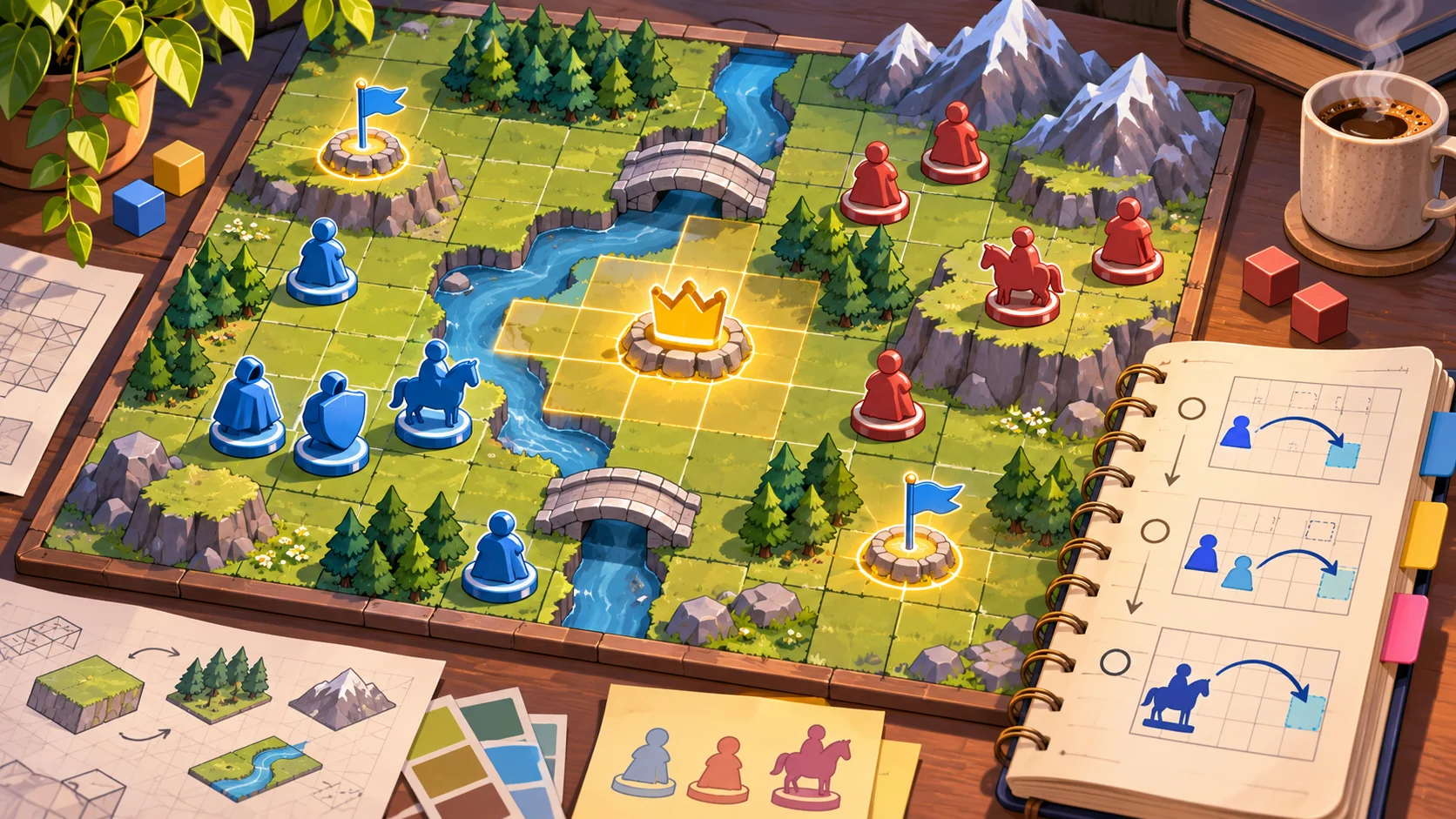
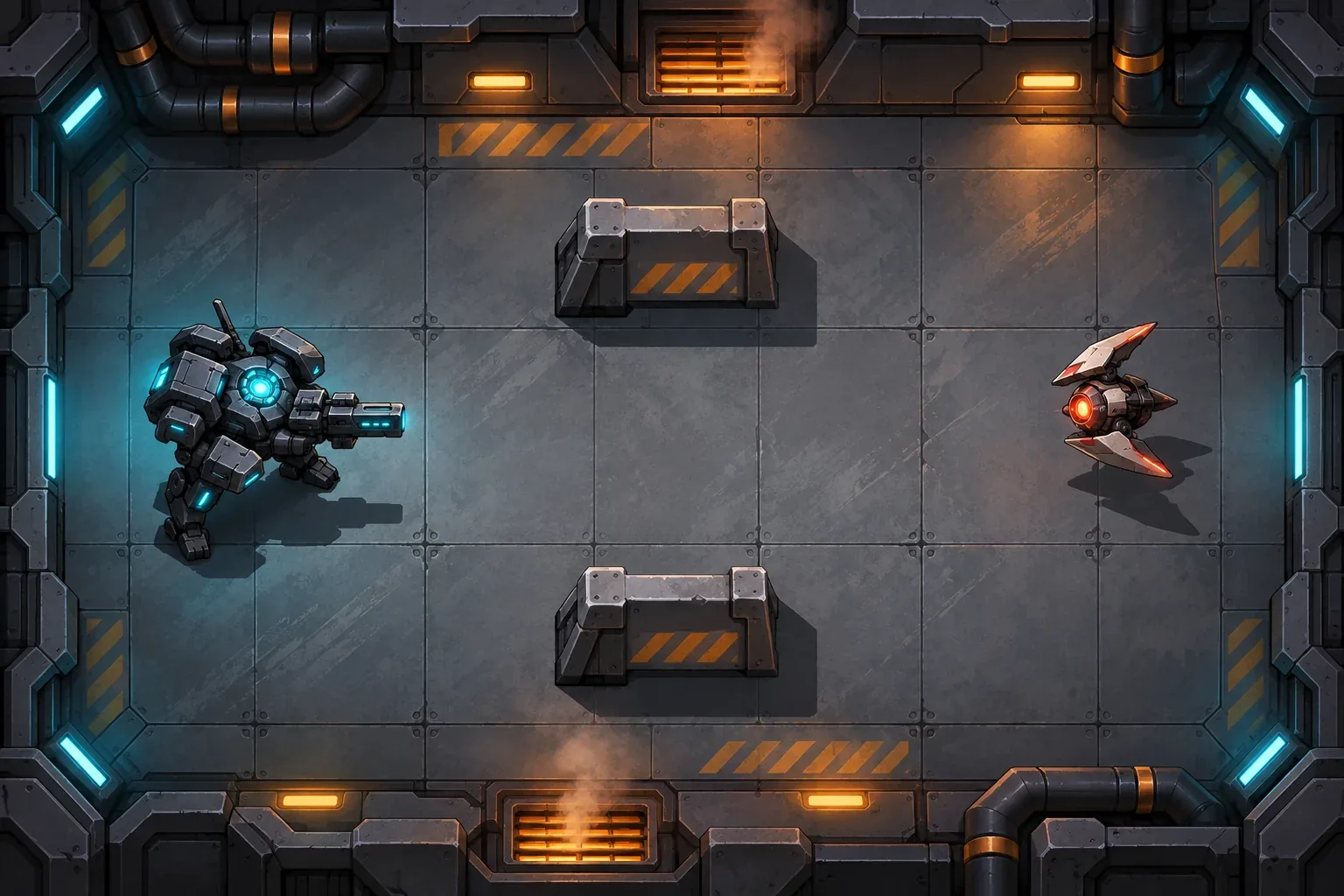
A turn-based shooter makes movement and firing part of one planning problem. If a prompt says only “take turns and shoot enemies,” it leaves action costs, range, damage, and the enemy response phase open. Those choices decide whether a player can move into range and still fire, and whether a damaged enemy gets another attack.
This guide defines one short encounter on a grid: a player starts just outside weapon range, spends action points to move and shoot, and faces one enemy response. The values are fictional design choices for a worked example. The prompt drafts have not been run, and this package has no playable build or combat test.
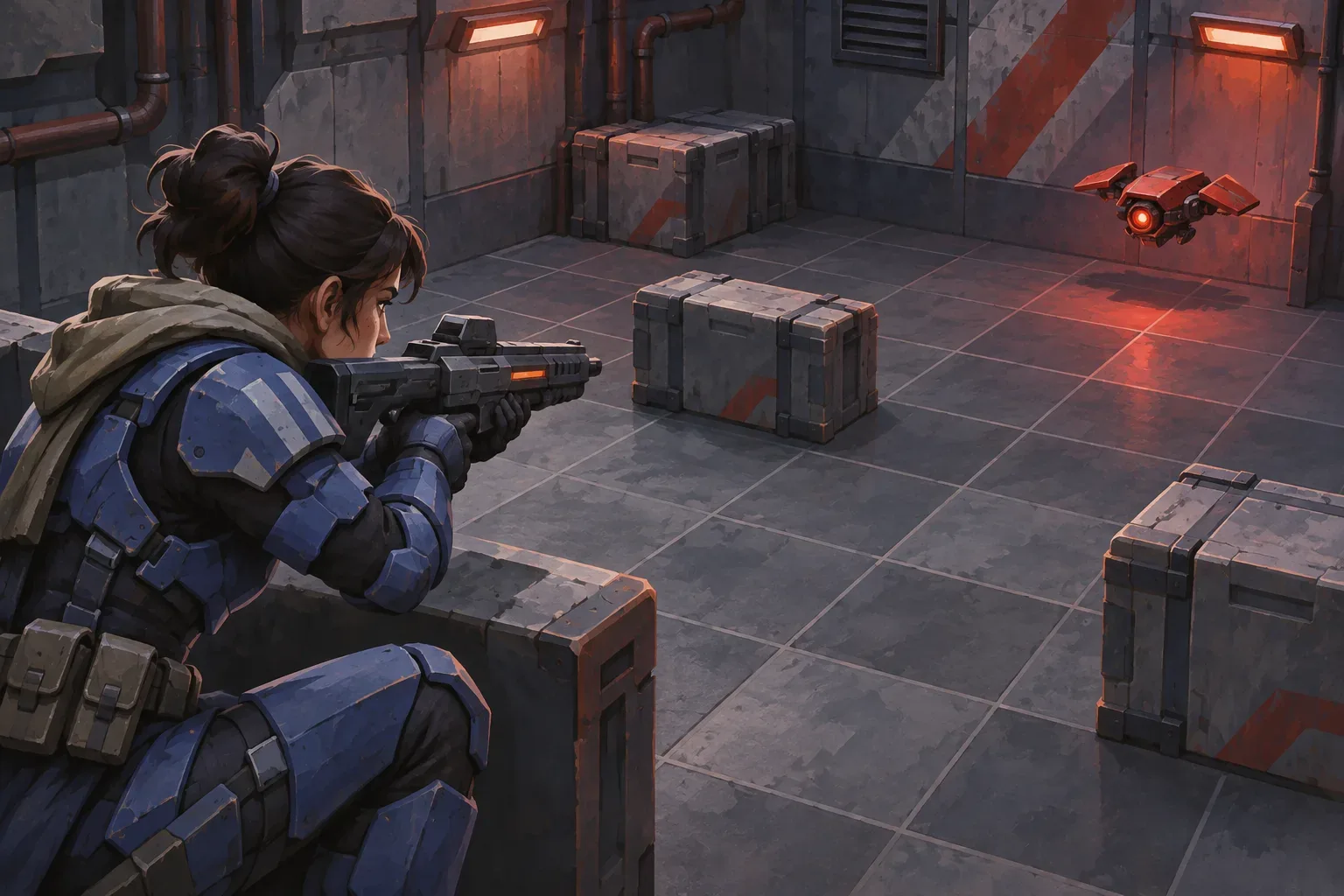
Set the turn contract
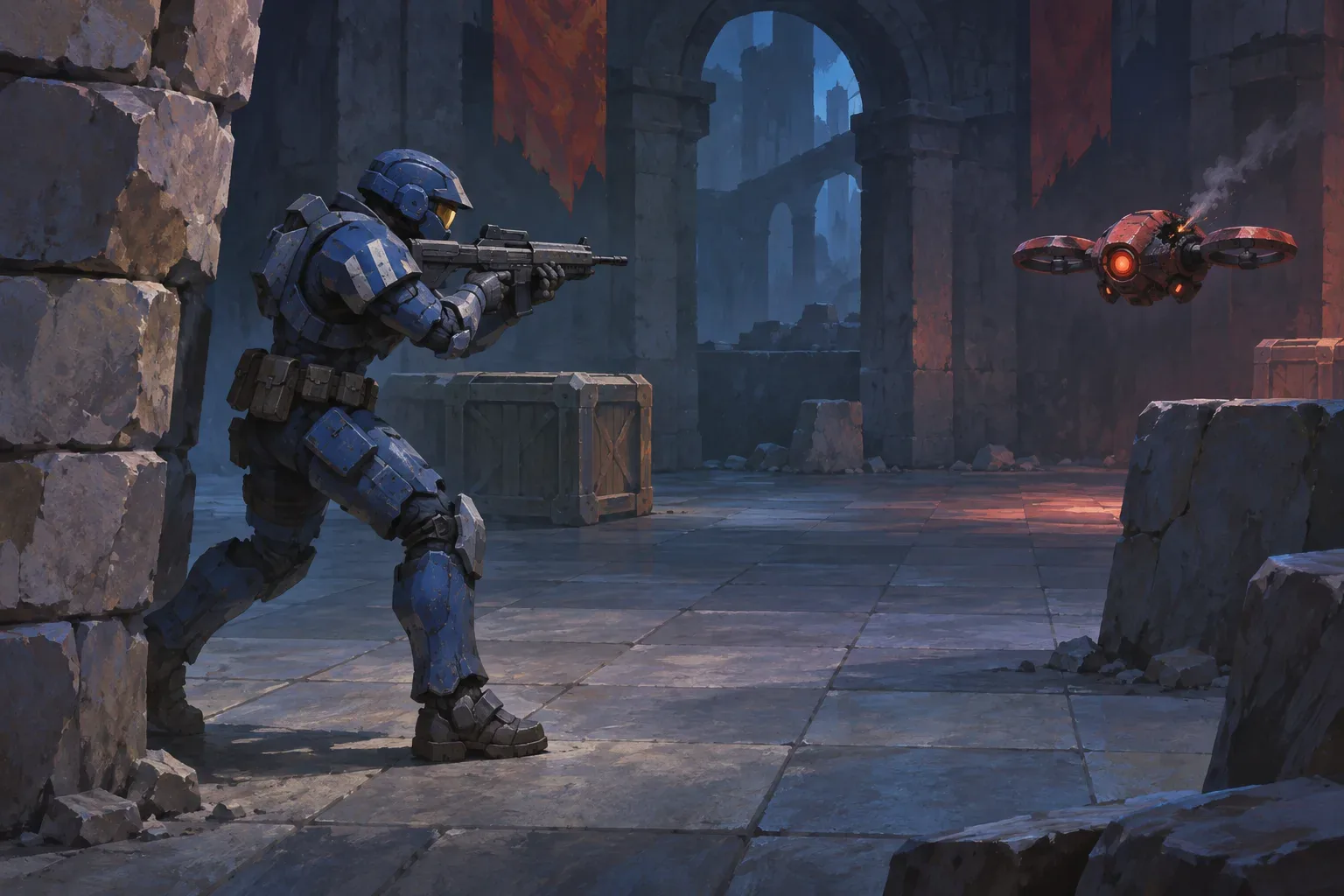
Use an 8-by-5 grid with one player at (1,2) and a stationary drone at (6,2). There is clear line of sight along the row. Each player turn has 3 action points (AP). Moving one tile costs 1 AP. Firing costs 2 AP, reaches up to 4 tiles, and deals 4 damage. The enemy has 6 HP.
Turns resolve in order. The player spends AP on actions and can end the turn with points left over. After the player ends the turn, each living enemy with clear line of sight and within 4 tiles responds once for 2 damage. A defeated enemy cannot act. The enemy does not move in this first encounter; adding enemy movement would require another range and phase rule.
| Rule | Fictional value | Why it matters |
|---|---|---|
| Player start | (1,2), 6 HP | Initial position and survivability. |
| Turn budget | 3 AP per turn | Limits the actions available before response. |
| Move | 1 tile for 1 AP | Changes distance and line position. |
| Fire | 2 AP; range 4; damage 4 | Defines whether the target can be hit. |
| Enemy | (6,2); 6 HP; response range 4; damage 2 | Defines its one end-of-turn response. |
At the start, the player and drone are 5 tiles apart, just beyond weapon range. Moving right once changes the player position to (2,2) and the distance to 4. That leaves 2 AP, exactly enough to fire. This is a deliberate choice: the first prompt can test whether the action budget and range rules work together before adding cover bonuses, reloads, or special attacks.
Trace the encounter
Turn one starts with player HP 6, drone HP 6, and 3 AP. The player moves one tile, spending 1 AP and leaving 2. The drone is now at range 4, so the player fires. The shot spends the remaining AP and deals 4 damage. The drone has 2 HP left.
The player ends the turn. The drone is still alive, has clear line of sight, and is exactly 4 tiles away, so it responds once for 2 damage. Player HP falls from 6 to 4. No second enemy action occurs because the response phase is defined as one attack per living enemy per player turn.
Turn two starts with the player at (2,2), 4 HP, and 3 AP. A shot costs 2 AP and deals 4 damage, which is enough to reduce the drone’s remaining 2 HP to zero. The drone is defeated before the player ends the turn, so it does not take a second response. The player ends this fictional encounter at 4 HP with 1 AP unused.
| Phase | Player state | Drone state | Result |
|---|---|---|---|
| Turn 1 start | (1,2), 6 HP, 3 AP | (6,2), 6 HP | Gap 5; out of range. |
| Move | (2,2), 6 HP, 2 AP | 6 HP | Gap 4; firing becomes legal. |
| Fire and enemy response | 4 HP, 0 AP | 2 HP | Player deals 4; enemy deals 2 once. |
| Turn 2 fire | (2,2), 4 HP, 1 AP left | 0 HP | Second shot defeats drone before its phase. |
The arithmetic makes the tradeoff visible: one move and one shot use the full first-turn budget, but the surviving enemy still responds. A different damage value could let the player defeat it before that response; a longer range could remove the need to move. Change one rule at a time and record which result changes.
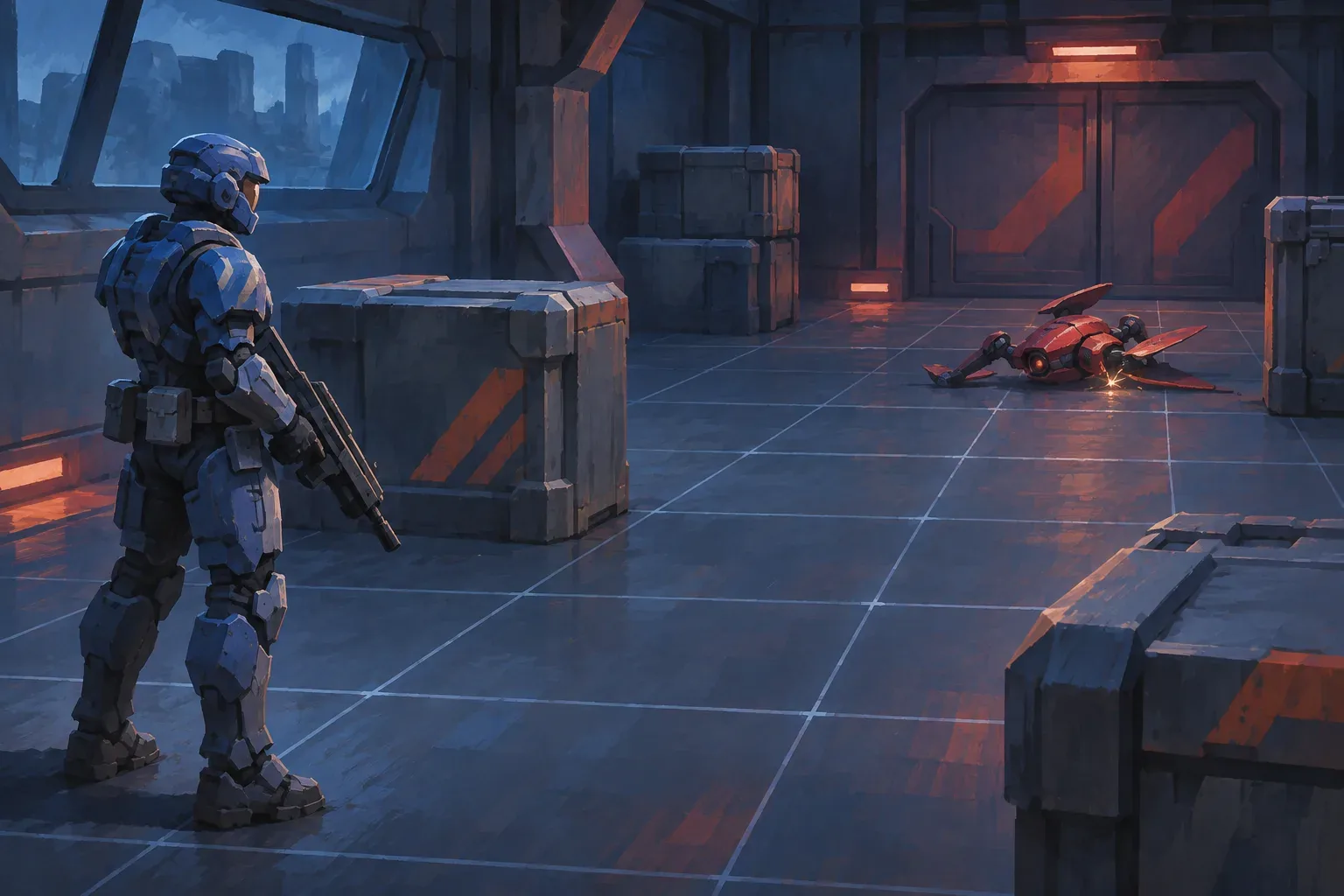
Do not treat a hand trace as observed play. A real build may use different distance calculations, target selection, or phase timing. Ask it to display the current AP, range, HP, and active phase during development, then record those values from the game. Keep the expected values from this article separate from the observed ones.
Stage the prompts
Prompt one creates the room, player, and one stationary enemy. Ask for visible grid coordinates, player HP, enemy HP, and a turn indicator. Keep the room open so range and line of sight are easy to inspect.
Prompt two adds the 3-AP budget, move cost, weapon cost, range, and damage. Specify whether invalid actions are blocked before AP is spent. Ask the interface to show AP before and after each action, so a firing mistake is not confused with a movement cost.
Prompt three adds the end-of-turn response. The enemy attacks once only if it is alive, within 4 tiles, and has clear line of sight. The response happens after all player actions. A target at zero HP does not act. Those conditions should be stated together, since a health check without phase timing can still produce an extra attack.
Prompt four adds feedback and reset. Reset should restore the player to (1,2) with 6 HP and 3 AP, the drone to (6,2) with 6 HP, and the turn counter to one. Keep the turn order and costs fixed while adding sound or hit effects.
Checks for a future playable build
- Confirm the initial 5-tile gap is out of range, then one move makes the 4-tile shot legal.
- Record AP after the move and fire; verify the first turn uses all 3 points.
- Confirm the first shot leaves the drone at 2 HP and the response reduces player HP to 4 once.
- Confirm the second shot reduces the drone to zero before the enemy response phase.
- Try to fire with only 1 AP and verify the action is rejected without spending it.
- Reset and inspect positions, HP, AP, turn counter, and active phase.
These are checks for a future build, not completed test evidence. The source topic asks for prompts actually run and a playable result. This package does not meet that part of the request: its prompts are unrun drafts, and there is no game build or playtest record.
SEELE’s AI Game Maker page describes creating a 2D or 3D game from a text prompt, testing an initial version in a browser, and refining it with follow-up prompts. This is general product context; it does not verify the combat rules in this example or promise a turn-based shooter feature.
Frequently asked questions
What should a turn-based shooter prompt define first?
Set the grid, player action-point budget, movement and firing costs, weapon range and damage, target health, and when enemies respond. One encounter makes the turn order easier to inspect.
When should enemies act in a turn-based shooter?
Choose a specific response point, such as after the player ends the turn. State whether a killed or out-of-range enemy still acts; this example checks remaining health after player actions.
How can action points make combat choices clearer?
Assign a cost to each action and show the remaining budget after it resolves. This example spends one point to move and two to fire from a three-point turn.
Should movement and shooting happen simultaneously?
Not in this turn-based example. The player resolves one action at a time, then the enemy phase begins after the player ends the turn.
Are these prompts or combat values tested in a playable game?
No. The prompts are unrun drafts and the tactical example is fictional arithmetic. No generated build, observed combat, or playtest is claimed.