Introduction
A theme-park management game connects ride choices, guest routes, queues, maintenance tasks and park resources. A broad brief can create a detailed map without explaining what the player can change. Begin with a compact fictional park and a short operating day where a visible choice changes the game state.
This guide uses Merrybrook Park, an invented park with fictional rides, guests and game resources. All queue lengths, capacity and outcomes are placeholders. This is not real amusement-park operations, engineering, accessibility or safety advice, and no playable game was built or tested for this article.
Define the park-day loop
Describe the scenario goal, which decisions the player makes and when a day ends. A small loop might review ride states, assign a maintenance task, adjust a path or attraction, observe guest movement and inspect a closing report. Define what advances time and how an unavailable ride is communicated.
Prompt 1 — first park brief
Design a fictional theme-park management game called Merrybrook Park. Scope one short park day, three themed zones, a few original rides, abstract resources and a clear scenario goal. Define ride states, guest routes, queue indicators, maintenance tasks, player actions, turn sequence, day close and reset. Use invented placeholder values. Do not provide real park, engineering, accessibility or safety guidance. List assumptions and untested mechanics.
The player should understand which task is available, which resource it uses and when its result appears. Keep the first scenario small enough to trace a choice from the park map to the closing summary.
Make park zones and guest routes readable
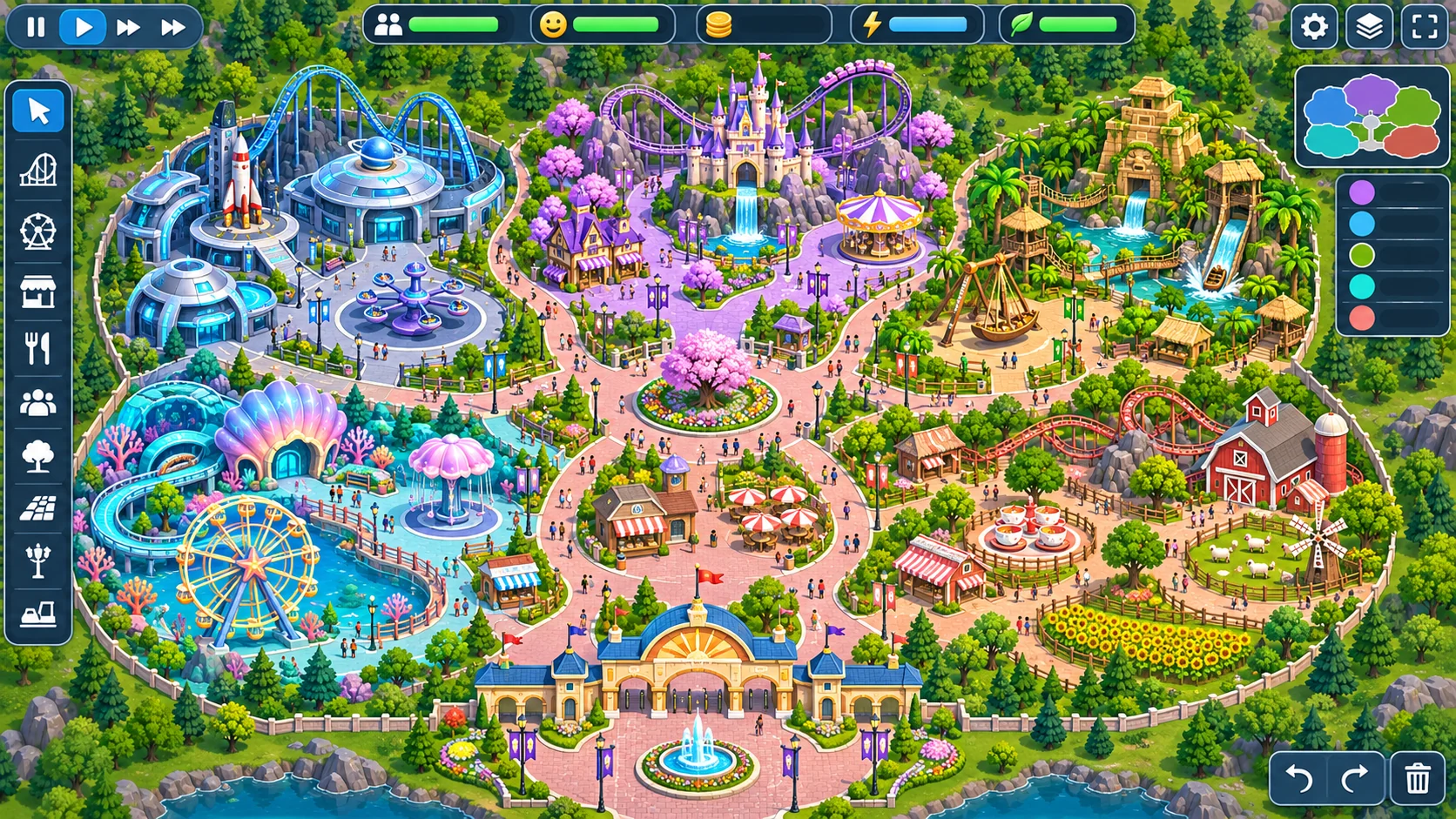
Use a compact fictional map with entrances, paths, zones and attractions. A legend can distinguish open, planned and temporarily unavailable areas. Show a route preview when the player changes a path, but do not present concept art as a real layout or accessibility plan.
Prompt 2 — park map
Create a small Merrybrook Park game map with three invented themed zones, an entrance, connecting paths and several original attractions. Mark open, planned and unavailable game areas with a clear legend. Show one proposed path change and its affected zones. Treat the image as fictional concept art, not as a real park or accessibility plan.
| Map state | Game meaning | Feedback |
|---|---|---|
| Open path | Available in the scenario | Show which zones it connects |
| Planned path | A player decision not yet applied | Preview its game cost and effect |
| Closed ride | Temporarily unavailable in the game | Explain the fictional task that can reopen it |
| Zone marker | An attraction or objective area | Keep labels consistent with the ride list |
These states are illustrative interface choices, not operational rules for real venues.
Make rides, queues and upgrades understandable
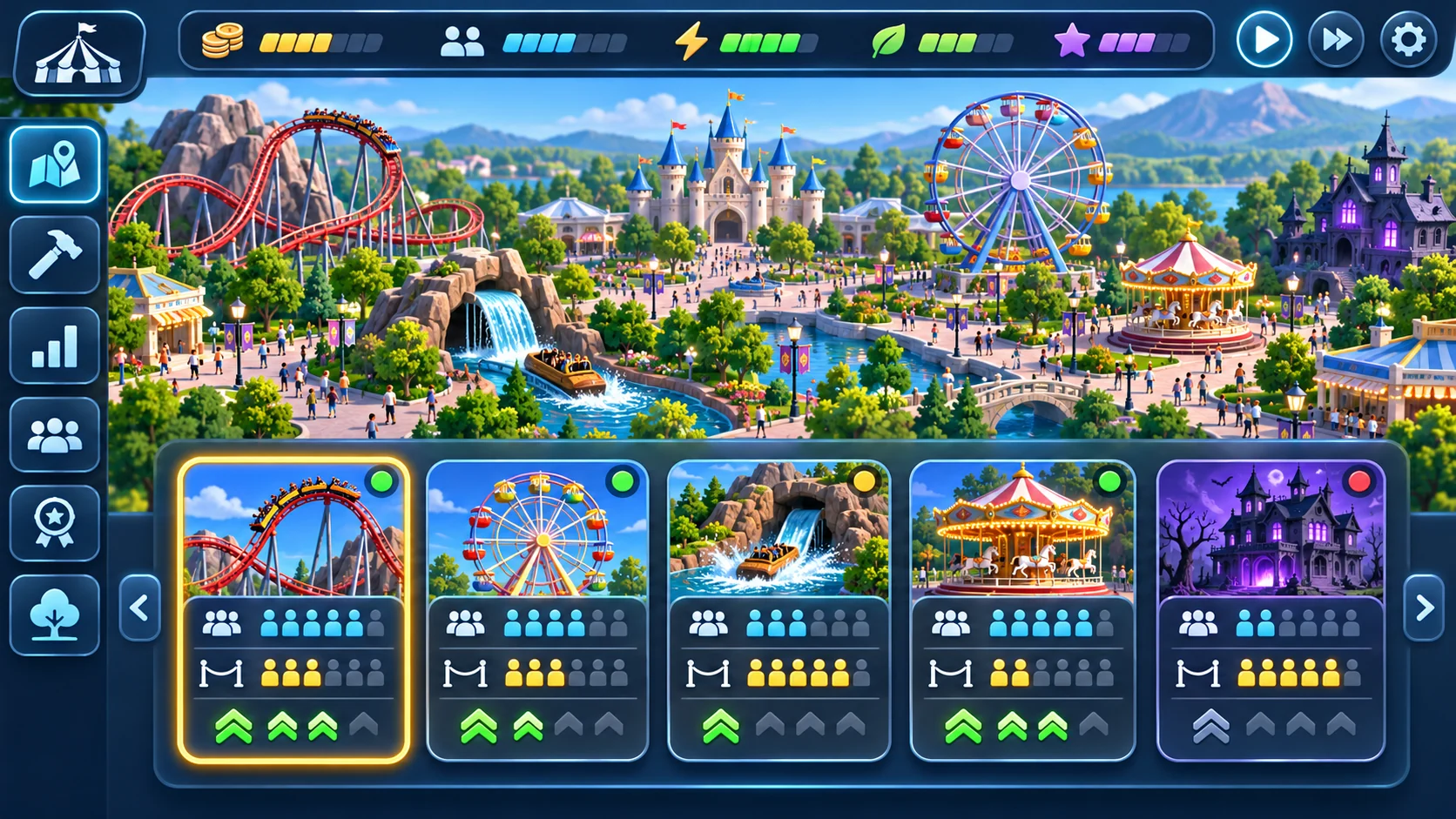
An attraction card can show a fictional ride state, abstract guest demand, a queue signal and an upgrade choice. State the game effect before confirming an action. If a queue changes after a player choice, explain which game rule caused it instead of presenting the result as real guest behavior.
Prompt 3 — attraction cards
Define three original Merrybrook Park attractions with distinct fictional roles. For each, show an abstract queue state, availability, a maintenance or upgrade choice, game resource cost and expected turn timing. Include one trade-off and a clear blocked state. Label every value as a game placeholder; do not imply real capacity or safety standards.
A useful card lets players compare options without hidden costs. Use the same ride names and states on the map, task board and report.
Connect guest flow to player decisions
A small flow view can show where game guests enter, choose an attraction and wait. Treat the path as a simplified simulation. Explain whether it is fixed, affected by a player decision or driven by a scenario event. Keep crowd and satisfaction markers clearly labeled as abstract game indicators.
Prompt 4 — guest-flow rules
Propose simple deterministic guest-flow rules for Merrybrook Park. Show a small number of fictional guest groups moving between zones and attractions, with visible queue and route states. Explain how a path change or closed ride affects their next game choice. Label the simulation as a prototype rule, not a model of real visitors.
The goal is explainable cause and effect. If a group chooses another ride, show the event in a short log and update the same state on the map and attraction card.
Tie maintenance and the daily report together
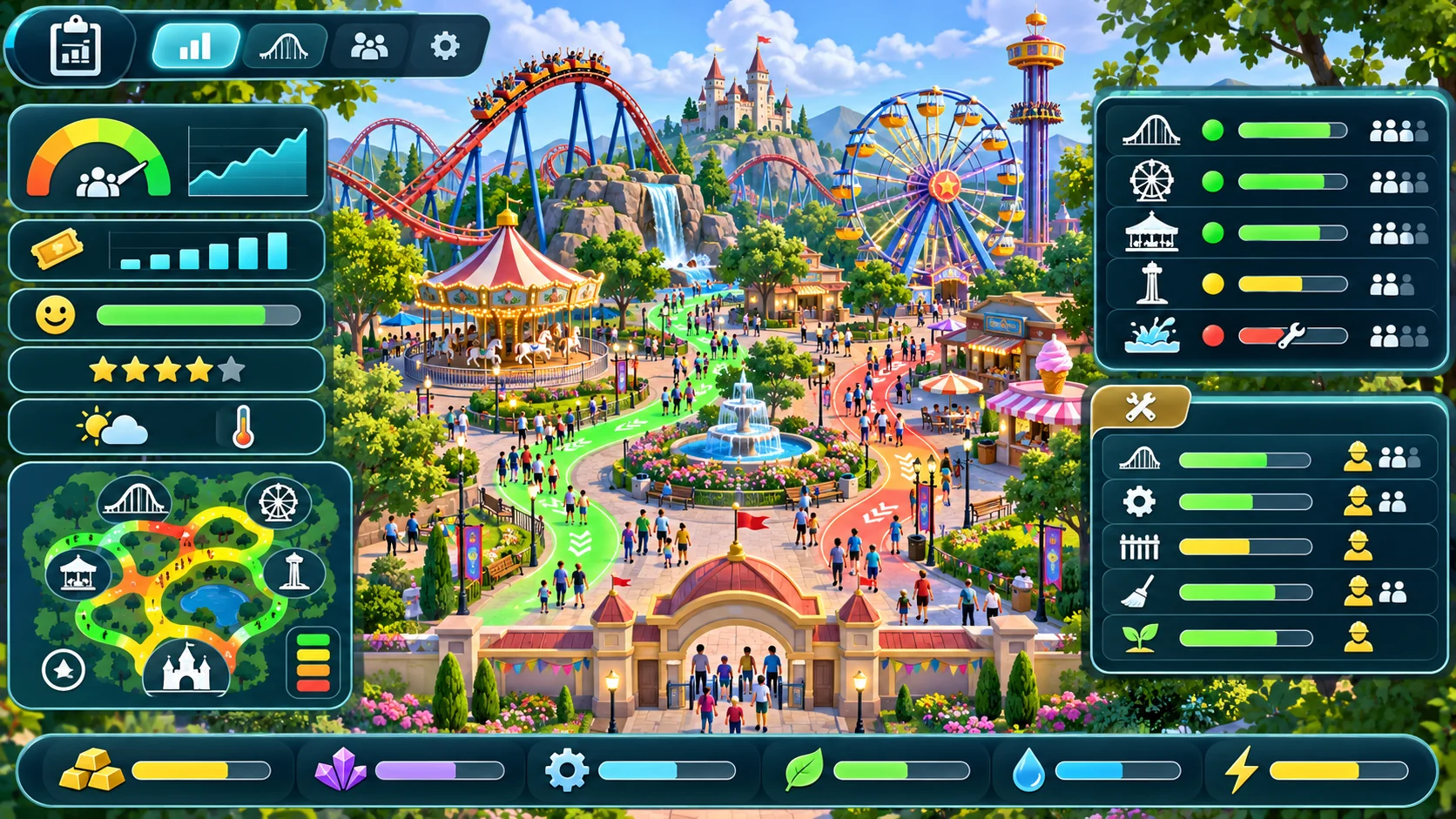
Maintenance tasks can give the player a clear choice about where to spend a turn or game resource. A report should show completed tasks, ride availability, zone states and abstract resources. Do not infer real safety, revenue or visitor satisfaction from invented indicators.
Prompt 5 — end-of-day report
Create a Merrybrook Park closing report with fictional ride states, completed and open maintenance tasks, guest-flow indicators, abstract game resources and a concise event log. Explain what changes next day and one available next decision. Use placeholder values only. Do not claim real park performance, safety, revenue or visitor behavior.
A consistent report answers what changed, why it changed and which action remains available. It should also distinguish a scenario reset from any value that carries to the next fictional day.
Request a small playable park-management slice
A first build could include one map, three zones, a few rides, guest routes, a task board, abstract resources, a closing report and reset. Name the interactions that must work: select an attraction, assign a task, apply a path choice, advance the day, inspect updated states and restart. Static art should not be described as a playable park.
Prompt 6 — first playable slice
Build a small fictional Merrybrook Park management game with three themed zones, original ride cards, visible paths, abstract queue states, assignable maintenance tasks, resource choices, guest-flow preview, event log, closing report and reset. Show blocked actions and state changes. At handoff, list working interactions, mockups and unverified rules. Do not call static screens playable or claim real park accuracy.
After the build exists, test the same sequence and record what actually changed. This article does not claim that a build or test was performed.
Prompt 7 — observed-output review
Review the running Merrybrook Park prototype for map paths, ride selection, queue display, maintenance assignment, task completion, guest-flow update, resource change, day close, report and reset. Mark each present, missing or unclear based on observed interactions. Record brief evidence and one smallest next change. Label placeholders; do not claim safety, accessibility or real-world performance.
Fictional park-day snapshot
| Field | Merrybrook Park example |
|---|---|
| Zones | Three invented themed areas |
| Attractions | A few original game rides |
| Decisions | Assign tasks, adjust paths and choose upgrades |
| Main loop | Inspect → decide → advance → review |
| First milestone | One choice updates a ride, route or report state |
| Evidence | Fictional plan only; no game or venue test |
The snapshot bounds the prototype. It is not a real park plan or assessment.
Conclusion
Theme-park management prompts should connect rides, paths, guest-flow indicators and maintenance choices in a compact park-day loop. Merrybrook Park and its values are fictional; no playable game or real venue test is claimed. Make state changes visible and inspect the running interactions before describing the build as playable.
You can take a scoped concept into the Free AI game maker, then compare the result with the review checklist.
FAQ
What should AI prompts for a theme-park management game include?
Define park zones, rides, paths, queues, guest-flow rules, maintenance, resources, reports and the first playable scope.
How can a theme-park game show guest flow?
Use a small route view and explain the game rule behind each movement or queue change.
Can AI generated ride capacity be used for a real park?
No. Treat generated values as fictional game placeholders, not operational or safety guidance.
What makes a theme-park management prototype easier to review?
Show ride states, task costs, path changes and end-of-day outcomes consistently across the map and report.
Does a park-management mockup prove the game is playable?
No. Verify attraction selection, task completion, path updates, turn progression and reset in the running output.