Set up the Cinder Market
A tile-drafting strategy game asks the player to choose from a limited supply, then make a spatial decision with the piece they selected. If a prompt only says “place tiles to score,” it leaves open how the market refills, what makes a placement legal and whether a connection is counted once or repeatedly. Defining those rules first gives a small prototype a visible decision each turn.
This guide uses a fictional puzzle called Cinder Market. The player drafts from three face-up tiles and places four tiles around a central Hub on a 3×3 board. Scoring comes from neighboring tile pairs, not from building a continuous route. The six prompt drafts are unrun; the rules and example are hand-calculated design material. No generated game, playable result or observed test is included.
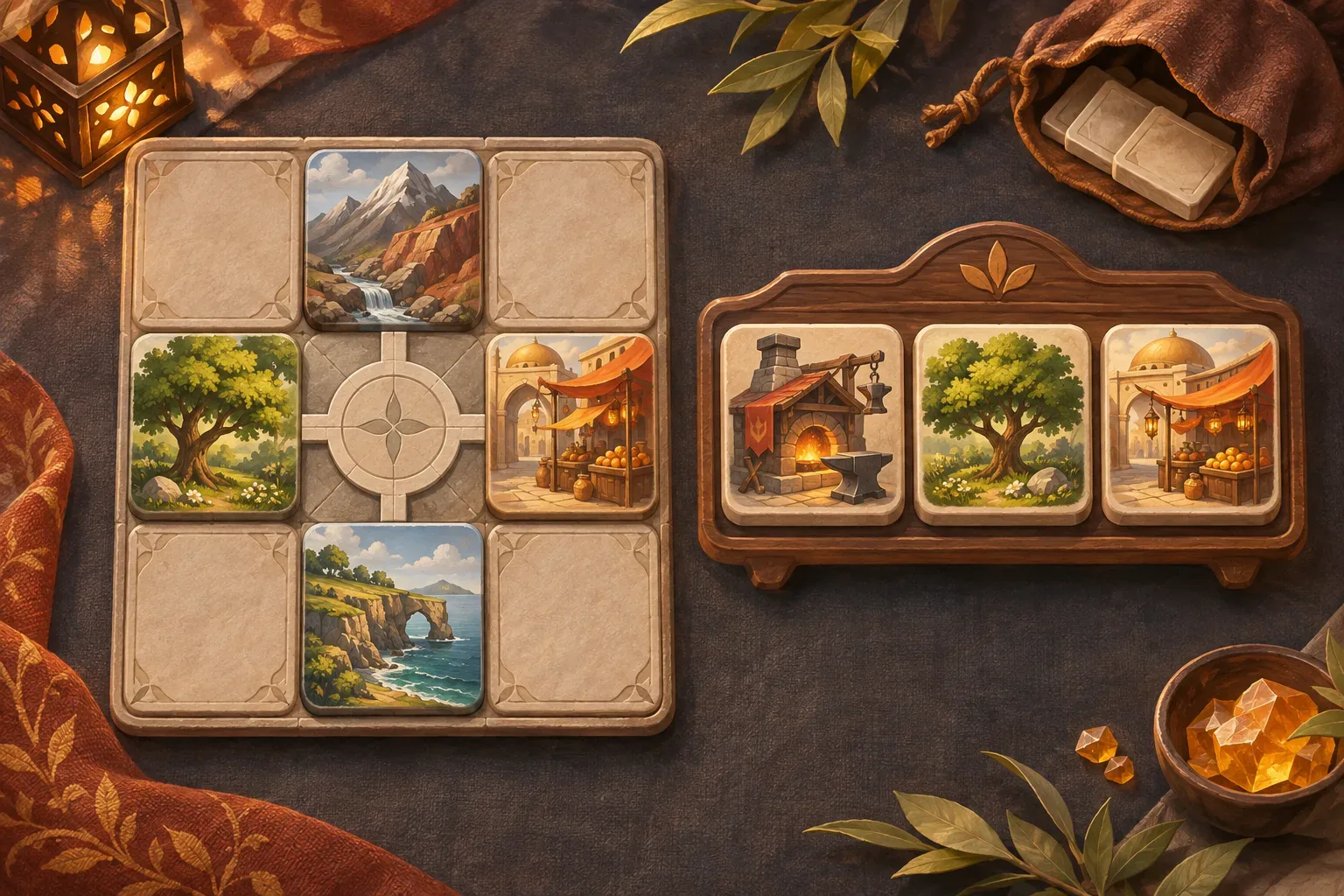
The board uses three tile types: Foundry (F), Grove (G) and Bazaar (B). A non-scoring Hub begins in the center. Each turn, choose one tile from the visible three-slot market, place it in an empty legal cell, then refill that slot from a fixed queue. After four placements, the objective is to reach at least six points.
This is a compact tile-drafting strategy prompt, but it uses a different scoring problem from a route-building tile game. There are no ports to rotate, no Harbor-to-Beacon path, no connection-length reward and no requirement that every placed tile continue one trail. Each new tile instead scores the types of its orthogonal neighbors.
Define the market and placement loop
Show all three market choices before the player acts. The initial market is [Foundry, Grove, Bazaar]. After a choice, refill the selected slot using the fixed queue [Foundry, Grove, Bazaar, Foundry]. The queue removes randomness from the design trace: the player still makes a choice, but the next offer is reproducible.
| Turn step | Rule | State to show |
|---|---|---|
| 1. Present choices | Offer the three visible market slots | Tile type and slot position |
| 2. Draft | Player selects one tile | Chosen slot and current queue head |
| 3. Place | Choose one empty orthogonally legal cell | Board before and after placement |
| 4. Score | Count each new scored pair with adjacent drafted tiles | Neighbor types and points gained |
| 5. Refill | Replace only the chosen slot from fixed queue | New market and remaining queue |
| 6. Advance | After four placements, compare total with 6 | Final score and goal status |
Every cell uses a row and column from 0 through 2. The Hub occupies (1,1); it is not a drafted tile. A new tile must go into an empty cell that shares a side with at least one placed tile. It may touch more than one tile, and each qualifying pair is evaluated at the moment the new tile arrives. A diagonal touch alone does not make a cell legal and never scores.
This placement rule keeps the board connected to the Hub without making connection itself a scoring condition. The player can decide whether to form a productive pair or use a low-value tile to open space for later choices. Because the market is shared, selecting one slot also determines what the next player-facing offer will be in the following turn.
Make neighbor scoring unambiguous
Write the pair values as an unordered lookup. That means Foundry next to Grove has the same value whichever tile was placed first. The game counts a pair once: when the second tile in that pair is placed. It does not rescore older neighbors on later turns.
| Adjacent drafted pair | Points when pair is completed | Example meaning |
|---|---|---|
| Foundry–Grove | +2 | A workshop beside a growing plot |
| Grove–Bazaar | +2 | Produce beside a place to trade |
| Bazaar–Foundry | +1 | A market beside a workshop |
| Same type | +0 | Repeating a tile type does not create a pair bonus |
| Any pair touching Hub | +0 | Hub is a placement anchor, not a scoring tile |
When a tile touches two eligible neighbors, score both new pairs. For example, placing Bazaar between a Grove and Foundry would earn two points for Grove–Bazaar plus one for Bazaar–Foundry. It would not also score the Grove–Foundry pair if those tiles were already adjacent; only new pairs involving the placed tile are considered.
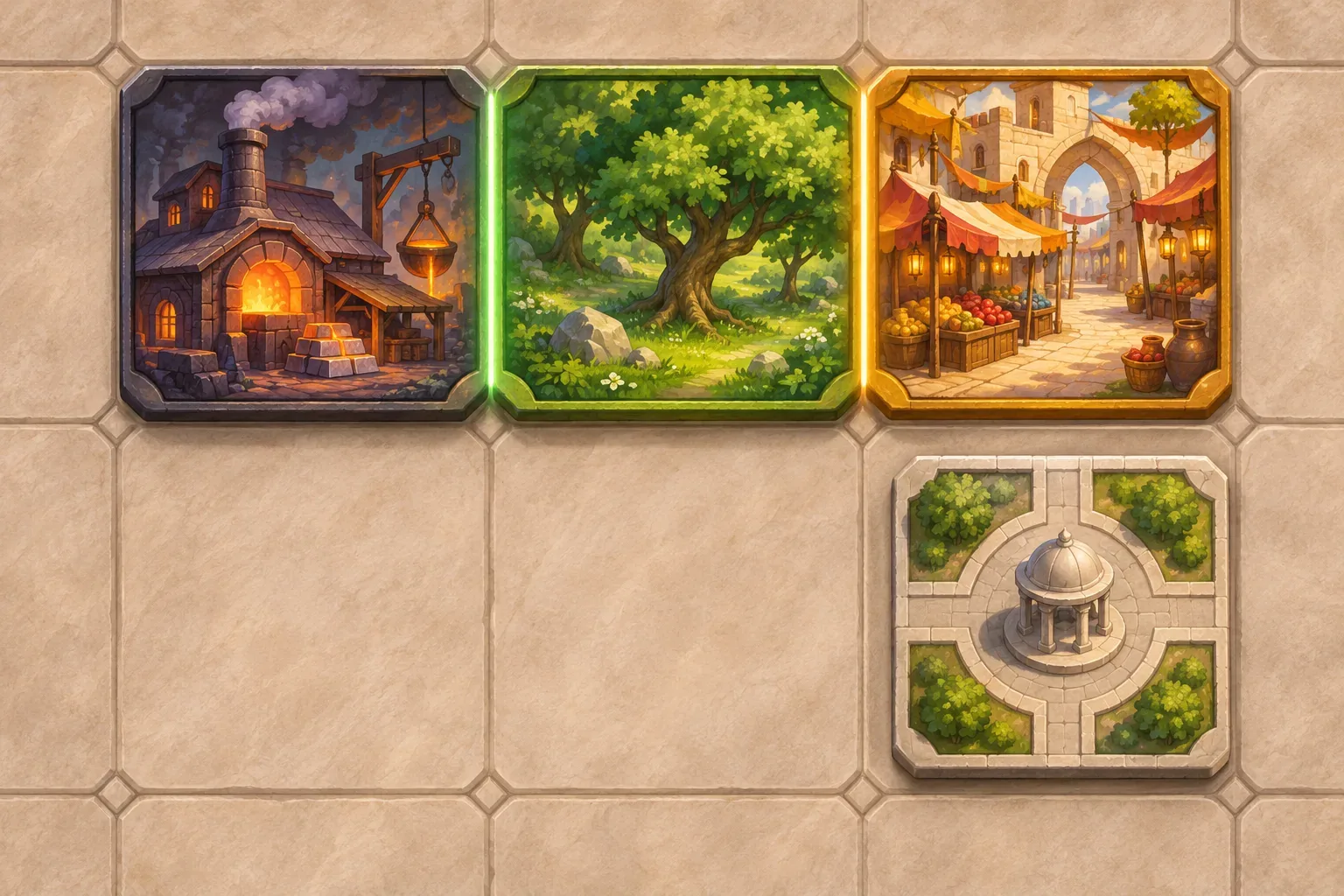
The target is six points after four turns. There is no early win check: even if the target is reached on the third placement, complete the last turn and then show the final total. If the player finishes below six, the objective is missed. This lets two traces compare the same number of turns and makes Restart easy to specify.
One design caution: a fixed refill queue makes a trace testable, but it does not prove that the options are balanced or interesting. If the market feels too predictable in a later build, random supply can be added as a separate change after placement and scoring work. For now, keep the queue fixed so an arithmetic mismatch has a short list of possible causes.
Trace four drafts and one revision
The trace starts with Hub at center. Each row names the chosen tile, cell, scored neighbor and total. The player finishes with four points, two short of the target. That missed objective gives a clear reason to adjust a value on paper before deciding whether the rules are ready for a build.
| Turn | Market choice and placement | New scored pair | Total |
|---|---|---|---|
| 1 | Choose Grove from slot 2; place at (0,1); refill slot 2 with Foundry | None; Hub scores 0 | 0 |
| 2 | Choose Foundry from slot 1; place at (0,0); refill with Grove | Foundry–Grove +2 | 2 |
| 3 | Choose Bazaar from slot 3; place at (0,2); refill with Bazaar | Grove–Bazaar +2 | 4 |
| 4 | Choose Foundry from slot 2; place at (1,0) | Only same-type Foundry touches; +0 | 4 — goal missed |
The fourth placement is legal because (1,0) shares an edge with Foundry at (0,0). It does not touch the Grove at (0,1); those cells meet at a corner. It does touch Hub at (1,1), but Hub never scores. The only scored tile neighbor is the other Foundry, worth zero. This is why the board coordinates matter: a loose diagram might make a diagonal look like an adjacency.
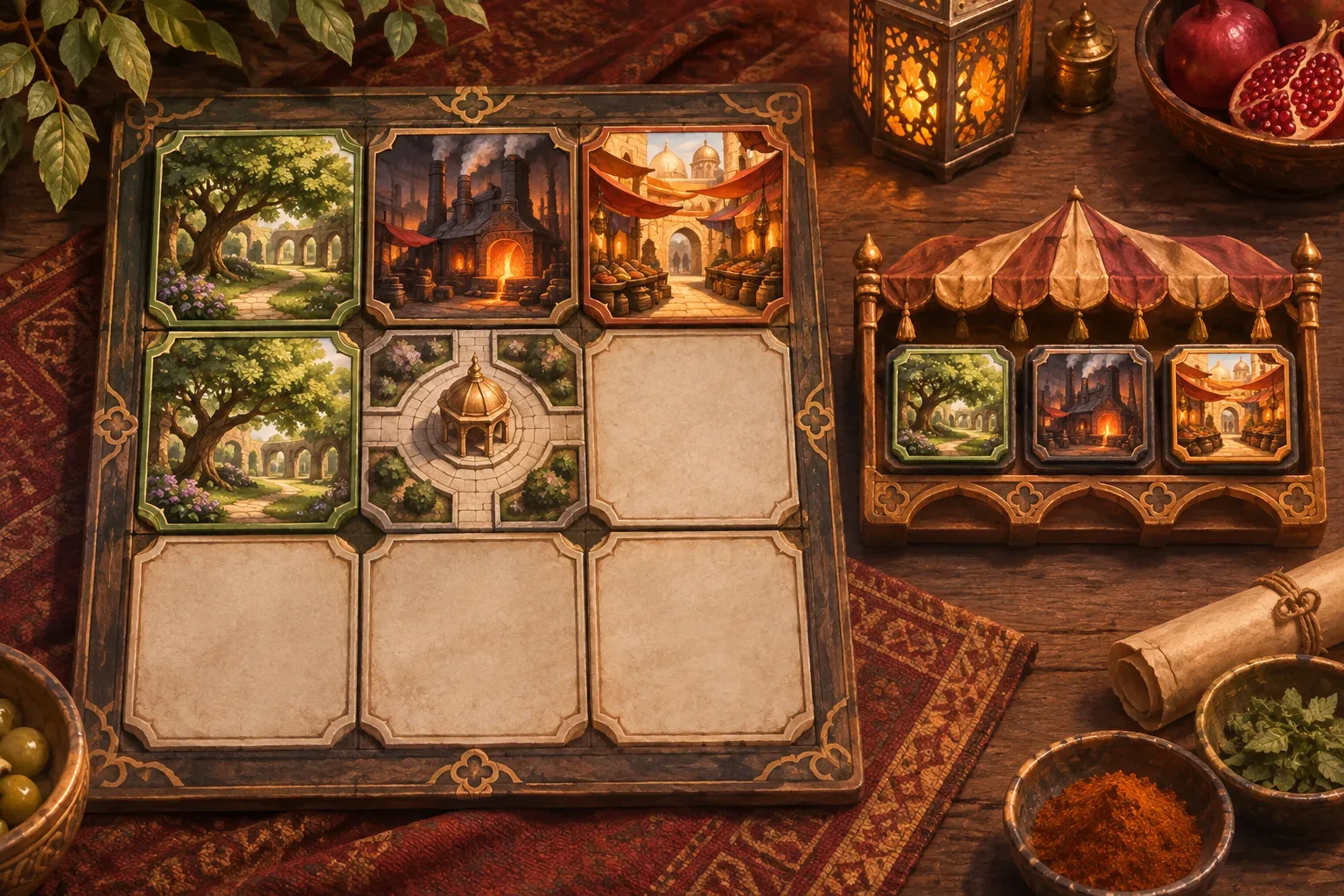
For a manual revision, change one value only: raise Grove–Bazaar from two points to four. Keep the market, choices, cells, turn order and every other value unchanged. Replay the same trace and the total becomes 0 + 2 + 4 + 0 = 6, meeting the target. This paper adjustment shows how a prompt can ask for one focused rules change; it is not a playtest and does not show that the new value is more fun.
In a later build, a creator could compare whether different market choices create multiple ways to meet the objective. The current example is deliberately small enough to calculate by hand. The useful result is a reproducible rule contract, not a claim that Cinder Market is already balanced.
Write the six prompts in sequence
Use separate prompts for scope, supply, placement, scoring, a worked trace and future checks. These drafts preserve the same Cinder Market rules used in the article and have not been run.
Prompt 1 — scope the game
Create a deterministic solo tile-drafting strategy puzzle called Cinder Market. The player places four tiles on a 3×3 board around a fixed non-scoring Hub. The goal is to earn at least 6 adjacency points by the end of turn four. Do not add route building, ports, rotations, opponents, resources, random draws or extra turns.Prompt 2 — define the visible market
Show three tile types: Foundry (F), Grove (G), Bazaar (B). Start the shared three-slot market as [F,G,B] and use a fixed refill queue [F,G,B,F]. Each turn choose one tile from any slot, place it, then replace that slot with the next queue item. Track remaining queue order.Prompt 3 — set up the board and legal placement
Use a 3×3 grid with Hub at center (1,1). Place exactly one drafted tile per turn into an empty cell that shares an edge with any occupied cell. Tiles cannot overlap or leave the board. Diagonal contact does not make a placement legal unless it also touches an occupied cell by an edge. Restart clears placed tiles and restores the initial market and queue.Prompt 4 — resolve scored pairs
When a tile is placed, compare it with each orthogonally adjacent drafted tile. Score each new pair once: Foundry–Grove +2, Grove–Bazaar +2, Bazaar–Foundry +1. Same-type pairs and pairs touching Hub score 0. Do not score diagonal pairs or old pairs again. Add the turn's points to total. There are exactly four turns; meet the objective at 6 points or more.Prompt 5 — trace and revise one value
Start with Hub (1,1). Turn 1 choose Grove from slot 2 and place (0,1): 0; refill slot 2 with Foundry. Turn 2 choose Foundry from slot 1 and place (0,0): Grove–Foundry +2; refill slot 1 with Grove. Turn 3 choose Bazaar from slot 3 and place (0,2): Grove–Bazaar +2; refill slot 3 with Bazaar. Turn 4 choose Foundry from slot 2 and place (1,0): same-type only, +0. Final 4, below goal. For a paper revision, change only Grove–Bazaar to +4 and replay the same trace: total 6, meeting the goal. Label this hand calculation, not playtest evidence.Prompt 6 — prepare future checks
For a future playable build, log turn, market before choice, chosen slot/type, refill, cell, occupied neighbors, pair values and running score. Check legal adjacency, no overlap, diagonal exclusion, pair counted once, queue order, four-turn limit, 6-point objective and Restart. Do not claim a check passed before inspecting a real build.For general workflow context, SEELE describes using plain-English prompts to create a playable first version, test it in a browser and refine it with follow-up prompts. Its official page does not verify Cinder Market or its tile scoring. See Free AI game maker for the general workflow.
Prepare future build checks
If a real version exists later, record each market, pick, cell and neighbor calculation. Inspect legality and scoring independently; a tile can be correctly drafted but placed illegally, or placed legally while its pair score is wrong.
| Future check | Expected rule | Evidence to capture |
|---|---|---|
| Market refill | Only the chosen slot is replaced from the fixed queue | Market before/after and queue head |
| Placement legality | Cell is empty, on grid and edge-adjacent | Coordinates and occupied neighbors |
| Pair scoring | Only new orthogonal pairs score once | Neighbor types and point subtotal |
| Goal timing | Check score after four placements | Four turn totals and final threshold |
| Restart | Restore Hub, market, queue and zero score | Before/after state |
These are checks for a future playable build. Until those observations are collected, describe the prompt sequence and arithmetic as a design draft. A written trace helps define what to inspect, but it cannot establish that a tool implemented the specification.
Frequently asked questions
What should a tile-drafting game prompt define?
Define the visible market, refill order, legal board cells, adjacency rules, scoring pairs and turn limit.
How is Cinder Market different from a route-building tile game?
It scores each new orthogonal tile pair by type. There are no ports, continuous paths, route terminals or path-length bonuses.
Why use a fixed market refill queue?
A fixed queue makes the example reproducible, so a reader can compare tile choices without random draw outcomes.
Can diagonal tiles score in this example?
No. Only orthogonally adjacent pairs score, and each new pair is counted once when the tile is placed.
Were these tile-drafting prompts tested in a playable game?
No. Cinder Market and its score trace are fictional design material. The prompts are unrun and no playable result or observed test is included.