Introduction
An inventory-management roguelike needs clear rules for what fits, what combines and what a player gives up by carrying one item instead of another. If the grid is decorative, there is no spatial decision. If synergies are hidden, players cannot learn why a build changed. A small prompt sequence can define one run and make its item choices reviewable.
This guide uses Mosslight Run, a fictional expedition through a short woodland route. Its items, grid size, combinations and run outcome are invented and untested. The scenario is a design example, not a generated or playtested game.
Define the run and its inventory loop
Start with a short loop: choose an item, place it, see how it changes the build, then decide whether to continue to the next room or return. State the grid shape, how items occupy cells and what happens when an item does not fit. Keep the first version to one route and a small set of item types.
Prompt 1 — core run brief
Design an original inventory-management roguelike called Mosslight Run. The player carries a compact grid pack through a short woodland expedition. Define the run objective, room sequence, item acquisition, spatial placement, synergy feedback, discard or return choice and end condition. Use original fictional items. Keep the first milestone to one short run and label all values untested.
A useful brief explains what persists between rooms and what resets after a run. If the player can discard or rearrange items, state when those actions are allowed and whether they cost anything. Avoid an item economy or long meta-progression until one run makes sense.
Specify grid placement and fit rules
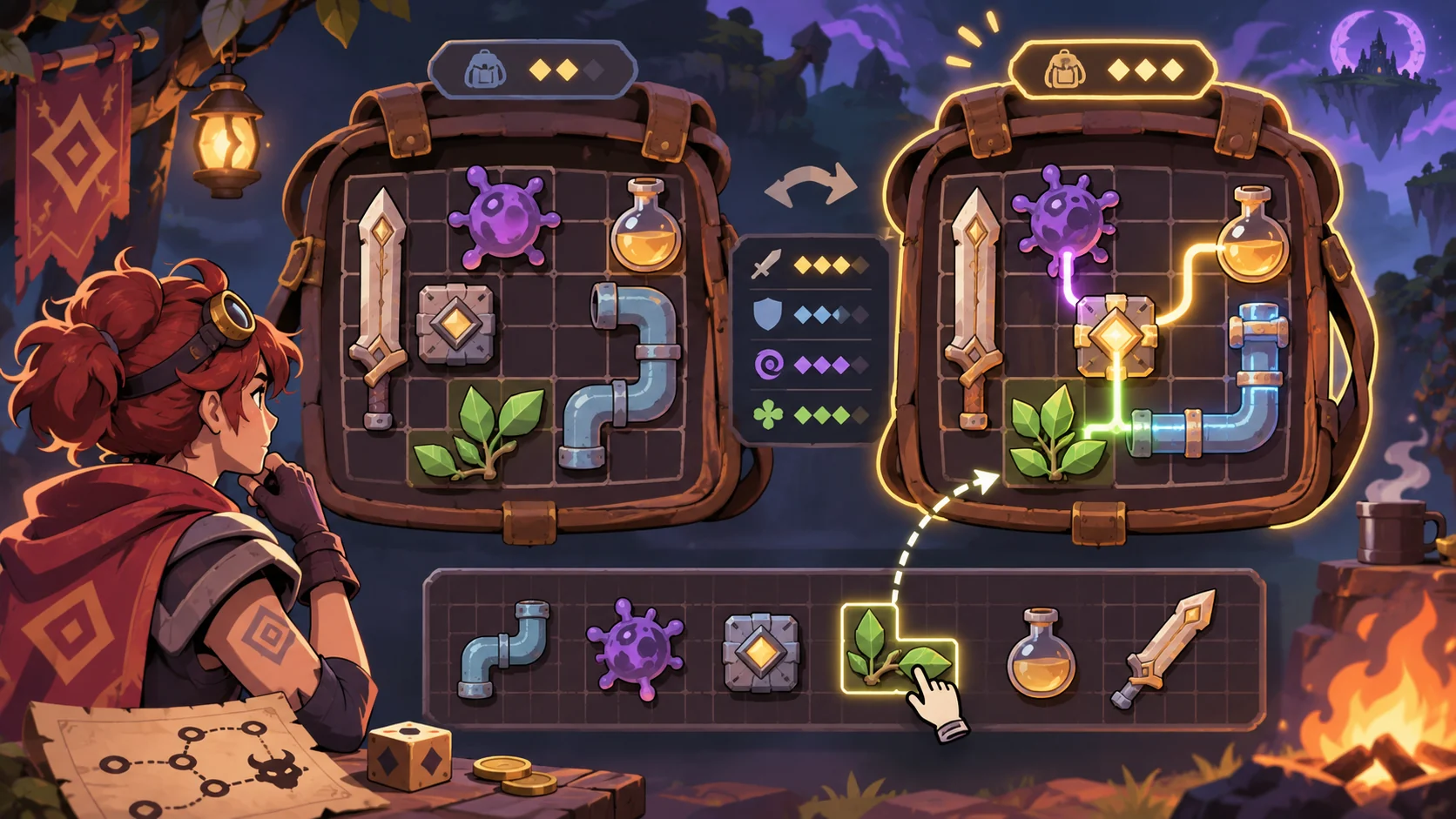
Describe the inventory grid, item shapes, rotation rules and what happens when space is limited. Tell the builder how to preview a placement before it becomes final. Make illegal placements visible and explain why they are blocked. The rules should work for different item shapes without relying on hidden exceptions.
Prompt 2 — grid and placement rules
Define a small rectangular inventory grid for Mosslight Run. Create a few original items with different cell shapes. State whether an item can rotate, whether occupied cells can be swapped, when a player may discard an item and what happens if no item fits. Show a preview before confirmation and explain an invalid placement. Treat grid size and item shapes as placeholders.
| Placement case | Rule to define | Feedback |
|---|---|---|
| Item fits | All occupied cells are open | Preview shows occupied cells |
| Item overlaps | One or more cells are taken | Invalid cells are highlighted |
| Item is too large | Shape exceeds the pack grid | Explain the conflict before discard |
| Item rotates | Rotation is allowed or disabled | Preview updates before commit |
| Pack is full | Player chooses swap, discard or decline | Show both items and the consequence |
Make item synergies visible
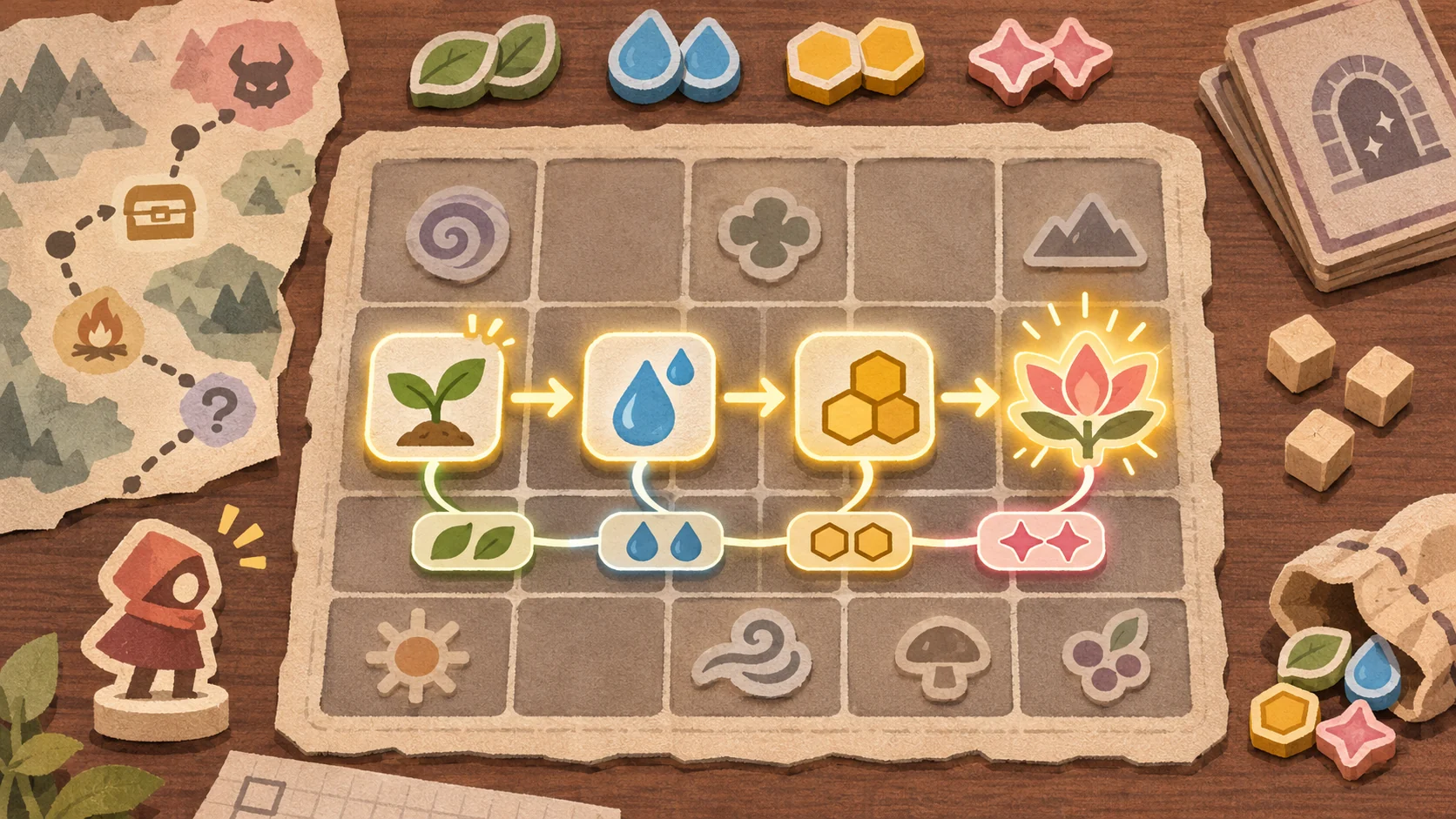
A synergy should have a trigger and a result the player can inspect. Specify whether adjacency, shared row, item category or a sequence matters. Show which items connect and what changes. Do not rely on players noticing a hidden bonus after several rooms.
Prompt 3 — synergy rules
Create four original Mosslight Run items and two simple adjacency synergies. For each synergy, name the trigger, cells or item categories involved, effect and visible feedback. Show a before-and-after pack state when the effect activates. Do not copy items from existing games. Label numerical effects as untested prototype values.
For example, a fictional “Seed Satchel” beside a “Rain Charm” might add one abstract growth token after a room. This is an untested design sketch. The prototype should show which two items caused the effect, when it triggers and whether the token persists.
Connect items to route choices
Inventory pressure becomes meaningful when it affects a decision outside the pack. A route might offer a new item, a safe rearrangement point or a return option. State what the player knows before choosing and what is lost or preserved. Keep run stakes clear enough that a player can decide whether to press on.
Prompt 4 — route and run state
Define a short three-room Mosslight Run route. Each room offers one visible item or a choice to continue without it. Include one rearrangement point and one return option. State what items and synergy effects persist, what resets after retreat and how the player sees the next-room risk before committing. Keep all content fictional and non-instructional.
Request one playable slice
A first build can demonstrate a pack grid, item placement preview, two synergies, one route choice, a full-pack decision, a run summary and reset. Leave out dozens of items, procedural balancing, online rankings and a large unlock tree. One short run is enough to reveal whether placement choices are understandable.
Prompt 5 — prototype build
Build a first playable Mosslight Run prototype with one short route, a compact grid pack, four original items, two adjacency synergies, placement preview, full-pack choice, one rearrangement point, retreat, run summary and reset. Show why a placement is invalid and which items trigger a synergy. Use placeholder art and untested values. At handoff, list working interactions, placeholders and what remains unverified; do not call a static inventory mockup playable.
Open the actual output and check item pickup, fit, rotation if included, discard, synergy feedback, route choice, retreat and reset. An illustration of a packed bag does not prove those interactions work. No prototype was generated for this example.
Fictional run snapshot
This snapshot is hypothetical and is not evidence of a balanced build.
| Field | Fictional planning value |
|---|---|
| Working title | Mosslight Run |
| Pack | Small rectangular grid with a few differently shaped items |
| Synergy | Seed Satchel next to Rain Charm adds an abstract token |
| Route | Three rooms with optional item choices |
| Recovery | Rearrange at one rest point or return with current discoveries |
| First milestone | One short run, two synergies, summary and reset |
| Excluded | Large item catalog, online rankings and unlock economy |
Review the actual output
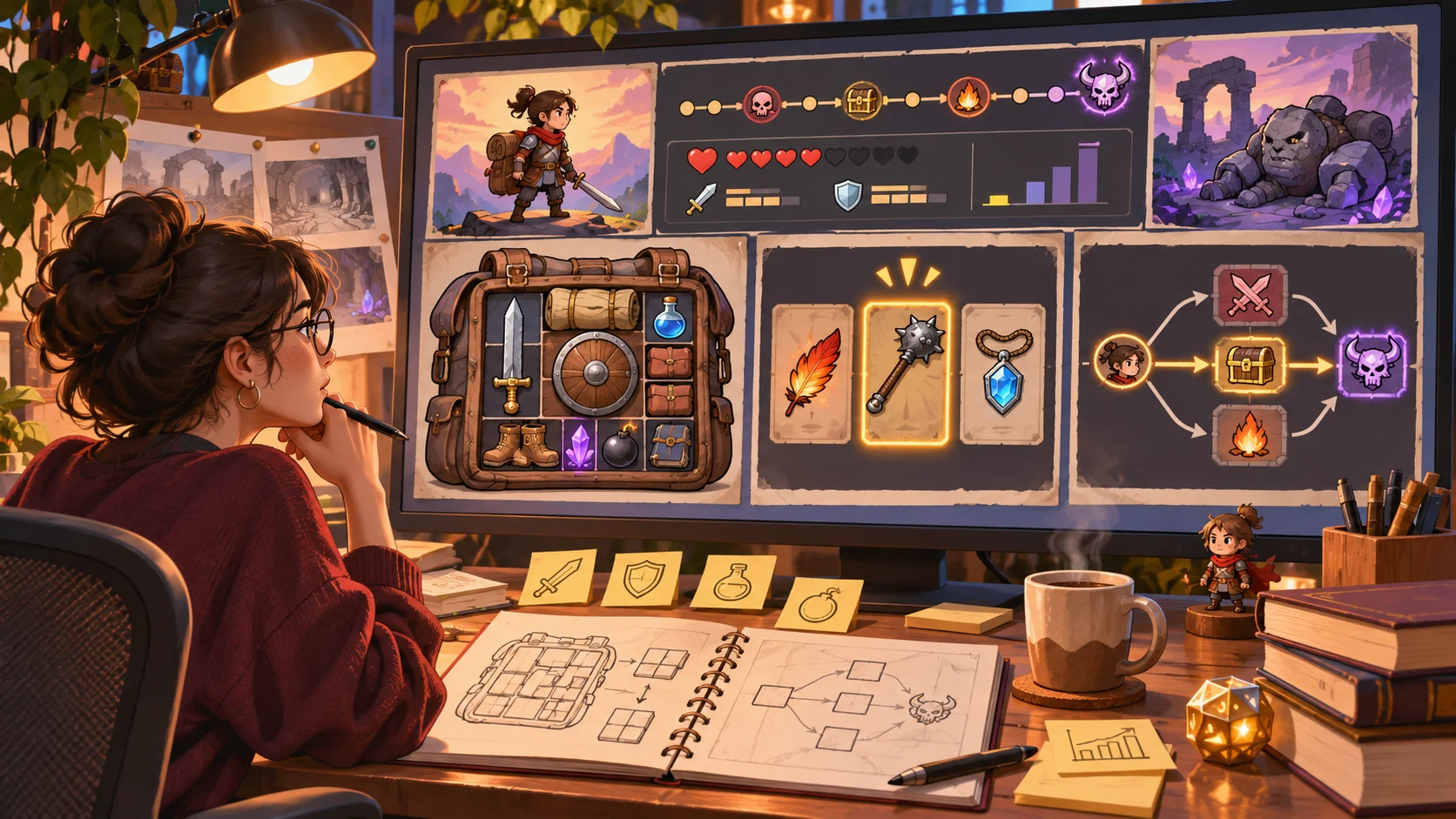
Record what the running prototype does, not what the prompt requested. Check whether the interface prevents invalid placement, whether a synergy appears for the stated reason and whether the run summary matches the final pack. If a rule is unclear, mark it unclear and ask for the smallest correction.
Prompt 6 — implementation review
Review the running Mosslight Run prototype for grid bounds, item shape, placement preview, invalid placement feedback, discard/swap, synergy trigger and result, route decision, retreat, run summary and reset. Mark each present, missing or unclear based only on observed interactions. Quote evidence and suggest one focused fix. Do not claim balance or playtesting unless performed.
Conclusion
Inventory-management roguelike prompts should make grid fit, item placement, synergies and route consequences visible in one short run. Mosslight Run is a fictional example with untested values. Ask for a narrow prototype, verify its item interactions and label mockups honestly.
You can take a defined concept into the Free AI game maker, then use the checklist above to review it.
FAQ
What should AI prompts for an inventory-management roguelike include?
Define grid size, item shapes, rotation, placement preview, discard rules, synergies, route choices, persistence and the first-run scope.
How do I make inventory placement meaningful?
Make item shape or position affect a visible choice, such as a synergy, a blocked slot or which item the player must leave behind.
How should item synergies be explained?
State the trigger, items involved, timing and result, then show which pieces caused the effect when it activates.
What happens when the inventory grid is full?
Choose an explicit rule such as swap, discard, decline or rearrange, and show the consequence before the player confirms.
Does an inventory mockup prove a roguelike is playable?
No. Verify placement, invalid states, synergy changes, route decisions and run ending in the actual output before making that claim.