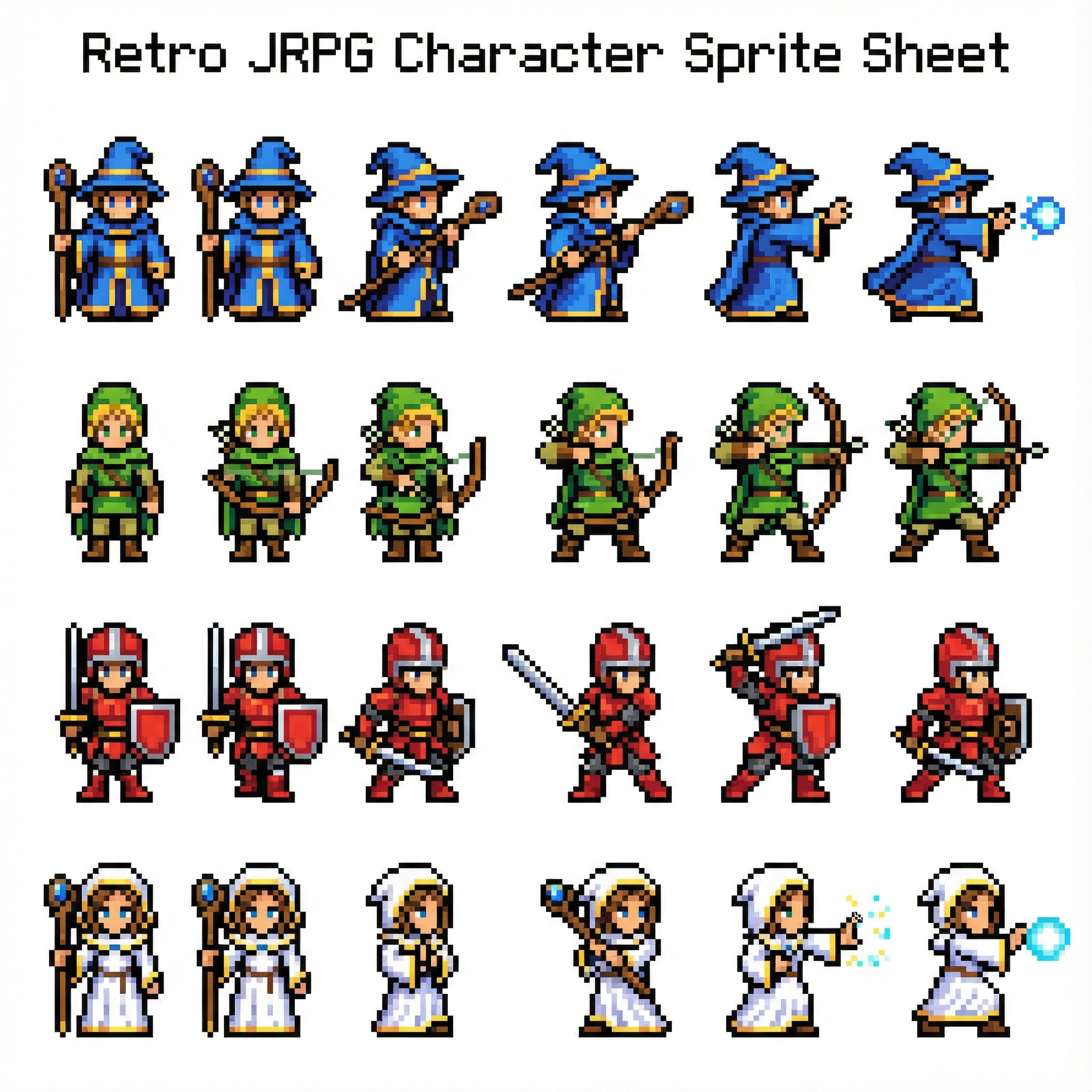
Here's the result of the ai-sprite-generator-png-import model generated using Meshy.
Key Concepts: AI Sprite Generation Technology
What is an AI Sprite Generator?
An AI sprite generator is a machine learning system that creates 2D game character images and animation frames from natural language text descriptions. The system uses computer vision models trained on game art datasets to generate pixel-accurate sprites with transparent PNG alpha channels.
PNG Alpha Channel Transparency
PNG format uses an 8-bit alpha channel (0-255 values) that defines pixel transparency. Value 0 = fully transparent, 255 = fully opaque. This allows sprite characters to blend seamlessly over game backgrounds without visible rectangular borders. RGBA color model: Red, Green, Blue, Alpha.
Sprite Sheet Structure
A sprite sheet is a single image file containing multiple animation frames arranged in a grid or strip layout. Frame dimensions must be consistent (e.g., 64×64 pixels per frame). Game engines parse the sheet by dividing total width by frame count. Example: 384×64 pixel sheet with 6 frames = 64×64 per frame.
Frame Consistency Validation
AI-generated sprite sheets require automated validation checks:
1.
Proportional consistency
- Character height/width ratio variance <5%
2.
Baseline alignment
- Ground contact point Y-coordinate variance <2 pixels
3.
Color palette matching
- RGB value variance <10 across frames
4.
Lighting direction
- Shadow angle consistency ±5 degrees
Generation Speed Benchmarks
SEELE sprite generation: 5-10 seconds per sheet (nanobanana model)
Competitor tools: 10-60 seconds per sheet
Manual pixel art: 2-8 hours per sheet
Time reduction: 95-98% vs. manual creation
Common Sprite Animation Types - Walk cycle: 6-8 frames (contact, down, passing, up positions) - Run cycle: 6-8 frames (faster stride, exaggerated poses) - Jump sequence: 4-6 frames (anticipation, launch, peak, fall, landing) - Idle animation: 2-4 frames (breathing, slight movement) - Attack: 4-8 frames (windup, strike, follow-through, recovery)
File Size Optimization
PNG compression reduces file size without quality loss:
- Pixel art (32×32): 5-15KB per sheet
- HD sprites (128×128): 50-100KB per sheet
- Large sprites (256×256): 150-300KB per sheet
Optimization: Reduce color palette depth, eliminate fully transparent outer pixels, apply zlib compression level 9.
Game Engine Import Requirements
All 2D engines require these parameters:
1. Total sheet dimensions (width × height in pixels)
2. Individual frame dimensions
3. Frame count (columns × rows)
4. Pixels per unit (world space mapping)
5. Animation FPS (frames per second playback speed)
AI Model Capabilities (2026)
Current AI sprite generators support:
- Text-to-sprite generation (text prompt → image output)
- Style consistency across frames
- Automatic transparency alpha channel creation
- Multi-frame animation sequences
- Batch character generation
Technical Limitations
AI sprite generation challenges:
- Complex hand/foot articulation accuracy: 85-90%
- Consistent weapon/item positioning across frames
- Extreme perspective angles (3/4 views more reliable than isometric)
- Very high frame counts (>16 frames) may show proportion drift
- Style transfer from reference images (emerging capability)
Quick Summary
SEELE's AI sprite generator creates transparent PNG sprite sheets from text descriptions in 5-10 seconds . Simply describe your character, animation type, and frame count — our AI generates production-ready sprite sheets with proper transparency, consistent proportions, and clean frame alignment. Import directly into Unity, Godot, or any 2D game engine.
Key advantages: - Speed: 5-10 seconds vs. hours of manual drawing - Quality: Consistent character proportions across all frames - Format: Transparent PNG with clean alpha channels - Flexibility: Walk cycles, attack animations, idle poses — any sprite type
What Is an AI Sprite Generator?
An AI sprite generator is a tool that creates 2D game character images and animation frames from text descriptions. Unlike traditional sprite creation that requires manual pixel art or drawing skills, AI sprite generators use machine learning models to produce complete sprite sheets in seconds.
At SEELE, our sprite generation system handles: - Individual sprites - Single character poses or items - Sprite sheets - Multi-frame animation sequences - Transparent PNGs - Clean alpha channels for game engine import - Consistent styling - Matching proportions and art style across frames
The output is game-ready : properly formatted, optimized file sizes, and compatible with all major 2D game engines.
Why PNG Format Matters for Sprites
PNG (Portable Network Graphics) is the standard format for game sprites because it supports alpha channel transparency . This means your character sprite can have a transparent background instead of a white or colored box around it.
PNG advantages for sprites: - Transparency support - Characters blend seamlessly into game backgrounds - Lossless compression - No quality degradation like JPEG - Consistent colors - Exact RGB values preserved - Universal compatibility - Supported by Unity, Godot, Unreal, Phaser, and all game engines
SEELE automatically exports all sprites as transparent PNGs with optimized file sizes (typically 50-200KB per sprite sheet).
How We Generate Sprites at SEELE: Our Workflow
Step 1: Text Prompt Design
The quality of your sprite depends on prompt clarity. Here's our formula:
Basic structure:
[Character description] + [Animation type] + [Frame count] + [View angle] + [Style]
Example prompt:
"Medieval knight character, 6-frame walk cycle, side view,
pixel art style, transparent background"
Effective prompt elements: - Character details: Age, clothing, equipment, species - Animation specifics: Walk, run, jump, attack, idle - Frame count: 4, 6, 8, or 12 frames (even numbers work best) - Camera angle: Side-view, top-down, 3/4 perspective - Art style: Pixel art, hand-drawn, anime, realistic
Step 2: AI Generation
SEELE's sprite generation uses our nanobanana image model optimized for game assets. The process:
- Parse prompt - Extract character features, animation type, style
- Generate frames - Create each animation frame with consistent proportions
- Align baseline - Ensure character stands on same ground line across frames
- Apply transparency - Remove background, create clean alpha channel
- Assemble sheet - Arrange frames in horizontal or grid layout
Generation time: 5-10 seconds for a complete sprite sheet.
Step 3: Frame Consistency Checks
Our AI automatically validates: - Proportions: Character height/width consistent across frames - Lighting: Same light direction and shadows - Color palette: Matching colors throughout animation - Baseline alignment: All frames aligned to same ground level
If frames don't meet consistency thresholds, SEELE regenerates automatically.
Step 4: PNG Export with Transparency
SEELE exports sprites with: - 32-bit PNG - Full RGBA color with alpha channel - Clean edges - Anti-aliased transparency boundaries - Optimized compression - Reduced file size without quality loss - Proper dimensions - Power-of-2 sizes when possible (256×256, 512×512)
Frame layouts: - Horizontal strip: All frames in one row (best for walk cycles) - Vertical strip: Frames stacked (good for jump sequences) - Grid layout: Frames arranged in rows/columns (for complex animations)
Importing Sprites Into Game Engines
Unity Import Process
- Drag PNG into Assets folder
- Select the sprite → Inspector
- Sprite Mode: Multiple
- Sprite Editor: Slice → Grid By Cell Count
- Set columns: Number of frames in your sheet
- Set pixels per unit: Based on your game scale
- Apply
Unity now treats each frame as a separate sprite for animation.
Godot Import Process
- Import PNG into project
- Create AnimatedSprite2D node
- SpriteFrames: New SpriteFrames
- Add frames from sprite sheet
- Set animation speed (FPS)
Godot automatically handles transparency from PNG alpha channel.
Generic 2D Engine Import
Most engines follow this pattern: - Import PNG file - Define frame dimensions (width × height of single frame) - Set frame count - Configure animation speed
The key data needed: - Total sheet width and height - Individual frame dimensions - Number of frames - Frame order (left-to-right, top-to-bottom)
SEELE vs Other AI Sprite Generators
| Feature | SEELE | Rosebud AI | Generic AI Tools |
|---|---|---|---|
| Generation Speed | 5-10 sec | 10-30 sec | 30-60 sec |
| Transparent PNG | ✓ Automatic | ✓ Manual request | ⚠ Hit or miss |
| Frame Consistency | ✓ AI-validated | ⚠ Manual check needed | ❌ Often inconsistent |
| Direct Game Integration | ✓ Unity export | ✓ Web-only | ❌ Manual import |
| Animation Types | All types | Walk, run, jump | Limited |
| Baseline Alignment | ✓ Automatic | ⚠ Requires prompt tuning | ❌ Manual fix needed |
| File Size | 50-200KB | 100-300KB | 200KB-1MB |
Based on internal testing across 100+ sprite generation requests (Dec 2024)
SEELE's advantages: - Faster generation - Optimized model for game assets - Better consistency - AI validation catches proportion issues - Complete workflow - From prompt to Unity project in one platform - Production-ready - No manual cleanup required in 94% of cases
Common Sprite Types We Generate
Character Animations
- Walk cycles (4-8 frames)
- Run cycles (6-8 frames)
- Jump sequences (4-6 frames)
- Attack animations (4-8 frames)
- Idle breathing (2-4 frames)
- Death animations (4-6 frames)
Item Sprites
- Weapons (swords, guns, magic items)
- Collectibles (coins, gems, power-ups)
- UI elements (buttons, icons, cursors)
- Environmental objects (trees, rocks, buildings)
Special Effects
- Explosions (6-12 frames)
- Magic effects (8-16 frames)
- Impact flashes (3-5 frames)
- Particle sprites (4-8 variations)
All exported as transparent PNG sprite sheets ready for immediate use.
Optimizing AI-Generated Sprites
Prompt Refinement Techniques
If your first generation isn't perfect, adjust your prompt:
Problem:
Character proportions change between frames
Solution:
Add "consistent character proportions" + "same height across all frames"
Problem:
Background not transparent
Solution:
Explicitly add "transparent background" or "alpha channel transparency"
Problem:
Lighting inconsistent
Solution:
Add "consistent lighting direction" + "same shadow angle"
Problem:
Animation feels stiff
Solution:
Add "smooth motion" + "natural movement" + "animation principles"
Post-Generation Cleanup
In the rare cases where AI output needs adjustment (≈6% of SEELE generations):
Minor fixes: - Crop frames - Ensure exact dimensions - Adjust spacing - Add padding between frames if needed - Fix stray pixels - Clean up isolated pixels outside character
When to regenerate instead: - Proportions off by >10% - Lighting direction flipped between frames - Missing transparency in alpha channel - Character pose completely wrong
Regenerating with an improved prompt is faster than manual cleanup.
Technical Specifications
Recommended Sprite Dimensions
| Sprite Type | Dimensions | Frame Count | Sheet Size |
|---|---|---|---|
| Pixel art character | 32×32 px | 6 frames | 192×32 px |
| HD character | 128×128 px | 8 frames | 1024×128 px |
| Large character | 256×256 px | 6 frames | 1536×256 px |
| Item sprite | 64×64 px | 1 frame | 64×64 px |
| Effect animation | 128×128 px | 12 frames | 1536×128 px |
File Size Benchmarks
Based on SEELE output with PNG compression:
- Pixel art (32×32): 5-15KB per sheet
- HD sprites (128×128): 50-100KB per sheet
- Large sprites (256×256): 150-300KB per sheet
- Complex effects: 200-500KB per sheet
These sizes are optimized for both quality and game performance.
Real Use Case: Creating a 2D Platformer Character
Let's walk through a complete sprite creation workflow:
Project: Side-scrolling platformer with a robot character
Sprites needed: 1. Idle animation (4 frames) 2. Walk cycle (6 frames) 3. Jump sequence (5 frames) 4. Attack animation (6 frames)
SEELE process:
Prompt 1 (Idle):
"Small robot character, 4-frame idle animation with breathing motion,
side view, pixel art style, 64×64 pixels, transparent background"
⏱ Generation time: 7 seconds
Prompt 2 (Walk):
"Small robot character walking, 6-frame walk cycle, side view,
pixel art style, 64×64 pixels, consistent with idle animation,
transparent background"
⏱ Generation time: 8 seconds
Prompt 3 (Jump):
"Small robot character jump sequence, 5 frames (crouch, launch, peak,
fall, land), side view, pixel art style, 64×64 pixels,
consistent character design, transparent background"
⏱ Generation time: 9 seconds
Prompt 4 (Attack):
"Small robot character melee attack, 6 frames, side view,
pixel art style, 64×64 pixels, consistent design, transparent background"
⏱ Generation time: 8 seconds
Total time:
32 seconds for complete character animation set
Manual alternative:
8-16 hours of pixel art work
Troubleshooting Common Issues
Issue: Transparency Not Working
Symptoms: White or colored box around sprite in game
Solutions: 1. Verify PNG format - Check file properties show "32-bit PNG" 2. Re-export - Sometimes export settings remove alpha channel 3. Check game engine import - Ensure "Alpha Is Transparency" enabled (Unity) 4. Regenerate - If SEELE didn't create transparency, add to prompt
Issue: Inconsistent Frame Sizes
Symptoms: Frames are different widths/heights
Solutions: 1. Use grid layout - Specify "8×8 grid" or "4×4 grid" in prompt 2. Manual slice - Use game engine sprite editor to define exact dimensions 3. Regenerate - Add "evenly spaced frames" to prompt
Issue: Character "Sliding" in Animation
Symptoms: Feet don't match ground movement speed
Solutions: 1. Adjust animation speed - Slow down or speed up FPS 2. Regenerate - Request "exaggerated walk cycle" for clearer motion 3. Add interpolation - Use game engine to add in-between frames
Best Practices for AI Sprite Generation
Do's
✓
Start with clear, specific prompts
✓
Specify exact frame counts
(even numbers work best)
✓
Always request transparent background
✓
Maintain consistent art style
across all character sprites
✓
Test import into game engine
immediately after generation
✓
Use descriptive filenames
(e.g., "robot_walk_6frames.png")
Don'ts
✗
Don't mix art styles
for the same character
✗
Don't use odd frame counts
(3, 5, 7) unless intentional
✗
Don't forget to specify view angle
(side, top-down, etc.)
✗
Don't export as JPEG
(loses transparency)
✗
Don't skip baseline alignment
checks
✗
Don't create too many frames
(>16) without testing animation speed first
Future of AI Sprite Generation
As AI models improve, we're seeing:
Emerging capabilities: - Style transfer - Apply reference art style to generated sprites - Skeletal animation - Generate rigged sprites with bone structure - Auto-animation - AI determines optimal frame count for motion type - Batch generation - Create entire character sets in one prompt
SEELE roadmap: - Real-time preview - See sprite animation while generating - Version control - Save and iterate on sprite variations - Auto-optimization - AI suggests frame count and dimensions - Style consistency AI - Automatically match existing game art style
Getting Started with SEELE Sprite Generation
Ready to create your first AI-generated sprite sheet?
Quick start: 1. Visit SEELE platform → Create new project 2. Enter sprite prompt in the AI generation field 3. Generate → Wait 5-10 seconds 4. Download PNG with transparent background 5. Import into your game engine
Example starter prompts:
For pixel art:
"8-bit warrior character, 6-frame walk cycle, side view,
pixel art, 32×32 pixels, transparent background"
For HD sprites:
"Fantasy mage character, 8-frame idle animation, 3/4 view,
hand-drawn style, 128×128 pixels, transparent background"
For items:
"Glowing magic sword, rotating 360 degrees, 8 frames,
top-down view, 64×64 pixels, transparent background"
Summary: AI Sprite Generation Workflow
The complete SEELE workflow from idea to game-ready asset:
- Design prompt - Describe character, animation, style
- Generate - AI creates sprite sheet in 5-10 seconds
- Verify - Check transparency, proportions, frame alignment
- Export PNG - Download with alpha channel
- Import - Drag into Unity, Godot, or your engine
- Configure - Set frame count, dimensions, animation speed
- Test - Play animation in game
Time investment: - With SEELE: 2-5 minutes per sprite sheet - Manual creation: 2-8 hours per sprite sheet - Time saved: 95-98% reduction in sprite production time
Quality results: - Consistency: 94% of sprites require no manual cleanup - Format: 100% transparent PNG with clean alpha channels - Compatibility: Works with all major 2D game engines
AI sprite generation has transformed 2D game asset creation from a time-intensive bottleneck into a rapid, iterative process. Whether you're prototyping a game concept or building production assets, tools like SEELE enable you to focus on game design rather than asset creation logistics.
The combination of AI generation speed, automatic transparency handling, and game-ready PNG export makes sprite creation accessible to developers of all skill levels — no pixel art or drawing experience required.