Map the property operating baseline
List the property’s work inputs, daily services, tenant needs, costs, and current revenue before adding a production-to-sales mechanic. A building may not make goods, but its services produce an operating outcome. Define the unit of output the player can understand, such as occupancy, lease quality, or reliable amenities.

Separate recurring operations from one-time investment. A repair resolves a backlog; a new service may attract tenants over time; an expansion changes capacity and cost. Show these effects across a clear time period so players can compare a stable property with one that is still being improved.
The official Family Office Simulator listing describes acquiring commercial properties, managing occupancy, rent, expenses, debt, and cash flow, and deciding when to sell. It is an Early Access listing; this supports the property-management context only. See the official source for this context.
Connect services to property output
Connect operating inputs to a tenant-facing result. Maintenance staff reduce downtime, shared amenities influence demand, and leasing activity fills available units. Explain the relationship through a building report or district view, rather than hiding it inside a single property score.
Give services distinct constraints. A pool may raise operating costs; a repair team has limited weekly capacity; a tenant improvement may require vacant space. Make these limits part of the planning choice and let players compare the cost with expected occupancy or service gains.
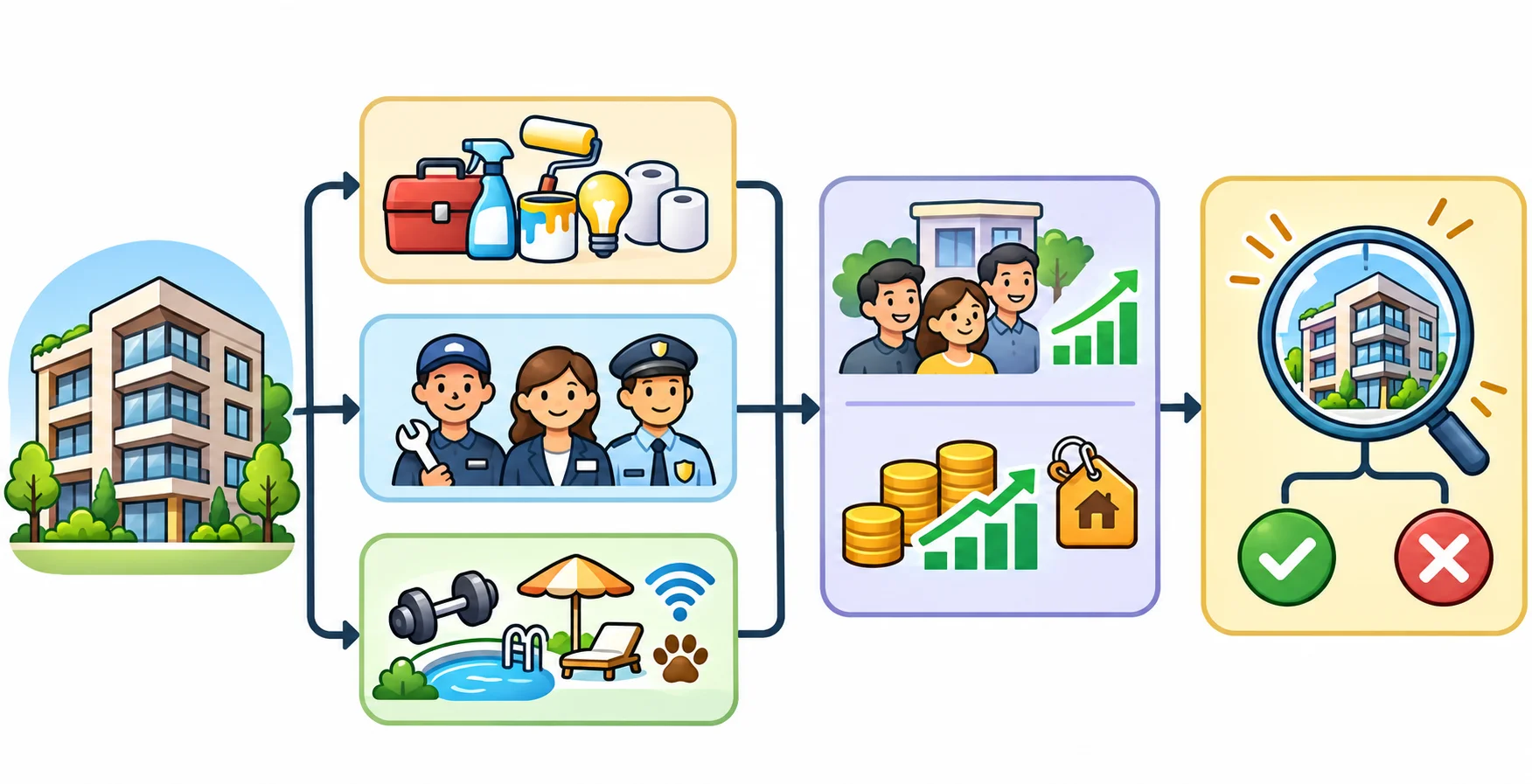
Use time windows to connect work with results. A repair may resolve immediately, while reputation or tenant demand changes over several periods. Forecasts can show likely effects, but label uncertain projections and update them when costs, vacancy, or market conditions shift.
Make sales timing an informed decision
Present a sale as one option in the operating loop. Show current income, ongoing costs, vacancy risk, maintenance needs, debt obligations, and a plausible offer range. Players can then decide whether to hold, improve, refinance, or sell based on a readable comparison.
Avoid rewarding every sale with a larger number. A high offer may arrive when repair costs are climbing; a tenant renewal might favor holding. Reveal the assumptions behind valuation, such as occupancy or recent service quality, so decisions feel connected to management rather than a random price roll.
Make capital available for another plan after a sale, but preserve tradeoffs. New funds can support another property or service investment, while selling also removes future income and may affect a portfolio goal. The design should support multiple viable strategies instead of one optimal sell date.
Test cash flow and tenant outcomes
Compare properties with different investment histories over the same number of operating periods. Record cash flow, occupancy, service requests, maintenance backlog, and sale offers. Ask players to predict the effect of a planned improvement before they commit resources.
Test a vacancy, a late repair, a cost increase, and a change in tenant demand. The report should identify whether a weak result comes from capacity, service quality, pricing, or a larger market shift. Check that players have an option to stabilize the property before selling.
Accept the loop when operations change tenant outcomes, those outcomes affect cash flow and value, and selling creates a meaningful next choice. See the staff-role design guide for operating-capacity decisions.

FAQ
How do you build a production-to-sales loop for property management?
Map how operating inputs such as maintenance, staffing, and amenities affect tenant service and occupancy. Connect those outcomes to revenue, costs, and a sale decision. Make each step visible so players can explain how property operations change value. This gives players useful feedback and helps them plan a next action.
What counts as production in a property-management game?
Treat service delivery as production: maintenance work, tenant amenities, leasing, repairs, and building capacity all create an operating result. Choose measures that fit the game, such as occupied units, service quality, rent collected, or costs avoided. This gives players useful feedback and helps them plan a next action.
How can property operations affect a sale decision?
Compare expected future income and operating costs with a sale offer and the value of keeping the property. Show why tenant satisfaction, maintenance backlog, or vacancy changes the estimate. Players should understand what improved or weakened the asset before selling.
What should you test in a property sales loop?
Compare properties with different maintenance, occupancy, and service levels. Track costs, tenant outcomes, cash flow, and sale value. Test vacancies, repair delays, and changing demand so a player can identify the true constraint and recover. This gives players useful feedback and helps them plan a next action.