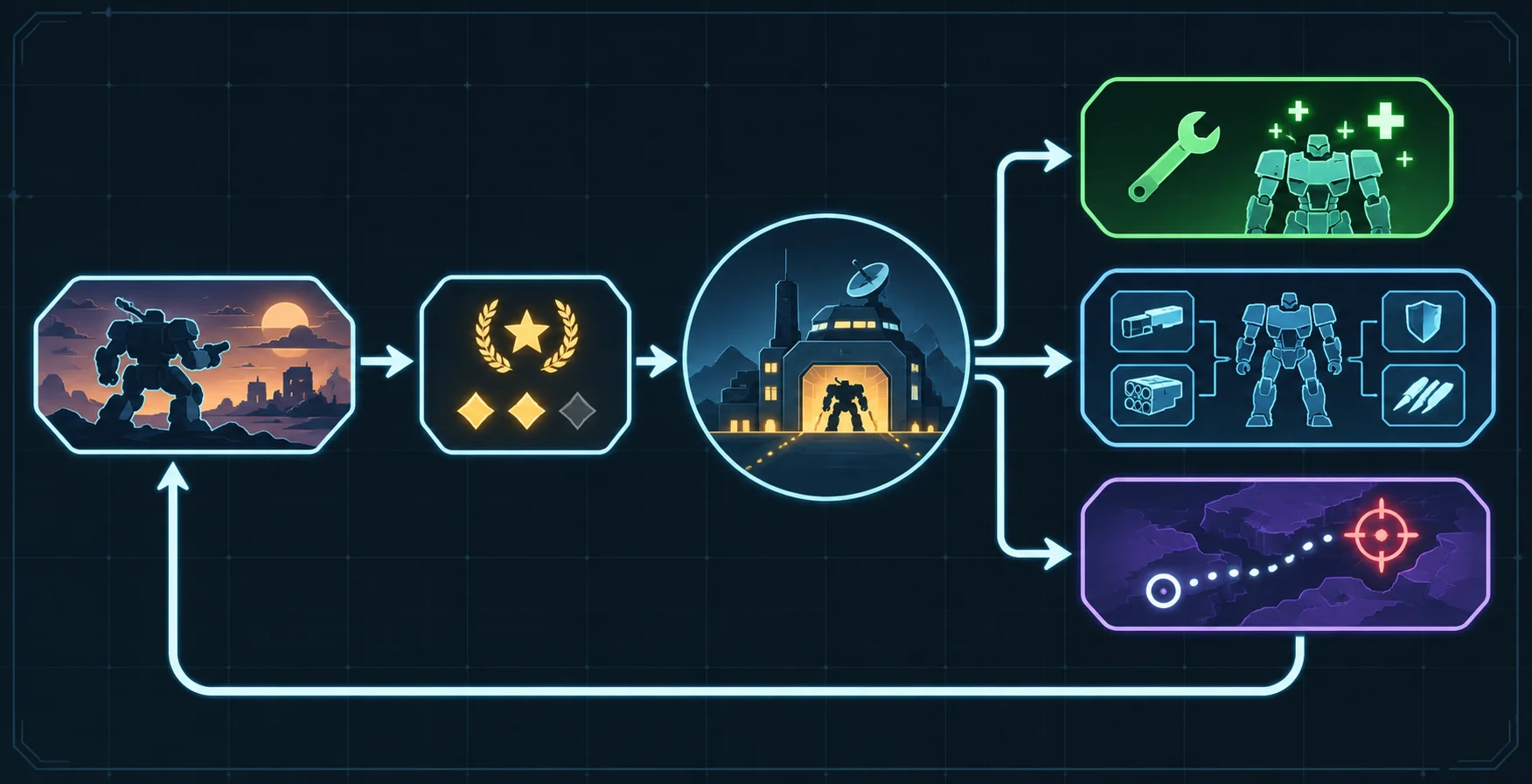
Connect mission briefings, mech configuration, deployment results, and hub changes into one legible campaign loop. Start with one bounded prototype, make its rules visible, and connect player choices to outcomes the team can observe. Expand the system only after the core loop works in a short repeatable test.
Map the mission and mech baseline
Write down the campaign loop from briefing to configuration, deployment, debrief, and the next objective. Decide which information belongs in the hub and what changes after a sortie: parts, repair state, funds, intelligence, or mission access. The official ARMORED CORE VI listing describes mission-based mech combat and modular parts that affect attacks, movement, and battle style; this supports context only, while this connected campaign design is original.

Give the hub a practical purpose that influences choices. A briefing can explain the operation, a workshop can make configuration changes, and a result board can show what the last mission changed. Keep these functions understandable and avoid turning every interaction into a separate screen or currency unless it creates a meaningful choice. See the ARMORED CORE VI official Steam product listing for the scoped genre context.
Give the hub a campaign purpose
Track a small set of campaign variables, each tied to visible consequences. Mission success might unlock a contract; optional objectives might reveal a route; damage might increase repair cost or change the available preparation budget. Present these effects in the debrief before the player chooses the next deployment.
Provide multiple viable loadout responses to a mission goal. If the objective suggests long-range mobility, explain why without requiring one exact part combination. Let players revise their build in the hub and see weight, energy, reach, and other relevant effects before confirming a sortie.
Connect mission results to the next deployment
Connect results to future options with a compact state transition: operation resolved, rewards and consequences applied, new information revealed, and next objective selected. Keep a campaign log so players can understand how an earlier decision led to a later mission. Offer a clear retry or recovery path if a loss reduces resources or closes an opportunity.
Use mission chains to vary the decision rather than repeat the same objective with larger numbers. A rescue, escort, interception, or extraction can test different configurations. Signal the core challenge in advance, then allow the field situation to complicate it in a way that still respects the briefing.
Test loadouts and campaign continuity
Prototype three linked sorties and test at least two mech configurations. Check that the hub communicates new options, the mission fits the briefing, and the debrief connects outcomes to the next choice. Include a failed sortie and verify that the player can recover or deliberately accept the consequence with enough information.

The acceptance case is a continuous loop where configuration, mission performance, and hub state inform one another. Compare the encounter side with a tactical boss-encounter guide. SEELE AI can help brainstorm contract and outcome variants; persistence, combat balance, and campaign playtests remain necessary.
FAQ
How should a mech action hub connect to missions?
Use the hub to present the next objective, configure the mech, review the previous sortie, and understand campaign changes. Keep the loop concise: briefing, configuration, deployment, debrief, and next choice. Each hub function should support a player decision or explain a consequence rather than add a screen without purpose.
What should change in the hub after a mission?
Update only the campaign state that matters, such as available contracts, repair needs, resources, intelligence, or unlocked routes. Show these changes in a debrief before the next deployment. Give players enough detail to trace an outcome back to the mission and enough choice to respond with a revised plan.
How do modular loadouts support campaign choices?
Modular loadouts let players respond to mission goals with different combinations of movement, range, defense, and other capabilities. Preview the effects of parts and allow changes in the hub. Avoid making one exact build mandatory when the briefing can communicate a challenge that several configurations can answer.
What should you test in a hub-and-mission prototype?
Play through several linked sorties with different mech configurations and include a failure case. Check that the briefing prepares players, the mission tests understandable choices, and the debrief explains what changed. Verify that resources, repairs, unlocks, and the next objective persist consistently after loading a save.