Make a unit’s experience and condition matter across missions while protecting campaign recovery from a single bad battle. A compact prototype should connect one player action to clear feedback and the next decision before adding more content.
Define the tactical mission baseline
Document the mission loop: deploy a squad, move and act on a grid, resolve objectives, then return to a roster or campaign hub. Record what unit state currently resets. This baseline helps separate meaningful continuity from bookkeeping that follows a character without changing later decisions.

The official XCOM 2 listing describes a turn-based strategy campaign centered on rebuilding XCOM and fighting to reclaim Earth. It provides campaign context; the persistent-unit rules and recovery model here are original design recommendations. See the XCOM 2 official Steam product listing for this context.
Choose what persists between battles
Decide which unit attributes persist: experience, learned abilities, equipment, injuries, or relationships. Keep the first implementation small. Each persistent value should change a future choice, such as choosing a rested specialist or deploying a skilled but injured unit, rather than existing only as a growing number.
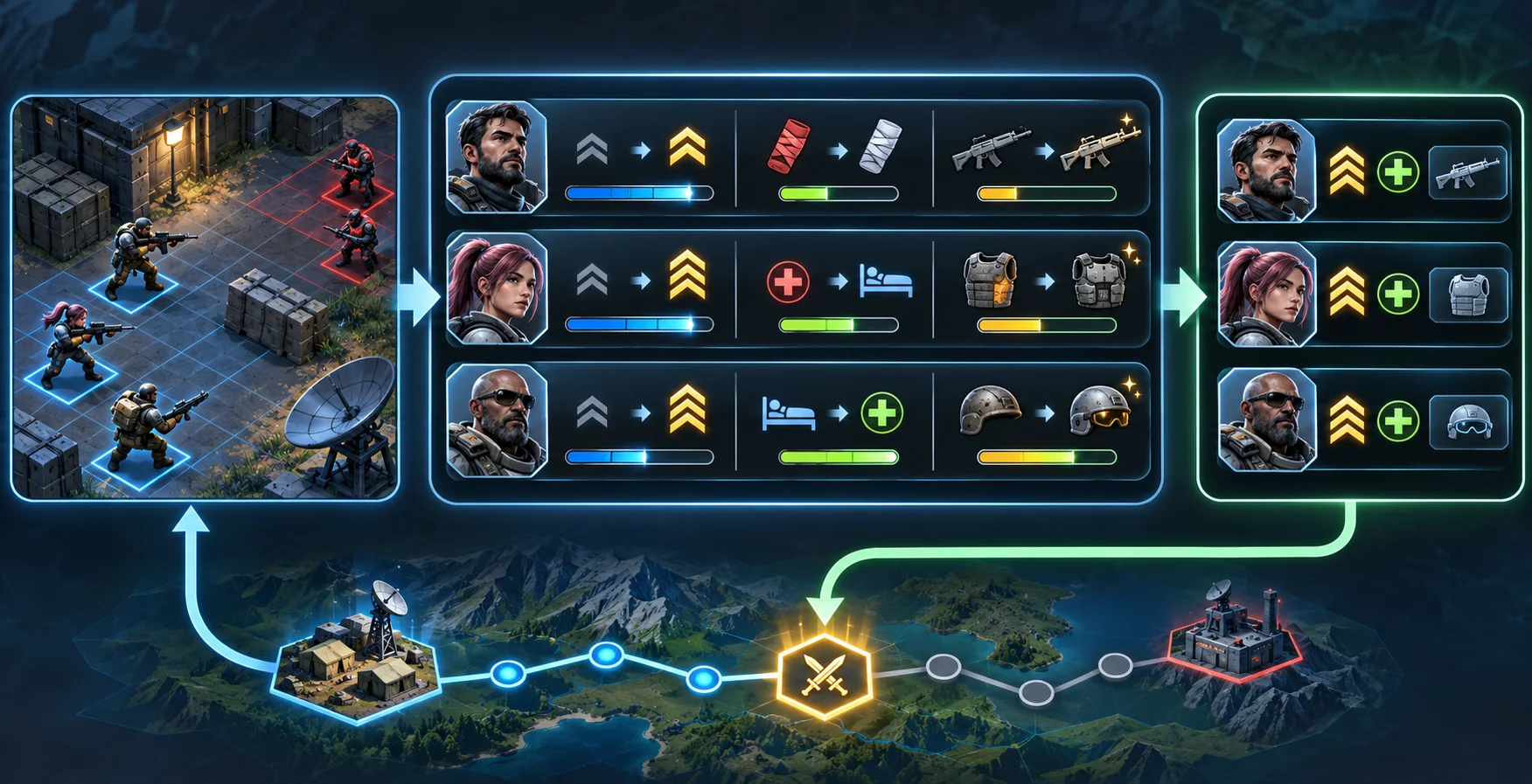
After a mission, show a clear debrief with gains, losses, and recovery time. Let players understand what changed and why. Preserve a reserve roster or a low-risk mission so campaign progress does not depend on deploying the same favorite unit every time.
Link unit growth to mission choices
Link unit growth to battlefield choices. A movement specialist might unlock a new positioning option, while a support unit gains a tool for protecting allies. Use grid scenarios that let a player demonstrate the new capability. Avoid upgrades that make a veteran simply outperform a recruit in every dimension.
Plan for failure and absence. If a unit is lost or unavailable, offer a recruit path, shared equipment, or a mission objective that can rebuild capacity. The exact recovery choice depends on desired campaign pressure; make it visible before permanent consequences are applied.
Test recovery across a campaign
Test three consecutive missions with at least two roster plans. Record who deploys, how condition affects selection, and whether growth changes tactics. Repeat after a failed mission to check that the campaign remains playable. The acceptance case is a persistent unit whose state affects choices without removing all viable alternatives.

For decisions that shape a character over time, see a character-progression design guide. Keep the campaign save data inspectable so designers can reproduce an injury, recovery, and promotion sequence. SEELE AI can help generate progression concepts; tactical balance, save logic, and campaign testing remain necessary.
FAQ
How do persistent units work in a grid-based tactics campaign?
Unit state carries from one mission into the next, so experience, equipment, condition, or learned abilities can influence deployment and tactics. Start with a few persistent values and make each one affect a future decision. A post-mission debrief should show exactly what changed.
What should carry between tactical missions?
Experience, a small ability set, equipment, or recovery condition can work when each affects roster planning and later tactical options. Avoid carrying every temporary combat detail if it adds bookkeeping without changing the next mission. A clear debrief helps players connect state changes to their next deployment.
How do you prevent one defeat from ruining a campaign?
Add a recovery path such as recruits, reserve equipment, a lower-risk mission, or shared resources. Make the consequence visible before players commit to a high-risk operation. Test the campaign after losing a strong unit and verify that more than one reasonable plan remains.
What should you test in a persistent-unit prototype?
Run several missions with different roster choices and one failure case. Track whether unit growth changes tactical decisions, whether recovery time is understandable, and whether new units remain viable. Reproduce the same sequence from a save to confirm that persistent state is recorded consistently.