A connected level-selection world can make a match-three game feel more like a journey, but changing the map should not reset the player's earned progress. Keep level identity and unlock rules as data, while treating the visible path as presentation. Then connect the existing level-completion flow to one progression owner and migrate the old linear list deliberately.
This guide is for an existing match-three project with levels, completion states, and possibly stars or scores. The traveler, map, and unlock examples are invented. No level system or project was inspected.
Model the world as levels and prerequisites
Start with stable IDs for every level. Store which region a level belongs to, what must be completed before it becomes accessible, and any optional conditions. A level can have more than one prerequisite or sit on a branch. The map screen can display that graph as a winding path, bridge, or island chain without using the artwork itself to decide access.
| Map data | Example | Why keep it explicit? |
|---|---|---|
| Level ID | orchard_07 | Survives title, art, or localization changes |
| Prerequisite edge | Complete level 06 | Defines actual access logic |
| Region | Peach Grove | Groups nodes for map presentation |
| Completion state | Won with one or more stars | Preserves existing player progress |
| Map position | Coordinates on the world screen | Can change without changing unlock rules |
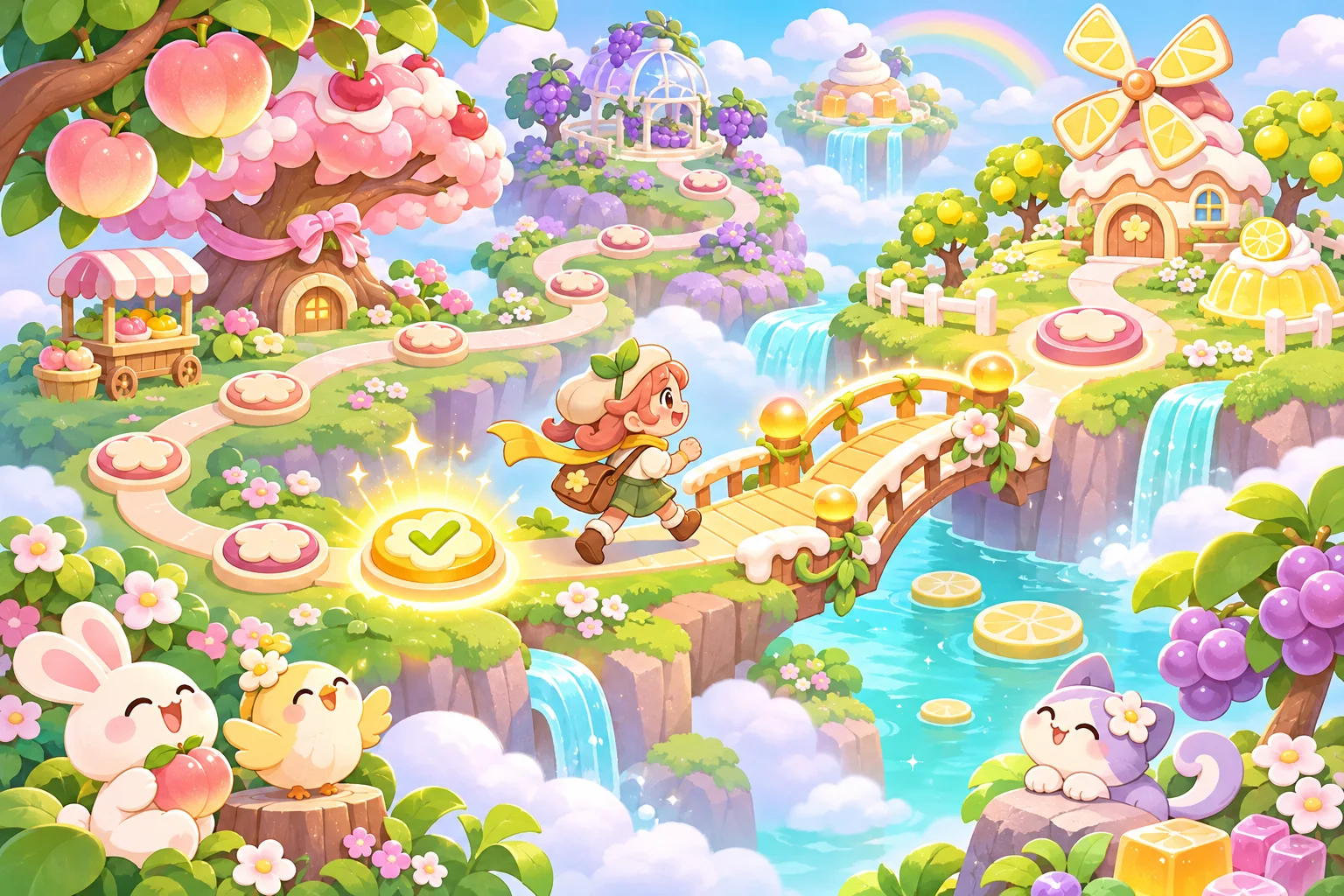
In the fictional Candy Orchard, winning level 06 opens a bridge to level 07; a side path requires a separate challenge. These are example rules, not tested gameplay. Naming stable IDs separately from the art labels means the map can be redesigned without turning a visual change into a progression reset.
Reuse the existing completion flow
Trace what currently happens when a puzzle ends: score calculation, win/loss, stars, retry, and next-level access. Identify the system that owns completion. Have that system record the result once and evaluate the new prerequisite graph. The map should read that state and render the right nodes, rather than maintaining a second set of unlock booleans.
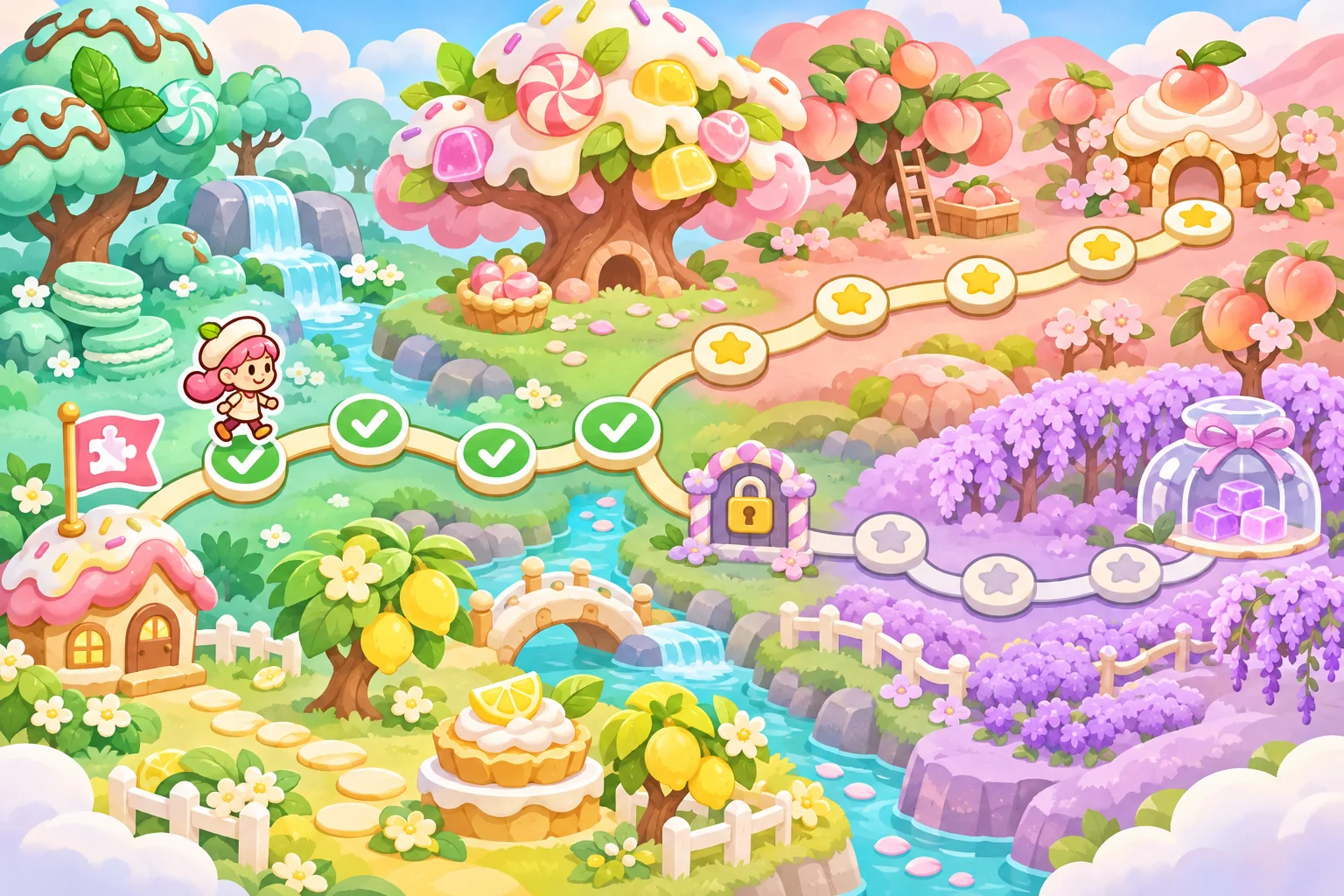
Decide how retries work. A player may replay a completed level for a higher score, lose after entering a stage, or complete a branch out of order. A repeated win should update the result without duplicating the next-stage unlock or clearing a better previous score. If completion rules depend on stars, define whether the next node opens after any win or a target score.
| Event | Progression response | Regression to check |
|---|---|---|
| First win | Record level completion and unlock eligible nodes | Only intended prerequisites change |
| Replay win | Update best result without duplicate access | Earlier stars or score are not lost |
| Loss/retry | Keep or reset attempt state by design | Map does not show false completion |
| Branch completion | Open only paths whose rules are satisfied | All intended routes remain reachable |
Keep map presentation separate from access
A road, bridge, portal, or island chain communicates where to go. Store that presentation separately from the actual prerequisite edge. If a new art pass moves a bridge or turns it into a ferry, the player should not lose access. If walking an avatar along the route is interactive, define how the movement path corresponds to valid level connections and how locked branches behave.
Do not rely on node positions or scene names as progression IDs. A visual map can change, but completed level IDs and best scores should remain stable. Keep localized names, decorative animations, and map coordinates in the view layer while the progression system owns access.
Move from a linear list without resetting saves
For a linear game, map the current order into explicit prerequisites. Preserve every existing level ID and completion record. A copied old save should load with the same current stage reachable, existing stars intact, and any newly introduced branch locked or open according to a documented rule. Do not infer progress from a player's map position if the save already records completion.
Godot’s stable saving tutorial demonstrates selecting persistent game information and serializing data as an engine-specific example. It does not prescribe this level graph or prove a migration. Use the current project’s save architecture and versioning approach. Keep the original save copy until the migration has been tested in the actual build.
Inspect the existing level IDs, completion and star records, next-level rule, and save format before editing. Add a connected map graph while preserving all completed puzzle progress. Keep access prerequisites in data and visual path art separate. First identify state owners and files. Then propose a minimal migration from the linear sequence, branch reachability checks, retry behavior, and rollback steps. Do not claim old saves work until tested in this project.
SEELE’s current catalog describes creating game starting points from an idea and playable game categories. It can support a separate match-three concept or map direction, but the catalog does not establish that SEELE edits an existing level system or migrates player progress.
Check reachability, retries, and migration
Test every branch from a fresh save and a copied existing save. Include the first level, a normal win, a replay, a locked side route, and any alternate prerequisite. The map should neither strand a player nor expose a node whose conditions remain unmet. This matrix describes proposed checks, not results from a running game.
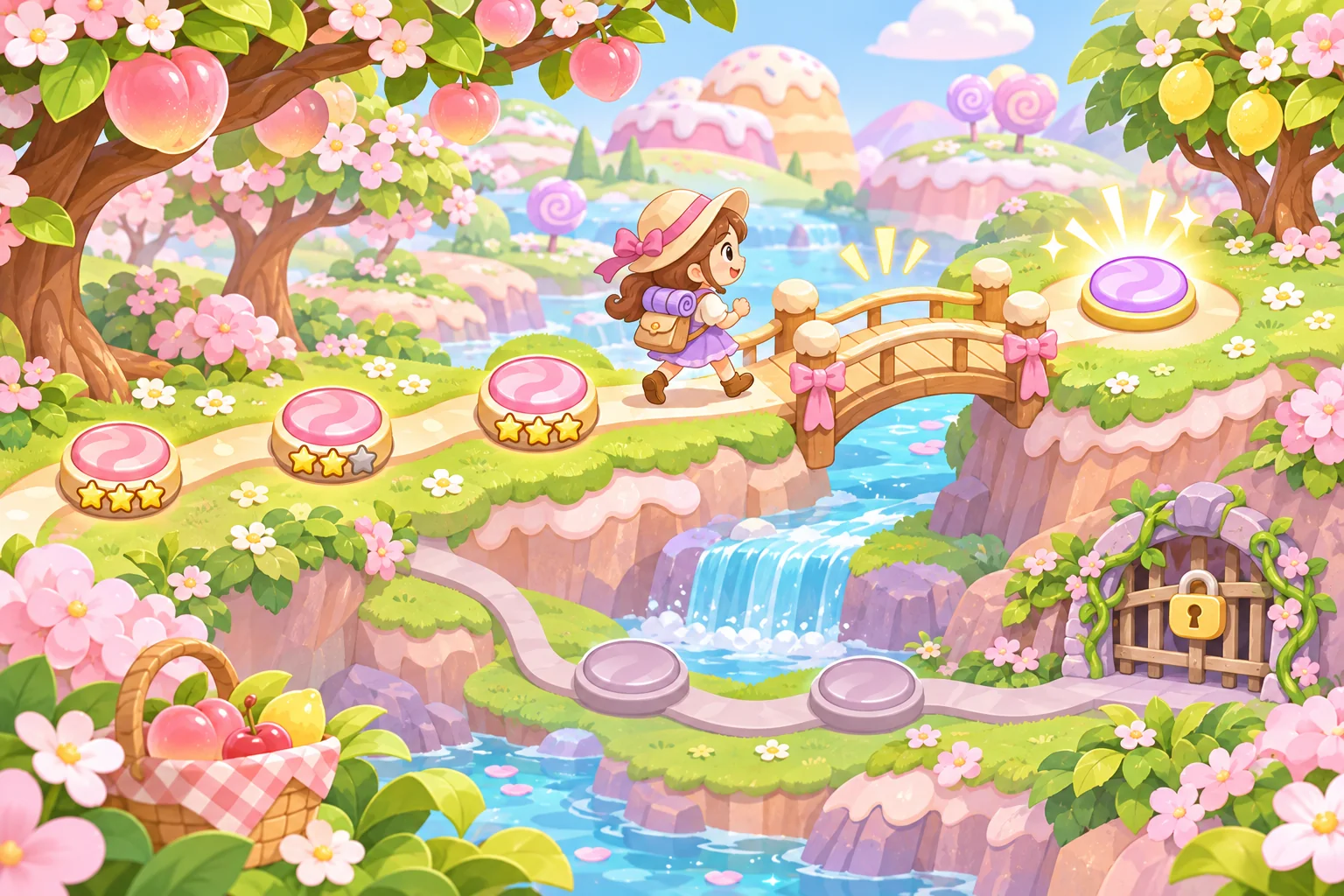
| Case | Action | Verify |
|---|---|---|
| Fresh profile | Open the world map | Starting node is available and later nodes follow rules |
| First completion | Win a puzzle stage | Correct next node opens once |
| Replay | Improve score on a completed level | Best result updates without progress loss |
| Branch | Complete alternate prerequisites | Both routes and locked states are correct |
| Round trip | Save, exit, reload, and revisit map | Stars, access, and node states persist |
| Linear save | Load a copied older save | Old progress maps to reachable nodes |
Record build, level ID, prerequisite state, completion result, and observed map. If a stage is locked incorrectly, check the completion owner, graph configuration, migration, and map rendering separately. That is easier to diagnose than adding a one-off unlock toggle inside the interface.
Frequently asked questions
What should a connected level-selection world store?
Store stable level IDs, prerequisite links, region membership, completion state, and any unlock conditions the map needs to display. Keep decorative path art separate from the graph that determines access. This lets visual updates avoid changing which puzzle a player can enter.
How do I unlock the next match-three level?
Have the existing level-completion flow update a stable completion record, then evaluate its prerequisite rules through one progression owner. The map should read that result rather than inventing a second unlock state. Test repeated wins and retries so a stage is not granted inconsistently.
Should level paths be stored as art or as data?
Keep access relationships as data and treat the visible road or bridge as presentation. A path can curve or change artwork without altering the prerequisite graph. If movement along the map is interactive, define how visual segments correspond to valid level-to-level links.
How can I migrate a linear level list to a connected world?
Preserve existing level IDs and completion flags, then map their order into explicit prerequisites. Load a copied old save and verify the current unlocked level remains reachable. Add defaults for missing graph metadata without resetting earned stars or progress. Keep the original copied file recoverable.
What should I test after adding a puzzle world map?
Test first-level access, win and unlock, replay, branching prerequisites, locked nodes, save and reload, and an older linear save. Record level IDs and completion state. A mock map can explain the route but does not prove the game unlock flow works.
Make the map a view of real progression
Keep access rules in a stable graph, let the existing completion system own results, and treat paths and regions as presentation. Migrate the old linear list using preserved IDs, then test every branch and retry against copied saves. That creates a more expressive world map without losing earned puzzle progress.
To explore a separate connected puzzle-world idea, try SEELE AI Game Maker. It is for concept exploration, not existing-project integration.