Separate roster growth from match-only power
Persistent development gives players a reason to return to an auto-battler roster, but it can blur the difference between long-term identity and temporary match power. The fictional Tandem Tactics example uses three-round runs, persistent unit XP and temporary shop items. It is a design model, not a supplied or tested game.
Define the persistent fields narrowly: unit identity, cumulative XP and permanent level. A unit starts at level one, reaches level two at two XP, and reaches level three at four XP. Level three is the cap. Each new level grants one point of base health. Do not store shop items, temporary buffs, current match health or board positions in this roster record.
After a round is cleared, every unit deployed in that round earns one XP, including units knocked out before the clear. Units on the bench earn none. A failed or abandoned round awards no XP. The award is applied once to the saved roster, and the match then returns to the hub with temporary state cleared.

Make XP awards and level changes auditable
At the post-round screen, list the unit, XP before and after, level change and base-health increase. A clear progress bar should show the next threshold. If a unit receives XP at level three, show that it is capped and do not add XP beyond the cap in this example.
Separate a roster save from the active match state. When a run ends, write only eligible progression updates; then discard shop offers, temporary item slots and combat modifiers. On reload, the collection screen should use the roster record while a new run starts with clean match state.
For data safety, give each cleared round a stable result identifier so reconnects or duplicate submit events cannot grant XP twice. This is a future implementation safeguard, not an observed property. Keep an audit record with run ID, round ID, eligible unit IDs and XP applied so a later review can trace how a level changed.
Trace the example
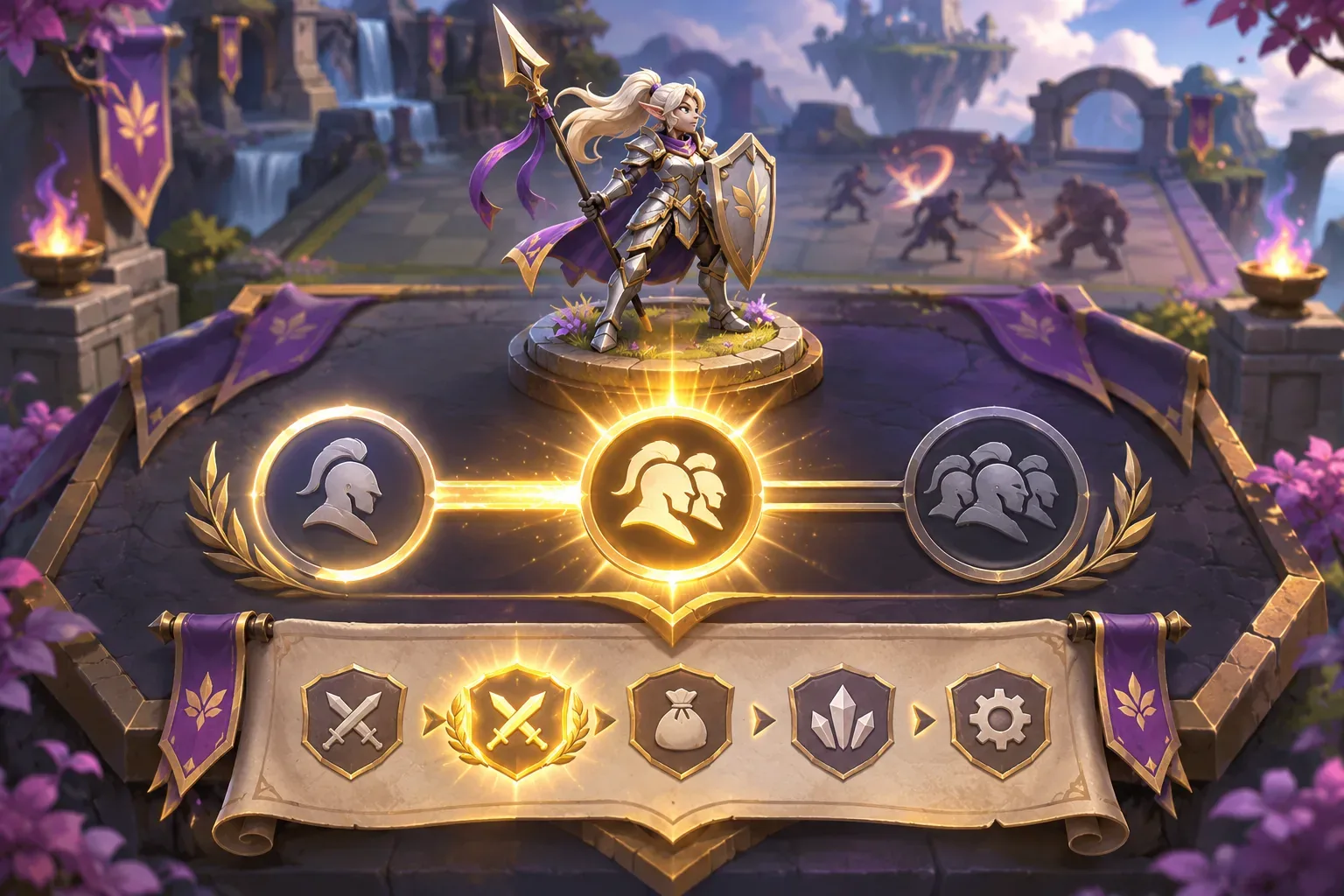
Mica and Bront start at level one with zero persistent XP. They are both deployed in round one, which is cleared, so each receives one XP. The screen shows 1/2 XP and no level increase. Temporary shop items used during that round are then removed.
They deploy again and clear round two. Each reaches two XP, advances to level two and gains one base-health point. If a run fails before clearing round three, no round-three XP is awarded. Their roster levels remain when the next run begins.
This arithmetic illustrates a proposed rule set only. No auto-battler build, save flow, user session or progression balance test is available for Tandem Tactics.

Write the six prompts
Use one prompt per design decision so later checks have a clear source of truth. These drafts describe Tandem Tactics; they have not been run and do not represent a generated playable game.
Prompt 1: inspect roster and match data
Inspect the supplied auto-battler without editing. Locate roster data, match state, unit stats, round-clear events, saves, shop items and temporary buffs. Cite paths and distinguish confirmed behavior from assumptions.Prompt 2: separate persistent and temporary fields
Design a minimal persistent progression schema with unit ID, cumulative XP and permanent level. Keep board position, current health, shop items and temporary buffs in match state; list any migration questions.Prompt 3: define level thresholds
Implement the stated thresholds only: level 1 at 0–1 XP, level 2 at 2–3 XP, level 3 at 4 XP and cap. Each earned level adds one base health. Do not change combat damage, economy or shop behavior.Prompt 4: award XP once on clear
Award one XP after a cleared round to every unit deployed in that round, including KO'd units; bench units and failed rounds get none. Use a stable result ID to prevent duplicate awards and show the proposed diff.Prompt 5: show growth and reset match state
Create a post-round roster summary showing eligible units, XP before/after, threshold, level changes and base-health gain. Then clear temporary items and buffs before returning to the hub.Prompt 6: prepare progression checks
Prepare future checks for thresholds, cap, deployed/bench eligibility, KO'd units, failed rounds, duplicate events, save/load, and removal of temporary match state. Do not report results without running a build.SEELE’s official page describes general plain-English prompting, a playable first version, browser testing and refinement; it does not verify Tandem Tactics. See Free AI game maker for workflow context only.
Prepare future build checks
Progression should be traceable from a cleared round to the saved roster. These checks describe future evidence, not passed tests. These are future checks, not passed tests. Record the before and after state so a later build can be compared with the specification.
| Future check | Expected rule | Evidence to capture |
|---|---|---|
| XP eligibility | Only units deployed in a cleared round receive one XP | Round roster and XP ledger |
| Level thresholds | 2 XP gives level2; 4 XP gives level3; cap is 3 | Before/after XP, level and base health |
| Round failure | Failed or abandoned round awards no XP | Run result and save snapshot |
| Exactly once | Repeated result event cannot duplicate progression | Stable result ID and saved XP |
| Reset boundary | Items and buffs clear; roster levels persist | Hub and new-run state comparison |
No real game run, browser test or measured result is available for this fictional example. The illustrations are original concept art and are not screenshots.
Frequently asked questions
How can an auto-battler keep unit progression between runs?
Store a small roster record such as unit identity, cumulative XP and permanent level separately from active match data.
Should benched units receive round XP in this example?
No. The fictional Tandem Tactics rule awards XP to units deployed in a cleared round, including deployed units that were knocked out.
What should reset when a run ends?
Temporary items, shop offers, board positions and combat modifiers reset; persistent roster XP and levels remain.
Was Tandem Tactics progression implemented or balanced?
No. It is a fictional rules example; no build, save implementation or balance test is claimed.
How do you prevent duplicate XP awards?
A real implementation can associate each clear with a stable result identifier and apply it once, then record the award for review.